
Theodosius of Trnovo
Our Venerable Father Theodosius of Trnovo
Venerable · d. 1363, at Constantinople
Commemorated 17 February — Repose at Constantinople
Theodosius of Trnovo (†1363) was the foremost Bulgarian hesychast of the fourteenth century — a monk and spiritual father, disciple of Gregory of Sinai, who carried the renewal of the Jesus-Prayer into the Bulgarian lands and founded the great monastery of Kilifarevo near the royal city of Trnovo (Tarnovo). Under him Kilifarevo became a school of prayer and learning that gathered hundreds of monks from Bulgaria, Serbia, and the Greek and Romanian lands, and from which came Euthymius, the last Patriarch of Trnovo. A zealous defender of Orthodoxy, Theodosius took a leading part in the councils held at Trnovo against the Bogomils, the followers of Barlaam and Akindynos, and other errors of his day. At the close of his life he went to Constantinople, where, received by his friend the Patriarch Callistus, he reposed in peace; Callistus wrote his Life. He is honoured chiefly by the Bulgarian Church, commemorated on February 17.

Monastic beginnings
Theodosius was a Bulgarian, born in the early fourteenth century, who embraced the monastic life in his youth and passed through several of the monasteries of the Bulgarian kingdom in search of a true teacher of prayer. The decisive turn came when he sought out Gregory of Sinai, the great renewer of hesychasm — the tradition of inner stillness (hēsychia) and the unceasing Prayer of Jesus — who had settled at Paroria, in the wild border country of the Strandzha mountains between Byzantium and Bulgaria. Under Gregory, Theodosius was formed in the discipline of watchfulness and prayer of the heart, and became one of his most beloved and gifted disciples, remaining with him until the elder's repose.
Kilifarevo
After Gregory's death Theodosius, with the support of the Bulgarian Tsar John Alexander, founded a monastery at Kilifarevo, in the hills near the capital Trnovo. There he raised a community that grew, the tradition says, to some hundreds of monks, drawn from Bulgaria and from the Serbian, Greek, Hungarian, and Wallachian lands — a house that became the chief centre of hesychast prayer and of sacred learning in the Bulgarian world, a seed-bed of the spiritual and literary revival that marked the last decades of the Second Bulgarian Empire. Among the disciples formed at Kilifarevo was Euthymius, afterwards Patriarch of Trnovo and the reformer of the Slavonic books, who carried his master's spirit into the Church's whole life; and the influence of Kilifarevo passed, through the dispersion that followed the Ottoman conquest, into the Serbian, Romanian, and Russian lands.
Defender of Orthodoxy
Theodosius was not only a man of prayer but a strong defender of the faith in an age of unrest. Bulgaria in his day was troubled by the old dualist heresy of the Bogomils and by newer errors — the anti-hesychast teaching of Barlaam and Akindynos condemned at Constantinople, and sects the sources name as Judaizers and Adamites. Theodosius took a leading part in the councils summoned at Trnovo under Tsar John Alexander to condemn these errors, standing with the Patriarch of Trnovo for the Orthodox and hesychast teaching that the councils of Constantinople had vindicated under Gregory Palamas. His authority in these matters rested on his sanctity and on his discipleship of Gregory of Sinai, which bound the Bulgarian Church closely to the hesychast renewal of the whole Orthodox East.
Last days and repose
Old and failing, and with the security of Paroria and the frontier monasteries breaking down before the Turkish advance, Theodosius set out for Constantinople, taking with him a few disciples, among them his beloved Romanus (Roman). There he was received with honour by the Patriarch Callistus I, who had been, like himself, a disciple of Gregory of Sinai and was his friend. Lodged in the monastery of Saint Mamas, Theodosius spent his last days in prayer, and reposed in the imperial city in 1363. Patriarch Callistus, who knew him well, composed his Life in Slavonic — the chief source for his story, and itself a monument of the hesychast literature of the age.
Feast and commemoration
Theodosius is commemorated on February 17 (church date; New Calendar civil February 17, Old Calendar civil March 2), kept chiefly by the Bulgarian Orthodox Church and in the Slavic calendars, where he is named with his disciple Romanus. His veneration belongs to the Bulgarian national tradition and to the memory of the hesychast fathers; he is honoured together with his master Gregory of Sinai and his disciple Euthymius of Trnovo as one of the pillars of the fourteenth- century Bulgarian spiritual and literary flowering.
He is not to be confused with the other Theodosii of the Slavic calendar — above all Theodosius of the Kiev Caves (†1074, May 3), the father of Rus' cenobitic monasticism, and Theodosius of Chernigov (†1696) — nor with Theodosius the Cenobiarch of the Judaean desert (†529), with whom the Slavonic epithet "the Great" is sometimes carelessly shared.
Hymns
Troparion — Tone 8
In you, O Father, was the divine image preserved with exactness; for taking up the Cross you followed after Christ, and by your deeds you taught men to despise the flesh, for it passes away, but to care for the soul, a thing immortal. Therefore, O venerable Theodosius, your spirit rejoices with the Angels.
Original translation from the Greek
Iconography
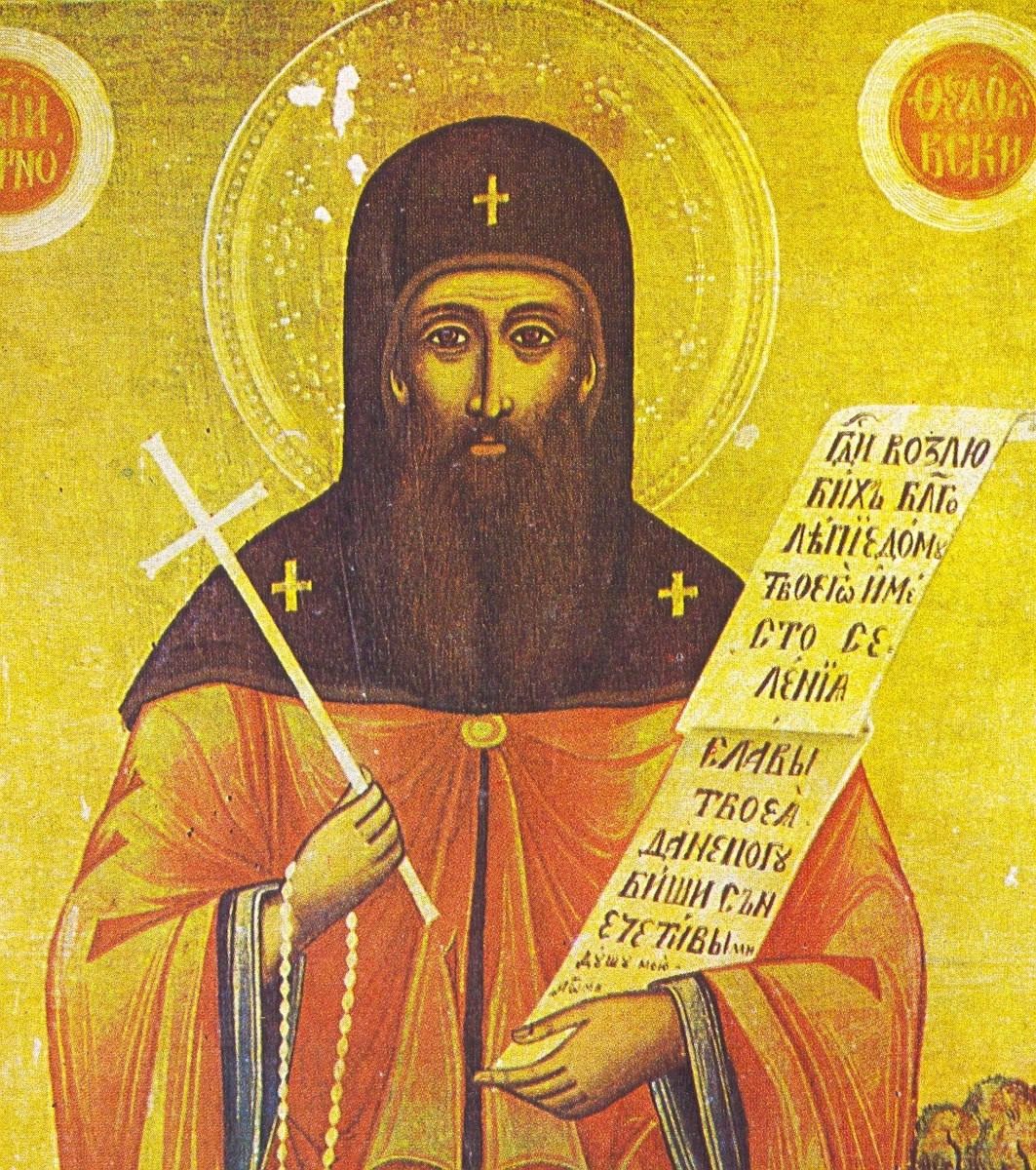
Theodosius is depicted as an aged monk in the schema, with a long white beard, in the settled type of a hesychast elder — often holding a scroll bearing a word on prayer or the ascetic life, sometimes shown with his monastery of Kilifarevo. The stored image is a 19th-century Bulgarian image of the hesychast of Trnovo.