
Theodosius the Cenobiarch
Our Venerable and God-bearing Father Theodosius the Great, the Cenobiarch
Venerable · b. c. 424, in Cappadocia — d. January 11, 529, aged c. 105
Commemorated 11 January — Repose at his monastery near Bethlehem
Theodosius the Great (c. 424 – 529) is honoured by the Church as the Cenobiarch — the father and lawgiver of cenobitic, or communal, monasticism in the Judaean desert. A Cappadocian of the same countryside that bore Sabbas the Sanctified, he came to the Holy Land as a young man, was blessed on the way by Simeon the Stylite, and after long years in a cave near Bethlehem gathered about him a vast community — several hundred monks of many tongues — for whom he built the great coenobium that bears his name, with its churches in Greek, Armenian and Thracian and its hospitals, guest-houses and hospices for the sick, the aged, the mad and the dying. Appointed by the Patriarch of Jerusalem superior-general of all the cenobia of Palestine — as Sabbas was of the anchorites — he stood with Sabbas as the great champion of the Council of Chalcedon, defying the emperor Anastasius to his face and crying that whoever would not receive the four Councils as the four Gospels should be anathema. He reposed on January 11, 529, at the age of about a hundred and five, and was buried in the cave of his first labours.

The memory of Theodosius is preserved in exceptional fullness. His disciple Theodore, later bishop of Petra, delivered and wrote a Life of his master within a year of his death; Cyril of Scythopolis, the great biographer of the Judaean monks, added a shorter Life of Theodosius as companion to his Life of Sabbas; and the two saints' careers are so entwined that each life illuminates the other. The account below follows these near-contemporary witnesses.
Origins and early life
Theodosius was born about the year 424 at Mogariassos (Garissos), a village in the district of Caesarea in Cappadocia — the same Cappadocian countryside, and almost the same generation, that produced his friend and fellow-labourer Sabbas, born at Mutalaska not far off. His parents were pious Christians, and the boy was given early to the service of the Church: he became a reader in his village church, and the beauty of the Scriptures, above all the call of Abraham — "Get thee out of thy country, and from thy kindred… unto a land that I will show thee" (Genesis 12:1) — kindled in him the desire to leave all and follow Christ into the desert. Still young, he set out for the Holy Land.
His road took him through Syria, and there he turned aside to the pillar of Simeon the Stylite the Elder, near Antioch. The tradition — told by Theodore of Petra and repeated in the synaxaria — holds that Simeon, seeing the young traveller approach, called him up onto the pillar and greeted him by name, though the two had never met, embraced him, and prophesied that he would become a shepherd of the rational sheep of Christ and would gather a great flock and win many souls. The meeting of the two ascetics — the stylite of the North and the coming cenobiarch of the South — is one of the cherished scenes of the Palestinian monastic memory, and it set the pattern of Theodosius's whole life under the sign of a prophecy.
Ascetic struggle: the cave near Bethlehem
Reaching Jerusalem and venerating the holy places, Theodosius placed himself first under an aged and holy elder named Longinus, whose discernment he prized above all things and whom he would not leave. At the request of a devout woman named Hikelia, who had built a church of the Mother of God on the road between Jerusalem and Bethlehem (the church "of the Old Seat," Kathisma), he consented for a time to guide that church; but the press of visitors and the danger of vainglory drove him to seek solitude. He withdrew to a cave a little to the east of Bethlehem — the cave in which, tradition said, the three Magi had lodged on their return from worshipping the newborn Christ, having been warned in a dream not to go back to Herod. There, in that cave hallowed by the memory of the first Gentiles to seek the Lord, Theodosius shut himself up in prayer, fasting and tears.
His austerities were severe and unbroken: coarse food, often only wild herbs and soaked pulse, little sleep, ceaseless psalmody, and a discipline of remembering death so constant that — the Life records — he dug his own grave and would stand beside it weeping, asking himself whether he was ready to lie in it. He is said to have passed some thirty years in this hidden warfare before the prophecy of Simeon began to be fulfilled.
The great coenobium
Disciples were drawn to him, at first a handful, then a stream, until the cave could not hold them. When he could no longer refuse them, Theodosius sought a sign: he took a censer with cold, dead coals and carried it through the desert, praying that where God willed his monastery to rise the coals would of themselves catch fire. At a place east of Bethlehem, toward the Dead Sea, the censer kindled of itself; and there — at the spot the Arabs still call Deir Dosi, the monastery of Dosi (Theodosius) — he raised the coenobium that made him famous throughout the Christian world.
Under his rule the community swelled to many hundreds of monks — the sources speak of four hundred and more, some say near seven hundred — drawn from every nation of the Christian East. Theodosius ordered it as a true cenobitic house: all things in common, common table, common prayer, obedience to the superior, manual labour, and the renunciation of every private will — the opposite pole from the lavra, the loose colony of semi-hermits living apart through the week, which Sabbas perfected in the same desert. Because his monks spoke many languages, he built several churches within the monastery so that each nation might hear the Divine Office in its own tongue — one for the Greeks, one for the Armenians, one for the Bessi (the Thracians, or Getae, of the lower Danube, who kept their own speech) — while for the Holy Communion all the brethren gathered together into the great Greek church, to be one body at the one Table. A further church, or oratory, served those troubled by evil spirits, that the mad might not be shut out from the prayers of the community.
Around the monastery Theodosius built up a whole city of mercy. There were guest-houses (xenodochia) for the endless stream of pilgrims and strangers; separate infirmaries for sick monks and for sick laymen; a home for the aged and infirm; care for the insane and the possessed; and a hospice for the dying, with the burial of the dead. In years of famine he fed the countryside from the monastery's stores, and the sources tell of the bread and provisions multiplying under his blessing when they should by every reckoning have run out. The coenobium of Theodosius became a model of the monastery as an engine of charity — worship and works of mercy joined in one household — and the pattern it set passed into the whole later tradition of Byzantine monasticism.
Superior-general of the cenobia, and the defence of Chalcedon
So great had the two friends grown in the esteem of the Church that about the year 494 the Patriarch of Jerusalem, Sallustius, set them jointly over all the monks of Palestine: Sabbas was made archimandrite and exarch of all the anchorites and lavras, and Theodosius archimandrite and exarch of all the cenobia — the communal monasteries. To Theodosius, therefore, belongs the title Cenobiarch, "head of the common life," by which the Church knows him; and the two offices together made Sabbas and Theodosius the visible heads of the whole desert, the strength of Orthodoxy in the Holy Land.
That strength was soon tried. The emperor Anastasius I (491–518) leaned toward the Monophysite party — the followers of Eutyches and of Severus of Antioch, who rejected the definition of the Fourth Ecumenical Council at Chalcedon (451) that Christ is acknowledged in two natures, divine and human, in one person. Anastasius pressed the Churches of the East to abandon Chalcedon and to embrace the Henotikon and the Severan cause, and he set himself to win the monks of Palestine, whose word carried immense weight with the people. He is said to have sent Theodosius a great sum of gold — thirty pounds, the tradition says — under the name of alms; the old man took it and gave it all to the poor, but did not bend an inch from the faith. When bribes and blandishments failed and the emperor turned to threats and to open pressure for the rejection of the Council, Theodosius, though bowed with age, came forward as the champion of Orthodoxy. Standing in Jerusalem, before a great concourse of monks and people, he cried aloud the words that the tradition has never forgotten: "If anyone does not receive the four holy Ecumenical Councils as he receives the four holy Gospels, let him be anathema!" With Sabbas he rallied the monasteries of the desert, and together they wrote to the emperor in the name of the monks of Palestine, professing the faith of Chalcedon and refusing every compromise. For this Theodosius was for a time driven into exile; but the persecution did not last, and after the death of Anastasius in 518 — some accounts have him restored even before the emperor's death, the emperor relenting before the old man's fearlessness — he returned to his monastery in peace. It is because of this confrontation that the Church honours Theodosius, with Sabbas, as one of the pillars who held the Holy Land to the Council of Chalcedon in the darkest hour of the Monophysite crisis.
Repose
Theodosius governed his community to a very great age. In his last illness, foreseeing his end, he summoned three of the bishops who were his spiritual sons and made his farewell, foretelling the day of his departure. He reposed on January 11, in the year 529, having lived, the tradition agrees, about a hundred and five years — some sixty of them, or more, in the monastic life. The Patriarch of Jerusalem, Peter, together with a vast multitude of monks, clergy and people, came to his burial, and he was laid to rest in the cave of the Magi where his labours had begun. Miracles of healing were reported at his tomb, and his memory was kept from the first as that of one of the greatest fathers of the desert.
Feast and commemoration
Theodosius is commemorated on January 11 (church date; Old Calendar civil January 24), within the afterfeast of the Theophany, so that his office in the Menaion is sung together with the festal hymns of the Lord's Baptism. The day is his throughout the Orthodox world — the Antiochian, Greek and Slavic calendars agree — and he is very frequently commemorated in the same breath as Sabbas the Sanctified (December 5), the two being named together in the hymnography as the joint fathers of the Palestinian desert, the one of the common life and the other of the solitary. In the Slavic books he is styled Theodosius the Great; in the Greek, the Cenobiarch (Κοινοβιάρχης). The Roman Church keeps his memory on the same day, January 11.
Three saints named Theodosius are commemorated on this one day — this Theodosius the Cenobiarch, Theodosius of Antioch the hermit (†c. 412), and Theodosius, Metropolitan of Trebizond (†1392) — and they are not to be confused with one another, nor with the two other great Theodosii of the Slavic calendar: Theodosius of the Kiev Caves (Feodosy Pechersky, †1074), the father of communal monasticism in Rus', whose memory is kept on May 3 and on August 14, and Theodosius of Chernigov (†1696), the archbishop, kept in February and September; nor, above all, with the holy emperor Theodosius the Great (†395), likewise surnamed "the Great" and kept a few days later, on January 17. "The Cenobiarch" and "the Great" of the Judaean desert belong to this Theodosius alone.
Hymns
Troparion — Tone 8
With the streams of thy tears thou didst husband the barrenness of the desert, and by thy sighing from the depths thou didst make thy labours bear fruit a hundredfold; and thou becamest a luminary to the whole world, shining forth with miracles, O our venerable Father Theodosius. Intercede with Christ our God that our souls may be saved.
Original translation from the Greek
Kontakion — Tone 8
Planted in the courts of thy Lord, thou didst put forth in gladness the most radiant virtues, and thou didst multiply thy children in the wilderness, watering them with the showers of thy tears, O chief shepherd of the divine folds of God. Wherefore we cry to thee: Rejoice, O Father Theodosius.
Original translation from the Greek
Appointed readings
Epistle — 2 Corinthians 4:6–15
6For God, who commanded the light to shine out of darkness, hath shined in our hearts, to give the light of the knowledge of the glory of God in the face of Jesus Christ. 7But we have this treasure in earthen vessels, that the excellency of the power may be of God, and not of us. 8We are troubled on every side, yet not distressed; we are perplexed, but not in despair; 9Persecuted, but not forsaken; cast down, but not destroyed; 10Always bearing about in the body the dying of the Lord Jesus, that the life also of Jesus might be made manifest in our body. 11For we which live are alway delivered unto death for Jesus’ sake, that the life also of Jesus might be made manifest in our mortal flesh. 12So then death worketh in us, but life in you. 13We having the same spirit of faith, according as it is written, I believed, and therefore have I spoken; we also believe, and therefore speak; 14Knowing that he which raised up the Lord Jesus shall raise up us also by Jesus, and shall present us with you. 15For all things are for your sakes, that the abundant grace might through the thanksgiving of many redound to the glory of God.
Gospel — Luke 6:17–23 (so the earlier-recorded appointment; the OCA lectionary, 2026, appoints Matthew 11:27–30 — both are venerable commons, recorded side by side)
17And he came down with them, and stood in the plain, and the company of his disciples, and a great multitude of people out of all Judæa and Jerusalem, and from the sea coast of Tyre and Sidon, which came to hear him, and to be healed of their diseases; 18And they that were vexed with unclean spirits: and they were healed. 19And the whole multitude sought to touch him: for there went virtue out of him, and healed them all. 20And he lifted up his eyes on his disciples, and said, Blessed be ye poor: for yours is the kingdom of God. 21Blessed are ye that hunger now: for ye shall be filled. Blessed are ye that weep now: for ye shall laugh. 22Blessed are ye, when men shall hate you, and when they shall separate you from their company, and shall reproach you, and cast out your name as evil, for the Son of man’s sake. 23Rejoice ye in that day, and leap for joy: for, behold, your reward is great in heaven: for in the like manner did their fathers unto the prophets.
Iconography
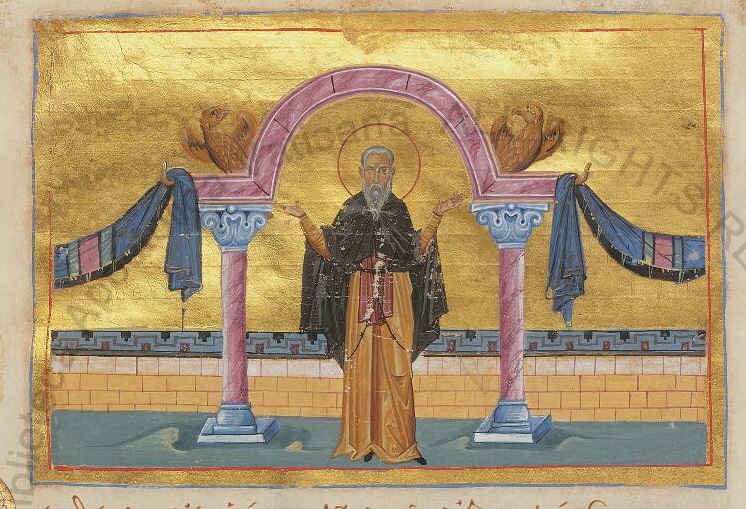
Theodosius is depicted as an aged abbot and desert father: white-haired and with a long, full white beard, in the monastic schema and mantle, most often holding a scroll or making the gesture of blessing or of teaching — the settled type of the venerable cenobiarch. He is frequently shown paired with Sabbas the Sanctified, the two old men of the Judaean desert standing together, or set among the choir of the venerable fathers. Narrative scenes illustrate the episodes of his Life: the young Theodosius blessed by Simeon on his pillar; the censer kindling of itself in the desert; the saint standing beside the grave he had dug for himself.
The stored image is the miniature for January 11 from the Menologion of Basil II (Constantinople, c. 985; Vatican, Vat. gr. 1613), the standard first-resort portrait of the saint: Theodosius as an aged monk, the desert father of the common life (source, public domain, pd-old-work).