
Theophan the Recluse
Our Father among the Saints Theophan the Recluse, Bishop of Tambov and Shatsk
Bishop · b. January 10, 1815, at Chernavsk in the Orlov province — d. January 6, 1894, at the Vysha Hermitage
Theophan the Recluse (1815 – 1894) — born George Vasilievich Govorov — was a Russian bishop, ascetic, and spiritual writer, and one of the most influential teachers of the inner life in the modern Orthodox world. The son of a priest, educated at the Kiev Theological Academy, he was tonsured a monk, taught and governed as rector and then as bishop of Tambov and of Vladimir, and in 1866 laid down his see to withdraw to the Vysha Hermitage, where from 1872 until his death he lived in complete reclusion for twenty-two years, seeing almost no one, serving the Liturgy alone in a chapel he built in his cell, and pouring out a vast correspondence and a library of spiritual works. He gave the Russian Church its great translation of the Philokalia (the Dobrotolubiye), the classic manual The Path to Salvation, and the adaptation of Unseen Warfare, teaching above all the "keeping of the heart" and the standing before God in the mind descended into the heart. He reposed on January 6, 1894, the feast of the Theophany, and was glorified by the Russian Orthodox Church in 1988; his feast is kept on January 10.

Origins and formation
He was born George (Georgy) Vasilievich Govorov on January 10, 1815, in the village of Chernavsk in the Orlov province of central Russia, the son of a parish priest, Vasily Govorov, and raised in the piety and the settled devotional round of a rural clergy household. He was schooled at the Livny church school and the Orel seminary, and then sent, as a promising student, to the Kiev Theological Academy, where he studied from 1837 to 1841 in the years when the Kiev Caves Lavra and its relics and its living tradition of prayer were close at hand. Before finishing his course he was tonsured a monk, in 1841, taking the name Theophan ("manifested by God"), and was ordained hierodeacon and then hieromonk.
Teacher, rector, and bishop
For the next quarter-century Theophan served the Church in her schools and her government. He taught and held rectorships in a succession of seminaries and academies — at Kiev, at Novgorod, at the St. Petersburg Theological Academy, of which he became rector — and served a term with the Russian ecclesiastical mission in Jerusalem and a period at the embassy church in Constantinople, where he came to know the Greek monastic tradition and the manuscripts of the Fathers at first hand, an acquaintance that would bear fruit in his life's work of translation. In 1859 he was consecrated bishop of Tambov and Shatsk, and in 1863 translated to the see of Vladimir — a diocesan bishop of energy and warmth, a preacher and a visitor of his churches, remembered for his gentleness and his care of the poor.
The withdrawal to Vysha
But the government of a diocese was not where Theophan's heart lay. In 1866, after only seven years as a bishop, he petitioned to be released from the administration of his see, and withdrew to the Vysha Hermitage (Vyshenskaya Pustyn), a quiet monastery in the Tambov diocese, to give himself wholly to prayer, study, and writing. For some years he lived there in the ordinary monastic round; then, in 1872, after the Paschal season, he entered upon a strict reclusion (zatvor) which he kept unbroken for the remaining twenty-two years of his life. He shut himself in a small suite of cells, saw no visitors save his confessor and the one or two who served him, built a little chapel in his rooms, and there served the Divine Liturgy — at first on Sundays and feasts, and in his last years every day, alone before God. His outward life shrank to nothing; his inner life and his labour for others expanded without measure.
The recluse's labour: letters and books
Reclusion did not mean idleness or silence toward the world. From his cell Theophan carried on an immense correspondence — thousands of letters of spiritual direction to monastics, clergy, and laypeople of every station, who wrote to the hidden bishop as to a living father, and whose letters, collected and published, form one of the great bodies of Orthodox pastoral counsel. And he wrote, and translated, on a scale few have equalled:
- The Dobrotolubiye — his Russian rendering and expansion of the Greek Philokalia of Nikodemos the Hagiorite and Macarius of Corinth, issued in five large volumes: the compendium of the hesychast and ascetic Fathers on watchfulness and prayer, which through Theophan's version became the formative spiritual book of the modern Russian Church, as the Slavonic Philokalia of Paisius Velichkovsky had been for the generation before.
- The Path to Salvation (Put' ko spaseniyu) and What the Spiritual Life Is and How to Be Attuned to It — his systematic guides to the whole course of the Christian life, from the awakening of grace through repentance to the union of the soul with God.
- Unseen Warfare (Nevidimaya bran') — his free Russian adaptation, by way of Nikodemos the Hagiorite's Greek, of the Combattimento spirituale of Lorenzo Scupoli: the classic manual of the interior struggle against the passions, so thoroughly reworked in an Orthodox key that it is read as Theophan's own.
- Commentaries on the Psalms (notably the long Psalm 118) and on the Epistles of Saint Paul; the Thoughts for Each Day of the Year; and many shorter works.
At the centre of all his teaching stands the heart. The whole aim of the spiritual life, Theophan taught, is to gather the scattered mind out of the head and the senses and to stand before God with the mind in the heart — attentive, sober, unceasing in prayer — so that the grace given in Baptism, too often buried under the cares and passions of the world, may be uncovered and fanned into flame and come to rule the whole person. His counsel is remarkable for its balance, its psychological penetration, and its freedom from all exaggeration: he warns as sharply against the reckless pursuit of exalted states as against sloth, and sets the ordinary Christian, in the ordinary conditions of life, on the same royal road of watchfulness and prayer that the great ascetics walked.
Repose
Theophan died in his reclusion on January 6, 1894, the feast of the Theophany whose name he bore — found reposed in his cell, it is said, after serving the Liturgy, his face composed as in prayer. He was buried at the Vysha Hermitage. Because his repose fell on one of the greatest feasts of the year, his commemoration is kept not on January 6 but on January 10, within the afterfeast of the Theophany.
Glorification and relics
Theophan's spiritual authority only grew after his death, as his books and letters spread through the Russian Church and, in the twentieth century, through the whole Orthodox world in translation. His relics were uncovered in 1973, and in 1988, at the celebration of the Millennium of the Baptism of Rus', he was solemnly glorified (canonised) by the Russian Orthodox Church among the saints, his cultus quickly received across the Orthodox jurisdictions. His relics rest at the restored Vysha monastery, a place of pilgrimage.
Feast and commemoration
Theophan is commemorated on January 10 (church date; Old Calendar civil January 23) — not the day of his repose (January 6, occupied by the great feast of the Theophany) but a fixed day within the afterfeast, on which day he is joined in the calendar to Gregory of Nyssa and the other saints of January 10. The uncovering of his relics (1973) and his glorification (1988) are also kept in the Russian Church, on days that vary in the sources and are left for later verification. His feast is universal in the Russian Church and kept by the Orthodox Church in America and widely across the jurisdictions.
Iconography
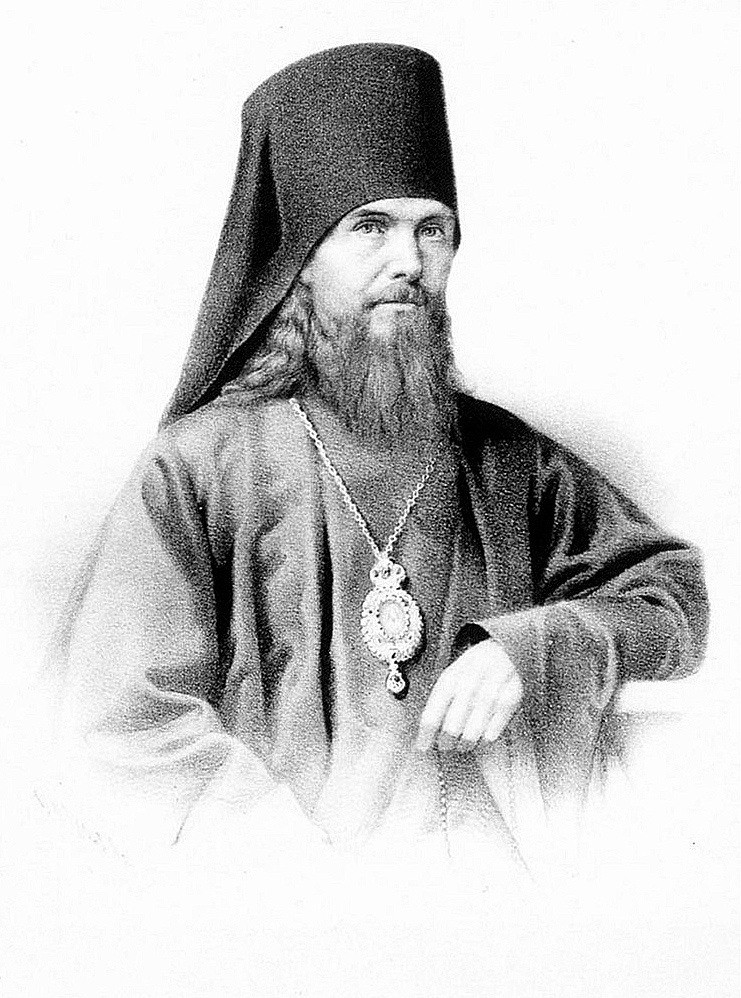
Theophan is depicted as a bishop-monk of the nineteenth century: an elderly man with a full, flowing grey beard, in the black monastic klobuk and mantle, or vested as a hierarch, most often holding a book or a scroll — the mark of the teacher and writer — and sometimes shown at his writing-desk in the cell, or before the small chapel of his reclusion. His face, in the icons as in the photographs and portraits from life, is gentle and grave, with the high forehead and the searching eyes of the thinker.
The stored image is a lithograph of 1860 by P. F. Borel, a portrait made from life during Theophan's episcopate, more than thirty years before his death: the bishop in his prime, vested, the features firm and the gaze direct. It is a documentary portrait rather than an icon, and is offered as a faithful likeness of the saint; the modern painted icons of Theophan, made since his 1988 glorification, are living artists' works and are not stored here.
Disputed questions
- Not to be confused with the ancient Greek namesakes whose form of the name is Theophanes: above all Theophanes the Confessor of Sigriane, the Byzantine chronicler and iconodule confessor (†817/818, kept March 12), and Theophanes the Branded the hymnographer (†c. 845, October 11). This Theophan — the Recluse of Vysha — is a Russian bishop and spiritual writer of the nineteenth century.