
Timothy and Maura
The Holy Martyrs Timothy the Reader and Maura his Wife, of the Thebaid
Martyr · d. c. 286
Commemorated 3 May — Crucifixion of the married pair in the Thebaid
Timothy and Maura were a young married couple of Penapeis in the Thebaid of Upper Egypt who were put to death about the year 286, in the persecution of Diocletian, twenty days after their wedding. Timothy, son of a village priest, was a reader of the church and a copyist of the sacred books, and when the prefect Arrianus demanded that he surrender the Scriptures for burning he answered that he would as soon give up his own children. Blinded with red-hot irons and hung head downward, he was not broken; and when the prefect summoned his bride in the hope that a girl of twenty days' marriage would plead him into apostasy, Maura was instead won over to her husband's confession and declared herself ready to die with him. She was scalped, her fingers were cut off, and she was plunged in boiling water; and at the last the two were crucified facing one another and hung on their crosses for nine days, giving up their souls on the tenth. Maura is the patroness of Lefkada — the island the Venetians called Santa Maura after her.
_-_икона_09031_Тимофей_и_Мавра.png)
Penapeis in the Thebaid
The passion places the two martyrs at Penapeis (the Greek books also give Panapolis, and Slavonic and English retellings Perapa), a village of the Thebaid, the great southern province of Roman Egypt that in the same generation was filling with hermits and with martyrs. Timothy was the son of a presbyter named in the Greek tradition Pikolpossos, and had been raised in the church from infancy. He held the minor order of reader (ἀναγνώστης), and with it the office that in an Egyptian village church of the third century made a man both indispensable and conspicuous: he read the Scriptures aloud to the congregation, taught the catechumens, and copied out the sacred books by hand. The passion adds that he preached — that is, that he expounded what he read — and this is what brought him to the prefect's notice.
He had been married only twenty days to a young woman named Maura, of the same village, when the edict reached the Thebaid.
The books
The persecution of Diocletian (reigned 284–305) is remembered in Egypt above all for its demand for books: the imperial order that the Christian Scriptures and liturgical volumes be handed over to the magistrates and burnt. Refusal to surrender them was the formal charge that created the traditores controversy in the Latin West a generation later, and it is the exact charge laid against Timothy. The prefect of the Thebaid, Arrianus, had him brought in and required him to produce the books he was known to keep and copy.
Timothy refused. The dialogue the passion preserves has the ring of the Egyptian acts: the prefect argued that a man who would not give up mere parchment for the sake of his own body was a fool; the reader answered that the books were the words by which he lived, and that a father does not deliver up his children to be killed. Neither threat nor the offer of office moved him.
The torments of Timothy
Arrianus ordered that red-hot iron spits be driven into his ears. The burning destroyed the humours of the eyes and Timothy was blinded; the passion notes, with the flat realism these documents often have, that his sight was lost as a consequence of the torture of the ears rather than by a separate act. When he still would not yield he was hung head downward, a heavy stone tied about his neck and a gag of wood forced into his mouth so that he could not confess Christ aloud; and still he did not recant.
Maura won over
It was then that the prefect, having failed with iron, tried the subtler instrument. He sent for Maura — twenty days a wife, and by every ordinary expectation the one person who might beg her husband into compliance — adorned her, and set her before Timothy to plead for his life and hers.
The turn on which the whole passion rests is that the plan succeeded in reverse. Timothy spoke to his bride of the brief sweetness of the world and the length of eternity; and Maura, hearing him, went over wholly to his side. Her answer to the prefect — "I am ready to die together with my husband" — is the sentence for which the two are remembered in the Church, and it is on the strength of it that the pair are hymned as a ζεῦγος ὁμόζυγον, a yoked pair, drawing one plough.
The torments of Maura
The prefect turned on her the cruelty ordinarily reserved for a woman's shame. Her hair was torn out by the roots, and the fingers of her hands cut off. She was thrown into a cauldron of boiling water, and came out of it unhurt; when Arrianus, suspecting some trick, ordered her to throw the water over herself, she did so and was still unharmed, and told him that the boiling water had felt to her like the water of a bath at her own house. Bystanders who murmured that this was sorcery she answered with the sentence the passion sets against her husband's: "Let no one speak for me. I have one Defender, God, in whom I trust."
Her own mother, the tradition adds, came and begged her to save herself, and Maura refused her as she had refused the prefect.
Crucified together
Baffled, Arrianus condemned the two to the death of their Lord. They were crucified, and their crosses were set facing one another, so that each should see the other's agony and be tempted to give way; and the passion says they hung there nine days, speaking to one another and singing, and died on the tenth. The Greek synaxarion verses make this the whole point of the feast: "Christ of old stretched out His hands upon the Cross; now Maura stretches hers out too, with Timothy."
The nine days on the cross are the setting of the two visions the passion attributes to Maura, which belong to the oldest layer of Egyptian ascetic literature as much as to hagiography. In the first, a figure in white came to her with a cup of milk and honey and bade her drink; she asked where the water was, made the sign of the Cross, and the figure fled — the demon offering, on a cross, the comfort of the marriage feast she had been denied. In the second she was carried up and shown a throne and a robe and a crown, and an angel told her they were kept for her, and a second crown for Timothy, and that she must go back to her cross and finish. Both narratives turn on the same discrimination of spirits: the martyr's refusal of a consolation that has not the Cross in it.
They gave up their souls on the tenth day, about the year 286.
Relics and veneration
The two are among the earliest Egyptian martyrs to be venerated widely outside Egypt, and Maura's cultus outran her husband's. Her skull is kept in the church at Koilani in the wine country of Cyprus; particles of her relics are held at the monastery of Kykkos on the same island, and in a church at Venice — a Venetian provenance that explains the name by which the island of Lefkada was known for four centuries. The great Venetian fortress that commands the channel there was dedicated to her, and island, fortress and town alike were called Santa Maura (Ἁγία Μαύρα) until the modern Greek name was restored; she remains the island's patroness.
Timothy and Maura passed into Western usage as well, and are entered in the Roman Martyrology on the same 3 May. Their crucifixion has attracted painters outside the iconographic tradition — the seventeenth-century Dutch engravers of the martyrologies, and in the nineteenth century the Polish academician Henryk Siemiradzki, whose Martyrdom of Saints Timothy and Maura fixed the pair in the European imagination as a young couple on facing crosses.
Feast and commemoration
May 3 (church date; Old Calendar civil May 16) — the day is theirs in the Greek, Slavonic and Antiochian books alike, and in the Menaion the office of the two martyrs shares the day with the venerable Theodosius of the Kiev Caves in Slavonic usage and with Peter of Argos in Greek. Because May 3 can fall either before or after Pascha depending on the year, the martyrs' office is sung now with the hymns of the Pentecostarion and now within the Lenten or Paschal cycle, and in the Slavonic Menaion the day carries the Paschal rubrics for the ordinary weekday.
Their commemoration is one of the small number of Egyptian martyr-feasts that is kept without local qualification across every Orthodox jurisdiction, and in the West on the same day.
Hymns
Apolytikion — Tone 4
As a pair yoked together and a wondrous team, O all-wise Timothy and Maura, bride of Christ, ye contended in godly manner; for scorning the vanity of the idols, ye were made conformable to the sufferings of the Lord, and were stretched out together upon the cross. Wherefore ye have received glory that fadeth not, and cease not to intercede for our souls.
Kontakion — Tone 4
Having borne torments of every kind and received your crowns from God, intercede for us with the Lord, O holy martyrs, that He may grant remission of sins to us who keep your all-sacred memory.
Original translation from the Greek
Iconography
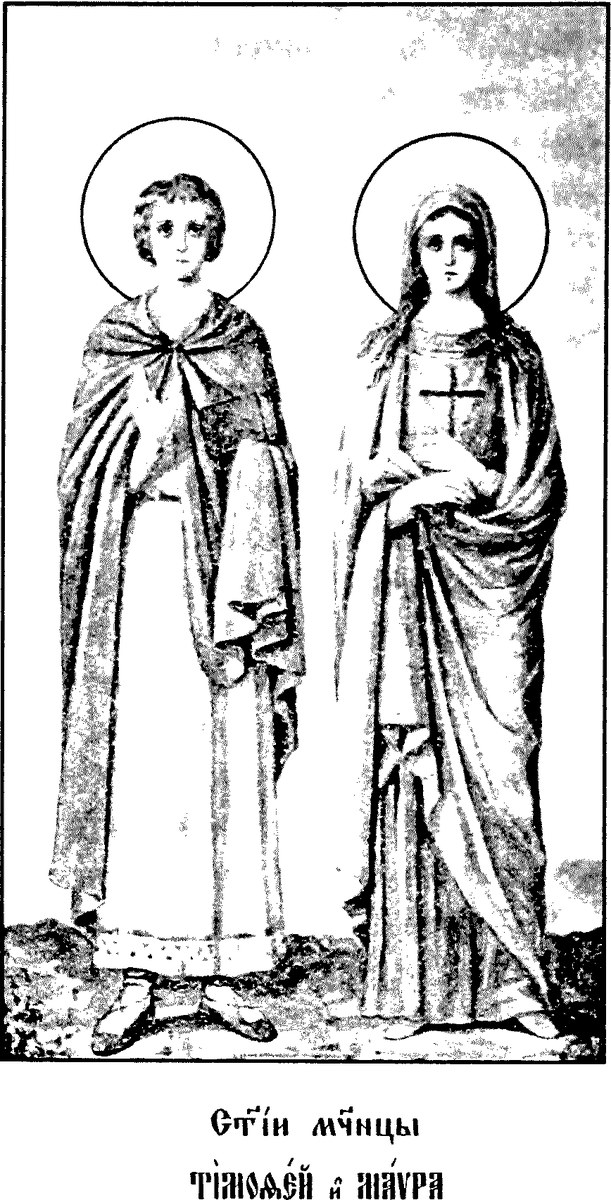
Timothy and Maura are painted together, as a pair, and almost never separately: two standing figures of equal height, Timothy at the viewer's left as the elder in order, beardless or very lightly bearded and young, in the tunic and mantle of a layman — never in a deacon's sticharion, since he was a reader and not ordained — and Maura at the right in a long maphorion over her tunic, her head covered. Both hold the cross of martyrdom, and Maura's cross is often set at her breast in the manner of the woman martyrs. Where the scene rather than the portrait is shown, the subject is the double crucifixion: two crosses side by side, the martyrs turned toward each other, and the prefect and soldiers below — a composition unusual in Byzantine art precisely because the crucifixion of anyone but Christ is rarely depicted, and one that Western printmakers seized upon with relish. Timothy's blinding, the irons at his ears, and the cauldron of Maura are given as small marginal scenes in menologion cycles.
The stored image is the engraved plate for May 3 from the illustrated Russian Lives of the Saints (Жития Святых) published 1903–1911 after the recension of St Dimitry of Rostov, which follows the received type exactly: the two saints standing side by side, haloed, Timothy in tunic and mantle with a scroll in his hand — the reader's attribute — and Maura veiled, with a cross on her breast, the Slavonic inscription beneath reading Ст҃ıи мч҃нцы Тімоѳей и Мавра, "the holy martyrs Timothy and Maura." A pre-modern Byzantine, Cretan or Cypriot icon of the pair would be an upgrade and none has yet been located; the Menologion of Basil II, the usual first resort, covers only September to February and so cannot supply this day.
Disputed questions
- The name of the village. Greek sources give Πενάπεις / Penapeis, and also Panapolis; the Slavonic and English lives have Perapa. All are recognisably the same Theban village name transmitted through three alphabets, and no identification with a known site is secure.
- The date. The received year is 286, within Diocletian's reign but before the "great" persecution of 303–305; the demand for the books, which is the substance of the charge, belongs more naturally to the later edicts, and some accounts accordingly place the martyrdom in the first years of the fourth century. This entry keeps the traditional 286 while noting the tension. The nine days on the cross, with death on the tenth, is the figure given consistently by the Greek and Slavonic synaxaria alike.
- Arrianus. The prefect who condemned them bears the name of the Arrianus of the Coptic acts who, after presiding at many martyrdoms, was himself converted and martyred (kept in Coptic and Greek usage in December). Whether the two are the same official is not determinable; the passion of Timothy and Maura makes nothing of it.
- Not to be confused with the other Timothys of the calendar — the Apostle Timothy (January 22), disciple of St Paul, and the venerable Timothy of Symbola (February 21). Maura has no namesake on the fixed calendar, and where "Agia Maura" appears in Greek place-names it always refers to this martyr.