
Vitalis of Gaza
Our Venerable Father Vitalis the Monk, of the coenobium of Abba Seridos, ascetic of Alexandria
Venerable · b. mid-6th century, at Gaza in Palestine — d. c. 620, at Alexandria
Commemorated 22 April — Repose at Alexandria
Vitalis (†c. 620) was a monk of the great coenobium of Abba Seridos near Gaza who, at the age of sixty, went to Alexandria and there undertook the strangest and most deliberately scandalous ascetic labour recorded of any Orthodox saint: he wrote down the names of all the prostitutes of the city, hired himself out as a day-labourer, and every evening carried his wage to one of them, paying her not to sin that night, and passing the night himself in prayer in the corner of her room while she slept — binding each to secrecy, and bearing the contempt of the whole city as a fornicating monk. Many of the women were converted. He was struck down at last by a young man who thought he was defending Christ's honour, and died in his hut on his knees, holding a scroll that read "Judge nothing before the time, until the Lord come." Only then did the women he had saved come out and tell the truth, and the Patriarch John the Almsgiver, who had refused all along to condemn him on hearsay, buried him with honour.
_-_икона_08222_Виталий.png)
From the coenobium of Seridos to Alexandria
Vitalis was a monk of the coenobium of Abba Seridos near Gaza — the same community that produced Barsanuphius and John, Abba Dorotheus, and the boy Dositheus, and one of the most spiritually exacting houses in Palestine. Nothing is transmitted of his years there beyond the fact of them; when he appears in the record he is already sixty years old, and he has left Gaza for Alexandria, the second city of the empire, in the years when John the Almsgiver held its patriarchal throne (610 – c. 620).
Alexandria was the great port and marketplace of the East, and its brothels were notorious. Vitalis's undertaking, as the accounts describe it, began with a list: he wrote down from memory the names of all the prostitutes of the city, and set himself to pray for them one by one.
The labour of the wage
He then hired himself out as a day-labourer in the city, the humblest employment available to an old man, and earned the small daily wage of the Alexandrian labourer — twelve copper coins. Of it he kept enough to buy one bean, or a single lupin, for his one meal at evening. The rest he carried, at nightfall, to one of the women on his list.
The bargain he offered was always the same: take this money, and do not sin with anyone tonight. Then he stayed in her house until morning — standing or kneeling in a corner in prayer while the woman slept, keeping vigil for her soul. In the morning he made her swear an oath to tell nobody what he did there; and he went out again to his work.
He was not, however, secretive about the visiting itself. The accounts are emphatic and even comic on this point: he would announce aloud where he was going as he approached the houses, and when he was reproached with keeping such company he would answer with deliberate provocation — Have I not a body like other men? Are monks not made of flesh? Mind your own business. The oath of silence bound the women; his own tongue built the scandal.
The scandal, and the Patriarch's refusal to judge
The result was exactly what he intended. All Alexandria — clergy, monks, laity — believed him a fornicator who had sold his habit, and the abuse was constant. Monks of the city carried the complaint to the Patriarch John the Almsgiver and pressed him to depose and expel the man. John refused to act on report and rumour, and answered them (the tradition says) with the example of Constantine the Great, who would not receive accusations against clergy but said he would cover such a one with his own cloak rather than expose him. It is one of the finest recorded moments of that Patriarch's judgement, and it is the reason the story ends as it does.
One of the women, unable to bear hearing him slandered, broke her oath and defended him publicly — and was at once seized by a demon, which the city read as a sign in the saint's favour, though it did not stop the talk.
Of the women themselves, the accounts say that many were changed: some abandoned the trade and married; some entered monastic life; some found honest work, supported at first by the old man's wage. They are the fruit of the labour, and the reason the Church calls it a labour and not a folly.
Repose and vindication
The end came from a man who thought he was defending God. As Vitalis came out of one of the houses, a young man struck him a heavy blow on the head, crying that he was dishonouring the name of Christ. Vitalis reached his hut, and was found there dead — on his knees before an icon, with a small scroll in his hand on which he had written the Apostle's words: Judge nothing before the time, until the Lord come (1 Corinthians 4:5). The tradition adds that the young man who struck him was afterwards tormented by a demon, and was delivered only at the saint's tomb, publishing his own guilt.
When the news went through the city the women came out into the streets and told, at last, what the old monk had really done in their houses — and the abuse turned to lamentation. Patriarch John came with his clergy, and Vitalis was carried to burial with honour, the women he had rescued walking behind with candles and lamps.
The pattern of his ascesis
Vitalis's labour belongs to a recognisable, if rare, Eastern type: the ascetic who takes on dishonour as his discipline, courting the contempt of men in order to strip himself of the last and subtlest attachment, the love of a good name — the same root from which folly for Christ grows. What distinguishes Vitalis is that the dishonour is not merely accepted but manufactured, and that it is spent on behalf of other people: the reputation he destroys is his own, and the purchase is the chastity of a woman for one night and, in the end, the conversion of many. The Fathers who transmitted the story were plainly aware that it is dangerous as an example, and the point they draw from it is not imitation but the prohibition of judgement — which is why the scroll in his dead hand is the story's own moral and why the icon puts it there.
Feast and commemoration
Vitalis is commemorated on April 22 (church date; Old Calendar civil May 5), the day of his repose at Alexandria, on which day the office belongs to Theodore the Sykeote and Vitalis has only his synaxarion notice. He is kept on this day by the Orthodox Church in America, by the Russian calendar (as Преподобный Виталий), and in the Greek OrthodoxWiki listings; the printed Greek synaxaristes for the day omit him. The Roman calendar keeps him on January 11, and the January 11 file of this collection notes the divergence and defers his entry to this day.
There is no shrine, no relic-tradition and no proper hymnography attached to him: his cultus is entirely the cultus of a story, and the story is told rather than sung.
Hymns
Troparion — Tone 8
In thee, O father, was preserved unimpaired that which is according to the image: for taking up the cross, thou didst follow Christ, and by thy deeds didst teach us to despise the flesh, for it passeth away, but to care for the soul, which is a thing immortal. Wherefore thy spirit, O venerable Vitalis, rejoiceth with the angels.
Original translation from the Greek
Iconography
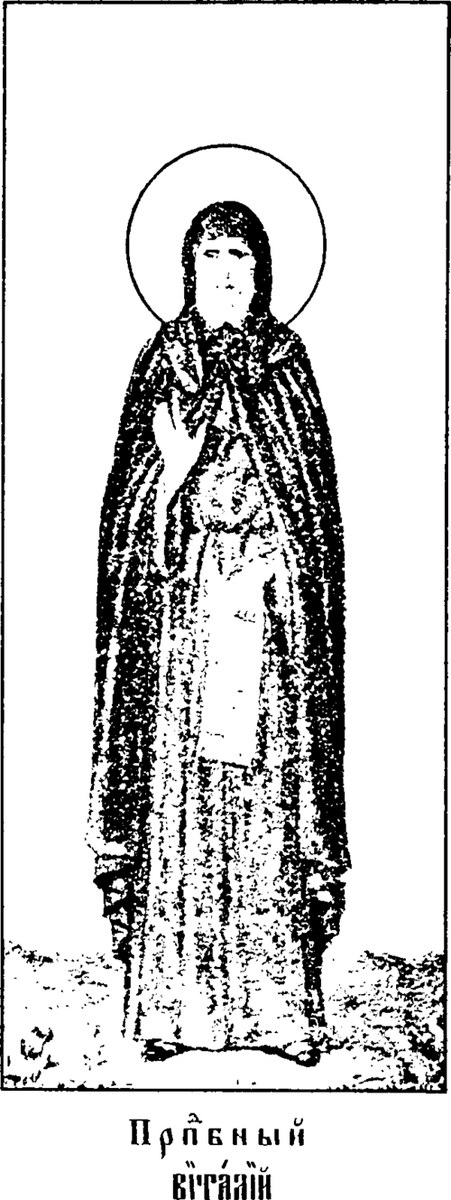
Vitalis is painted in the plain type of the venerable monastic: an elder in the dark tunic, mantle and koukoulion, bareheaded or cowled, the right hand raised in prayer or blessing and the left holding an unrolled scroll — and the scroll is the one iconographic detail that is his own, for it bears the sentence found in his dead hand, Judge nothing before the time. Where a narrative scene is attempted — chiefly in Russian illustrated Lives — it is his death: the old monk on his knees before the icon in his hut, or the crowd of women with candles following his bier.
The stored image is a Russian engraving from the illustrated Lives of the Saints (Жития Святых), published 1903–1911, after the traditional type: the venerable Vitalis standing full-length in mantle and cowl, the right hand raised, an open scroll at his breast, inscribed in Church Slavonic Пр[е]п[о]добный Вїталїй — "the venerable Vitaly." A pre-modern Byzantine or Palestinian image would be an upgrade if one is found.
Disputed questions
- The date of his repose. The Russian calendars set his life "609–620," and the Western notices give c. 620 or c. 625. The frame is fixed by the patriarchate of John the Almsgiver, who came to Alexandria about 610 and left it in 619, dying in Cyprus about 620; Vitalis's death, and the burial performed by that Patriarch, must therefore fall between about 610 and 619, and the later date of "c. 625" cannot be right if the burial by John is genuine. This entry gives c. 620 as the received approximation and records the difficulty.
- The day: January 11 or April 22? The Orthodox calendars — the OCA and Slavic listings and the Russian menologion — keep him on April 22. The Roman martyrology and the Western hagiographical literature keep him on January 11, and the Latin books make him patron of day-labourers and of prostitutes. The printed Greek synaxaristes for April 22 do not list him at all, his commemoration on this day being in practice a Slavic and Alexandrian one. All three data are recorded rather than harmonised; April 22 is used here because it is the Orthodox usage, and the January 11 entry in this collection accordingly defers to this day.
- The source of the story. No independent early Life or passion of Vitalis survives. The narrative belongs to the Alexandrian cycle of anecdotes attached to the patriarchate of John the Almsgiver and to the monastic tale-collections of that generation, and reached the Byzantine and Slavic synaxaria through them. Its shape — the ascetic who buys the chastity of harlots and is taken for one of their customers — recurs in the desert literature, and a sober reader will treat the circumstantial details (the twelve coins, the single bean, the scroll) as belonging to that literature rather than to a documentary record.
- Not to be confused with Vitalis of Milan — the martyr buried at Ravenna, husband of Valeria and father of Gervasius and Protasius, whom the Greek synaxarion keeps on July 23 with Apollinaris — nor with the Bolognese Vitalis kept with Agricola, nor with Vitalius of Castronuovo (†994), the Italo-Greek abbot of Calabria; nor is he to be classed among the fools for Christ, a title the calendars do not give him, although his labour touches that vocation closely.