
Paschaltide, day 6 · 5 days since Pascha
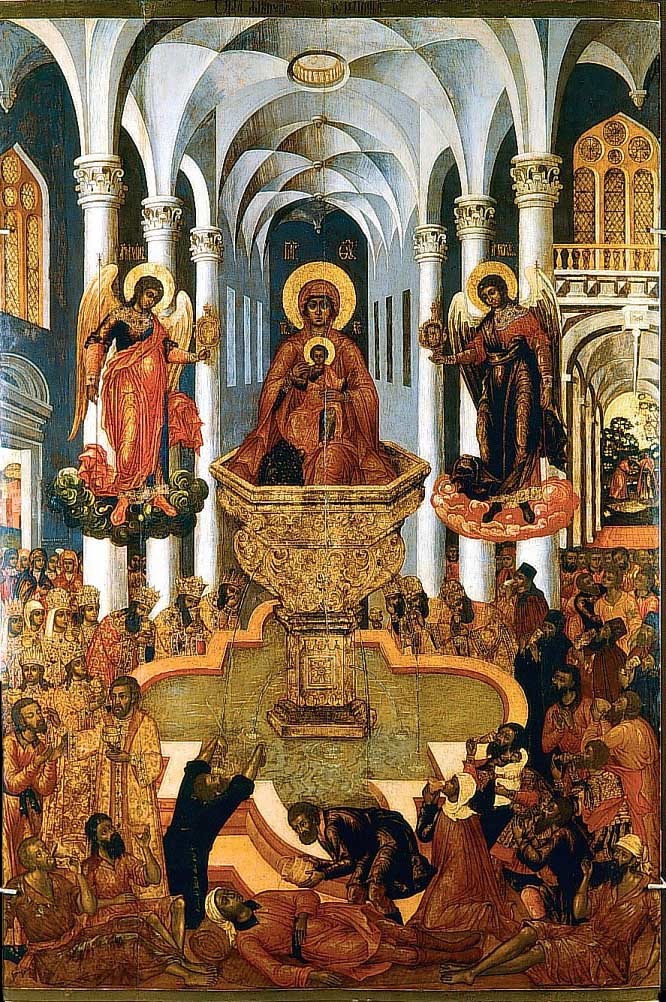
The Life-Giving Spring of the Most-holy Theotokos; Ven. Theodosius, Abbot of the Kiev Caves
About The Life-Giving Fountain →

Saints commemorated
-
Martyrs Timothy the Reader and his wife Maura of Antinoe in Egypt (286)
Timothy and Maura were a young married couple of Penapeis in the Thebaid of Upper Egypt who were put to death about the year 286, in the persecution of Diocletian, twenty days after their wedding. Timothy, son of a village priest, was a reader of the church and a copyist of the sacred books, and when the prefect Arrianus demanded that he surrender the Scriptures for burning he answered that he would as soon give up his own children. Blinded with red-hot irons and hung head downward, he was not broken; and when the prefect summoned his bride in the hope that a girl of twenty days' marriage would plead him into apostasy, Maura was instead won over to her husband's confession and declared herself ready to die with him. She was scalped, her fingers were cut off, and she was plunged in boiling water; and at the last the two were crucified facing one another and hung on their crosses for nine days, giving up their souls on the tenth. Maura is the patroness of Lefkada — the island the Venetians called Santa Maura after her.
-
Diodorus and Rhodopianus
Diodorus and Rhodopianus were deacons of the church of Aphrodisias in Caria, on the south-western coastlands of Asia Minor, who were stoned to death by their own townspeople in the persecution of Diocletian, about the year 302. The synaxarion notice is short and gives no dialogue and no magistrate: the two were known in the city as Christians and as preachers of Christ among the pagans, were seized by the soldiery, endured insults and scourging, and were finally killed with stones — the mob's death rather than the executioner's, and one of the few martyrdoms by stoning in the Byzantine calendar after the age of the Apostles. The Greek books keep them on May 3 and the Slavonic books and the OCA on April 29; this entry, following the Greek placement, is primary on May 3 and secondary on April 29.
-
Luke of Steiris
Luke of Steiris (c. 896 – c. 953), called the Younger and Luke of Hellas, was the most beloved Greek ascetic-saint of the tenth century and one of the great wonderworkers of the Byzantine world. Born of poor Phocian farmers who had fled the Arab raids on Aegina, he gave himself from childhood to prayer, fasting, and an almost reckless charity, and left the world young to live as a monk and hermit in the mountains of central Greece. Driven from place to place by war, he settled at last at Steiris in Phocis, where a community gathered around him. He was famed for healings, for the reading of hearts, for the gift of prophecy — most celebrated of all his foretelling that Crete would be recovered from the Saracens, which came to pass under Nikephoros Phokas eight years after his death — and, the tradition says, for being lifted from the ground in prayer. He reposed on February 7. Over his tomb rose the monastery of Hosios Loukas, one of the supreme monuments of Byzantine art, where his myrrh-flowing relics rest to this day.
-
Peter of Argos
Peter (c. 855 – c. 922) was bishop of Argos and Nauplion in the Peloponnese, and is remembered in the Greek Church chiefly as the merciful hierarch: a monk of Constantinople from a family in which all five children took the habit, who twice refused a bishopric and accepted the third call only under compulsion, and who then spent some thirty years feeding a province through famine, ransoming captives from the Saracen raiders of Crete, and healing the sick. The Peloponnese of his episcopate was a frontier under attack, and his charity has the shape of that emergency: the Life by Theodore of Nicaea makes the miracle for which he is best known the flour and grain that would not run out while the queues of the hungry lasted. He wrote homilies, of which some seven survive; he foretold the day of his death and reposed at about seventy; and in 1421 his relics were carried to Nauplion, whence they exuded myrrh. He is titled ὁ Θαυματουργός, the Wonderworker, and is the patron of Argos and of Nauplion.
-
Theodosius of the Kiev Caves
Theodosius (Feodosy Pechersky, †3 May 1074) is the father of Russian monasticism: the second founder, with Antony, of the Kiev Caves monastery, and the man who turned a company of hermits in a hillside burrow into a cenobium governed by a written rule. Born at Vasilev near Kiev and raised at Kursk, he baked the prosphora for his village church as a boy against his mother's violent opposition, escaped to Kiev in his twenties, and was received by Antony into the cave above the Dnieper and tonsured by Nicon. As abbot he procured a copy of the typikon of the Studion monastery at Constantinople and imposed it on the brotherhood — common table, common property, unbroken obedience — so that the Caves became the mother and model of every monastery in the land of Rus'. He raised the community from a handful to a hundred, built the wooden and then began the great stone church of the Dormition, gave a tenth of the monastery's income to the poor and maintained a hospice for the sick and the mutilated, sent a cartload of bread each week to the prisoners, and rebuked the Grand Prince Svyatoslav to his face for usurping his brother's throne. His Life, written by Nestor the Chronicler, is one of the founding works of Slavonic literature; his relics were uncovered on 14 August 1091, and in 1108 he became the first monastic saint of Rus' to be formally canonised. Not to be confused with any of the six other saints named Theodosius already in this corpus, and above all not with Theodosius the Cenobiarch (†529), the founder of the coenobia of the Judaean desert. See Disputed questions below.
British Isles and Ireland
- St. Conleth the bishop (519)
- St. Scannal, missionary (563)
- St. Aldwyn, abbot of Partney (8th C)
Troparia & kontakia
Apolytikion — Tone 3
An unbreakable rock of the Church, and the best of shepherds for the city of Argos, hast thou been shown to be, O all-praised hierarch…
Apolytikion — Tone 4
As a pair yoked together and a wondrous team, O all-wise Timothy and Maura, bride of Christ, ye contended in godly manner; for scorning the vanity of the idols, ye were made conformable to the sufferings of the Lord, and were stretched out together upon the cross. Wherefore ye have received glory that fadeth not, and cease not to intercede for our souls.
Exapostilarion
Thou art in very truth the fount of living water, O Lady; therefore thou dost wash away the grievous sicknesses of souls and of bodies by thy touch alone, who pourest forth Christ, the water of salvation.
Kontakion — Tone 8 (to the automelon *Τῇ ὑπερμάχῳ*)
Out of thine inexhaustible Fountain, O thou who art graced of God, thou bestowest upon me the waters of thy grace, which stream forth unfailingly and beyond all speech; for as thou didst bear the Word past all understanding, I entreat thee to bedew me with thy grace, that I may cry to thee: Rejoice, O water of salvation.
Kontakion — Tone 4
Gloriously didst thou bear the name of the Chief of the wise Apostles, O father Peter…
Kontakion — Tone 3
Let us honour today the star of Rus', which rose in the east and came unto the west, enriching all this land with miracles and with good things, and founding for us the rule and the order of the monastic life: the blessed Theodosius. Him the monastery of the Caves honoureth, and with the brethren we cry aloud: Rejoice, O father, boast of the monks!
Kontakion — Tone 4
Having borne torments of every kind and received your crowns from God, intercede for us with the Lord, O holy martyrs, that He may grant remission of sins to us who keep your all-sacred memory.
Megalynarion
Let us honour with faith the life-flowing water of the Fountain, which poureth out the immortal dew, the manna, the divine nectar, the strange ambrosia, the honey out of the rock.
Oikos — Tone 8
O immaculate Theotokos, who ineffably didst bear the pre-eternal Word of the Father, enlarge my mouth, O pure one, and take me with thee unto thy praise, that I may sing thy Fountain and cry aloud: Rejoice, fount of unceasing gladness; rejoice, stream of beauty past telling. Rejoice, undoing of every sickness; rejoice, flood that drowns the manifold passions. Rejoice, clearest current, that makest the faithful whole; rejoice, most gracious water, to them that are many times diseased.
Troparion — Tone 4 (common of two martyrs)
Thy martyrs Diodorus and Rhodopianus, O Lord, in their contest received incorruptible crowns from Thee, our God; for possessing Thy strength, they cast down the tyrants and shattered the feeble insolence of the demons. By their intercessions save our souls.
Troparion — Tone 1
The glory of Hellas and the boast of the venerable, the luminary of Steiris and its holy dweller — Luke the God-bearer — let us honour with piety in songs and hymns; for he poureth forth healings upon those who draw near to him in faith and cry: Glory to Christ who hath glorified thee; glory to him who hath made thee wondrous; glory to him who through thee worketh healings for all.
Troparion — Tone 4 (common of a hierarch)
O God of our fathers, who ever dealest with us according to Thy gentleness: take not Thy mercy from us, but by the intercessions of Thy hierarch Peter guide our life in peace.
Troparion — Tone 8
Raised up unto virtue, and loving the monastic life from thy childhood, thou didst valiantly attain unto thy desire and didst make thy dwelling in a cave, adorning thy life with fasting and with purity; and abiding in prayer as one without a body, thou didst shine forth in the land of Rus' as a radiant beacon, O venerable father Theodosius. Pray thou unto Christ God that our souls may be saved.
Readings
Vespers
Wisdom of Solomon 5.15-6.3
15But the righteous live for evermore; their reward also is with the Lord, and the care of them is with the most High. 16Therefore shall they receive a glorious kingdom, and a beautiful crown from the Lord’s hand: for with his right hand shall he cover them, and with his arm shall he protect them. 17He shall take to him his jealousy for complete armour, and make the creature his weapon for the revenge of his enemies. 18He shall put on righteousness as a breastplate, and true judgment instead of an helmet. 19He shall take holiness for an invincible shield. 20His severe wrath shall he sharpen for a sword, and the world shall fight with him against the unwise. 21Then shall the right aiming thunderbolts go abroad; and from the clouds, as from a well drawn bow, shall they fly to the mark. 22And hailstones full of wrath shall be cast as out of a stone bow, and the water of the sea shall rage against them, and the floods shall cruelly drown them. 23Yea, a mighty wind shall stand up against them, and like a storm shall blow them away: thus iniquity shall lay waste the whole earth, and ill dealing shall overthrow the thrones of the mighty. 1Hear therefore, O ye kings, and understand; learn, ye that be judges of the ends of the earth. 2Give ear, ye that rule the people, and glory in the multitude of nations. 3For power is given you of the Lord, and sovereignty from the Highest, who shall try your works, and search out your counsels.
Wisdom of Solomon 3.1-9
1But the souls of the righteous are in the hand of God, and there shall no torment touch them. 2In the sight of the unwise they seemed to die: and their departure is taken for misery, 3And their going from us to be utter destruction: but they are in peace. 4For though they be punished in the sight of men, yet is their hope full of immortality. 5And having been a little chastised, they shall be greatly rewarded: for God proved them, and found them worthy for himself. 6As gold in the furnace hath he tried them, and received them as a burnt offering. 7And in the time of their visitation they shall shine, and run to and fro like sparks among the stubble. 8They shall judge the nations, and have dominion over the people, and their Lord shall reign for ever. 9They that put their trust in him shall understand the truth: and such as be faithful in love shall abide with him: for grace and mercy is to his saints, and he hath care for his elect.
Wisdom of Solomon 4.7-15
7But though the righteous be prevented with death, yet shall he be in rest. 8For honourable age is not that which standeth in length of time, nor that is measured by number of years. 9But wisdom is the gray hair unto men, and an unspotted life is old age. 10He pleased God, and was beloved of him: so that living among sinners he was translated. 11Yea speedily was he taken away, lest that wickedness should alter his understanding, or deceit beguile his soul. 12For the bewitching of naughtiness doth obscure things that are honest; and the wandering of concupiscence doth undermine the simple mind. 13He, being made perfect in a short time, fulfilled a long time: 14For his soul pleased the Lord: therefore hasted he to take him away from among the wicked. 15This the people saw, and understood it not, neither laid they up this in their minds, That his grace and mercy is with his saints, and that he hath respect unto his chosen.
Matins Gospel
Luke 6.17-23
17And he came down with them, and stood in the plain, and the company of his disciples, and a great multitude of people out of all Judæa and Jerusalem, and from the sea coast of Tyre and Sidon, which came to hear him, and to be healed of their diseases; 18And they that were vexed with unclean spirits: and they were healed. 19And the whole multitude sought to touch him: for there went virtue out of him, and healed them all. 20And he lifted up his eyes on his disciples, and said, Blessed be ye poor: for yours is the kingdom of God. 21Blessed are ye that hunger now: for ye shall be filled. Blessed are ye that weep now: for ye shall laugh. 22Blessed are ye, when men shall hate you, and when they shall separate you from their company, and shall reproach you, and cast out your name as evil, for the Son of man’s sake. 23Rejoice ye in that day, and leap for joy: for, behold, your reward is great in heaven: for in the like manner did their fathers unto the prophets.
Epistle
Acts 3.1-8
1Now Peter and John went up together into the temple at the hour of prayer, being the ninth hour. 2And a certain man lame from his mother’s womb was carried, whom they laid daily at the gate of the temple which is called Beautiful, to ask alms of them that entered into the temple; 3Who seeing Peter and John about to go into the temple asked an alms. 4And Peter, fastening his eyes upon him with John, said, Look on us. 5And he gave heed unto them, expecting to receive something of them. 6Then Peter said, Silver and gold have I none; but such as I have give I thee: In the name of Jesus Christ of Nazareth rise up and walk. 7And he took him by the right hand, and lifted him up: and immediately his feet and ancle bones received strength. 8And he leaping up stood, and walked, and entered with them into the temple, walking, and leaping, and praising God.
Hebrews 13.7-16 (St Theodosius)
7Remember them which have the rule over you, who have spoken unto you the word of God: whose faith follow, considering the end of their conversation. 8Jesus Christ the same yesterday, and to day, and for ever. 9Be not carried about with divers and strange doctrines. For it is a good thing that the heart be established with grace; not with meats, which have not profited them that have been occupied therein. 10We have an altar, whereof they have no right to eat which serve the tabernacle. 11For the bodies of those beasts, whose blood is brought into the sanctuary by the high priest for sin, are burned without the camp. 12Wherefore Jesus also, that he might sanctify the people with his own blood, suffered without the gate. 13Let us go forth therefore unto him without the camp, bearing his reproach. 14For here have we no continuing city, but we seek one to come. 15By him therefore let us offer the sacrifice of praise to God continually, that is, the fruit of our lips giving thanks to his name. 16But to do good and to communicate forget not: for with such sacrifices God is well pleased.
Philippians 2.5-11 (Theotokos)
5Let this mind be in you, which was also in Christ Jesus: 6Who, being in the form of God, thought it not robbery to be equal with God: 7But made himself of no reputation, and took upon him the form of a servant, and was made in the likeness of men: 8And being found in fashion as a man, he humbled himself, and became obedient unto death, even the death of the cross. 9Wherefore God also hath highly exalted him, and given him a name which is above every name: 10That at the name of Jesus every knee should bow, of things in heaven, and things in earth, and things under the earth; 11And that every tongue should confess that Jesus Christ is Lord, to the glory of God the Father.
Gospel
John 2.12-22
12After this he went down to Capernaum, he, and his mother, and his brethren, and his disciples: and they continued there not many days. 13And the Jews’ passover was at hand, and Jesus went up to Jerusalem, 14And found in the temple those that sold oxen and sheep and doves, and the changers of money sitting: 15And when he had made a scourge of small cords, he drove them all out of the temple, and the sheep, and the oxen; and poured out the changers’ money, and overthrew the tables; 16And said unto them that sold doves, Take these things hence; make not my Father’s house an house of merchandise. 17And his disciples remembered that it was written, The zeal of thine house hath eaten me up. 18Then answered the Jews and said unto him, What sign shewest thou unto us, seeing that thou doest these things? 19Jesus answered and said unto them, Destroy this temple, and in three days I will raise it up. 20Then said the Jews, Forty and six years was this temple in building, and wilt thou rear it up in three days? 21But he spake of the temple of his body. 22When therefore he was risen from the dead, his disciples remembered that he had said this unto them; and they believed the scripture, and the word which Jesus had said.
Matthew 11.27-30 (St Theodosius)
27All things are delivered unto me of my Father: and no man knoweth the Son, but the Father; neither knoweth any man the Father, save the Son, and he to whomsoever the Son will reveal him. 28Come unto me, all ye that labour and are heavy laden, and I will give you rest. 29Take my yoke upon you, and learn of me; for I am meek and lowly in heart: and ye shall find rest unto your souls. 30For my yoke is easy, and my burden is light.
Luke 10.38-42, 11.27-28 (Theotokos)
38Now it came to pass, as they went, that he entered into a certain village: and a certain woman named Martha received him into her house. 39And she had a sister called Mary, which also sat at Jesus’ feet, and heard his word. 40But Martha was cumbered about much serving, and came to him, and said, Lord, dost thou not care that my sister hath left me to serve alone? bid her therefore that she help me. 41And Jesus answered and said unto her, Martha, Martha, thou art careful and troubled about many things: 42But one thing is needful: and Mary hath chosen that good part, which shall not be taken away from her. 27And it came to pass, as he spake these things, a certain woman of the company lifted up her voice, and said unto him, Blessed is the womb that bare thee, and the paps which thou hast sucked. 28But he said, Yea rather, blessed are they that hear the word of God, and keep it.