
Paschaltide, day 4 · 3 days since Pascha
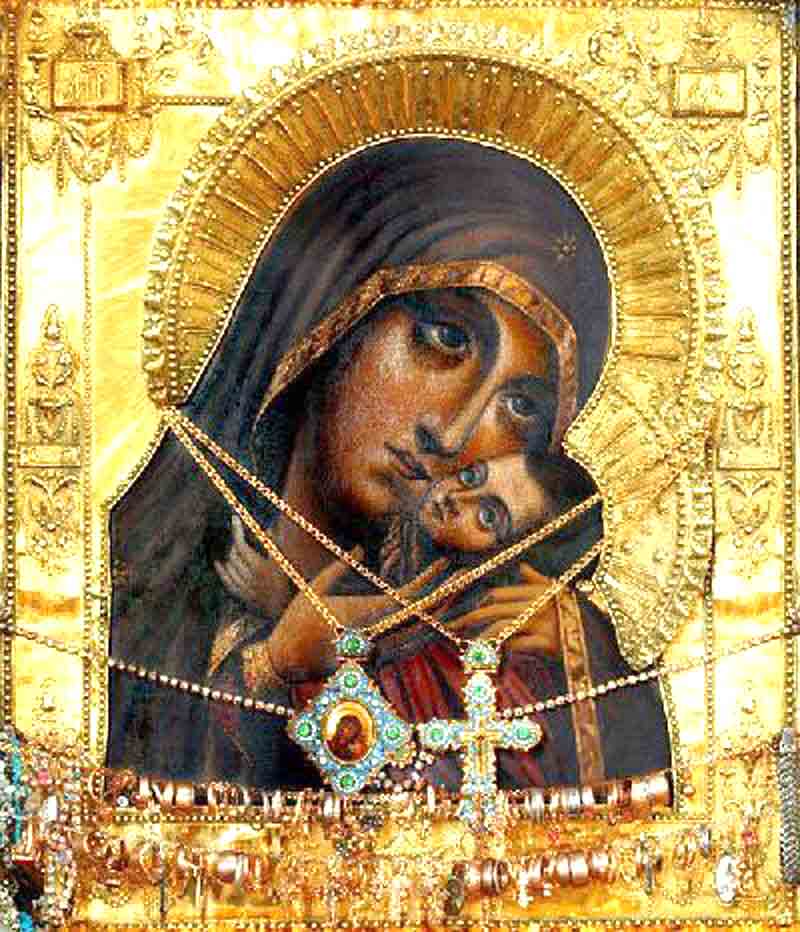
About Kasperov Icon of the Mother of God →

Saints commemorated
-
St Theodore the Sykeote
Theodore the Sykeote (†22 April 613) was the greatest of the holy men of Galatia: born in the village of Sykeon, the son of an innkeeper, he was given from childhood to the martyr George, at whose hill-shrine above the village he became first a boy-ascetic, then a hidden cave-dweller, then the founder of a monastery whose fame filled Asia Minor. He was ordained priest at eighteen, tonsured a monk at Choziba in the Judaean desert, and was at last dragged from his cave to be made Bishop of Anastasiopolis, a burden he bore for some years before obtaining release from the Patriarch to return to his cell. He stood in an iron cage through the winter fast, weighed down with irons; he stopped plagues, locusts, hail and rivers; he cast out demons across the Galatian countryside; he foretold the throne to Maurice and the coming of ruin upon the empire, and blessed Heraclius on his march east. His Life, written by his disciple George of Sykeon, is one of the richest documents of provincial Byzantine society that survives.
-
Holy Martyr Leonidas (202)
-
Our Holy Father, the monk Vitalis
-
Apelles, Lucius and Clement of the Seventy
Apelles, Lucius and Clement (1st century) are three of the Seventy Apostles, commemorated together on September 10. All three are greeted by name in the letters of Paul: Apelles, "approved in Christ" (Romans 16:10), became bishop of Heraclea; Lucius (Romans 16:21) — whom the Slavic tradition identifies with the Evangelist Luke, while the Greek synaxaria keep him distinct — became bishop of Laodicea in Syria; and Clement, whose name Paul says is "in the book of life" (Philippians 4:3), became bishop of Sardis. Each finished his course as a preacher of the Gospel; no acts of martyrdom are transmitted. They share the day's synaxis listing with no individual propers, and are commemorated again with all the Seventy on January 4.
-
Luke the Evangelist
Luke the Evangelist (first century, reposed in Boeotia at the age of 84 by the most ancient account) is the "beloved physician" of Colossians 4:14, the faithful travelling-companion of the Apostle Paul — "only Luke is with me" (2 Timothy 4:11) — and the author of the third Gospel and the Acts of the Apostles, the largest single contribution to the New Testament and the Church's first written history. The tradition, from Eusebius onward, makes him a native of Antioch in Syria, numbers him among the Seventy Apostles and as one of the two disciples of the road to Emmaus, and — from the sixth century — remembers him as the first painter of icons of the Theotokos. His relics were translated from Thebes to the church of the Holy Apostles in Constantinople in 357 and lie today in Padua, from which a rib was returned to his ancient tomb at Thebes in 1998. His feast is October 18.
-
Nathanael the Apostle
Nathanael — "Nathanael of Cana in Galilee," the man of whom Christ said "Behold an Israelite indeed, in whom is no guile" — is known from the Fourth Gospel alone, where Philip brings him to Jesus under the fig tree (John 1:45–51) and where he stands among the seven disciples at the Sea of Tiberias after the Resurrection (John 21:2). April 22 in the Byzantine calendar keeps not his death but "the remembrance of his coming to know Christ" — the day of his calling. Who he was under his other name the Church has never settled: the printed Greek Menaion says outright that Nathanael "is Simon the Zealot"; the Slavonic and Russian books gloss the same commemoration "Apostle Bartholomew (Nathanael)"; Western tradition since the twelfth century, and almost all modern commentary, identifies him with Bartholomew; and Augustine doubted that he was one of the Twelve at all. This entry keeps the name the calendar keeps, and sets out the identifications without adopting one.
-
Nearchus
Nearchus is a martyr of the third century whom the Byzantine synaxarion commemorates on April 22 in a single line — "the holy martyr Nearchus is perfected by fire" — with one verse of epigram and nothing more. The Greek synaxaristes and the modern hagiographers identify him, with reserve, as the Nearchus of the Passion of St Polyeuctus: the Christian soldier of the Twelfth Legion at Melitene in Armenia whose grief at the thought of being parted from his unbaptised friend brought Polyeuctus to Christ and to martyrdom, and who gathered up his friend's body afterwards. If the identification holds, Nearchus is the instrument of one of the most beloved conversions in the martyrologies, and himself died in the flames some time after the man he had won.
-
Vitalis of Gaza
Vitalis (†c. 620) was a monk of the great coenobium of Abba Seridos near Gaza who, at the age of sixty, went to Alexandria and there undertook the strangest and most deliberately scandalous ascetic labour recorded of any Orthodox saint: he wrote down the names of all the prostitutes of the city, hired himself out as a day-labourer, and every evening carried his wage to one of them, paying her not to sin that night, and passing the night himself in prayer in the corner of her room while she slept — binding each to secrecy, and bearing the contempt of the whole city as a fornicating monk. Many of the women were converted. He was struck down at last by a young man who thought he was defending Christ's honour, and died in his hut on his knees, holding a scroll that read "Judge nothing before the time, until the Lord come." Only then did the women he had saved come out and tell the truth, and the Patriarch John the Almsgiver, who had refused all along to condemn him on hearsay, buried him with honour.
-
Vsevolod-Gabriel of Pskov
Vsevolod-Gabriel (†1138) was a prince of the house of Kiev — son of Mstislav the Great and grandson of Vladimir Monomakh — who ruled Novgorod and became the first beloved prince of Pskov. Born at Novgorod and given in baptism the name Gabriel, he governed Novgorod for many years as a builder of churches and a protector of the poor, founding the stone Church of Saint John the Forerunner at Opoki and beginning the great works of the city. After a disputed campaign and a falling-out with the turbulent Novgorodians, who expelled him, he was received in Pskov, which took him gladly as its prince; there, in the brief months left to him, he laid the foundation of the Cathedral of the Holy Trinity, the mother-church of Pskov, and reposed on 11 February 1138. His relics, uncovered incorrupt in 1192 and enshrined in the cathedral he had founded, made Pskov's Trinity Cathedral a place of wonders, and Vsevolod-Gabriel its heavenly patron; his sword, inscribed Honorem meum nemini dabo — "I will yield my honour to no one" — was long kept above his tomb.
Troparia & kontakia
Apolytikion — Tone 3
O holy Apostle and Evangelist Luke, intercede with the merciful God, that He grant unto our souls the forgiveness of offences.
Apolytikion — Tone 4
A rule of faith and an image of meekness, a teacher of temperance, hath the truth of thy deeds revealed thee to be unto thy flock: therefore hast thou attained the heights by humility, and riches by poverty. O Father and Hierarch Theodore, intercede with Christ God that our souls may be saved.
Kontakion — Tone 6
Protection of Christians that cannot be put to shame, mediation unto the Creator unfailing: despise not the suppliant voices of sinners, but be quick to help us who cry to thee in faith; hasten to intercession and make speed to entreaty, O Theotokos, who dost ever protect them that honour thee.
Kontakion — Tone 2
Let us praise the divine Luke, the herald of true piety, the orator of ineffable mysteries, the star of the Church: for the Word, who alone knoweth the hearts of men, chose him, together with the wise Paul, to be a teacher of the nations.
Kontakion — Tone 4
Having become a disciple of God the Word, with Paul thou didst enlighten all the earth and drive away the gloom, having written the divine Gospel of Christ.
Kontakion — Tone 3
Mounted upon the virtues as upon a chariot of fire, O God-bearer, thou didst run up to the dwellings of heaven: an angel keeping company with men, a man dancing in the choir of the angels. Therefore wast thou shown forth a divine vessel of wonders, O Theodore.
Magnification
We magnify thee, O Apostle of Christ and Evangelist Luke, and we honour the pains and labours whereby thou didst toil in the good tidings of Christ.
Stichera — Tone 1
Become an initiate of the mysteries of the Word, O father, and shining with the virtues in the radiance of the Spirit, thrice-blessed Theodore, thou bestowest the gifts of healings upon us who draw near on this thy sacred memorial and honour thee.
Troparion — Tone 4
To the Theotokos let us now run in haste, we sinners and lowly ones, and let us fall down in repentance, crying from the depth of our soul: O Lady, help us, having compassion upon us; make haste, for we perish from the multitude of our transgressions; turn not thy servants away empty, for thee alone have we as our hope.
Troparion — Tone 3
Holy Apostles Apelles, Lucius and Clement, intercede with the merciful God, that he grant to our souls the forgiveness of offences.
Troparion — Tone 5
With sacred songs let us praise the holy apostle Luke, the recounter of the Acts of the Apostles and radiant writer of the Gospel of Christ, glorious in the Church of Christ, the all-praised one: for he is a physician, healing the infirmities of men, the diseases of nature and the wounds of souls, and he prayeth without ceasing for our souls.
Troparion — Tone 3
Holy Apostle Nathanael, intercede with the merciful God, that he grant to our souls the forgiveness of offences.
Troparion — Tone 4
Thy martyr Nearchus, O Lord, in his contest received an incorruptible crown from thee, our God; for possessing thy strength, he cast down the tyrants and shattered the feeble insolence of the demons. By his intercessions save our souls.
Troparion — Tone 8
In thee, O father, was preserved unimpaired that which is according to the image: for taking up the cross, thou didst follow Christ, and by thy deeds didst teach us to despise the flesh, for it passeth away, but to care for the soul, which is a thing immortal. Wherefore thy spirit, O venerable Vitalis, rejoiceth with the angels.
Readings
Epistle
Acts 2.22-36
22Ye men of Israel, hear these words; Jesus of Nazareth, a man approved of God among you by miracles and wonders and signs, which God did by him in the midst of you, as ye yourselves also know: 23Him, being delivered by the determinate counsel and foreknowledge of God, ye have taken, and by wicked hands have crucified and slain: 24Whom God hath raised up, having loosed the pains of death: because it was not possible that he should be holden of it. 25For David speaketh concerning him, I foresaw the Lord always before my face, for he is on my right hand, that I should not be moved: 26Therefore did my heart rejoice, and my tongue was glad; moreover also my flesh shall rest in hope: 27Because thou wilt not leave my soul in hell, neither wilt thou suffer thine Holy One to see corruption. 28Thou hast made known to me the ways of life; thou shalt make me full of joy with thy countenance. 29Men and brethren, let me freely speak unto you of the patriarch David, that he is both dead and buried, and his sepulchre is with us unto this day. 30Therefore being a prophet, and knowing that God had sworn with an oath to him, that of the fruit of his loins, according to the flesh, he would raise up Christ to sit on his throne; 31He seeing this before spake of the resurrection of Christ, that his soul was not left in hell, neither his flesh did see corruption. 32This Jesus hath God raised up, whereof we all are witnesses. 33Therefore being by the right hand of God exalted, and having received of the Father the promise of the Holy Ghost, he hath shed forth this, which ye now see and hear. 34For David is not ascended into the heavens: but he saith himself, The LORD said unto my Lord, Sit thou on my right hand, 35Until I make thy foes thy footstool. 36Therefore let all the house of Israel know assuredly, that God hath made that same Jesus, whom ye have crucified, both Lord and Christ.
Gospel
John 1.35-51
35Again the next day after John stood, and two of his disciples; 36And looking upon Jesus as he walked, he saith, Behold the Lamb of God! 37And the two disciples heard him speak, and they followed Jesus. 38Then Jesus turned, and saw them following, and saith unto them, What seek ye? They said unto him, Rabbi, (which is to say, being interpreted, Master,) where dwellest thou? 39He saith unto them, Come and see. They came and saw where he dwelt, and abode with him that day: for it was about the tenth hour. 40One of the two which heard John speak, and followed him, was Andrew, Simon Peter’s brother. 41He first findeth his own brother Simon, and saith unto him, We have found the Messias, which is, being interpreted, the Christ. 42And he brought him to Jesus. And when Jesus beheld him, he said, Thou art Simon the son of Jona: thou shalt be called Cephas, which is by interpretation, A stone. 43The day following Jesus would go forth into Galilee, and findeth Philip, and saith unto him, Follow me. 44Now Philip was of Bethsaida, the city of Andrew and Peter. 45Philip findeth Nathanael, and saith unto him, We have found him, of whom Moses in the law, and the prophets, did write, Jesus of Nazareth, the son of Joseph. 46And Nathanael said unto him, Can there any good thing come out of Nazareth? Philip saith unto him, Come and see. 47Jesus saw Nathanael coming to him, and saith of him, Behold an Israelite indeed, in whom is no guile! 48Nathanael saith unto him, Whence knowest thou me? Jesus answered and said unto him, Before that Philip called thee, when thou wast under the fig tree, I saw thee. 49Nathanael answered and saith unto him, Rabbi, thou art the Son of God; thou art the King of Israel. 50Jesus answered and said unto him, Because I said unto thee, I saw thee under the fig tree, believest thou? thou shalt see greater things than these. 51And he saith unto him, Verily, verily, I say unto you, Hereafter ye shall see heaven open, and the angels of God ascending and descending upon the Son of man.