
Thursday 28 May 2020
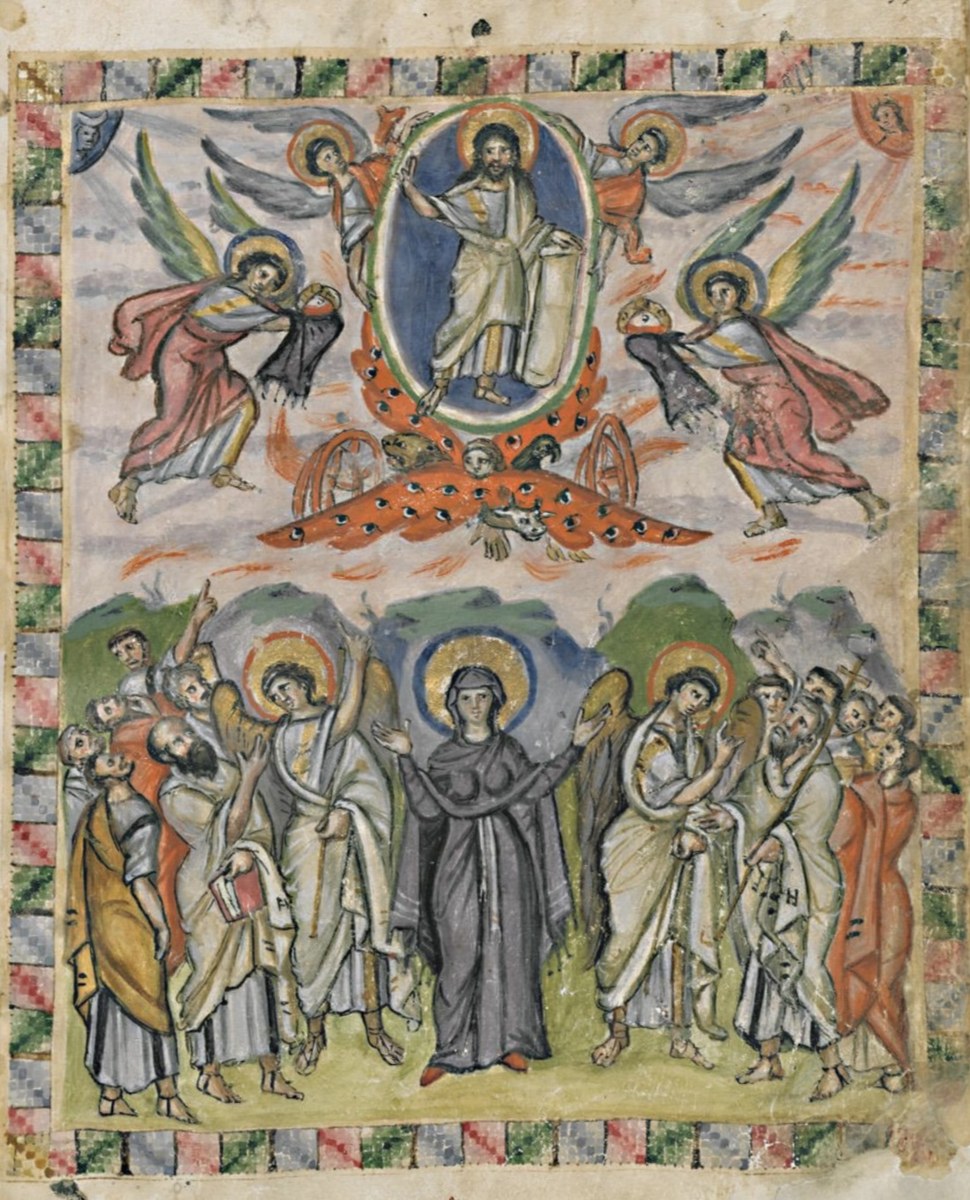
Ascension of the Lord
The Ascension of our Lord, God, and Saviour Jesus Christ
Ascensiontide, day 1 · 39 days since Pascha
Ascension of the Lord
About Ascension of the Lord → · About Nicaea Icon of the Mother of God →

Saints commemorated
-
St Nicetas, Bishop of Chalcedon
Nicetas, bishop of Chalcedon on the Asian shore opposite Constantinople, was one of the hierarchs who lost their sees for the holy icons in the second period of Byzantine Iconoclasm, under the emperor Leo V the Armenian (813–820). The synaxarial notice remembers him twice over: for a bishop's charity — he kept an open house for travellers, maintained the poor, took the part of orphans and widows, and made himself the advocate of anyone who had been wronged — and for the plainness with which he told his flock that the images of Christ, of His Mother and of the saints were to be venerated, when the emperor had forbidden it. He was tortured and sent into exile, where he reposed early in the ninth century; healings were reported at his relics. He is one of a crowded family of holy Nicetases and is frequently confused with them.
-
St Ignaty, Bishop of Rostov
Ignatius (†1288) was bishop of Rostov for twenty-six years, in the second and third generations of the Mongol yoke, and is one of the very few Russian saints whose veneration began at his own funeral. A monk of Rostov who rose through the city's Epiphany monastery to be its archimandrite, he was consecrated bishop in 1262 and spent his episcopate holding together a principality that the Horde and its own princes were pulling apart: he reconciled the feuding brothers Dmitry and Konstantin Borisovich, went himself to the Golden Horde on the Church's business, sat at the reforming council of Vladimir in 1274, and once — notoriously — passed sentence on a dead prince by removing his body from the cathedral. He reposed on 28 May 1288, and at his burial, in the sight of the people, his hand was seen to rise from the bier to take the prayer of absolution; he was never lowered into the ground but laid openly in the Dormition cathedral of Rostov, where his relics have rested ever since. He is one of the three founding hierarchs of Rostov, with Leontius and Isaiah.
-
St Nicetas the Confessor, bishop of Chalcedon (9th c.)
-
Eutychius of Melitene
Eutychius is remembered in a single line of the synaxarion: a co-worker of the holy apostles who was bishop of Melitene in Armenia Minor and who suffered for Christ there in the first century. Nothing further about him has been transmitted — no passion, no account of his preaching, no name of a persecutor, not even a manner of death. The Church keeps him on May 28 as a hieromartyr of the apostolic generation, and the whole of what can honestly be said about him is that the memory of a bishop-martyr of Melitene from the very first age of the Church was preserved at Constantinople and passed into the Menaion under that description.
-
Germanus of Paris
Germanus (c. 496–576) was bishop of Paris for the last twenty years of his life and the most respected churchman in the Frankish kingdoms of his generation: a Burgundian of Gallo-Roman family, abbot of St Symphorian at Autun before his elevation, and thereafter a hierarch who spent his episcopate trying to restrain the Merovingian kings from murdering one another and their subjects. He fed and ransomed the poor on a scale that emptied his own house, presided at the councils of Paris and Tours, went so far as to excommunicate a reigning king for his marriages, and was appealed to by St Radegund for protection against her husband. The great abbey he founded beside the Seine, dedicated to the Holy Cross and St Vincent, took his own name after his burial in it and is known to this day as Saint-Germain-des-Prés. He is one of the pre-schism fathers of the West received into Orthodox commemoration, and is kept on May 28 in both the Greek Great Synaxaristes and the OCA calendar.
-
Heliconis of Thessalonica
Heliconis was a Christian woman of Thessalonica who, in the middle of the third century, went of her own accord to Corinth during a persecution and preached openly in the city against the worship of idols. Arrested and brought before the governor, she endured a long and inventive series of torments — the furnace, the flaying of her scalp, the burning of her head and breasts — and then, feigning consent to sacrifice, had herself led in procession to the temple, where she was left alone and broke every idol in it. Beaten and imprisoned, she was healed in the night by a vision of Christ with the Archangels Michael and Gabriel; thrown to three lions, she was not touched by them; and at last she was beheaded, in the year given by the tradition as 244. She is one of the boldest of the women martyrs of the Greek synaxarion, and among the very few whose passion is built around a deliberate, premeditated destruction of a pagan sanctuary.
-
Helladius the Hieromartyr
Helladius is remembered in the books as a bishop "in the East" — that is, somewhere in the vast Roman Diocese of Oriens, the territory of the Antiochene patriarchate — who was thrown into a fire for his faith in Christ and came out of it unhurt, and who died afterwards of the beating inflicted on him. His service adds one further detail, and it is the one his commemoration is really built on: that the Lord Jesus Christ came to him in his prison and healed his wounds. Neither his see nor the name of his persecutor has been transmitted, and the sources are divided over his century, some placing him among the Christians who suffered in the Persian invasions of the Roman East, others four centuries later. He is a saint of whom the Church has kept the substance — a bishop, a fire, a scourging, a visitation — and lost every circumstance.
-
Sophronius the Bulgarian
Sophronius — Stephen before his tonsure — was a Bulgarian hieromonk of the turn of the fifteenth and sixteenth centuries, from the village of Penkovtsi in the Sofia region, who served in the monastery of Penkovo near Sofia until word came that the Ottoman troops were about to fall on it. He fled north across the Danube into Wallachia, settled in a monastery on the river, and gave the rest of his life to fasting, vigil and prayer in the monastic community of Rusensk — a house associated in the tradition with St Joachim, Patriarch of Trnovo. He was known for almsgiving and for care of the poor, and reposed on 28 May 1510; some accounts say he was murdered by a servant, and that his relics were found incorrupt three years afterwards. He belongs to the small company of Bulgarian monastic saints of the first Ottoman century, whose lives were lived out largely in exile north of the Danube.
-
William of Gellone
William (c. 755–812) was a Frankish count and duke of Toulouse, a kinsman of Charlemagne and one of the commanders who held the Pyrenean frontier of Christendom against the emirate of Córdoba — he was in the field at the disaster on the Orbieu in 793 and at the capture of Barcelona in 801 — who then laid down his arms, founded the monastery of Gellone in the wild gorge of the Hérault in 804, enriched it with a relic of the True Cross given him by the emperor, and in 806 entered it himself as a simple monk. He died there on 28 May 812 and was formally canonised at Rome in 1066; the abbey and the village that grew around it are called Saint-Guilhem-le-Désert to this day. He is among the pre-schism saints of the West received into Orthodox commemoration, and he is the historical seed of an enormous cycle of medieval French epic, the Geste de Guillaume d'Orange, which buried the real man under a legendary one.
Troparia & kontakia
Apolytikion — Tone 4
Thou wast taken up in glory, O Christ our God, and didst gladden thy disciples with the promise of the Holy Spirit; and by the blessing they were made certain that thou art the Son of God, the Redeemer of the world.
Apolytikion — Tone 4 (common of a hieromartyr)
As a sharer in the ways and a successor to the thrones of the Apostles, thou didst find in action the means to ascend to divine contemplation, O divinely-inspired one; wherefore, rightly dividing the word of truth, thou didst also contend for the faith even unto blood, O hieromartyr Eutychius: intercede with Christ God that our souls may be saved.
Apolytikion — Tone 4 (common of a hierarch)
O holy hierarch Germanus, shepherd of the Church of Paris, thou didst feed the poor with thine own bread and ransom the captive with thine own goods, and thou didst rebuke kings without fear of their swords: intercede with Christ God that peace be given to the nations and great mercy to our souls.
Apolytikion — Tone 4 (common of a woman martyr)
Thy lamb Heliconis, O Jesus, cries out with a great voice: Thee, my Bridegroom, do I love, and seeking Thee I contend; I am crucified with Thee and buried in Thy baptism; I suffer for Thy sake, that I may reign with Thee; I die for Thee, that I may live in Thee. Accept me as a spotless offering, sacrificed to Thee in love. By her intercessions, as Thou art merciful, save our souls.
Apolytikion — Tone 4 (common of a hieromartyr)
As a sharer in the ways and a successor to the thrones of the Apostles, thou didst find in action the means to ascend to divine contemplation, O divinely-inspired one; wherefore, rightly dividing the word of truth, thou didst also contend for the faith even unto blood, O hieromartyr Helladius: intercede with Christ God that our souls may be saved.
Apolytikion — Tone 4
O God of our fathers, who dealest with us ever according to Thy gentleness: take not away Thy mercy from us, but by the prayers of Thy holy confessor Nicetas guide our lives in peace.
Apolytikion — Tone 8 (common of a venerable father)
Driven from thy monastery by the sword of the ungodly, thou didst carry the monastic rule across the river and there didst labour the more in fasting and in vigil, giving to the poor what thine own hands had earned. O venerable father Sophronius, glory of the Bulgarian land, intercede with Christ God that our souls may be saved.
Apolytikion — Tone 8 (common of a venerable father)
Having guarded the borders of the Christian people with the sword, thou didst lay the sword aside for the Cross, O William, and didst enter the desert of Gellone as the least of the brethren; and where thou hadst commanded armies thou didst learn to obey. O venerable father, intercede with Christ God that our souls may be saved.
Exapostilarion — Tone 2 (sung three times)
Before the eyes of thy disciples thou wast taken up, O Christ, to be enthroned together with the Father; and the angels running on before thee cried aloud: Lift up the gates, lift them up, for the King has gone up to the glory that is the source of light.
Kontakion — Tone 6
Having fulfilled the dispensation for our sake, and united the things of earth with the things of heaven, thou wast taken up in glory, O Christ our God, in no way parted from us, but remaining inseparable and crying to those who love thee: I am with you, and no one is against you. Leaving on earth the things of earth, and yielding the ashes to the dust, come, let us wake and lift up our eyes and our thoughts on high; let us mortals send our sight and our senses together flying toward the gates of heaven; let us reckon that we are on the Mount of Olives and are gazing upon the Redeemer as he is borne upon a cloud.
Kontakion — Tone 2
Entering alone among the idols of Corinth, thou didst break them all in pieces, O bride of Christ; and the fire did not burn thee, and the lions lay down before thee. Wherefore, O Heliconis, healed in prison by the hands of thy Bridegroom and crowned by the sword, pray for those who honour thee.
Kontakion — Tone 8
Rostov rejoices in thee, O father, holding thy relics unburied as a treasure and a fountain of healings; for the earth did not receive thee whom the heavens had already glorified. Wherefore we cry to thee: rejoice, O wonderworker Ignatius, boast of the hierarchs of the Russian land.
Kontakion — Tone 2
The star of Chalcedon, the herald of the venerable image of Christ, the father of orphans and the shelter of strangers, let us praise with hymns: for having endured the tyrant's chastisement and exile, Nicetas the confessor now intercedes unceasingly for our souls.
The
O Lord, having in thy goodness fulfilled the mystery hidden from the ages and from the generations, thou didst come with thy disciples to the Mount of Olives, having with thee her who bore thee, the Maker and Fashioner of all things; for she who as a mother grieved above all others in thy Passion had also to enjoy the surpassing joy of the glorifying of thy flesh — in which we too, sharing it, glorify at thine ascent into the heavens, O Master, thy great mercy that has come upon us.
Theotokion
Thy womb has become a holy table, holding the heavenly Bread, Christ; of which whoever eats does not die, as the Nourisher of all has said, O Theotokos.
Troparion — Tone 4 (common of an icon of the Theotokos)
O Lady, we thy servants have thine icon as a rampart and a shield, and by it we are delivered from every affliction; for thou dost swiftly avenge the honour of thy image and swiftly hear those who honour it. Wherefore we cry to thee: O Mother of God, save thy people.
Troparion — Tone 4
Enlightened from thy youth by the grace of God, thou wast shown to be a shepherd of the flock of Rostov, and a peacemaker among warring princes; and after thy repose thou didst stretch out thy hand to receive the word of forgiveness, and didst bless thy city from on high. O holy hierarch Ignatius, pray to Christ God that our souls may be saved.
Readings
Vespers
Isaiah 2.2-3
2And it shall come to pass in the last days, that the mountain of the LORD’s house shall be established in the top of the mountains, and shall be exalted above the hills; and all nations shall flow unto it. 3And many people shall go and say, Come ye, and let us go up to the mountain of the LORD, to the house of the God of Jacob; and he will teach us of his ways, and we will walk in his paths: for out of Zion shall go forth the law, and the word of the LORD from Jerusalem.
Composite 21 - Isaiah 62.10-63.3, 7-9
1Thus says the Lord: Walk, go through my gates; prepare my way and make a way for my people, and cast the stones out of the way; raise up a standard for the nations. For see, the Lord has made it heard to the ends of the earth: Say to the daughter of Sion: See, your Saviour has come, and his reward is with him, and his work before his face. And he will call it a holy people, redeemed by the Lord; while you will be called a city sought after, and not forsaken. Who is this who comes from Edom, the scarlet of his garments from Bosor, thus beautiful in his apparel? He cries out with much strength. I reason of justice and judgement of salvation. Why are your garments red, and your clothing as from a trodden winepress? I am full of the trodden grape; I have trampled the winepress quite alone, and no man from the nations was with me. I have remembered the mercy of the Lord, I will recall the Lord’s virtues, the Lord’s praise for all the things with which He rewards us. The Lord is a good judge for the house of Israel; he deals with us according to his mercy and according to the multitude of his justice. And he said: Are you not my people? Children will surely not be rebellious; and he became for them salvation out of their every distress. It was not an emissary, not an Angel, but the Lord himself saved them because he loved them and spared them. He redeemed them and took them up and exalted them all the days of the age.
Composite 22 - Zechariah 14.1, 4, 8-11
1Thus says the Lord: See, the day of the Lord is coming, and on that day his feet will stand upon the mount of Olives, opposite Jerusalem, where the sun rises. And on that day living water will come out from Jerusalem, half towards the first sea and half towards the last sea; in spring and in summer it shall be so; and the Lord will be for a King over all the earth; in that day there shall be one Lord, and his name, compassing all the earth and the wilderness from Gabaa as far as Remmon, south of Jerusalem; and he shall be exalted and remain on his place from the gate of Benjamin as far as the place of the first gate, as far as the gate of Gomor and as far as the tower of Anameël and as far as the tower of the corners and as far as the king’s winepresses; they shall dwell in it and there shall be no more curse and Jerusalem shall dwell confidently.
Matins Gospel
Mark 16.9-20
9Now when Jesus was risen early the first day of the week, he appeared first to Mary Magdalene, out of whom he had cast seven devils. 10And she went and told them that had been with him, as they mourned and wept. 11And they, when they had heard that he was alive, and had been seen of her, believed not. 12After that he appeared in another form unto two of them, as they walked, and went into the country. 13And they went and told it unto the residue: neither believed they them. 14Afterward he appeared unto the eleven as they sat at meat, and upbraided them with their unbelief and hardness of heart, because they believed not them which had seen him after he was risen. 15And he said unto them, Go ye into all the world, and preach the gospel to every creature. 16He that believeth and is baptized shall be saved; but he that believeth not shall be damned. 17And these signs shall follow them that believe; In my name shall they cast out devils; they shall speak with new tongues; 18They shall take up serpents; and if they drink any deadly thing, it shall not hurt them; they shall lay hands on the sick, and they shall recover. 19So then after the Lord had spoken unto them, he was received up into heaven, and sat on the right hand of God. 20And they went forth, and preached every where, the Lord working with them, and confirming the word with signs following. Amen.
Epistle
Acts 1.1-12
1The former treatise have I made, O Theophilus, of all that Jesus began both to do and teach, 2Until the day in which he was taken up, after that he through the Holy Ghost had given commandments unto the apostles whom he had chosen: 3To whom also he shewed himself alive after his passion by many infallible proofs, being seen of them forty days, and speaking of the things pertaining to the kingdom of God: 4And, being assembled together with them, commanded them that they should not depart from Jerusalem, but wait for the promise of the Father, which, saith he, ye have heard of me. 5For John truly baptized with water; but ye shall be baptized with the Holy Ghost not many days hence. 6When they therefore were come together, they asked of him, saying, Lord, wilt thou at this time restore again the kingdom to Israel? 7And he said unto them, It is not for you to know the times or the seasons, which the Father hath put in his own power. 8But ye shall receive power, after that the Holy Ghost is come upon you: and ye shall be witnesses unto me both in Jerusalem, and in all Judæa, and in Samaria, and unto the uttermost part of the earth. 9And when he had spoken these things, while they beheld, he was taken up; and a cloud received him out of their sight. 10And while they looked stedfastly toward heaven as he went up, behold, two men stood by them in white apparel; 11Which also said, Ye men of Galilee, why stand ye gazing up into heaven? this same Jesus, which is taken up from you into heaven, shall so come in like manner as ye have seen him go into heaven. 12Then returned they unto Jerusalem from the mount called Olivet, which is from Jerusalem a sabbath day’s journey.
Gospel
Luke 24.36-53
36And as they thus spake, Jesus himself stood in the midst of them, and saith unto them, Peace be unto you. 37But they were terrified and affrighted, and supposed that they had seen a spirit. 38And he said unto them, Why are ye troubled? and why do thoughts arise in your hearts? 39Behold my hands and my feet, that it is I myself: handle me, and see; for a spirit hath not flesh and bones, as ye see me have. 40And when he had thus spoken, he shewed them his hands and his feet. 41And while they yet believed not for joy, and wondered, he said unto them, Have ye here any meat? 42And they gave him a piece of a broiled fish, and of an honeycomb. 43And he took it, and did eat before them. 44And he said unto them, These are the words which I spake unto you, while I was yet with you, that all things must be fulfilled, which were written in the law of Moses, and in the prophets, and in the psalms, concerning me. 45Then opened he their understanding, that they might understand the scriptures, 46And said unto them, Thus it is written, and thus it behoved Christ to suffer, and to rise from the dead the third day: 47And that repentance and remission of sins should be preached in his name among all nations, beginning at Jerusalem. 48And ye are witnesses of these things. 49And, behold, I send the promise of my Father upon you: but tarry ye in the city of Jerusalem, until ye be endued with power from on high. 50And he led them out as far as to Bethany, and he lifted up his hands, and blessed them. 51And it came to pass, while he blessed them, he was parted from them, and carried up into heaven. 52And they worshipped him, and returned to Jerusalem with great joy: 53And were continually in the temple, praising and blessing God. Amen.