
Ignatius of Rostov
Our Father among the Saints Ignatius the Wonderworker, Bishop of Rostov
Bishop · Wonderworker · d. 28 May 1288, at Rostov
Commemorated 23 May — Synaxis of the Saints of Rostov and Yaroslavl, 28 May — Repose at Rostov, and the miracle at his burial
Ignatius (†1288) was bishop of Rostov for twenty-six years, in the second and third generations of the Mongol yoke, and is one of the very few Russian saints whose veneration began at his own funeral. A monk of Rostov who rose through the city's Epiphany monastery to be its archimandrite, he was consecrated bishop in 1262 and spent his episcopate holding together a principality that the Horde and its own princes were pulling apart: he reconciled the feuding brothers Dmitry and Konstantin Borisovich, went himself to the Golden Horde on the Church's business, sat at the reforming council of Vladimir in 1274, and once — notoriously — passed sentence on a dead prince by removing his body from the cathedral. He reposed on 28 May 1288, and at his burial, in the sight of the people, his hand was seen to rise from the bier to take the prayer of absolution; he was never lowered into the ground but laid openly in the Dormition cathedral of Rostov, where his relics have rested ever since. He is one of the three founding hierarchs of Rostov, with Leontius and Isaiah.

Rostov before him
Rostov the Great, on Lake Nero, was the mother-city of the Russian north-east and the oldest see beyond the Volga watershed. Its Christian foundations had been laid with difficulty: two of its first bishops were driven out by the pagan population, and the see was established in fact only by St Leontius (†c. 1073), whose relics were uncovered in 1164, and consolidated by his successor St Isaiah (†1090). By Ignatius's day, two centuries later, Rostov was Christian, wealthy in churches, and politically fractured — the principality had been divided between the Vasilkovich brothers, and every dispute among them was arbitrated, in the last resort, at the court of the Mongol khan at Sarai.
From the Epiphany monastery to the episcopate
Ignatius began in the lowest clerical rank — the chronicles remember him first as a church attendant at Rostov — and rose within the city's own monastic establishment to be archimandrite of the Epiphany (Bogoyavlensky) monastery, the ancient Avraamiev house at Rostov, one of the oldest monasteries of the north-east. In 1261, at the request of Prince Alexander Nevsky, he was appointed assistant to the aged bishop Kirill II of Rostov, and on Kirill's death he succeeded him: he was consecrated bishop on 19 September 1262 by Metropolitan Kirill of Kiev and All Rus'. The sixteenth-century Facial Chronicle of Ivan the Terrible illustrates the consecration and records it in an inscription that names the metropolitan and the reigning prince, Boris Vasilkovich.
His episcopate lasted twenty-six years, which in the circumstances of the 1260s to 1280s was an achievement in itself. The chronicles show him at the great occasions of the ruling house — the baptisms, marriages and funerals of the Rostov princes between 1266 and 1278 — and among the hierarchs at the council of Vladimir in 1274, summoned by Metropolitan Kirill to correct the disorders that had multiplied in the Russian Church since the invasion: simony in ordinations, irregularities in baptism, drunkenness among the clergy.
The affair of Prince Gleb Vasilkovich
The one episode of his episcopate that provoked a public scandal, and the one the hagiographic tradition passes over in silence, is the posthumous condemnation of Prince Gleb Vasilkovich, prince of Beloozero and then of Rostov, who died in 1278.
Ignatius buried Gleb, as was proper, in the Dormition cathedral of Rostov. Nine weeks later he had the body taken up by night and removed from the cathedral, and reburied at the Saviour monastery outside the city. It was an extraordinary act: a bishop reversing his own funeral and expelling a prince's remains from the mother church of the diocese, which in the language of the time was a public judgement on the dead man's soul. Metropolitan Kirill imposed an ecclesiastical censure on him for it, and the chronicle records the reproof.
The grounds of Ignatius's action are not stated in any source. Gleb had spent much of his life in the closest possible dealings with the Horde — he had married a baptised Mongol princess, a relative of Batu's line, and had campaigned with the khan's armies — and later writers have supposed that the bishop was judging him for those associations, or for extortion, or for some private sin known to his confessor. This is inference. What can be said is that the censure was lifted quickly, which suggests the metropolitan was satisfied that the bishop had acted on cause and not on caprice, and that Ignatius's standing was in no way damaged: three years later he was arbitrating between the princes of Rostov with full authority.
Peacemaker
In 1281 the Rostov brothers Dmitry and Konstantin Borisovich quarrelled over the partition of the principality, at exactly the moment when the wider Russian land was being torn between the Grand Prince Dmitry Alexandrovich and his brother Andrei, each with his own Mongol backing. Ignatius reconciled the two brothers, and persuaded the Grand Prince Dmitry Alexandrovich to come to Rostov in person and confirm the settlement. In thanksgiving for the peace he built a church of the holy Passion-bearers Boris and Gleb — the princely martyr-brothers whose whole meaning in Russian devotion is the refusal of fratricide, and therefore exactly the right dedication for the occasion.
In 1282 he travelled to the Golden Horde, to Sarai, on behalf of the Russian Church — to secure and confirm the immunities of the clergy under the khan's protection, the one instrument by which the Church survived and even prospered during the yoke. Two hierarchs of the north-east made that journey in the thirteenth century; Ignatius was one of them.
Repose and the miracle at the burial
He reposed on 28 May 1288. His body was carried into the cathedral church for the funeral, and there — before the clergy and the people — occurred the event on which his veneration rests. The account, as the chronicles and the Life transmit it, has two parts, and different sources emphasise one or the other:
- As the prayer of absolution was to be laid in the dead bishop's hand, his hand rose of itself from the bier and took the scroll.
- Two persons — in the older telling, a monk and a devout woman keeping vigil — saw the saint rise from his coffin and stand in the air above the church, bless the people and the city, and return to his coffin.
The clergy concluded that he was not to be buried in the earth at all, and he was laid openly in the Dormition cathedral, in the manner of relics already glorified. Healings followed at once at the tomb.
Relics and cultus
Ignatius is thus among the small number of Russian saints whose relics were never interred: they lay open in the Dormition cathedral of Rostov from 1288, later in a silver shrine, and were transferred to a new reliquary in 1795. His local glorification was effectively immediate; the earliest surviving service to him dates from the late fourteenth or early fifteenth century, and the earliest manuscript of his Life from about 1420 — early enough to make him one of the first canonised saints of the Muscovite north. His memory was kept at Rostov with a six-stichera (шестеричный) office annually, and he takes his place with Leontius and Isaiah as the third of the founding hierarchs of Rostov, the group with which he is almost always painted.
Feast and commemoration
May 28 (church date; New Calendar civil May 28, Old Calendar civil June 10) — the day of his repose, always within the Pentecostarion — and May 23, when he is commemorated among the Synaxis of the Saints of Rostov and Yaroslavl, the collective feast instituted by Patriarch Alexis I in 1964 and attached to the day of St Leontius of Rostov. The commemoration is Russian, Ukrainian and OCA; it is not kept in Greek or Antiochian usage, where May 28 belongs to Eutychius of Melitene and Heliconis. In the Russian books he stands second in the day, after Nicetas of Chalcedon. At Rostov itself his feast is one of the four hierarchical commemorations of the Dormition cathedral.
Hymns
Troparion — Tone 4
Enlightened from thy youth by the grace of God, thou wast shown to be a shepherd of the flock of Rostov, and a peacemaker among warring princes; and after thy repose thou didst stretch out thy hand to receive the word of forgiveness, and didst bless thy city from on high. O holy hierarch Ignatius, pray to Christ God that our souls may be saved.
Original translation from the Slavonic
Kontakion — Tone 8
Rostov rejoices in thee, O father, holding thy relics unburied as a treasure and a fountain of healings; for the earth did not receive thee whom the heavens had already glorified. Wherefore we cry to thee: rejoice, O wonderworker Ignatius, boast of the hierarchs of the Russian land.
Original translation from the Slavonic
Iconography
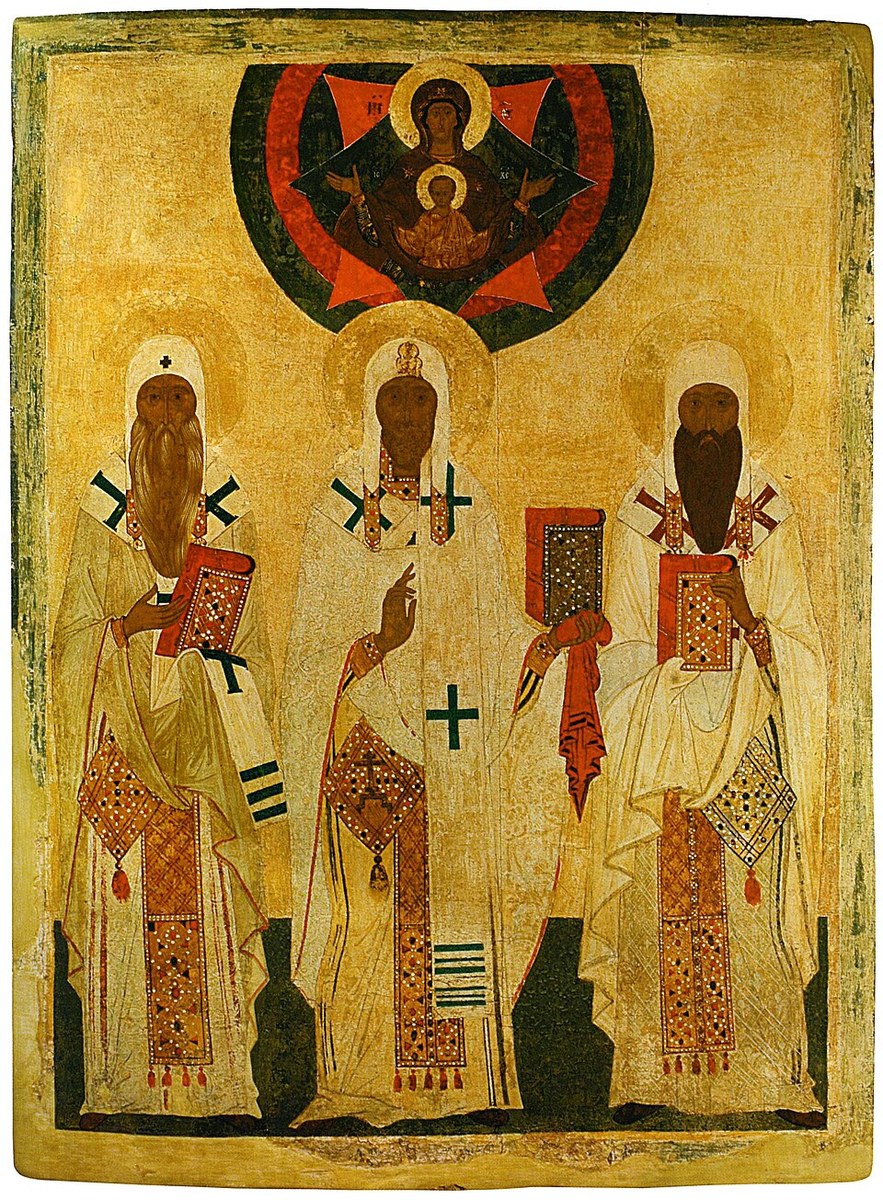
Ignatius is painted as a Russian hierarch of the thirteenth century: a bishop of middle age or older, dark-bearded and with the beard shorter and more rounded than that given to Leontius, in the white cross-covered polystaurion and the omophorion, blessing or holding the Gospel-book. His almost invariable context is the group of the three Rostov hierarchs — Leontius, Isaiah and Ignatius together, frequently under an image of the Theotokos of the Sign, the palladium of the Rostov and Novgorod north. In vita-icons and in the border scenes of the Rostov cathedral programmes the distinctive subject is the miracle at his funeral: the saint lying vested on the bier and lifting his hand to take the scroll of absolution, or standing in the air above the cathedral with his hand raised in blessing over the city. The sixteenth-century Facial Chronicle supplies two further scenes that entered the tradition — his consecration by Metropolitan Kirill, and his reconciliation of the princes Dmitry and Konstantin Borisovich.
The stored image is the late-fifteenth-century Rostov panel of the three hierarchs: Leontius, Isaiah and Ignatius standing full-length in white polystaurion vestments with richly worked epigonatia and epimanikia, the Theotokos of the Sign in a starred glory above them. Ignatius is the dark-bearded hierarch at the (viewer's) right, holding the red-covered Gospel; the aged white-bearded figure at the left is Leontius, and the central hierarch, blessing, is Isaiah. It should be recorded frankly that the inscriptions are not legible in the available reproduction, and the identification of the three figures — and therefore of Ignatius among them — rests on the catalogue description of the panel and on the fixed canonical grouping, not on a reading of the titles. A second image is stored as a variant: a detail of an eighteenth-century Yaroslavl icon showing Ignatius alone, in the polystaurion with Gospel and pastoral staff, described in its source as St Ignatius of Rostov but likewise without a legible inscription.
Disputed questions
- The Gleb affair. The chronicle's record of the removal of the body and of the metropolitan's censure is firm; the reason is not transmitted, and every explanation offered — Gleb's Mongol marriage and service, extortion of his subjects, a private sin — is a later conjecture. The hagiographic tradition omits the episode altogether. Both the fact and the silence are recorded here.
- The date of Gleb's death and of the removal. Sources give 1278 for the prince's death, with the removal nine weeks after; a few Russian accounts place the whole affair in 1280.
- Not to be confused with the other saints named Ignatius, of whom the calendar has several and two are near neighbours in the books: Ignatius of Antioch (December 20, †c. 107), the God-bearer; Ignatius of Constantinople (October 23, †877), the patriarch of the Photian controversy; and Ignatius of Lomsk (December 28, †1591), the Vologda hermit — who, like this Ignatius, is also numbered in the Synaxis of the Rostov and Yaroslavl saints on May 23, so that the two Russian Ignatii appear together in that collective commemoration five days before this feast.
- Not to be confused with the Ignatius named in the canon of Nicetas of Chalcedon — the Byzantine confessor's brother, commemorated in the hymnography of this same day. The two Ignatii of May 28 have no connection whatever: one is a ninth-century Greek of whom nothing but the name survives, the other a thirteenth-century Russian bishop.
- "Ignatius I." Russian reference works number him Игнатий I to distinguish him from later bishops of Rostov of the same name; the numeral is not part of his liturgical title.