
Nicetas of Chalcedon
Our Father among the Saints Nicetas the Confessor, Bishop of Chalcedon
Bishop · Confessor · b. mid-8th century — d. early 9th century (after 815)
Commemorated 28 May — Commemoration of the confessor-bishop of Chalcedon
Nicetas, bishop of Chalcedon on the Asian shore opposite Constantinople, was one of the hierarchs who lost their sees for the holy icons in the second period of Byzantine Iconoclasm, under the emperor Leo V the Armenian (813–820). The synaxarial notice remembers him twice over: for a bishop's charity — he kept an open house for travellers, maintained the poor, took the part of orphans and widows, and made himself the advocate of anyone who had been wronged — and for the plainness with which he told his flock that the images of Christ, of His Mother and of the saints were to be venerated, when the emperor had forbidden it. He was tortured and sent into exile, where he reposed early in the ninth century; healings were reported at his relics. He is one of a crowded family of holy Nicetases and is frequently confused with them.

Origins and the see of Chalcedon
Nothing is transmitted of Nicetas's family or birthplace. The notice places his life in the second half of the eighth century — the generation formed in the reaction against the first iconoclasm, which grew up under the emperors Constantine V and Leo IV and saw the restoration of the icons at the Seventh Ecumenical Council at Nicaea in 787 — and says that he was raised to the episcopate "for his God-pleasing life," that is, from a manner of life already known and respected before his election.
The see he received was one of the most honourable in the empire and one of the most exposed. Chalcedon (Kadıköy) lay directly across the Bosporus from the capital, the first city of Bithynia and the seat of the Fourth Ecumenical Council of 451; its metropolitan sat high in the order of precedence under the Patriarch of Constantinople and lived, in effect, within sight of the imperial palace. A bishop of Chalcedon could not be overlooked, and could not dissent quietly.
The bishop's charity
The synaxarion is unusually specific about the works of mercy for which Nicetas was remembered, and they are worth keeping in the order the notice gives them. He was merciful to the poor, giving away what came to him. He lodged strangers and travellers in his own house — the road from the capital into Asia ran through Chalcedon, and the bishop's residence stood on it. He took charge of orphans and widows, the canonical charge of every bishop but not the practice of every bishop. And he pleaded the cause of the wronged, standing between the powerful and their victims; in a provincial city of the Byzantine east that meant confronting tax-collectors, landowners and imperial officials on behalf of people with no other advocate. It is a portrait of the episcopate as the eighth-century Church wished to see it, and it is the ground on which the notice builds what follows: a man already accustomed to opposing power did not find it hard to oppose an emperor.
Confession under Leo V the Armenian
In 815 the emperor Leo V the Armenian, having deposed the patriarch Nicephorus and installed a compliant successor, had a synod at the church of the Holy Apostles annul the Council of Nicaea and renew the iconoclast decrees of 754. Bishops were required to subscribe. Those who refused were deprived of their sees, and the more obstinate were beaten, imprisoned and dispersed to remote fortresses and islands.
Nicetas refused. The notice says that he denounced the heresy openly and that he urged his flock to go on venerating the icons of Christ, of the Theotokos and of the saints — the pastoral act, not merely the private opinion, which the government could not tolerate. He was accordingly "subjected to many sufferings from the impious emperor and those who thought as he did": interrogation, blows, and finally exile. Where he was sent is not recorded. He did not return; he reposed in banishment, a confessor, early in the ninth century, and the day of his commemoration is the twenty-eighth of May.
Relics and healings
The notice adds that many healings were worked from his relics — the ordinary sign, in the iconophile literature of the ninth century, that the Church had already made up its mind about a confessor whom the state had condemned. After the Triumph of Orthodoxy in 843 the names of the deposed bishops were restored and read in the churches, and Nicetas took his place among the hierarchs of the Synodikon.
The canon of Joseph the Hymnographer and the brother Ignatius
The proper hymnography for the day is a canon by Joseph the Hymnographer (†886), the great Constantinopolitan poet of the generation after the Triumph of Orthodoxy, who supplied the Menaion with canons for scores of confessors of the iconoclast years. Joseph's canon is of particular interest because it does not celebrate Nicetas alone: it names and praises with him his brother, Saint Ignatius, so that the two are carried together in the service even though only Nicetas stands in the title of the day. Nothing further is transmitted about this Ignatius — no see, no date, no separate notice — and he must not be confused with the other Ignatii of the calendar (see Disputed questions).
Feast and commemoration
May 28 (church date; New Calendar civil May 28, Old Calendar civil June 10). The day always falls within the Pentecostarion, and the Menaion's hymns for Nicetas are sung together with the propers of the paschal season. He is carried in the Greek Menaion (as Νικήτας ὁ Ὁμολογητής), in the Slavonic books (as преподобный Никита исповедник, епископ Халкидонский), and in the OCA and Antiochian calendars derived from them; in the Russian usage he is usually the first commemoration named for the day. No church is known to be dedicated to him, and no proper akolouthia beyond the canon of Joseph is transmitted.
Hymns
Apolytikion — Tone 4
O God of our fathers, who dealest with us ever according to Thy gentleness: take not away Thy mercy from us, but by the prayers of Thy holy confessor Nicetas guide our lives in peace.
Kontakion — Tone 2
The star of Chalcedon, the herald of the venerable image of Christ, the father of orphans and the shelter of strangers, let us praise with hymns: for having endured the tyrant's chastisement and exile, Nicetas the confessor now intercedes unceasingly for our souls.
Original translation from the Greek
Iconography
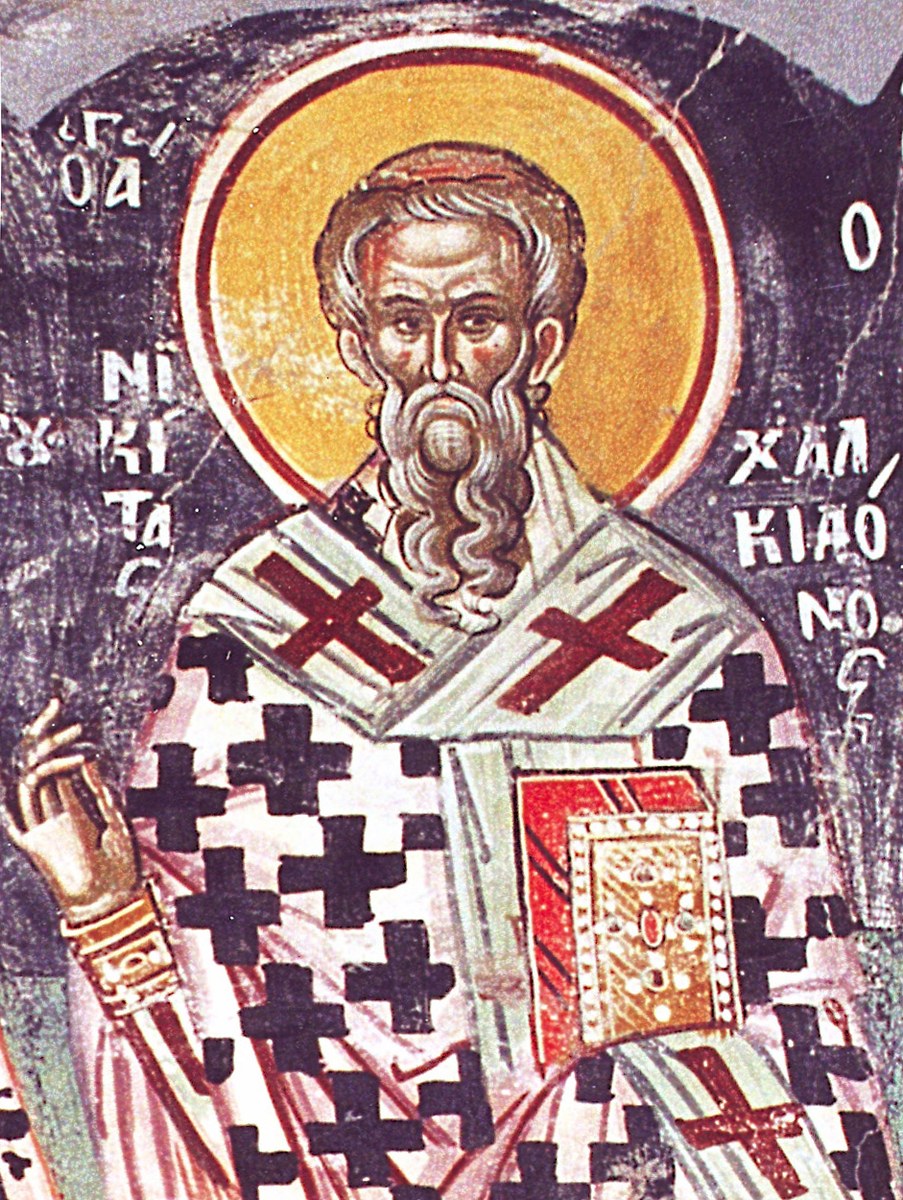
Nicetas is painted as a hierarch: an elderly bishop, the hair receding and the beard long, grey and pointed, vested in the phelonion or the cross-patterned polystaurion with the omophorion over the shoulders, blessing with the right hand and holding the jewelled Gospel in the left. As a confessor for the images he is very often given a small icon or medallion of Christ to hold or to display, the attribute by which post-Byzantine painters mark out the iconophile hierarchs; he belongs with them in the wall-programmes of the sanctuary and in the May leaf of painted menologia.
The stored image is a sixteenth-century post-Byzantine wall-painting, inscribed in the field on either side of the head Ο ΑΓΙΟΣ ΝΙΚΙΤΑΣ Ο ΧΑΛΚΙΔΟΝΟΣ — "Saint Nicetas of Chalcedon" — which fixes the identification against the other Nicetases beyond dispute: the hierarch in the white cross-covered polystaurion, blessing, with the gemmed Gospel-book at his breast.
Disputed questions
- Eighth or ninth century? The notice as it stands says both that he "lived in the second half of the eighth century" and that he confessed under Leo V (813–820), dying "at the beginning of the ninth century." These are not contradictory if they are read as birth-and-formation on the one hand and death on the other, and that is how they are taken here: born and made bishop in the eighth century, deprived and exiled after 815, reposed in the ninth. Some Slavonic menologia, reading the first clause alone, place his whole struggle under the first iconoclasm and under Constantine V — which would make him a different and earlier man. The Greek books consistently give him the title ὁμολογητής, "the Confessor," without dating the confession.
- Not to be confused with Nicetas of Medikion (April 3, †824), the abbot-confessor of Bithynia. This is the confusion most likely to occur and it is already in circulation: reference works — including the OrthodoxWiki day-list for May 28 — have printed the hybrid style "Nicetas of Medikion, Archbishop of Chalcedon," welding the two men into one. They are distinct. Nicetas of Medikion was a monk and abbot, never a bishop, who suffered under Leo V in the capital and in exile and is commemorated on April 3; Nicetas of Chalcedon was a diocesan bishop of a great metropolitan see, commemorated on May 28. Both were confessors of the icons under the same emperor, which is why the two notices attract each other.
- Not to be confused, above all, with Nicetas the Confessor of Apollonias (March 20), whose profile is all but identical: another Nicetas, another bishop of a Bithynian see, another confessor of the icons deposed and exiled by Leo V the Armenian, another death in banishment in the ninth century — and in the Greek books the same title, Νικήτας ὁ Ὁμολογητής, with no epithet of place. Only the see (Apollonias on the Rhyndakos versus Chalcedon on the Bosporus) and the feast (March 20 versus May 28) separate them in the transmitted record; wherever a source gives the bare name and title, the day of commemoration is the only reliable means of telling which man is meant.
- Not to be confused with the other Nicetases of the calendar: Nicetas the Goth (September 15, martyr †372), Nicetas the Patrician (October 13, †c. 838, a courtier-monk and confessor of the same iconoclast century), Nicetas, John and Joseph of Nea Moni (May 20, eight days before this feast), Nicetas the Stylite of Pereyaslavl (May 24, †1186 — four days before this feast), and Nikitas of Novgorod (January 31, †1108). The name Νικήτας, "victor," was common, and the iconoclast century alone produced at least four holy bearers of it.
- The brother Ignatius of Joseph's canon is not the patriarch Ignatius of Constantinople (October 23, †877), nor Ignatius of Rostov — who is commemorated on this same day and is a thirteenth-century Russian bishop with no connection to Chalcedon whatever. The coincidence of an Ignatius in the hymnography and an Ignatius in the day-list is accidental.