
Ascension of the Lord
The Holy Ascension of our Lord and God and Saviour Jesus Christ
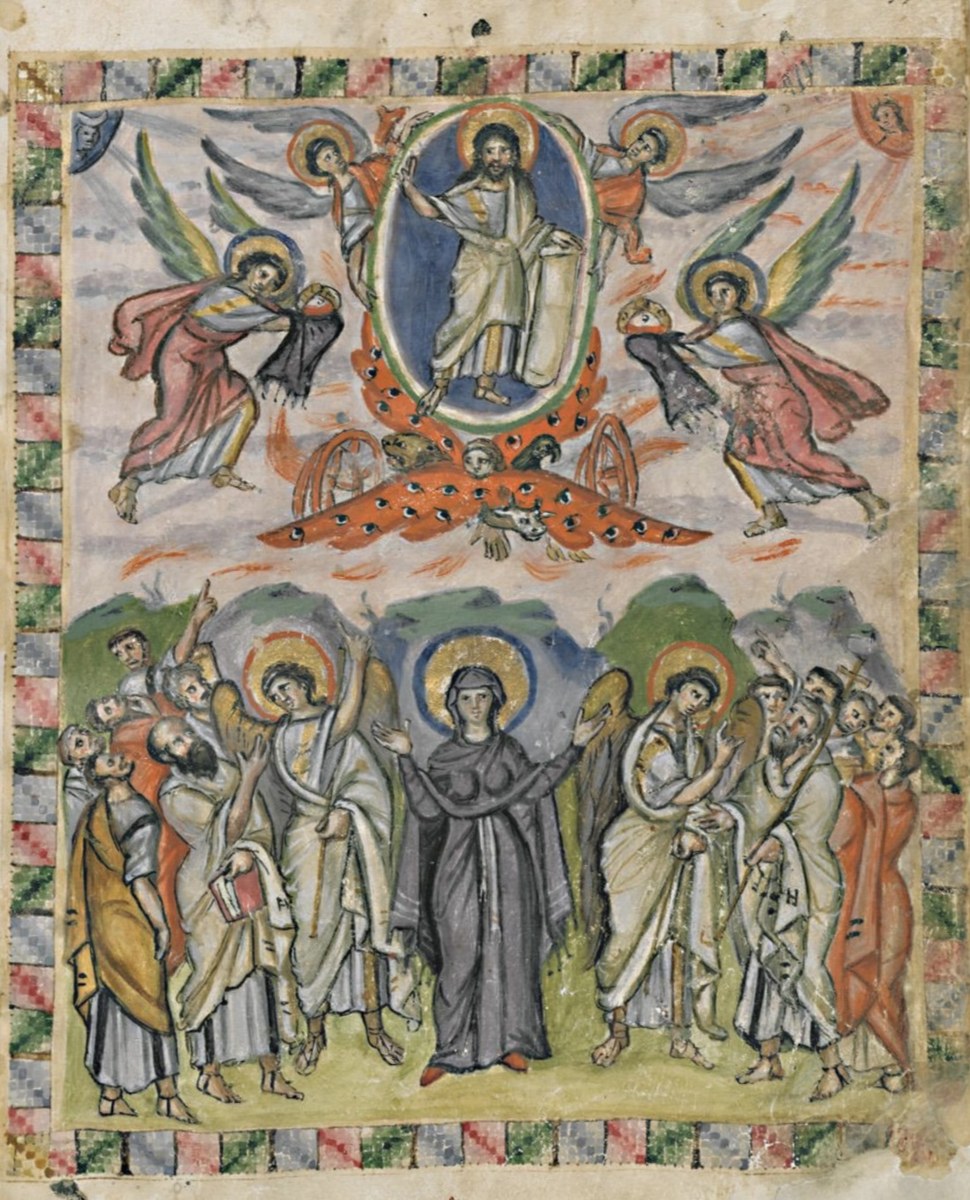
The Holy Ascension of our Lord and God and Saviour Jesus Christ, kept on the fortieth day after Pascha and therefore always on a Thursday, is the Great Feast on which the Church celebrates the last of the events of the incarnate economy: that Christ, having shown himself alive to his disciples over forty days, led them out toward Bethany on the ridge of the Mount of Olives, lifted up his hands and blessed them, and while he blessed them was taken up, a cloud receiving him out of their sight, until two men in white apparel stood by them and said that this same Jesus should so come again as they had seen him go. The feast is not a farewell. Everything the Church sings on the day insists on the opposite: he is "in no way parted" from those he leaves, and what happens on the mountain is not a subtraction from earth but an addition to heaven, for the flesh he took from the Virgin is carried into the divine glory and seated at the right hand of the Father, so that — in the phrase the hymnography returns to again and again — our nature, long ago cast out, is set above the angels upon the throne of God. The Ascension is thus read as the completion of the Incarnation rather than its reversal, the crowning of the Resurrection rather than its cancellation, and the necessary condition of Pentecost, since it was the Lord himself who said that unless he went away the Comforter would not come. It is one of the Twelve Great Feasts, kept with an all-night vigil; it stands ten days before Pentecost with a week of afterfeast between; and it is preceded, on its eve, by the leavetaking of Pascha, when "Christ is risen" is sung for the last time in the year. In the icon of the feast the Mother of God stands motionless at the centre of the apostles although the Acts account does not name her on the mountain — a deliberate and very old confession that what is being painted is not a photograph of an event but the Church beneath her ascended Head.

The scriptural record
The Ascension is narrated at length only by Luke, who tells it twice, once at the end of his Gospel and once at the beginning of his second volume, and who is the sole source for the interval of forty days.
Luke 24:50–53 closes the Gospel: "And he led them out as far as to Bethany, and he lifted up his hands, and blessed them. And it came to pass, while he blessed them, he was parted from them, and carried up into heaven. And they worshipped him, and returned to Jerusalem with great joy: and were continually in the temple, praising and blessing God." Three details of this short passage have shaped the whole feast. The first is the blessing: the last thing the disciples see is a pair of raised hands, and the troparion of the day makes the blessing itself the ground of their certainty — "by the blessing they were assured that thou art the Son of God." The second is joy: they do not mourn, they worship and go back rejoicing, which is the exact reverse of what a bereavement produces and is the strongest internal argument that the earliest Christians did not experience the Ascension as a loss. The third is the temple: Luke's Gospel opened in the sanctuary with Zacharias and closes with the disciples continually there, so that the ascent of Christ into the true holy place is framed by the shadow of it.
Acts 1:1–12 retells the same event as the hinge of the Church's history and supplies what the Gospel omitted. Christ "shewed himself alive after his passion by many infallible proofs, being seen of them forty days, and speaking of the things pertaining to the kingdom of God"; he charges them not to depart from Jerusalem but to wait for the promise of the Father, "for John truly baptized with water; but ye shall be baptized with the Holy Ghost not many days hence"; they ask — still, after everything — "Lord, wilt thou at this time restore again the kingdom to Israel?" and are told that the times are not theirs to know, but that they shall receive power when the Holy Spirit is come upon them and shall be witnesses "unto the uttermost part of the earth." Then: "while they beheld, he was taken up; and a cloud received him out of their sight. And while they looked stedfastly toward heaven as he went up, behold, two men stood by them in white apparel; which also said, Ye men of Galilee, why stand ye gazing up into heaven? this same Jesus, which is taken up from you into heaven, shall so come in like manner as ye have seen him go into heaven. Then returned they unto Jerusalem from the mount called Olivet, which is from Jerusalem a sabbath day's journey."
Mark 16:19 gives the event in a single sentence of dogmatic weight: "So then after the Lord had spoken unto them, he was received up into heaven, and sat on the right hand of God." This is the verse that ties the Ascension to Psalm 109:1 (110:1), "The Lord said unto my Lord, Sit thou at my right hand," and through it to the sixth article of the Creed. It belongs to the longer ending of Mark, whose textual standing is discussed below; the Orthodox Church reads it as Scripture, and reads the whole of Mark 16:9–20 as the Gospel of Matins on the feast.
The rest of the New Testament does not narrate the Ascension but everywhere presupposes it, and the epistolary language is if anything bolder than the narrative. Ephesians 4:8–10 applies Psalm 67:19 (68:18) to Christ — "When he ascended up on high, he led captivity captive, and gave gifts unto men" — and draws the conclusion that "he that descended is the same also that ascended up far above all heavens, that he might fill all things," which is the exact theology of the kontakion. 1 Timothy 3:16 places the Ascension at the end of what is plainly an early hymn: "God was manifest in the flesh, justified in the Spirit, seen of angels, preached unto the Gentiles, believed on in the world, received up into glory." 1 Peter 3:22 speaks of him "who is gone into heaven, and is on the right hand of God; angels and authorities and powers being made subject unto him." And the Epistle to the Hebrews builds its entire argument on the Ascension understood as a priestly act: we have "a great high priest that is passed into the heavens" (4:14); "Christ is not entered into the holy places made with hands, which are the figures of the true; but into heaven itself, now to appear in the presence of God for us" (9:24); and "this man, after he had offered one sacrifice for sins for ever, sat down on the right hand of God" (10:12). What Luke describes from the mountain, Hebrews describes from within the sanctuary: the same movement seen from the other side of the veil.
The forty days, and why forty
Only Acts 1:3 supplies the number, and it governs the calendar of the whole Church. The forty days are not presented as a continuous companionship. Luke's phrase is that Christ was "seen of them" through that period — appearing and withdrawing, entering through shut doors, unrecognised on the Emmaus road until the bread is broken, standing on the shore of Tiberias in the morning mist. John Chrysostom draws exactly this out: the Lord no longer lived with the disciples as before, but came and disappeared again, and the intermittence was itself pedagogy — enough appearance to make the Resurrection certain, enough absence to make them stop treating him as they had treated him before, and to lift their minds to what he now was. The risen body is not a resuscitated body; Lazarus came back into the same mortal condition and died again, while Christ rose into an order of existence that the old habits of discipleship could no longer contain.
The number itself carries the whole weight of the biblical forty. The rain fell forty days upon the earth; Moses was on Sinai forty days and forty nights, and again forty days after the golden calf; Elijah walked forty days to Horeb in the strength of a single meal; Israel was forty years in the wilderness; the Lord himself fasted forty days after his baptism; and the child Jesus was brought into the temple on the fortieth day, so that the Ascension, the entry of the incarnate Son into the true sanctuary, answers the Meeting of the Lord at the beginning of his human life. In the patristic reading forty is the number of a completed formation — a period long enough to make a witness, a fast, a nation or a catechumen — and the forty days of Acts are the risen Christ's own catechism, spent "speaking of the things pertaining to the kingdom of God." The Church has always taken that phrase seriously: what the apostles were taught in those days is the reason the apostolic tradition is understood to contain more than the written Gospels record.
There is also a plain liturgical consequence. Because the interval is counted from the Resurrection and the Resurrection is always a Sunday, the fortieth day is always a Thursday. The Ascension is the only one of the Twelve Great Feasts that can fall on no other day of the week, and the only one whose Great Feast character has to assert itself against an ordinary working weekday — which is part of the reason several Western jurisdictions have transferred their observance to the following Sunday, and part of the reason the Orthodox East has refused to.
The Mount of Olives and the site
Acts names the place: "the mount called Olivet," a sabbath day's journey from Jerusalem — the rabbinic limit of about two thousand cubits, roughly a kilometre, which is precisely the distance from the city to the ridge and is Luke's quiet way of saying that the disciples could walk back that same day without breaking the Law. The Mount of Olives is the long limestone ridge east of the Old City, separated from the temple platform by the ravine of the Kidron and rising above eight hundred metres, so that a man standing on it looks down into the sanctuary. It is the mountain of David's flight and of Ezekiel's vision of the glory of the Lord departing from the city and standing upon the mountain on its east side; it is where Christ wept over Jerusalem, where he spoke the discourse on the last things, and from whose slope he rode down into the city on the foal of an ass; Gethsemane lies at its foot. That the Ascension takes place there is not incidental. It is the same ground from which he entered the city to die.
Above all it is the mountain of Zechariah 14:4, read at the Vespers of the feast: "and his feet shall stand in that day upon the mount of Olives, which is before Jerusalem on the east." The prophecy is of the Day of the Lord, and the Church reads it as the promise of the return — so that the place of the departure is by prophetic appointment also the place of the coming, and the angels' "shall so come in like manner" is heard as the fulfilment of a text already read aloud that evening.
The site was marked early. The pilgrim Egeria, in Jerusalem about 381–384, describes the stations of the Great Week and of the fiftieth day on the mount, distinguishing the cave-church of the Eleona on the slope — the basilica of the teaching of Christ, associated with the building programme of Constantine and Helena — from the open hillock above it, which the Greek-speaking community called the Imbomon, "on the hill." Within a few years of her visit a Roman noblewoman named Poimenia paid for a church there, built between about 384 and 390 around the place of the last footprints, and it was constructed deliberately as a rotunda open to the sky, ringed with porticoes and arches and roofed by nothing at all: a building whose architecture is an argument, since the one thing that must not be interrupted at the place of the Ascension is the line of sight upward. The Mount of Olives churches suffered in the Persian sack of Jerusalem in 614 and were restored afterwards; the Crusaders rebuilt the shrine in the twelfth century as a small octagon within a larger octagonal enclosure; and after the fall of the kingdom to Saladin in 1187 the chapel passed into Muslim hands, was roofed over, and was given a mihrab in its south wall. It remains in the custody of the Islamic Waqf, and the Christian communities of Jerusalem — Greek Orthodox, Armenian, Syriac, Coptic and Latin — are admitted to serve their liturgies there on their respective Ascension days, each raising a temporary altar in the enclosure. Inside the little octagon lies the Ascension Rock, a slab bearing what pilgrims have venerated since antiquity as the print of Christ's right foot, the left having been carried off to the Aqsa in the Middle Ages. Two hundred metres to the north-east stands the Russian Convent of the Ascension, founded in 1870, whose slender white bell tower — the tallest thing on the ridge — is visible from most of Jerusalem.
The two men in white, and the answer to the gazing
The angelic interruption in Acts 1:10–11 is not decorative. The disciples are left standing with their faces turned up, and are rebuked for it: why stand ye gazing up into heaven? The rebuke is the most practical sentence in the feast. It ends the contemplation and starts the mission; ten days later the same men will be in the street being accused of drunkenness. The Church's hymnography quotes the angels' words directly and repeatedly, and the aposticha of Vespers turn the whole exchange into a dialogue — "Ye men of Galilee, why do ye stand looking into heaven? This is Christ our God, who has been taken up from you into heaven; he shall come again in the same manner as ye beheld him going into heaven."
Their second sentence is the Church's doctrine of the Second Coming in one clause: "in like manner." The return will be of this same Jesus, bodily, visibly, and from the same quarter — not a symbol, not a diffusion, not a different person. What was taken up is what will come back, and it is human. Hence the paradox the feast keeps insisting on: the Ascension is at once the last of the events of the first coming and the first announcement of the second, which is why the katavasia and the stichera of the day slip so easily from the cloud that receives him into the throne of judgement, and why the Church appointed the strongly eschatological Zechariah 14 to be read at its Vespers.
The two figures are described only as "men," as at the empty tomb in Luke's own Gospel; the tradition and the iconography read them as angels, and the icon gives them wings and puts them in white in the centre of the apostolic company, pointing upward with one hand and speaking with the other.
The enthroning of human nature
The doctrinal content of the feast is compressed into the sixth article of the Creed — "and ascended into heaven, and sitteth at the right hand of the Father" — and everything the Church sings on the day is commentary on it.
The first thing to be said is negative, and the Fathers say it firmly: the "right hand of the Father" is not a place, and the Ascension is not a journey. God has no right side, heaven is not the sky, and no one imagines that the physical Jesus is now seated on a material chair somewhere in the created universe. To sit at the right hand is a scriptural idiom of shared rule and equal honour, and to say that the ascended Christ sits there is to say that the humanity he assumed has been brought into the very life of God. The Son as God never left the Father's bosom — the doxastikon of Great Vespers begins by saying so, "not separated from the Father's bosom" — so that whatever moves in the Ascension is not the divinity but the flesh.
That is the second and positive thing, and it is the whole feast. What ascends is a human body: circumcised, hungry, tired, scourged, pierced, and now incorruptible. The stichera dwell on the astonishment of the bodiless powers at the sight, and the astonishment is not sentimental — the angels are amazed because something is happening to the created order that has never happened, namely that a creature of dust is being carried past them to the throne. The canon of the eighth ode states it flatly: our nature, which fell of old, has been raised above the angels and enthroned upon the divine throne beyond all understanding. John Chrysostom, whose Ascension preaching the Orthodox tradition has quarried ever since, makes the same point with a kind of civic astonishment: we who were not fit for earth have been brought up to the kingdom on high; the nature which the cherubim guarded out of Paradise with a flaming sword has now gone up and sat down on the throne of the Lord.
From this follow the two great consequences the feast exists to state. The first is that the Ascension is the completion of the Incarnation, not its undoing. The Word did not put on flesh for thirty-three years and lay it down; he took it for ever, and carried it home. The oikos of the feast and the whole apparatus of Hebrews say the same thing from the priestly side: a man has entered the holy of holies, once and for all, and stays there — "now to appear in the presence of God for us." There is a human being in the presence of God on our behalf, permanently, and that is what an Orthodox Christian means by saying that Christ is our intercessor. The second consequence is theosis. If our nature has been glorified in him, then the promise that we may become "partakers of the divine nature" has an actual location and an actual first instance. The Ascension is the pledge that the ordinary human material of which the saints are made is capable of the glory of God, because a specimen of it is already there.
Two ancient refinements are worth recording. The Greek name of the feast, Ἀνάληψις, is a passive noun — a taking up, from the ἀνελήμφθη of Acts — whereas the Latin West named it Ascensio, an active going up. The hymnography uses both freely ("thou wast taken up", "thou didst go up"), and the Fathers were content that it should, because the two forms guard the two natures: as man he was taken up, as God he ascended by his own power. The comparison the tradition draws is with Elijah, whose chariot of fire the second canon explicitly names as the image of this day: Elijah was carried, and only as far as the height of heaven; Christ went by his own authority, and past every heaven. And it was noticed early that the last thing the disciples saw was a blessing and not a valediction — the priestly gesture of Aaron, given at the moment of entry into the sanctuary, and never withdrawn.
"It is expedient for you that I go away"
The Ascension is the condition of Pentecost, and this is stated by Christ himself in the discourse at the Supper: "Nevertheless I tell you the truth; It is expedient for you that I go away: for if I go not away, the Comforter will not come unto you; but if I depart, I will send him unto you" (John 16:7). John had already noted that "the Holy Ghost was not yet given; because that Jesus was not yet glorified" (John 7:39). The Church has therefore never treated the ten days between the two feasts as an empty interval, and the troparion says outright that the Lord's going up gladdened the disciples — with the promise of the Spirit, which is the only reason a departure could gladden anyone.
Why the sequence should be necessary is answered in several complementary ways. The plainest is the one Chrysostom gives: the gifts of the Spirit are the seal of a reconciliation, and until the reconciliation was accomplished and the first-fruits of our nature actually presented in heaven, there was nothing to seal. Ten days before, our nature went up to the throne; on the fiftieth day the Spirit came down onto that nature. A second answer concerns the disciples themselves: while Christ was visibly present they could and did rest in his presence, and the whole burden of the farewell discourse is that they must be made to carry him inwardly instead — the local, seen, touchable presence gives way to a presence that is everywhere and interior, which is a gain and not a loss, but only for those who have been given the Spirit to hold it with. A third is ecclesiological and is the reason the Ascension is spoken of as the birth of the Church's mission: an ascended Head requires a body on earth, and the Spirit is given to constitute it. The kontakion holds the whole paradox in a single line — taken up in glory, yet in no way parted, and crying to those who love him, "I am with you, and no one is against you."
The Theotokos at the centre
The Acts narrative names only the apostles on the mountain. It mentions the Mother of God nine verses later, in the upper room, "with the women, and Mary the mother of Jesus, and with his brethren" (Acts 1:14) — present for the waiting and for Pentecost, but not written into the scene of the Ascension itself. Yet in every Byzantine and Slavic icon of the feast she stands at the exact centre of the lower register, taller and stiller than everyone around her, usually in the orans posture with both hands raised, and she is very often the only figure who is not looking up.
This is deliberate and it is old — it is already the arrangement of the sixth-century Rabbula miniature — and the Church's liturgical texts, not the painters' imagination, are its warrant. The doxastikon at the Litia of Great Vespers states in plain words that Christ came to the Mount of Olives having with him her who bore him, and gives the reason: she who as a mother suffered in his Passion beyond all others must also have the surpassing joy of the glorification of his flesh. The aposticha of Little Vespers say the same, that in his Ascension he filled with boundless joy both the disciples and the Theotokos who bore him. The tradition thus asserts her presence, and asserts it for a reason of justice rather than of narrative.
Her position also does theological work that no other figure could do. The Ascension is the feast of the glorifying of the flesh of Christ, and that flesh came from her: she is the pledge and the source of the very humanity now being enthroned, so that to put her at the centre beneath the mandorla is to say where the ascending body came from. And because she stands among the apostles with her hands raised in prayer, she is at the same time the figure of the Church — the praying assembly gathered beneath its ascended Head, with the apostolic college around her and the two angels turning them from the sky toward the world. Iconographers commonly include Paul among the apostles as well, who was not converted until afterwards, which is the same statement made a second time: the lower half of this icon is not a group portrait of the eyewitnesses but a portrait of the Church, in which the Mother of God stands at the centre because that is where she stands.
The history of the feast
The Ascension as a doctrine is as old as the preaching of the apostles; the Ascension as a separate feast on the fortieth day is not, and the earliest period is genuinely obscure.
The oldest discernible arrangement seems to be that the ascent of Christ and the gift of the Spirit were kept together at the close of the fifty days, the whole Pentecost being celebrated as one continuous festal season of which the fiftieth day was the crown. The much-discussed forty-third canon of the Synod of Elvira (about 300) censures a local practice concerning the observance of the fiftieth day in a way that is most naturally read as presupposing an undivided commemoration; the canon is compressed and its interpretation is contested, but it is the earliest evidence anyone has.
Through the fourth century the fortieth day emerges as a feast in its own right, and by the end of it the separation is complete across the Christian world. Egeria at Jerusalem in the early 380s describes observances on the Mount of Olives; the Apostolic Constitutions, compiled in Syria about 380, legislate for the fortieth day as an established solemnity and forbid work upon it; Gregory of Nyssa preached a homily on the Ascension which the standard handbooks customarily cite as the earliest surviving sermon certainly delivered for the feast, usually dated to 388; and John Chrysostom preached on it at Antioch, in the open air at a martyrium outside the city — a detail of particular interest to the Antiochian tradition, since it places a fully formed Ascension feast in the Syrian metropolis in the closing years of the fourth century. By the time of Augustine the feast was so universal that he could argue in a well-known letter that observances kept everywhere and instituted by no council must come from the apostles themselves, and he named the Ascension as one of his examples; the argument is not history, but the premise is: nobody in the early fifth century could remember the feast not existing.
From the sixth century onward the Byzantine observance is fully articulate, and its hymnography belongs to the two great schools. The first canon, in Tone 5, is ascribed to John the Monk, that is to John of Damascus, and comes from the Palestinian workshop that produced the canons of the Transfiguration; the second canon, in Tone 4 and carrying an alphabetical acrostic, is the work of Joseph of Thessalonica, the brother of Theodore the Studite, and belongs to the Constantinopolitan Studite reform. The feast entered the Slavic calendar with the rest of the Byzantine inheritance as Вознесение Господне, Voznesenie Gospodne; in the Arabic of the Patriarchate of Antioch it is عيد الصعود, ʿĪd al-Ṣuʿūd, the Feast of the Ascent, and the day itself خميس الصعود, Khamīs al-Ṣuʿūd, Ascension Thursday.
Two later divergences are worth recording. In much of the Latin West the feast has been transferred in recent decades from Thursday to the following Sunday in many territories, on pastoral grounds; the Orthodox Church has made no such transfer anywhere, because the fortieth day is a datum of the text and not a convenience. And in the Byzantine rite the Ascension is one of the very few Great Feasts with no forefeast at all — an anomaly with a simple cause, explained below.
Feast and commemoration
The fortieth day after Pascha, counted inclusively from Pascha itself as day one, and therefore always the Thursday of the sixth week of the Pentecostarion (39 days after Pascha; see the rule file). Being movable it has no church date; in the civil calendar it falls between about 13 May and 16 June for the churches that keep the traditional Paschalion. It is a feast of the Lord and one of the Twelve Great Feasts, kept everywhere in the Byzantine rite with an all-night vigil, and as a Dominical feast it displaces or reduces whatever saint's commemoration falls on the day; where the coincidence is with a major saint — Constantine and Helen on 21 May, for instance — the Typicon prescribes a combined service, and the proper of the feast governs.
The position of the day inside the Pentecostarion is unusually eloquent. The Ascension has no forefeast, and the reason is that the day before it is occupied: Wednesday of the sixth week is the leavetaking of Pascha (38 days after Pascha), the thirty-eighth day, on which the entire paschal office is served for the last time in the year, the Paschal Hours are read for the last time, and the greeting "Christ is risen — Indeed he is risen" is exchanged for the last time until the next Pascha. The Church closes the Resurrection at Vespers and opens the Ascension at the same service; the two feasts touch without an interval, and the effect — a sudden silence where the paschal troparion has been sung continuously for five and a half weeks, immediately filled by "Thou wast taken up in glory" — is one of the most deliberate transitions in the whole liturgical year.
The afterfeast runs eight days, to the leavetaking (apodosis) on the Friday of the seventh week (47 days after Pascha), which is served with the full festal office; the Saturday following is the Trinity Soul Saturday (48 days after Pascha) and the day after that is Pentecost (49 days after Pascha). Within the afterfeast falls the Sunday of the Fathers of the First Ecumenical Council (42 days after Pascha), and its placement there is not accidental: the fathers of Nicaea are commemorated in the week of the feast whose article of the Creed — "and ascended into heaven, and sitteth at the right hand of the Father" — they defined, and the propers of the two are sung together.
Where a liturgical colour is appointed the feast is served in white and gold, the colours of light and of the Lord's feasts; Greek practice keeps no fixed colour system and vests in bright festal cloth by custom. In many places the icon of the feast is carried in procession, and in Russian usage the day carries a body of village custom concerning the last of the spring — the Lord's "forty days walking the earth" being popularly reckoned to end on this day. In Jerusalem the Greek Orthodox Patriarchate serves the Liturgy at the Chapel of the Ascension itself on the Mount of Olives, an altar being raised inside the octagonal enclosure by permission for the day.
Hymns
Apolytikion — Tone 4
Thou wast taken up in glory, O Christ our God, and didst gladden thy disciples with the promise of the Holy Spirit; and by the blessing they were made certain that thou art the Son of God, the Redeemer of the world.
Kontakion — Tone 6
Having fulfilled the dispensation for our sake, and united the things of earth with the things of heaven, thou wast taken up in glory, O Christ our God, in no way parted from us, but remaining inseparable and crying to those who love thee: I am with you, and no one is against you. Leaving on earth the things of earth, and yielding the ashes to the dust, come, let us wake and lift up our eyes and our thoughts on high; let us mortals send our sight and our senses together flying toward the gates of heaven; let us reckon that we are on the Mount of Olives and are gazing upon the Redeemer as he is borne upon a cloud.
Original translation from the Greek
Exapostilarion — Tone 2 (sung three times)
Before the eyes of thy disciples thou wast taken up, O Christ, to be enthroned together with the Father; and the angels running on before thee cried aloud: Lift up the gates, lift them up, for the King has gone up to the glory that is the source of light.
The
O Lord, having in thy goodness fulfilled the mystery hidden from the ages and from the generations, thou didst come with thy disciples to the Mount of Olives, having with thee her who bore thee, the Maker and Fashioner of all things; for she who as a mother grieved above all others in thy Passion had also to enjoy the surpassing joy of the glorifying of thy flesh — in which we too, sharing it, glorify at thine ascent into the heavens, O Master, thy great mercy that has come upon us.
Appointed readings
Epistle — Acts 1:1–12
1The former treatise have I made, O Theophilus, of all that Jesus began both to do and teach, 2Until the day in which he was taken up, after that he through the Holy Ghost had given commandments unto the apostles whom he had chosen: 3To whom also he shewed himself alive after his passion by many infallible proofs, being seen of them forty days, and speaking of the things pertaining to the kingdom of God: 4And, being assembled together with them, commanded them that they should not depart from Jerusalem, but wait for the promise of the Father, which, saith he, ye have heard of me. 5For John truly baptized with water; but ye shall be baptized with the Holy Ghost not many days hence. 6When they therefore were come together, they asked of him, saying, Lord, wilt thou at this time restore again the kingdom to Israel? 7And he said unto them, It is not for you to know the times or the seasons, which the Father hath put in his own power. 8But ye shall receive power, after that the Holy Ghost is come upon you: and ye shall be witnesses unto me both in Jerusalem, and in all Judæa, and in Samaria, and unto the uttermost part of the earth. 9And when he had spoken these things, while they beheld, he was taken up; and a cloud received him out of their sight. 10And while they looked stedfastly toward heaven as he went up, behold, two men stood by them in white apparel; 11Which also said, Ye men of Galilee, why stand ye gazing up into heaven? this same Jesus, which is taken up from you into heaven, shall so come in like manner as ye have seen him go into heaven. 12Then returned they unto Jerusalem from the mount called Olivet, which is from Jerusalem a sabbath day’s journey.
Gospel — Luke 24:36–53
36And as they thus spake, Jesus himself stood in the midst of them, and saith unto them, Peace be unto you. 37But they were terrified and affrighted, and supposed that they had seen a spirit. 38And he said unto them, Why are ye troubled? and why do thoughts arise in your hearts? 39Behold my hands and my feet, that it is I myself: handle me, and see; for a spirit hath not flesh and bones, as ye see me have. 40And when he had thus spoken, he shewed them his hands and his feet. 41And while they yet believed not for joy, and wondered, he said unto them, Have ye here any meat? 42And they gave him a piece of a broiled fish, and of an honeycomb. 43And he took it, and did eat before them. 44And he said unto them, These are the words which I spake unto you, while I was yet with you, that all things must be fulfilled, which were written in the law of Moses, and in the prophets, and in the psalms, concerning me. 45Then opened he their understanding, that they might understand the scriptures, 46And said unto them, Thus it is written, and thus it behoved Christ to suffer, and to rise from the dead the third day: 47And that repentance and remission of sins should be preached in his name among all nations, beginning at Jerusalem. 48And ye are witnesses of these things. 49And, behold, I send the promise of my Father upon you: but tarry ye in the city of Jerusalem, until ye be endued with power from on high. 50And he led them out as far as to Bethany, and he lifted up his hands, and blessed them. 51And it came to pass, while he blessed them, he was parted from them, and carried up into heaven. 52And they worshipped him, and returned to Jerusalem with great joy: 53And were continually in the temple, praising and blessing God. Amen.
Iconography
The Ascension is one of the fixed types of Orthodox iconography, settled in its essentials by the sixth century and thereafter varied but never restructured. Its scheme is strictly two-storeyed and the two storeys are joined by nothing — which is the point.
In the upper register Christ is enthroned or standing within a mandorla, usually circular rather than the almond of the Transfiguration, blessing with his right hand and holding a scroll or a Gospel book in his left. The mandorla is carried by angels, commonly two, often four, who fly with it in violent inclined postures, their bodies straining; in the Rabbula miniature and its descendants the mandorla rests on the fiery tetramorph of Ezekiel's vision, the winged chariot full of eyes with its wheels, so that Christ ascends on the throne-chariot of the prophet. Christ is characteristically shown frontal and motionless while everything around him strains, which is the iconographers' way of saying that he is not being transported: the movement is in the created order, not in him.
In the lower register, on the green slope of the mountain, stands the Mother of God at the exact centre, frontal, still, usually in the orans posture with both hands raised and often the only figure not looking upward. Flanking her immediately are the two angels in white, wingless in some early recensions and winged in most, one hand pointing up to the ascending Christ and the other extended in speech toward the apostles — the visualisation of "why stand ye gazing up into heaven." To either side, in two crowded groups, are the apostles, arranged in the sharpest possible contrast to the calm at the centre: heads thrown back, hands raised to shade the eyes, bodies twisting, several in profile looking at one another as though asking what has happened. Peter is normally at the head of the left group and Paul at the head of the right, and Paul's presence — he was not converted for years afterwards — is the frank signal that this lower half is the Church rather than a roll of witnesses. In many recensions two or three olive trees rise from the slope and a pair of footprints is shown on the rock beneath the Theotokos, the relic venerated on the mount itself.
The vertical gap between the two registers is left deliberately empty, and it is the most theologically loaded part of the composition: the distance is real, and the icon does not bridge it, because it is the Spirit and not a ladder that joins them, and that is Pentecost's business rather than this feast's. From the ninth century onward the scheme was regularly transferred to architecture and painted in the dome or the eastern vault of Byzantine churches, where the mandorla occupies the crown of the vault and the apostles stand round the drum looking genuinely upward at a genuine height.
The stored icon is the earliest surviving example of the developed type and the ancestor of all the rest: the Ascension miniature on folio 13v of the Rabbula Gospels, a Syriac Gospel book written and illuminated in AD 586 at the monastery of Saint John at Beth Zagba in the Syrian Orient and now in the Biblioteca Medicea Laurenziana in Florence (Plut. I, 56) — a manuscript of the Antiochian world, and one of the very few illuminated books of the period to survive at all. Christ stands in a deep blue oval mandorla, blessing, held aloft by two angels who lean inward, while two more fly in from either side with crowns; beneath the mandorla burns the orange tetramorph, its wings covered with eyes and its wheels at either edge, and the hand of God appears above. Below, on a green slope between grey hills, the Theotokos stands frontal at the exact centre in a dark blue-grey maphorion, both hands raised in prayer, her feet in red; two haloed angels in white flank her with hands extended toward the apostles; and the twelve crowd in on either side in ochre, red and white, one at the far left holding a red-edged codex, several with hands flung up and heads tilted back, all of them in motion while she is entirely still. Every element of the later Byzantine icon is already present in 586, which is the measure of how early this composition was fixed.
The second stored image shows the type at its Russian summit: the festal panel of the Ascension painted in 1408 for the iconostasis of the Dormition Cathedral at Vladimir, from the tier known as the Vasilyevsky chin — so called because the obsolete iconostasis was removed from the cathedral between 1768 and 1775 and sold to the village church of Vasilyevskoye near Shuya, from which the surviving panels were recovered by the state restoration workshops between 1918 and the early 1920s. The commission is that of Andrei Rublev and Daniil Chorny, and of the five surviving festal icons the Ascension is the one most often given to Rublev's own hand. Christ sits within a dark blue-green disc of glory, blessing, carried by four angels in blue and red whose bodies are laid out almost horizontally against a pale gold sky. Below, against the same gold, the Mother of God stands at the centre in a deep red maphorion over dark blue, her hands before her; two angels in white robes stand immediately behind and beside her, each with an arm raised toward the disc; and the apostles are massed six to a side in green, rose, olive and blue, their faces turned up and inward. What distinguishes the panel is exactly what distinguishes Rublev: the crowd is organised into a slow rhythm of inclined heads that rises from the outer edges toward the centre, so that the whole lower register reads as a single wave breaking upward beneath the ascending disc. It is in the State Tretyakov Gallery, Moscow.
Disputed questions
The date within Luke's Gospel. Read on its own, Luke 24 gives no interval at all: the women at the tomb, the Emmaus road, the appearance in Jerusalem and the leading out to Bethany follow one another in a single unbroken sequence, so that the Gospel taken by itself reads as though the Ascension happened on the evening of the Resurrection, while Acts 1:3 by the same author puts it forty days later. The observation is ancient and the modern discussion of it is large. The traditional resolution is that Luke's Gospel compresses — it is closing a book, not keeping a diary, and ancient narrative regularly telescopes without implying immediacy; Acts, whose subject is the sequel, supplies the chronology the Gospel had no reason to give. A body of modern criticism prefers to say that Luke has two accounts serving two theological purposes and has not harmonised them. The Church's practice answers the question liturgically rather than critically: it reads Luke 24:36–53 as the Gospel of the fortieth day, and Acts 1:1–12 as its Epistle, on the same morning.
Bethany or Olivet. Luke says he led them out "as far as to Bethany"; Acts says they returned "from the mount called Olivet." There is no real conflict — Bethany lies on the eastern flank of the same ridge, and "as far as toward Bethany" describes a direction of walking rather than an arrival — but the tradition's identification of the summit above the Eleona as the exact spot rests on fourth-century Jerusalem custom rather than on the text, and should be described as such.
The text of Luke 24:51. The words "and was carried up into heaven" are absent from a small but weighty group of witnesses, including the original hand of Codex Sinaiticus and Codex Bezae with part of the Old Latin, and they are one of the classic "Western non-interpolations" over which editors have divided since Westcott and Hort. Most modern critical editions now print the clause, and the Byzantine text has never lacked it; the point is worth recording because the Ascension is one of the few articles of the Creed whose narrative basis has ever been textually contested at all.
The longer ending of Mark. Mark 16:9–20, which contains the Ascension verse and is read as the Matins Gospel of the feast, is missing from Codex Sinaiticus and Codex Vaticanus and from a number of versional and patristic witnesses, and the great majority of modern textual critics regard it as a second-century addition to a Gospel that originally ended at 16:8. The Orthodox Church receives the longer ending as canonical Scripture on the ground of its universal liturgical use — it supplies three of the eleven resurrectional Matins Gospels — and treats the manuscript question as a matter of the history of the text rather than of the canon.
The identity of "John the Monk." The first canon of the feast is ascribed in the Pentecostarion to Ἰωάννης Μοναχός, John the Monk, and that signature is conventionally read as John of Damascus. The identification is probable and is the tradition's own, but the name was borne by more than one hymnographer of the Palestinian school and not every text signed in that way is certainly his.