
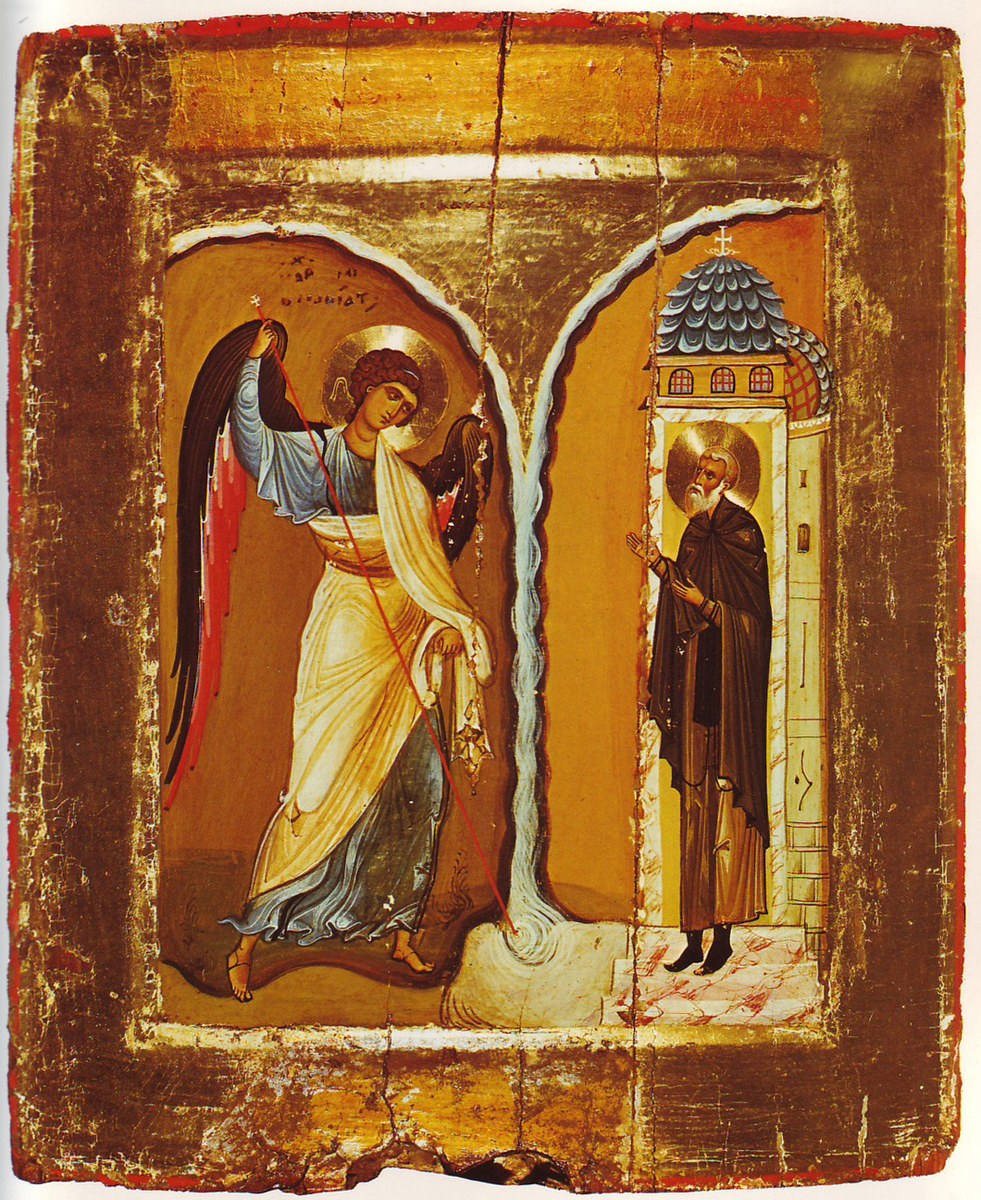
About Miracle of the Archangel Michael at Chonae →

Saints commemorated
-
Miracle of Archangel Michael at Colossae
-
Holy Prophet Zacharias and Righteous Elizabeth (1st c.), parents of St John the Forerunner.
-
St Maxim (Sandovich), martyr of Lemkos, Czechoslovakia (1914) (August 24 OC)
Maxim Sandovich (1886–1914), priest of the Lemko highlands, is the protomartyr of the Carpatho-Russian return to Orthodoxy — a young Lemko who left the Uniate Basilians for the Orthodox monastery of Pochaev, was ordained in 1911 for the villages of his own mountains, and served them under constant Austrian prosecution: two years in a Lviv prison on charges of "Russophile treason" ended in acquittal in the great trial of March 1914, and five months later, the World War having begun, he was seized again and shot without trial in the prison yard of Gorlice on 6 September 1914, crying with his last breath, "Long live the Rus' people, long live Orthodoxy!" His pregnant wife, father and brother were sent to the Talerhof camp; his posthumous son became a priest. The Church of Poland glorified him at Gorlice in September 1994.
-
Archippus of Herapolis
Archippus of Herapolis (Hierapolis in Phrygia) was the sacristan of the church of the Archangel Michael at the healing spring near Colossae, which he served for sixty years from the age of ten in a life of severe asceticism, catechising the pagans who came to the water. When his enemies loosed the joined flood of two rivers against the church to destroy both shrine and sacristan, his prayer was answered by the appearance of the Archangel Michael, who cleft the rock and swallowed the torrent — the Miracle at Chonae commemorated with him on September 6. He is not to be confused with the apostle Archippus of the Seventy (Colossians 4:17), commemorated February 19 and November 22.
-
David of Hermopolis
David of Hermopolis was the leader of a band of robbers in the Egyptian desert who, moved in old age to reckon with his crimes, forced his way into a monastery — threatening, when the abbot judged the life beyond his strength, to return and sack it — and there outstripped all the brethren in ascetic zeal. The tradition relates that the Archangel Gabriel announced God's forgiveness to him, and, when David could not believe that so great a sinner was so soon pardoned, left him mute except for the prayers and services of the church. He received grace to heal the sick and cast out demons, and reposed in peace, in the sixth century by the Greek reckoning. He is commemorated on September 6.
-
Eudoxius, Zeno and Macarius
Eudoxius was a high military commander under Diocletian and his successors, a secret Christian who laid down his rank rather than sacrifice to the idols and was martyred at Melitene in Armenia about 311–312, in the last great persecution before the peace of the Church. With him suffered his friend Zeno, who confessed Christ at his execution, and his household steward Macarius, who came forward after a vision of the martyr; his wife Basilissa, who sought but was denied a martyr's death, buried him. More than a thousand soldiers are said to have cast down their military belts in confession of Christ at his trial. The three are commemorated together on September 6.
-
Bega of Copeland
Bega (Bee) is the patroness of St Bees in Copeland, the coastal district of Cumbria whose headland and village still bear her name. The medieval tradition makes her an Irish king's daughter of the seventh century who fled a marriage to a pagan prince, crossed the sea, and lived as an anchoress at the headland later called St Bees; the York calendar styles her virgin and first abbess of Copeland. No contemporary record of her survives: her cult rests on the place-name, on the priory of St Bees, and on a famous bracelet-relic on which oaths were sworn in medieval Copeland. She is commemorated on September 6.
-
Felix and Augebert
Felix and Augebert were English youths sold as slaves in Gaul and ransomed at the direction of St Gregory the Great, who had captive Anglo-Saxon boys bought and placed in monasteries to be trained as missionaries for the conversion of their own people. Felix was in time ordained priest and Augebert deacon; but before they could be sent to England, both were killed by pagans in Champagne, about the beginning of the seventh century. Their whole record is this one notice, transmitted in the Western hagiographical compilations; they are commemorated together on September 6.
-
MacCallin of Lusk
MacCallin (Mac Cuilinn, Macculind) was bishop of Lusk (Lusca) in the north of the present County Dublin, one of the founding generation of the Irish church in the age after St Patrick. The Annals of Ulster record his death under the year 496; the traditional date, following the hagiographer Colgan, is 497. His name stands in the earliest Irish martyrologies, and a Scottish parish (Macallan, in Moray) preserved his veneration in Scotland. Beyond this the record is thin: the surviving Acts attached to his name are late and legendary. He is commemorated on September 6.
-
Magnus of Füssen
Magnus (Magnoald, Mang) is the apostle of the Allgäu, the Alpine country of south-western Bavaria, and founder of the monastery of Füssen on the river Lech, which bore his name (St Mang) until its dissolution. His Life places him in the circle of the Irish missionaries Columbanus and Gallus and dates his repose about 665 — so the York calendar styles him "disciple of St Columbanus" — though the Life is a ninth-century composition whose chronology is internally contradictory, and scholarship places the historical Magnus in the mid-eighth century. He reposed on September 6, his feast in Germany and in the York calendar alike.
Troparia & kontakia
Kontakion — Tone 2
Chief commander of God, minister of the divine glory, guide of men and captain of the bodiless powers: ask for us what is profitable, and great mercy, as chief commander of the bodiless hosts.
Troparion — Tone 4
Commander of the heavenly hosts, we the unworthy entreat thee without ceasing: wall us about by thy prayers beneath the shelter of the wings of thine immaterial glory, and guard us who fall down before thee and earnestly cry: deliver us out of dangers, as marshal of the powers on high.
Troparion — Tone 8
In thee, O father, that which is according to the image was preserved unimpaired; for taking up the cross thou didst follow Christ, and by thy deeds thou didst teach us to overlook the flesh, for it passeth away, but to care for the soul, an immortal thing; wherefore thy spirit, O venerable Archippus, rejoiceth with the angels.
Troparion — Tone 8
In thee, O father, that which is according to the image was preserved unimpaired; for taking up the cross thou didst follow Christ, and by thy deeds thou didst teach us to overlook the flesh, for it passeth away, but to care for the soul, an immortal thing; wherefore thy spirit, O venerable David, rejoiceth with the angels.
Troparion — Tone 4
Thy martyrs, O Lord, in their contest obtained from thee, our God, the crowns of incorruption; for possessing thy strength they cast down the tyrants and shattered the feeble insolence of the demons. By their intercessions, O Christ God, save our souls.
Troparion — Tone 4
As a good shepherd of the Lemko mountains thou didst lead thy people back to the faith of their fathers, and wast not silenced by prison nor by the rifles of the persecutors, O hieromartyr Maxim: standing at the wall with the cross in thy bound hands, thou didst cry out for Christ and thy people. Entreat him whom thou didst confess, that our souls may be saved.
Readings
2nd Matins Gospel
Mark 16.1-8
1And when the sabbath was past, Mary Magdalene, and Mary the mother of James, and Salome, had bought sweet spices, that they might come and anoint him. 2And very early in the morning the first day of the week, they came unto the sepulchre at the rising of the sun. 3And they said among themselves, Who shall roll us away the stone from the door of the sepulchre? 4And when they looked, they saw that the stone was rolled away: for it was very great. 5And entering into the sepulchre, they saw a young man sitting on the right side, clothed in a long white garment; and they were affrighted. 6And he saith unto them, Be not affrighted: Ye seek Jesus of Nazareth, which was crucified: he is risen; he is not here: behold the place where they laid him. 7But go your way, tell his disciples and Peter that he goeth before you into Galilee: there shall ye see him, as he said unto you. 8And they went out quickly, and fled from the sepulchre; for they trembled and were amazed: neither said they any thing to any man; for they were afraid.
Epistle
1 Corinthians 16.13-24
13Watch ye, stand fast in the faith, quit you like men, be strong. 14Let all your things be done with charity. 15I beseech you, brethren, (ye know the house of Stephanas, that it is the firstfruits of Achaia, and that they have addicted themselves to the ministry of the saints,) 16That ye submit yourselves unto such, and to every one that helpeth with us, and laboureth. 17I am glad of the coming of Stephanas and Fortunatus and Achaicus: for that which was lacking on your part they have supplied. 18For they have refreshed my spirit and yours: therefore acknowledge ye them that are such. 19The churches of Asia salute you. Aquila and Priscilla salute you much in the Lord, with the church that is in their house. 20All the brethren greet you. Greet ye one another with an holy kiss. 21The salutation of me Paul with mine own hand. 22If any man love not the Lord Jesus Christ, let him be Anathema Maranatha. 23The grace of our Lord Jesus Christ be with you. 24My love be with you all in Christ Jesus. Amen.
Gospel
Matthew 21.33-42
33Hear another parable: There was a certain householder, which planted a vineyard, and hedged it round about, and digged a winepress in it, and built a tower, and let it out to husbandmen, and went into a far country: 34And when the time of the fruit drew near, he sent his servants to the husbandmen, that they might receive the fruits of it. 35And the husbandmen took his servants, and beat one, and killed another, and stoned another. 36Again, he sent other servants more than the first: and they did unto them likewise. 37But last of all he sent unto them his son, saying, They will reverence my son. 38But when the husbandmen saw the son, they said among themselves, This is the heir; come, let us kill him, and let us seize on his inheritance. 39And they caught him, and cast him out of the vineyard, and slew him. 40When the lord therefore of the vineyard cometh, what will he do unto those husbandmen? 41They say unto him, He will miserably destroy those wicked men, and will let out his vineyard unto other husbandmen, which shall render him the fruits in their seasons. 42Jesus saith unto them, Did ye never read in the scriptures, The stone which the builders rejected, the same is become the head of the corner: this is the Lord’s doing, and it is marvellous in our eyes?