
Paschaltide, day 4 · 3 days since Pascha
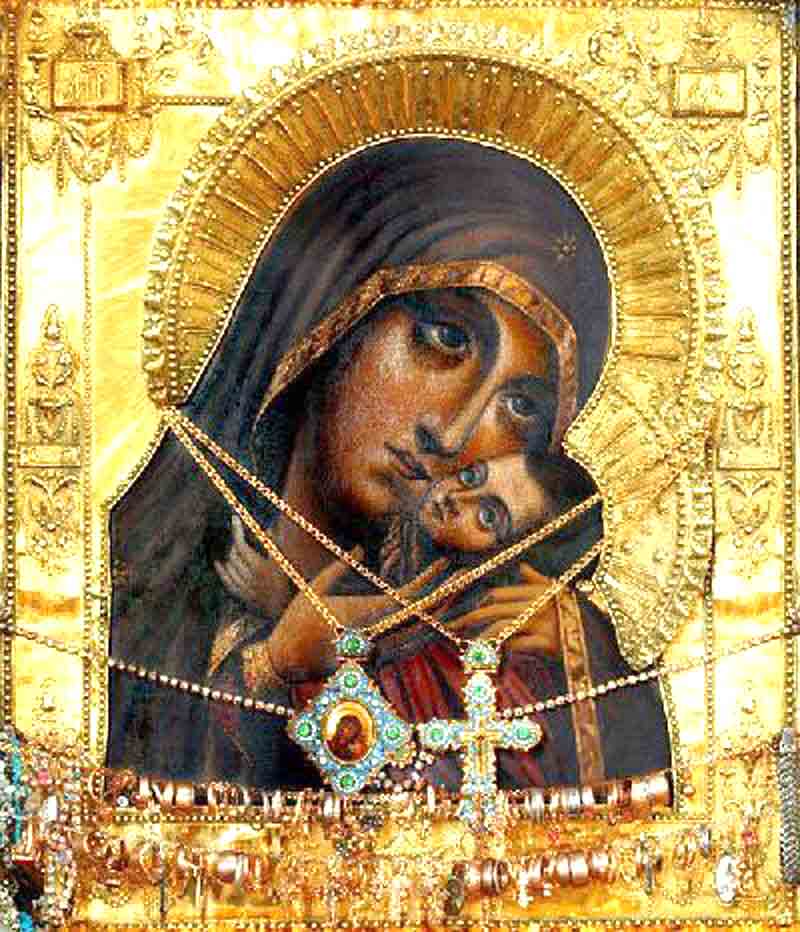
About Kasperov Icon of the Mother of God →

Saints commemorated
-
Hieromartyr Simeon, Kinsman of the Lord
Simeon, son of Clopas, was the second bishop of Jerusalem and a kinsman of the Lord according to the flesh — by the witness of Hegesippus a cousin of Christ, since Clopas was the brother of Joseph the Betrothed. Chosen to the throne of the mother church after the martyrdom of James the Brother of the Lord, he governed the Christians of Judea through the catastrophe of the Jewish War, the flight of the community across the Jordan to Pella, and the destruction of the Temple in the year 70, and held the see for some forty years — the longest bridge in the record between the apostolic generation and the Church of the second century. In the reign of Trajan, denounced by heretics both as a descendant of David and as a Christian, he was tortured for many days before the consular governor Atticus and at last crucified, in the year 107, at the reputed age of one hundred and twenty; his judges, says Hegesippus, marvelled that so old a man could endure. He is honoured as apostle of the Seventy, hierarch and martyr, and his feast is April 27.
-
Our Holy Father Stephen, Abbot of the Kiev Caves and Bishop of Vladimir (1094)
Stephen was a disciple of Theodosius of the Kiev Caves, whom the dying founder named as his own successor at the request of the brotherhood, and who as abbot completed the great church of the Dormition at the Caves monastery and reorganised its life around the new church. Deposed in 1078 by a faction within the community, he answered the injury by praying for those who had driven him out, and founded a new monastery on the Klov stream near Kiev, dedicating its church to the Placing of the Robe of the Theotokos at Blachernae in thanksgiving for the Mother of God's protection of the Caves. About 1091 he was made bishop of Vladimir in Volhynia, took part that same year in the translation of the relics of Theodosius, and for three years governed his see with a reputation for meekness and mercy before his repose on 27 April 1094. He is commemorated on April 27 and among the Saints of Volhynia on October 10.
-
Burning of the relics of St Sava I of Serbia by the Turks (1594)
Sabbas (Sava, c. 1174 – 1236), born Rastko Nemanjić, youngest son of the Serbian Grand Prince Stefan Nemanja, is the father of the Serbian Church and the most beloved of Serbian saints. As a youth he fled the court for Mount Athos and was tonsured a monk; there, joined by his abdicated father — the monk Symeon — he refounded the ruined monastery of Hilandar as the great Serbian house of the Holy Mountain. Returning home with his father's relics, he reconciled his warring brothers, reformed the monastic life of Serbia from Studenica, and in 1219 obtained from the exiled Patriarch of Constantinople at Nicaea the autocephaly of the Serbian Church and his own consecration as its first archbishop. He gave his people their law in the Zakonopravilo, its churches their order and hymnody, and its national memory its shape, writing the Life of his father the founder-saint. He died on pilgrimage at Tarnovo in Bulgaria in 1236; his relics, translated to Mileševa, worked wonders until the Turks, to break the Serbs, burned them at Belgrade in 1594 — the act that made him more than ever the symbol of the nation. He is commemorated on January 14, the leavetaking of the Theophany.
-
Eulogius the Hospitable
Eulogius, called Xenodochos, "the receiver of strangers," was a stonecutter of the Thebaid in Upper Egypt who earned a single small coin a day by his chisel and spent it all on the poor and on travellers: every evening, his work done and himself still fasting, he went out into the market place — in winter with a lantern in his hand — to find whoever had come into the town without bread or shelter, and brought them home. He is the subject of one of the most searching stories in the whole desert literature, the tale told in the Life of Abba Daniel of Sketis, in which Daniel, thinking to multiply so much good, prays God to give Eulogius wealth, and pledges his own soul for the man's salvation — whereupon Eulogius finds a buried hoard, rises to high office at Constantinople, and loses his charity altogether, until the loss of everything sends him back to the chisel and the lantern. He lived, the synaxarion says, more than a hundred years, and reposed in peace in his own country in the sixth century. His feast is April 27.
-
John of Kathara
John the Confessor, abbot of the monastery τῶν Καθαρῶν, "of the Pure," was one of the iconodule superiors broken by the second iconoclasm of the ninth century. Born about 778 at Irenopolis in the Decapolis of Coele-Syria, he was brought as a young monk into the orbit of the Seventh Ecumenical Council at Nicaea (787) and of the court of the Empress Irene and the Patriarch Tarasius, was ordained priest, and was set over the monastery of Kathara in the reign of Nicephorus I. When Leo V the Armenian revived the war on the holy icons, John's monastery was plundered and his community scattered; brought before the emperor, he rebuked him to his face and foretold his violent end, and was thrown into prison, then into the fortress of Pentadaktylon for eighteen months, then into the fortress of Kriotauron for two years. Leo's murder vindicated the prophecy; but John's confession was not finished, and under Theophilus the iconoclast patriarch John VII the Grammarian banished him at last to the island of Aphousia in the Propontis, where he reposed in peace about the year 839. His feast is April 27, and the Menaion's verse for him plays on the name of his house: suffering, it says, made John pure, who presided over the Pure.
British Isles and Ireland
- St. Asic, bishop of Elphin (490)
- Holy martyr Newlyna of Cornwall, (5th C)
- St. Enoder (Cynider) (6th C)
- St. Winewald, abbot of Beverley (751)
Troparia & kontakia
Apolytikion — Tone 4 (common of a righteous father)
O God of our fathers, who dealest with us ever according to Thy gentleness: take not Thy mercy from us, but by the prayers of Thy righteous one Eulogius govern our life in peace.
Apolytikion — Tone 8 (common of a venerable confessor)
In thee, O Father, was preserved unimpaired that which is according to the image; for taking up the Cross thou didst follow Christ, and by thy deeds thou hast taught us to despise the flesh, which passeth away, and to care for the soul, a thing immortal. Wherefore, O venerable John, thy spirit rejoiceth with the angels.
Apolytikion — Tone 1
Thee, the kinsman of Christ, O Simeon the hierarch and steadfast martyr, we praise with sacred hymns: for thou didst destroy delusion and keep the faith unharmed. Wherefore, as we keep today thy most holy memory, by thy prayers we receive the loosing of our sins.
Kontakion — Tone 6
Protection of Christians that cannot be put to shame, mediation unto the Creator unfailing: despise not the suppliant voices of sinners, but be quick to help us who cry to thee in faith; hasten to intercession and make speed to entreaty, O Theotokos, who dost ever protect them that honour thee.
Kontakion — Tone 8
As a great first-hierarch and companion of the Apostles, the Church glorifieth thee, O venerable one, thy own people's boast; but as thou hast boldness before Christ God, save us by thy prayers from every affliction, that we may cry to thee: Rejoice, O God-wise father Sava.
Kontakion — Tone 2
Having become a citizen of the Sion that is above, thou wast entrusted with the throne of the Sion that is below; and having guided thy flock well to the heavenly fold, thou wast crucified for Christ, O Simeon, imitating His divine Passion.
Kontakion — Tone 6
The enemy, envying thy honourable life, thrust thee out by his craft from the headship of the flock; yet thou, being driven forth, didst raise up in another place also a church of the Theotokos, for which she herself honoured thee with the rank of the hierarchy; and having therein well shepherded the sheep entrusted to thee, thou didst pass over in gladness unto Christ, O Stephen. Pray thou unto Him for us thy servants.
Synaxarion
Thou sufferest, Simeon, in brotherly wise with the Lord, hanged upon the tree as the Lord's own brother. On the twenty-seventh, Simeon was fastened upon a tall tree.
Troparion — Tone 4
To the Theotokos let us now run in haste, we sinners and lowly ones, and let us fall down in repentance, crying from the depth of our soul: O Lady, help us, having compassion upon us; make haste, for we perish from the multitude of our transgressions; turn not thy servants away empty, for thee alone have we as our hope.
Troparion — Tone 3
A guide and first-hierarch and teacher of the way that leadeth unto life wast thou; for coming first, O holy Sava, thou didst enlighten thy fatherland, and, giving it new birth by the Holy Spirit, thou didst plant thy all-hallowed children like olive trees in the noetic paradise. Wherefore, honouring thee as sharing the throne of the Apostles and hierarchs, we pray: intercede with Christ God to grant us great mercy.
Troparion — Tone 8
Obedient to the teaching of the God-bearing Theodosius, thou wast appointed by him to be the guide of his holy flock; and having shepherded it well, thou didst complete in comeliness the church of the Theotokos, founded in wonder by her own will, O ever-memorable Stephen. Therein entreat of Christ God great mercy for us who pray.
Readings
Epistle
Acts 2.22-36
22Ye men of Israel, hear these words; Jesus of Nazareth, a man approved of God among you by miracles and wonders and signs, which God did by him in the midst of you, as ye yourselves also know: 23Him, being delivered by the determinate counsel and foreknowledge of God, ye have taken, and by wicked hands have crucified and slain: 24Whom God hath raised up, having loosed the pains of death: because it was not possible that he should be holden of it. 25For David speaketh concerning him, I foresaw the Lord always before my face, for he is on my right hand, that I should not be moved: 26Therefore did my heart rejoice, and my tongue was glad; moreover also my flesh shall rest in hope: 27Because thou wilt not leave my soul in hell, neither wilt thou suffer thine Holy One to see corruption. 28Thou hast made known to me the ways of life; thou shalt make me full of joy with thy countenance. 29Men and brethren, let me freely speak unto you of the patriarch David, that he is both dead and buried, and his sepulchre is with us unto this day. 30Therefore being a prophet, and knowing that God had sworn with an oath to him, that of the fruit of his loins, according to the flesh, he would raise up Christ to sit on his throne; 31He seeing this before spake of the resurrection of Christ, that his soul was not left in hell, neither his flesh did see corruption. 32This Jesus hath God raised up, whereof we all are witnesses. 33Therefore being by the right hand of God exalted, and having received of the Father the promise of the Holy Ghost, he hath shed forth this, which ye now see and hear. 34For David is not ascended into the heavens: but he saith himself, The LORD said unto my Lord, Sit thou on my right hand, 35Until I make thy foes thy footstool. 36Therefore let all the house of Israel know assuredly, that God hath made that same Jesus, whom ye have crucified, both Lord and Christ.
Gospel
John 1.35-51
35Again the next day after John stood, and two of his disciples; 36And looking upon Jesus as he walked, he saith, Behold the Lamb of God! 37And the two disciples heard him speak, and they followed Jesus. 38Then Jesus turned, and saw them following, and saith unto them, What seek ye? They said unto him, Rabbi, (which is to say, being interpreted, Master,) where dwellest thou? 39He saith unto them, Come and see. They came and saw where he dwelt, and abode with him that day: for it was about the tenth hour. 40One of the two which heard John speak, and followed him, was Andrew, Simon Peter’s brother. 41He first findeth his own brother Simon, and saith unto him, We have found the Messias, which is, being interpreted, the Christ. 42And he brought him to Jesus. And when Jesus beheld him, he said, Thou art Simon the son of Jona: thou shalt be called Cephas, which is by interpretation, A stone. 43The day following Jesus would go forth into Galilee, and findeth Philip, and saith unto him, Follow me. 44Now Philip was of Bethsaida, the city of Andrew and Peter. 45Philip findeth Nathanael, and saith unto him, We have found him, of whom Moses in the law, and the prophets, did write, Jesus of Nazareth, the son of Joseph. 46And Nathanael said unto him, Can there any good thing come out of Nazareth? Philip saith unto him, Come and see. 47Jesus saw Nathanael coming to him, and saith of him, Behold an Israelite indeed, in whom is no guile! 48Nathanael saith unto him, Whence knowest thou me? Jesus answered and said unto him, Before that Philip called thee, when thou wast under the fig tree, I saw thee. 49Nathanael answered and saith unto him, Rabbi, thou art the Son of God; thou art the King of Israel. 50Jesus answered and said unto him, Because I said unto thee, I saw thee under the fig tree, believest thou? thou shalt see greater things than these. 51And he saith unto him, Verily, verily, I say unto you, Hereafter ye shall see heaven open, and the angels of God ascending and descending upon the Son of man.