
Paschaltide, day 29 · 28 days since Pascha
Samaritan Woman
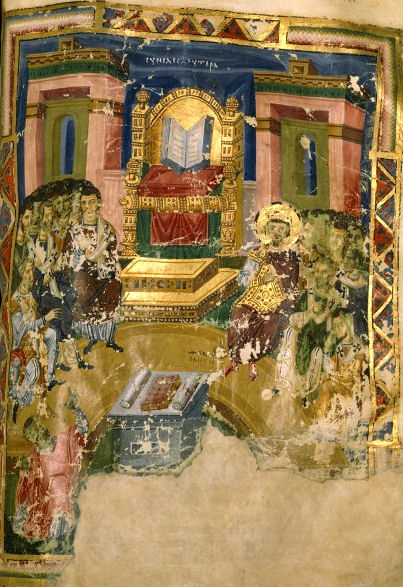
About Commemoration of the Second Ecumenical Council →

Saints commemorated
-
Martyr Basiliscus, Bishop of Comana
Basiliscus (†c. 308) was a young Christian of the Pontic country, nephew of the great-martyr Theodore the Recruit, who confessed Christ at Amasea together with Eutropius and Cleonicus and was left alive in prison when they were crucified. Driven at last in iron sandals studded with nails to Comana in Pontus, he prayed beside a withered plane-tree that put out leaves while a spring broke from its root, saw the idols of the city fall at his word, and was beheaded, his body thrown into the river and recovered by the faithful. Over his grave outside Comana a martyrium arose — and it was there, ninety-nine years later, that John Chrysostom, dying on the forced march into his last exile, was met in a night vision by Basiliscus with the words, "Take courage, brother John; tomorrow we shall be together." Chrysostom died the next day and was buried beside him.
-
Righteous Melchizedek, king of Salem.
-
Commemoration of the Second Ecumenical Council (381).
-
John Vladimir of Serbia
John Vladimir (c. 990 – 22 May 1016) was prince of Dioclea — Duklja, the Serbian principality on the Adriatic that lay where Montenegro and northern Albania meet — and is honoured as the first canonised saint of the Serbian people. Caught between the Empire of Basil II and the Bulgarian tsardom of Samuel, he surrendered his fortress rather than let his people starve, was carried captive to Prespa, and was there married to Samuel's daughter Theodora Kosara and restored to his throne as the tsar's vassal. He ruled a decade in peace, remembered as a mild, just, and prayerful prince, and was beheaded at the church door at Prespa on 22 May 1016 by order of Samuel's nephew John Vladislav, who had sworn him safe conduct. His relics, laid first in his own church on Lake Skadar, rest today in Tirana, and return each year to the monastery near Elbasan that bears his name for his feast. He is venerated as great-martyr and wonderworker by Serbs, Albanians, Bulgarians, Macedonians and Montenegrins alike.
-
Marcellus and Codratus
Marcellus and Codratus are two martyrs of the Byzantine synaxaria commemorated on May 22, of whom nothing is transmitted but their names and the manner of their deaths: Marcellus was made to swallow molten lead, and Codratus — the Greek notices name him Kodros — was torn to pieces by horses, dragged over the ground until he died. The synaxarion gives each a single line of verse and no more: that Marcellus drank the boiling lead as easily as a man drinks water, and that Codratus, having run his course as a horseman runs it, lifted his hands and received the crown. Their place, their century, and the persecution under which they suffered are not recorded.
-
Photini the Samaritan Woman
Photini (first century – c. 66) is the name the Church gives to the Samaritan woman whom Christ met at Jacob's Well near Sychar and to whom, alone among all to whom he spoke, he openly declared himself the Messiah (John 4). Tradition holds that she was baptized with the name Photini, "the enlightened," and became a fearless preacher of the Gospel — carrying it, with her two sons and her five sisters, as far as Carthage and at last to Rome in the days of Nero. There, the tradition relates, the whole company confessed Christ before the emperor, converted his daughter Domnina and the officer Sebastian sent to break them, and after fearful tortures were martyred about the year 66 — Photini herself, it is said, cast at the end into a dry well, the well of her witness answering the well of her calling. She is honoured as Great-Martyr and Equal-to-the-Apostles. Her fixed commemoration is February 26; her principal feast is the movable Sunday of the Samaritan Woman, the fourth Sunday after Pascha, on which the Church reads the Gospel of the Well.
-
Sophia the Physician
Sophia, called the Physician (ἡ ἰατρός), is a martyr of the Byzantine synaxaria commemorated on May 22, known only from her bare synaxarion notice: a woman who practised the healing art and was put to death by the sword for Christ. Nothing of her country, her century, or the circumstances of her passion has been transmitted. The synaxarion preserves the single line of verse that is her whole biography — that she who had once been a healer of bodies was, by the sword, shown to be a healer of souls — and she stands in the calendar as one of the small number of women whom the Church remembers in a learned profession.
British Isles and Ireland
- St. Conall, abbot of Inniscoel (7th C)
Troparia & kontakia
Apolytikion
Most glorified art Thou, O Christ our God, who hast set our Fathers as beacons upon the earth, and by them hast guided us all into the true faith: O greatly merciful One, glory to Thee.
Apolytikion — Tone 4 (common of a martyr)
Thy martyr Basiliscus, O Lord, has received from Thee, our God, an incorruptible crown for the contest he endured; for, having Thy strength, he cast down the tyrants and broke in pieces the powerless insolence of the demons. At his supplications, O Christ God, save our souls.
Apolytikion — Tone 4
Thou didst rule thy people in gentleness and didst give thy body to the sword rather than break thy word, O Prince John Vladimir; wherefore Christ has crowned thee with the martyrs and made thy relics a fountain of healing. Intercede with Him, O passion-bearing prince, that our souls may be saved.
Apolytikion — Tone 4 (common of martyrs)
Thy martyrs Marcellus and Codratus, O Lord, have received from Thee, our God, incorruptible crowns for the contest they endured; for, having Thy strength, they cast down the tyrants and broke in pieces the powerless insolence of the demons. At their supplications, O Christ God, save our souls.
Apolytikion — Tone 4 (common of a woman martyr)
Thy lamb Sophia crieth out to Thee with a great voice, O Jesus: I love Thee, my Bridegroom, and seeking Thee I strive in contest; I am crucified and buried with Thee in Thy baptism, and I suffer for Thy sake that I may reign with Thee; I die for Thee that I may live in Thee. Receive me as a spotless sacrifice, offered to Thee in love. At her supplications, O merciful One, save our souls.
Kontakion
The preaching of the Apostles and the definitions of the Fathers have sealed the one faith of the Church; and she, wearing the garment of truth woven from the theology that comes from above, rightly divides and glorifies the great mystery of godliness.
Kontakion — Tone 8
Shod in iron and bound to a withered tree, thou didst pray, and the dry wood put forth leaves and a spring of living water broke from its root; wherefore, when thy head was struck off at Comana, thou didst become thyself a fountain of healings, O Basiliscus, and a comfort to the exiled.
Kontakion — Tone 8
Summoned by an oath and betrayed at the church door, thou didst receive the sword with a quiet heart, and didst take up thine own head as a crown; O John Vladimir, first-fruits of the saints of thy people, cease not to intercede for those who honour thee.
Troparion — Tone 4
Thy ewe-lamb, O Jesus, cries out with a great voice: O my Bridegroom, thee I love, and seeking thee I struggle, and I am crucified and buried together with thee in thy baptism; I suffer for thy sake, that I may reign with thee; I die for thee, that I may live in thee. Receive me as a spotless sacrifice, offered to thee with love. By her intercessions save thou our souls, O thou who art merciful.
Readings
7th Matins Gospel
John 20.1-10
1The first day of the week cometh Mary Magdalene early, when it was yet dark, unto the sepulchre, and seeth the stone taken away from the sepulchre. 2Then she runneth, and cometh to Simon Peter, and to the other disciple, whom Jesus loved, and saith unto them, They have taken away the Lord out of the sepulchre, and we know not where they have laid him. 3Peter therefore went forth, and that other disciple, and came to the sepulchre. 4So they ran both together: and the other disciple did outrun Peter, and came first to the sepulchre. 5And he stooping down, and looking in, saw the linen clothes lying; yet went he not in. 6Then cometh Simon Peter following him, and went into the sepulchre, and seeth the linen clothes lie, 7And the napkin, that was about his head, not lying with the linen clothes, but wrapped together in a place by itself. 8Then went in also that other disciple, which came first to the sepulchre, and he saw, and believed. 9For as yet they knew not the scripture, that he must rise again from the dead. 10Then the disciples went away again unto their own home.
Epistle
Acts 11.19-26, 29-30
19Now they which were scattered abroad upon the persecution that arose about Stephen travelled as far as Phenice, and Cyprus, and Antioch, preaching the word to none but unto the Jews only. 20And some of them were men of Cyprus and Cyrene, which, when they were come to Antioch, spake unto the Grecians, preaching the Lord Jesus. 21And the hand of the Lord was with them: and a great number believed, and turned unto the Lord. 22Then tidings of these things came unto the ears of the church which was in Jerusalem: and they sent forth Barnabas, that he should go as far as Antioch. 23Who, when he came, and had seen the grace of God, was glad, and exhorted them all, that with purpose of heart they would cleave unto the Lord. 24For he was a good man, and full of the Holy Ghost and of faith: and much people was added unto the Lord. 25Then departed Barnabas to Tarsus, for to seek Saul: 26And when he had found him, he brought him unto Antioch. And it came to pass, that a whole year they assembled themselves with the church, and taught much people. And the disciples were called Christians first in Antioch. 29Then the disciples, every man according to his ability, determined to send relief unto the brethren which dwelt in Judæa: 30Which also they did, and sent it to the elders by the hands of Barnabas and Saul.
Gospel
John 4.5-42
5Then cometh he to a city of Samaria, which is called Sychar, near to the parcel of ground that Jacob gave to his son Joseph. 6Now Jacob’s well was there. Jesus therefore, being wearied with his journey, sat thus on the well: and it was about the sixth hour. 7There cometh a woman of Samaria to draw water: Jesus saith unto her, Give me to drink. 8(For his disciples were gone away unto the city to buy meat.) 9Then saith the woman of Samaria unto him, How is it that thou, being a Jew, askest drink of me, which am a woman of Samaria? for the Jews have no dealings with the Samaritans. 10Jesus answered and said unto her, If thou knewest the gift of God, and who it is that saith to thee, Give me to drink; thou wouldest have asked of him, and he would have given thee living water. 11The woman saith unto him, Sir, thou hast nothing to draw with, and the well is deep: from whence then hast thou that living water? 12Art thou greater than our father Jacob, which gave us the well, and drank thereof himself, and his children, and his cattle? 13Jesus answered and said unto her, Whosoever drinketh of this water shall thirst again: 14But whosoever drinketh of the water that I shall give him shall never thirst; but the water that I shall give him shall be in him a well of water springing up into everlasting life. 15The woman saith unto him, Sir, give me this water, that I thirst not, neither come hither to draw. 16Jesus saith unto her, Go, call thy husband, and come hither. 17The woman answered and said, I have no husband. Jesus said unto her, Thou hast well said, I have no husband: 18For thou hast had five husbands; and he whom thou now hast is not thy husband: in that saidst thou truly. 19The woman saith unto him, Sir, I perceive that thou art a prophet. 20Our fathers worshipped in this mountain; and ye say, that in Jerusalem is the place where men ought to worship. 21Jesus saith unto her, Woman, believe me, the hour cometh, when ye shall neither in this mountain, nor yet at Jerusalem, worship the Father. 22Ye worship ye know not what: we know what we worship: for salvation is of the Jews. 23But the hour cometh, and now is, when the true worshippers shall worship the Father in spirit and in truth: for the Father seeketh such to worship him. 24God is a Spirit: and they that worship him must worship him in spirit and in truth. 25The woman saith unto him, I know that Messias cometh, which is called Christ: when he is come, he will tell us all things. 26Jesus saith unto her, I that speak unto thee am he. 27And upon this came his disciples, and marvelled that he talked with the woman: yet no man said, What seekest thou? or, Why talkest thou with her? 28The woman then left her waterpot, and went her way into the city, and saith to the men, 29Come, see a man, which told me all things that ever I did: is not this the Christ? 30Then they went out of the city, and came unto him. 31In the mean while his disciples prayed him, saying, Master, eat. 32But he said unto them, I have meat to eat that ye know not of. 33Therefore said the disciples one to another, Hath any man brought him ought to eat? 34Jesus saith unto them, My meat is to do the will of him that sent me, and to finish his work. 35Say not ye, There are yet four months, and then cometh harvest? behold, I say unto you, Lift up your eyes, and look on the fields; for they are white already to harvest. 36And he that reapeth receiveth wages, and gathereth fruit unto life eternal: that both he that soweth and he that reapeth may rejoice together. 37And herein is that saying true, One soweth, and another reapeth. 38I sent you to reap that whereon ye bestowed no labour: other men laboured, and ye are entered into their labours. 39And many of the Samaritans of that city believed on him for the saying of the woman, which testified, He told me all that ever I did. 40So when the Samaritans were come unto him, they besought him that he would tarry with them: and he abode there two days. 41And many more believed because of his own word; 42And said unto the woman, Now we believe, not because of thy saying: for we have heard him ourselves, and know that this is indeed the Christ, the Saviour of the world.