
Pentecost week, day 2 · 50 days since Pascha
Day of the Holy Spirit
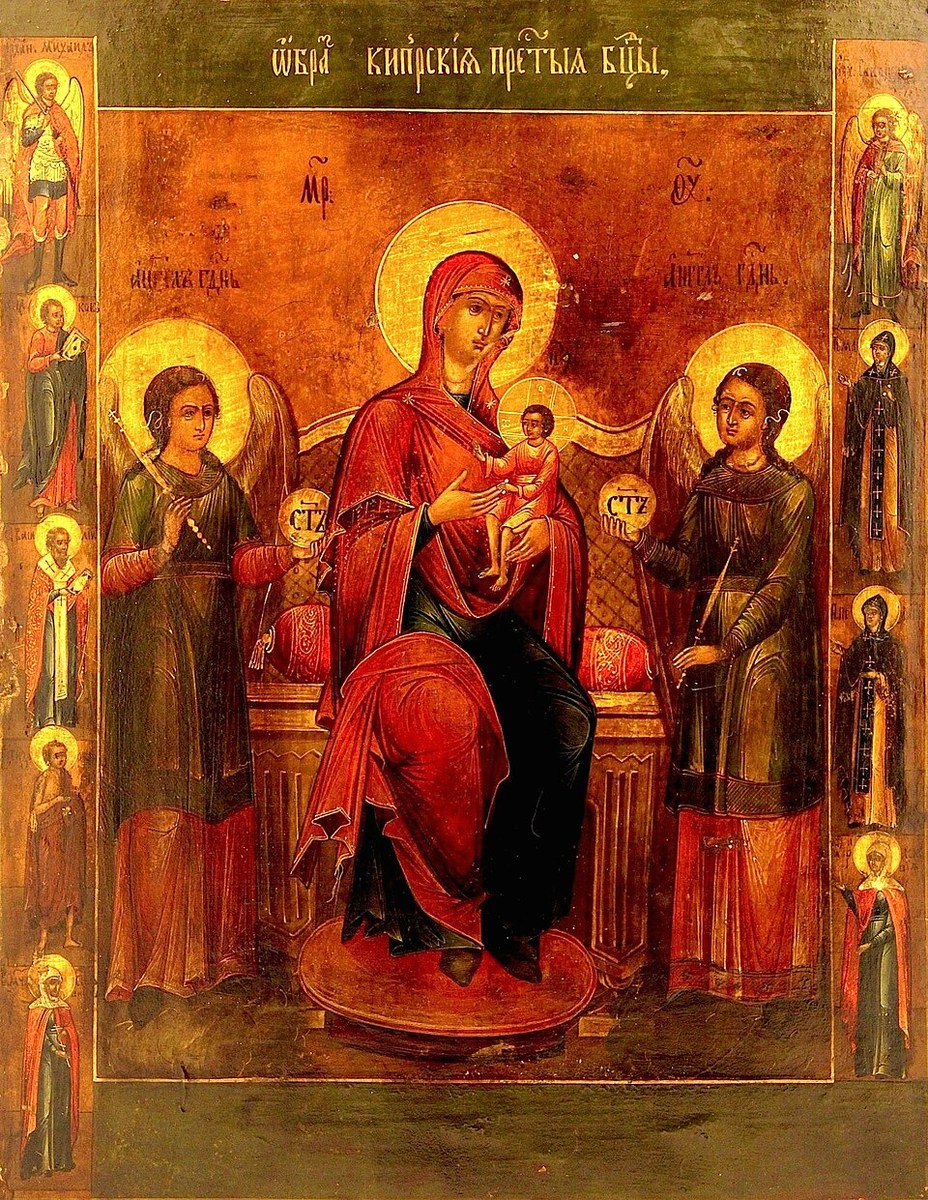
About Cyprus Icon of the Mother of God →

Saints commemorated
-
St Cyril of Alexandria
Cyril of Alexandria (c. 376 – 444) was Archbishop of Alexandria and the greatest of the Church's Christological doctors — the "Seal of the Fathers," whose defence of the unity of the person of Christ gave the Church her language for the mystery of God made man. As president of the Third Ecumenical Council at Ephesus in 431, he led the condemnation of Nestorius, Archbishop of Constantinople, who by dividing Christ into two subjects had refused to the Virgin the title Theotokos, "she who gave birth to God." Against him Cyril taught the hypostatic union: that the eternal Word of God, without ceasing to be God, truly made human flesh and a human soul his own, so that the one who was born of Mary, suffered, and rose is one and the same Son — God the Word incarnate — and Mary is therefore in all truth the Mother of God. His writings — the letters to Nestorius, the treatise On the Unity of Christ, the commentaries on John and Luke — became the charter of Orthodox Christology, honoured at Chalcedon and by the whole Church, Eastern and Oriental alike. He reposed at Alexandria on June 27, 444. His own feast is June 9; he is kept again on January 18 with Athanasius the Great, the two hierarchs of Alexandria, and on June 9.
-
Ven. Kirill of Belozersk
Cyril of White Lake (1337–1427) is the greatest of the founders of the "Northern Thebaid" and, after Sergius of Radonezh, the most influential monastic father of medieval Russia. A Moscow orphan raised in the household of a boyar at the court of Demetrius Donskoy, he was tonsured at the Simonov monastery, served nine years in its bakery under obedience, was made archimandrite in 1388 and laid the office down almost at once for the sake of silence. At sixty, following a voice heard while he read the Akathist before an icon of the Mother of God, he went north with Therapon into the forests of Beloozero and dug a cell in the ground above Siversk Lake. There grew the Kirillo-Belozersky monastery, the strictest and most learned house in Russia, whose rule of absolute non-possession — Cyril refused an offered estate outright — became the seed of the "non-possessor" tradition that Nilus of Sora carried forward a century later. He reposed at ninety on June 9, 1427, the feast of his patron Cyril of Alexandria.
-
St Columba of Iona (597)
Columba (521–597) — Colum Cille, "the dove of the church" — is with Patrick and Brigid one of the three patrons of Ireland, and the enlightener of the Picts of Scotland. A prince of the Cenél Conaill of the northern Uí Néill, trained under Finnian of Clonard and Mobhí of Glasnevin, he founded Derry and Durrow and many houses besides before a quarrel over a copied psalter drew him and his kin into the bloodshed of Cúl Dreimhne (561); for penance he undertook the peregrinatio pro Christo, and in 563 sailed with twelve companions to the small island of Iona off the coast of Dál Riata, from which Ireland could not be seen. From there for thirty-four years he preached to the Picts of the north, went up the Great Glen to the fortress of King Bridei son of Maelchon, arbitrated the affairs of kings at the Convention of Druim Cett, and ruled a family of monasteries whose abbots for a century carried Christianity through Scotland and into northern England. He reposed before the altar at Matins on June 9, 597, in his seventy-sixth year, and his life was written a hundred years later by Adomnán, ninth abbot of Iona, in one of the great books of the early medieval West.
-
Alexander of Kushta
Alexander of Kushta (c. 1371–1439) was one of the founders of the monastic wilderness of the Vologda north. Tonsured on the island monastery of the Saviour on the Stone in Lake Kubenskoye under Dionysius the Greek, the Athonite who brought the Holy Mountain's rule to the Russian north, he was ordained hieromonk and then fled his own monastery by night because the brethren had begun to revere him. He lived first in the forest on the river Syanzhema, then exchanged cells with the hermit Euthymius and settled at the mouth of the Kushta on the southern shore of Lake Kubenskoye, some forty versts from Vologda. When a third monk joined him he built a church of the Dormition of the Theotokos, receiving the blessing for it from the Archbishop of Rostov — his own former abbot. He met a Tatar raiding party with the cross in his hands, blessed a thief's stolen grain so that he could carry it, and reposed on June 9, 1439, in his sixty-eighth year; a rowan tree grew over his grave, and healings were recorded there.
-
Five Virgin-Martyrs of Persia
The five holy virgins Thecla, Mariamne, Martha, Mary and Ennatha were consecrated women of the Church in Persia, living near the village of Aza, who were put to death about the year 346 in the long persecution of Shapur II. Their story is remembered chiefly for the terrible part played in it by their own spiritual father, the priest Paul, to whom they had entrusted their goods: when the persecutors demanded of them apostasy and of him the treasure, Paul saved his money by conforming to the religion of the Persians, and — the synaxarion says — cut off with his own hand the heads of the five women who refused to follow him. His gain lasted a day: the Persians killed him the following evening and took everything he had. The virgins are honoured as martyrs and their betrayer as a warning, and the Church has kept them together in one memory since antiquity.
British Isles and Ireland
- St. Baithene of Tiree (600)
- St. Cummian (8th C)
Troparia & kontakia
Kontakion — Tone 6
Enthroned thou art shown in thine image, O Queen, with the angels standing about thee and the Word upon thine arm; the impious arrow drew blood from thee and the wound became a wonder, and to this day thou dost cleanse the eyes of them that look on thee. Wherefore we cry: hail, O thou refuge of the islands and of the Russian land.
Kontakion — Tone 8
Leaving behind the things of earth, thou didst make thy dwelling in the wilderness, and taking up thy cross thou didst follow after Christ, mortifying the desires of the flesh by fasting and by longing for God; and now, standing before Him, remember us who cry to thee: rejoice, O adornment of the Vologda wilderness, Alexander our father.
Kontakion — Tone 4
Rending asunder the snares of the heresies by the power of Christ through thy divine words, thou didst enrich the Church, O Cyril, cutting down all the tares of Nestorius; wherefore thou standest with the choirs of Angels, fervently interceding with Christ, O blessed one, that forgiveness of sins be granted unto all.
Kontakion — Tone 8
Having despised the things that perish and the reasonings that drag the soul downward, O father, thou didst set out with joy upon the upward road; and now, keeping festival with the angels, thou standest before the Trinity, and dost intercede without ceasing for the flock thou didst gather, O Cyril our father.
Kontakion — Tone 2
Betrayed by the shepherd who should have kept you, O virgins, you were not betrayed by the Shepherd who laid down His life; and receiving the sword in place of the bridal crown, you were joined for ever to Christ, in whom you had already given away all that you had.
Troparion — Tone 4 (common of an icon of the Mother of God)
Today the faithful keep radiant festival, overshadowed by thy coming, O Mother of God; and looking upon thy most pure image we cry with compunction: shelter us beneath the precious veil of thy protection, and deliver us from every evil, entreating thy Son, Christ our God, to save our souls.
Troparion — Tone 4
Choosing to serve God despite the heaviness of the flesh, thou didst make thy dwelling in the wilderness, O father Alexander, and there in labours and vigils and prayer thou didst wear thy body away; wherefore Christ enriched thee with the gift of wonders. Pray to Him for us who honour thy memory, that our souls may be saved.
Troparion — Tone 8
In thee, O father, the image was preserved with exactness: for taking up thy cross, thou didst follow after Christ; and by thy deeds thou didst teach us to despise the flesh, for it passes away, but to care rather for the soul, which is immortal. Wherefore, O venerable Columba, thy spirit rejoices with the angels.
Troparion — Tone 5
Adorned with divine wisdom, thou wast shown forth as leader of the Third Council, and didst cast down the terrible Nestorius, O Father, and didst brightly proclaim the pure Virgin to be Theotokos, O Cyril the Hierarch, glory of the Alexandrians and teacher of the Church.
Troparion — Tone 1
As a lily thou didst blossom in the wilderness after the manner of David, O father Cyril, uprooting the thorns of evil passion; and thou didst gather to thyself in that place disciples of virtue, in the fear of God and by thy teaching. Wherefore, having brought them unto God, pray thou earnestly for us, O most blessed one, that we may be kept from every deceitful assault, and that our souls may be saved.
Troparion — Tone 4
O Lord Jesus, Thy lambs cry out with a loud voice: We are wounded with love for Thee, O our Bridegroom, and we run to seek Thee; we are crucified with Thee, and buried in Thy baptism; we suffer for Thy sake, that we may reign with Thee; we die for Thee, that we may live in Thee. Accept us as spotless sacrifices offered to Thee in love. By their prayers, O merciful One, save our souls.
Readings
Epistle
Ephesians 5.8-19
8For ye were sometimes darkness, but now are ye light in the Lord: walk as children of light: 9(For the fruit of the Spirit is in all goodness and righteousness and truth;) 10Proving what is acceptable unto the Lord. 11And have no fellowship with the unfruitful works of darkness, but rather reprove them. 12For it is a shame even to speak of those things which are done of them in secret. 13But all things that are reproved are made manifest by the light: for whatsoever doth make manifest is light. 14Wherefore he saith, Awake thou that sleepest, and arise from the dead, and Christ shall give thee light. 15See then that ye walk circumspectly, not as fools, but as wise, 16Redeeming the time, because the days are evil. 17Wherefore be ye not unwise, but understanding what the will of the Lord is. 18And be not drunk with wine, wherein is excess; but be filled with the Spirit; 19Speaking to yourselves in psalms and hymns and spiritual songs, singing and making melody in your heart to the Lord;
Gospel
Matthew 18.10-20
10Take heed that ye despise not one of these little ones; for I say unto you, That in heaven their angels do always behold the face of my Father which is in heaven. 11For the Son of man is come to save that which was lost. 12How think ye? if a man have an hundred sheep, and one of them be gone astray, doth he not leave the ninety and nine, and goeth into the mountains, and seeketh that which is gone astray? 13And if so be that he find it, verily I say unto you, he rejoiceth more of that sheep, than of the ninety and nine which went not astray. 14Even so it is not the will of your Father which is in heaven, that one of these little ones should perish. 15Moreover if thy brother shall trespass against thee, go and tell him his fault between thee and him alone: if he shall hear thee, thou hast gained thy brother. 16But if he will not hear thee, then take with thee one or two more, that in the mouth of two or three witnesses every word may be established. 17And if he shall neglect to hear them, tell it unto the church: but if he neglect to hear the church, let him be unto thee as an heathen man and a publican. 18Verily I say unto you, Whatsoever ye shall bind on earth shall be bound in heaven: and whatsoever ye shall loose on earth shall be loosed in heaven. 19Again I say unto you, That if two of you shall agree on earth as touching any thing that they shall ask, it shall be done for them of my Father which is in heaven. 20For where two or three are gathered together in my name, there am I in the midst of them.