
Dormition Fast, day 8
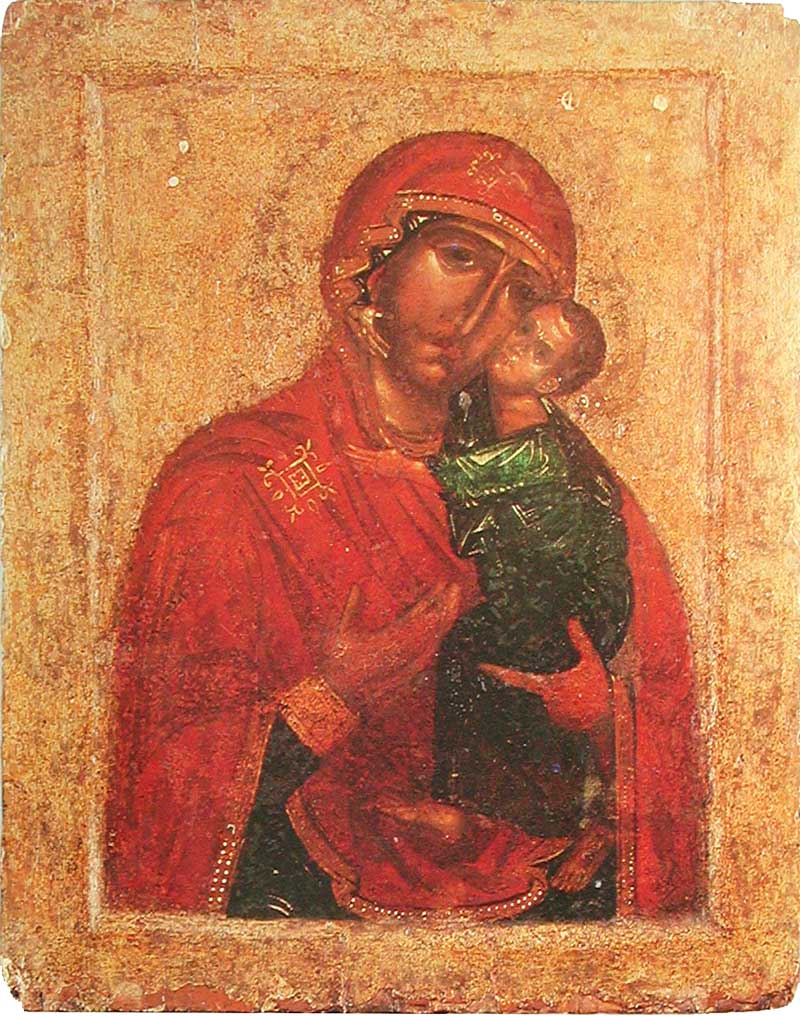
About Tolga Icon of the Mother of God →

Saints commemorated
-
Saint of the day
St Emilian the Confessor
-
Saint of the day
St Emilian the Confessor, bishop of Cyzicus (820)
Emilian the Confessor (died c. 820) was bishop of Cyzicus, on the Sea of Marmara, and a bold defender of the holy icons in the second iconoclast persecution under the emperor Leo V the Armenian. Summoned with the other bishops before the emperor when Leo moved to revive iconoclasm, Emilian refused to yield the veneration of the images and answered the emperor to his face, for which he was deposed, ill-treated, and sent into exile, where he died a confessor of the faith. He is numbered among the company of confessor-hierarchs who suffered in those years for the images of Christ and the saints. His principal feast is August 8; he is commemorated again on January 8, within the afterfeast of the Theophany.
-
St Myron the Wonderworker, Bishop of Crete (350)
Myron (c. 250–c. 350) is the great wonderworker of Crete: a farmer of the village of Raucos near Knossos, married and working his own land, who became famous first for a generosity so extravagant that it converted the men who came to rob him, and only afterwards, and by the island's insistence, a priest and then its bishop. The tradition credits him with the gift of miracles from his youth — the vineyard stripped for the poor and refilled from three grapes — and above all with the stilling of the flooded river Triton, which he crossed dry-shod and then sent his staff back to release. He reposed about the year 350, a hundred years old. His birthplace bears his name to this day, Agios Myronas, and he is the patron of the whole island's memory of its fourth-century Church.
-
St Gregory of Sinai (Mt Athos) (1346)
Gregory the Sinaite (c. 1265–1346) is the father of the fourteenth-century hesychast revival: the monk who gathered up the ancient discipline of inner stillness (hēsychia) and the unceasing Prayer of Jesus, learned it on Sinai and in Crete, planted it on Mount Athos at a moment when, by his own complaint, almost no one there knew it, and then carried it over the Byzantine frontier into the Slav lands, where at Paroria in the Strandzha mountains he formed the disciples — Callistus I of Constantinople, Theodosius of Trnovo, Romylos, Nicodemus of Tismana — through whom his teaching passed to Bulgaria, Serbia, Wallachia and at last to Russia. His five treatises stand in the Philokalia; the whole Athonite defence of the uncreated light waged by Gregory Palamas rests upon the practice Gregory the Sinaite had restored. He reposed at Paroria on 27 November 1346, and is commemorated on August 8.
-
Eleutherius and Leonidas
Eleutherius and Leonidas are two young martyrs of the Greek synaxarion, cast into the fire together with a number of infants for refusing to sacrifice to the idols. The record of them is a single line and a couplet in the Menaion for August 8; no passion, no place and no reign is transmitted, and the later notices which locate them at Constantinople do so without ancient warrant. They are kept, as the synaxarion keeps them, among the nameless multitude of those "perfected by fire."
-
Gregory the Iconographer of the Caves
Gregory the Iconographer was a monk of the Monastery of the Caves at Kiev and the companion in that craft of Alypius, the first named icon-painter of the Russian land. The Accounts of the Holy Iconographers preserved at the monastery say that he painted many wonderworking icons that were dispersed throughout Rus'; the ninth ode of the canon for the Synaxis of the Fathers of the Near Caves calls him a "Byzantine," which most probably means that he was one of the Greek masters who came from Constantinople to Kiev to decorate the Great Church of the monastery, the cathedral of the Dormition. His relics rest in the Near Caves, and he is commemorated on August 8.
-
Herman of Solovki
Herman was the first of the three founders of Solovki to reach the islands and the last of them to die: an unlettered hermit of the Karelian coast who was living by a chapel on the river Vyg when Sabbatius came north in 1429 looking for a place of solitude, and who told him of the empty island in the White Sea. The two crossed the sea together and settled under the Sekirnaya Hill, and lived there six years. After Sabbatius' repose Herman brought the young Zosimas across in 1436 and stayed with him while the monastery grew up around them; he was on the islands for more than fifty years, and outlived them both. Unable to read or write, he did the one thing that has mattered most to posterity: he called clerics and dictated his memories of Sabbatius and Zosimas, so that the Life of the founders of Solovki rests on the testimony of an eyewitness. He died at Novgorod in 1479 on one of the supply journeys he was still making in old age; when in 1484 his grave was opened to bring him home, the relics were found incorrupt, and that finding is his feast.
-
Sabbatius of Solovki
Sabbatius of Solovki (†1435) was the first hermit of the Solovki islands in the White Sea and, with Herman and Zosimas, is venerated as a founder of the great Solovetsky monastery, the fortress of monasticism in the Russian far north. A monk of the White Lake monastery of Cyril and then of Valaam on Lake Ladoga, he twice fled the esteem of the brethren, and in old age crossed the harsh sea with the hermit Herman to settle the uninhabited island. After six years of struggle there he reposed on September 27, 1435, at a chapel on the river Vyg, having sought out the Holy Mysteries in his last days; his relics were later carried to the monastery his successors built.
-
Ten Ascetics of Egypt
The Greek synaxarion for August 8 commemorates ten unnamed ascetics of Egypt, recording of them only that they were ten, that they were Egyptians, and that they reposed in peace. Not a name, a place, a monastery or a century survives. They stand in the calendar for the great anonymous body of the Egyptian desert — the monks of Scetis, Nitria and the Thebaid whose lives were never written — and the epigram appointed for them in the Menaion turns their number into the day's single memorable figure: ten offshoots of Egypt, matched to the ten plagues that Egypt once suffered.
-
Triandaphyllus of Zagora
Triandaphyllus — "Rose," as the name means in Greek — was a boy of fifteen, a sailor's apprentice from Zagora, who was beheaded at Constantinople in 1680 for refusing to accept Islam. He is one of the earliest of the long roll of neomartyrs of the Ottoman centuries, and one of the youngest; his witness is kept in Greek, Bulgarian and Serbian usage alike, the two nations disputing between them, out of affection rather than rivalry, which Zagora was his home.
-
Zosimas of Solovki
Zosimas (†17 April 1478) is the founder of the great monastery of Solovki in the White Sea and the father of coenobitic monasticism in the Russian far north. Born at Tolvui by Lake Onega, he gave away his inheritance, was tonsured, and went looking for a desert; at the mouth of the Suma he met Herman, who told him of an uninhabited island where he had spent six years with Sabbatius. About 1436 the two crossed the sea to the Solovetsky islands, and Zosimas, seeing in the air a vision of a shining church, built there the wooden Transfiguration church that became the Lavra of the north. He brought Sabbatius's relics from the Vyg in 1465, was made abbot by the brethren when the igumens sent from Novgorod could not endure the climate, foretold at Martha Boretskaya's table the beheading of six Novgorod boyars, and is honoured as the patron of beekeepers. His relics were translated with Sabbatius's on August 8, 1566, which is his second commemoration.
British Isles and Ireland
- St. Ultan, abbot of Crayke (7th C)
- St. Ellidius of Hirnant in Powys (7th C)
Troparia & kontakia
Kontakion — Tone 8
Thou didst come by night to the shore of the Volga and show thine image in a pillar of fire, and by morning a house was built for thee; wherefore the people of Yaroslavl and all the countryside cry out to thee with thanksgiving: Rejoice, O Lady of Tolga, our deliverance from pestilence and from every sorrow.
Kontakion — Tone 2
Thou didst learn stillness upon Sinai and in the caves of Crete, and didst carry it to the Holy Mountain and beyond the rivers into the lands of the Slavs; and where thou camest, there men learned to call upon the Name. O father Gregory, teacher of prayer, entreat Christ God that we also may guard our hearts.
Kontakion — Tone 2
Thou didst show the desert of the sea to those who sought it, and didst remain there when they had gone to their rest; and having no letters thyself, thou didst leave the memory of the fathers to the Church in written words. Wherefore Solovki honours thee, O Herman, as its first-comer and its faithful servant.
Kontakion — Tone 2
Thou didst till thine own field and give away its fruit, and the thieves that came to rob thee went away made honest men; and being set as a shepherd over the island, thou didst stay the flooded river with a word. O Myron, fragrance of virtue, pray that our hearts also may be made generous.
Kontakion — Tone 2
Fleeing the tumult of this life, thou didst make thy dwelling on an island of the sea, O wise one; and taking thy cross thou didst follow Christ, in prayers and vigils and fastings wearing down thy flesh with hard discipline. Wherefore thou wast the adornment of the venerable; and so with love we keep thy memory, O venerable Sabbatius: pray without ceasing to Christ God for us all.
Troparion — Tone 4
Today, like a beacon, thy most honoured icon shineth forth upon us, O Lady, and gladdeneth the hearts of the faithful, and calleth us to look upon the great wonder: for thou wast pleased to be borne upon a pillar of fire and to rest in the branches of a tree, and thou didst give the sign of thy coming to thy servant the bishop. Wherefore, falling down before thine image, we cry aloud to thee: O Sovereign Lady, keep this land and thy monastery in peace, and save our souls.
Troparion — Tone 4 (common of martyrs)
Thy martyrs Eleutherius and Leonidas and those with them, O Lord, in their contest received from Thee our God incorruptible crowns; for possessing Thy strength, they cast down the tyrants and shattered the feeble insolence of the demons. By their intercessions save our souls.
Troparion — Tone 4
O God of our Fathers, who dealest ever with us according to thy gentleness, take not thy mercy from us, but by the prayers of thy hierarch Emilian guide our life in peace.
Troparion — Tone 8
In thee, O Father, was the divine image kept unbroken; for thou didst take up the Cross and follow after Christ, and by thy deeds thou didst teach us to despise the flesh, which passeth away, and to care for the soul, which is a thing immortal. Wherefore, O venerable Gregory, thy spirit rejoiceth together with the Angels.
Troparion — Tone 8
In thee, O Father, was the divine image kept unbroken; for thou didst take up the Cross and follow after Christ, and by thy deeds thou didst teach us to despise the flesh, which passeth away, and to care for the soul, which is a thing immortal. Wherefore, O venerable Gregory, thy spirit rejoiceth together with the Angels.
Troparion — Tone 8
By a flood of tears thou didst make the barren desert fruitful, and thy longing for God brought forth fruit a hundredfold; thou becamest a beacon on the island of the sea, shining upon the north with signs and wonders. O our father Herman, intercede with Christ God that our souls may be saved.
Troparion — Tone 4 (common of a hierarch)
The truth of things revealed thee to thy flock as a rule of faith, an icon of meekness, and a teacher of abstinence; therefore thou hast attained the heights by humility, and riches by poverty. O father and hierarch Myron, intercede with Christ God that our souls may be saved.
Troparion — Tone 3
Withdrawing from the world and making thy dwelling in the wilderness, thou didst strive with a good struggle — by suffering hardship, by watchfulness and by prayers; wherefore also after death thou pourest forth healings, O Sabbatius our father. Pray to Christ God that our souls may be saved.
Troparion — Tone 4 (common of venerable fathers)
O God of our Fathers, who dealest ever with us according to thy gentleness, take not thy mercy from us, but by the prayers of thy venerable ones guide our life in peace.
Troparion — Tone 4 (common of a new martyr)
Thy martyr Triandaphyllus, O Lord, in his contest received from Thee our God an incorruptible crown; for possessing Thy strength, he cast down the tyrants and shattered the feeble insolence of the demons. By his intercessions save our souls.
Troparion — Tone 4
Having left the world and its cares, thou didst seek out an island in the cold sea, and there, where the vision of the church was shown thee, thou didst raise up a house of the Transfiguration of Christ; and gathering a brotherhood, thou wast a father to them in labour and in want. O venerable Zosimas, entreat the Saviour that our souls may be saved.
Readings
Epistle
1 Corinthians 14.26-40
26How is it then, brethren? when ye come together, every one of you hath a psalm, hath a doctrine, hath a tongue, hath a revelation, hath an interpretation. Let all things be done unto edifying. 27If any man speak in an unknown tongue, let it be by two, or at the most by three, and that by course; and let one interpret. 28But if there be no interpreter, let him keep silence in the church; and let him speak to himself, and to God. 29Let the prophets speak two or three, and let the other judge. 30If any thing be revealed to another that sitteth by, let the first hold his peace. 31For ye may all prophesy one by one, that all may learn, and all may be comforted. 32And the spirits of the prophets are subject to the prophets. 33For God is not the author of confusion, but of peace, as in all churches of the saints. 34Let your women keep silence in the churches: for it is not permitted unto them to speak; but they are commanded to be under obedience, as also saith the law. 35And if they will learn any thing, let them ask their husbands at home: for it is a shame for women to speak in the church. 36What? came the word of God out from you? or came it unto you only? 37If any man think himself to be a prophet, or spiritual, let him acknowledge that the things that I write unto you are the commandments of the Lord. 38But if any man be ignorant, let him be ignorant. 39Wherefore, brethren, covet to prophesy, and forbid not to speak with tongues. 40Let all things be done decently and in order.
Gospel
Matthew 21.12-14, 17-20
12And Jesus went into the temple of God, and cast out all them that sold and bought in the temple, and overthrew the tables of the moneychangers, and the seats of them that sold doves, 13And said unto them, It is written, My house shall be called the house of prayer; but ye have made it a den of thieves. 14And the blind and the lame came to him in the temple; and he healed them. 17And he left them, and went out of the city into Bethany; and he lodged there. 18Now in the morning as he returned into the city, he hungered. 19And when he saw a fig tree in the way, he came to it, and found nothing thereon, but leaves only, and said unto it, Let no fruit grow on thee henceforward for ever. And presently the fig tree withered away. 20And when the disciples saw it, they marvelled, saying, How soon is the fig tree withered away!