
Zosimas of Solovki
Our Venerable Father Zosimas, Igumen of Solovki, wonderworker
Venerable · Wonderworker · b. at Tolvui by Lake Onega, Novgorod land — d. 17 April 1478
Commemorated 17 April — Repose at Solovki, 1478, 8 August — Translation of the relics with Sabbatius into the Transfiguration cathedral, 1566; and the second translation of 1992
Zosimas (†17 April 1478) is the founder of the great monastery of Solovki in the White Sea and the father of coenobitic monasticism in the Russian far north. Born at Tolvui by Lake Onega, he gave away his inheritance, was tonsured, and went looking for a desert; at the mouth of the Suma he met Herman, who told him of an uninhabited island where he had spent six years with Sabbatius. About 1436 the two crossed the sea to the Solovetsky islands, and Zosimas, seeing in the air a vision of a shining church, built there the wooden Transfiguration church that became the Lavra of the north. He brought Sabbatius's relics from the Vyg in 1465, was made abbot by the brethren when the igumens sent from Novgorod could not endure the climate, foretold at Martha Boretskaya's table the beheading of six Novgorod boyars, and is honoured as the patron of beekeepers. His relics were translated with Sabbatius's on August 8, 1566, which is his second commemoration.

Tolvui, and the search for a desert
Zosimas was born in the diocese of Novgorod, in the village of Tolvui on Lake Onega, of pious parents named Gabriel and Barbara. Brought up in piety, he disposed of his inheritance after their death, gave what he had to the poor, and received the monastic tonsure. What he wanted was a wilderness, and he went north to find one, along the shores of the White Sea.
At the mouth of the river Suma he met the monk Herman, who had lived six years on an island far out in the sea with the elder Sabbatius — Sabbatius having since returned to the mainland and died there, at the chapel on the Vyg, in 1435. Herman told him what the island was, and the two agreed to go back to it.
The island, and the vision of the church
About the year 1436 they crossed the water in a boat and, providentially, made land on the Solovetsky islands. There Zosimas saw a vision: a great and beautiful church standing in the air, filled with light. They built themselves cells with their own hands, fenced an enclosure, broke the ground and sowed.
The first winter almost ended it. Herman went to the mainland late in the autumn for provisions and was cut off by the weather; Zosimas was left alone on the island through the whole winter, wrestling with the demons who came at him openly, and with starvation, until two strangers appeared at his cell, left him a store of bread, flour and oil, and were seen no more. In the spring Herman came back, with a fisherman named Mark and with food and materials for nets.
Hermits gathered. Zosimas built the little wooden church of the Transfiguration of the Lord — the vision made good — with a refectory beside it, and asked Novgorod for a priest; an igumen came with an antimension for the altar, and the Solovki monastery had begun.
Abbot
The igumens sent out from Novgorod could not stand the place. The winters, the isolation, the labour and the poverty defeated one after another, and at length the brethren elected Zosimas himself. He gave the house what it had lacked: a strict coenobitic rule, common property, common table, obedience — and it is this that makes him, and not Sabbatius, the founder of northern coenobitism. In 1465 he sent to the Vyg and brought back the relics of Sabbatius to be buried at Solovki, gathering the whole tradition of the island into one place.
Novgorod, Martha Boretskaya, and the six boyars
The monastery's fisheries were plundered by the boyars of Novgorod, who seized the catch of the monks' nets, and Zosimas was obliged to travel to the city and seek the archbishop's protection. On the archbishop's advice he went round the houses of the great families to ask them not to harm the house. The most powerful of them, the widow Martha Boretskaya, had him thrown out of her door; then, repenting, she sent after him and invited him to dine.
At her table Zosimas suddenly saw six of the illustrious guests sitting without their heads. He said nothing there, but told his disciple Daniel afterwards, and foretold their deaths. It came to pass in 1478, when Ivan III took Novgorod and the six boyars were executed.
Repose, relics, and the beekeeper
He prepared his own grave shortly before the end, and was buried in it, behind the altar of the Transfiguration church, on 17 April 1478. A chapel was raised over the relics.
On August 8, 1566 — the third day of the monastery's patronal feast of the Transfiguration — the relics of Zosimas and Sabbatius were carried into a chapel built for them in the Transfiguration cathedral. This is the commemoration of August 8. After the desecrations of the twentieth century the relics were returned to Solovki in 1992, with those of Herman, and that second translation is kept on the same day.
Zosimas and Sabbatius appeared repeatedly to fishermen perishing in the sea, and both are invoked for those in danger on the water. Zosimas in particular is the patron of beekeepers and the guardian of hives — "the Bee-keeper," as the Russian villages called him — and prayers for the increase of bees are addressed to him and to Sabbatius together; a great number of hospital churches across the Russian north and centre were dedicated in his name, testimony to his repute as a healer.
Feast and commemoration
April 17 (church date; Old Calendar civil April 30) is the principal feast, the day of his repose in 1478. August 8 (Old Calendar civil August 21) keeps the translation of his relics with those of Sabbatius into the Transfiguration cathedral in 1566, and with it the second translation of 1992; it falls within the afterfeast of the Transfiguration, which for Solovki is the patronal feast of the house itself, so that the day is doubly the monastery's own. He is further commemorated with Sabbatius and Herman in the Synaxis of the Saints of Solovki, and among the saints of Novgorod and of Karelia. The commemoration is Russian, carried by the OCA; the Greek books do not have it.
Hymns
Troparion — Tone 4
Having left the world and its cares, thou didst seek out an island in the cold sea, and there, where the vision of the church was shown thee, thou didst raise up a house of the Transfiguration of Christ; and gathering a brotherhood, thou wast a father to them in labour and in want. O venerable Zosimas, entreat the Saviour that our souls may be saved.
Original translation from the Slavonic
Iconography
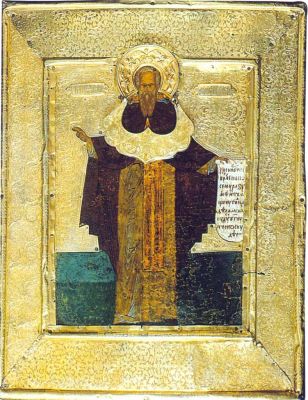
Zosimas is painted as a venerable father of the Russian north: an elder in the dark monastic habit and koukoulion, with a long grey beard, one hand raised in blessing or held to the breast and the other holding an unrolled scroll, usually inscribed with the words of his deathbed exhortation to the brethren. His characteristic image, however, is the joint one: Zosimas and Sabbatius side by side, holding between them a model of the Solovetsky monastery — walls, towers and the Transfiguration cathedral — and presenting it to Christ or to the Mother of God above. Icons of this composition were made in enormous numbers from the sixteenth century onward and carried all over the Russian north; the type is well represented in museum collections, and in some panels the two saints stand within a painted view of the island, with the White Sea and the fishing boats they were invoked to save.
The stored image is a sixteenth-century Russian panel of Zosimas alone: the saint standing full-length on a gold ground, in the dark mantle over a light-brown tunic, his right hand raised before his breast and an open scroll held out in his left, in the raised-border frame of the period. Its identification follows the catalogue attribution of the source, the inscription being no longer legible at the reproduction's resolution.
Disputed questions
- Founder — Sabbatius or Zosimas? Both, in different senses, and the calendars keep them together for that reason. Sabbatius and Herman were the first Christians to live on the island (from about 1429), but they left no institution; Zosimas founded the monastery, built its churches, obtained its priest and its antimension, and gave it the coenobitic rule. The Russian usage of naming "Zosimas and Sabbatius" in one breath, and of painting them together holding a model of the monastery, reflects a joint foundation and not a confusion.
- Not to be confused with the other Zosimases of this corpus — Zosimas of Cilicia, Zosimas of Babylon, Zosimas the Soldier — nor with the Palestinian Zosimas who communed Mary of Egypt.