
Macarius of Unzha
Our Venerable Father Macarius, Abbot of Yellow Waters and of Unzha, Wonderworker
Venerable · Wonderworker · b. 1349, Nizhny Novgorod — d. 25 July 1444, Unzha
Commemorated 25 July — Repose at the monastery of Unzha
Macarius (1349–1444) was the greatest of the colonising monks of the middle Volga: a boy of Nizhny Novgorod who ran away at twelve to be tonsured by Dionysius of Suzdal in the cave monastery above the city, and who spent ninety-five years pushing the frontier of Russian monasticism eastward into country the Church had not held. At Yellow Waters (Zheltye Vody) on the Volga he founded a Trinity monastery about 1435 and preached to the Mari, Chuvash and Mordvin peoples among whom it stood, baptising them in the lake. In 1439 the Kazan Tatars destroyed the house and carried him off; the khan, impressed by what he heard of him, released him with some four hundred captives on condition that he never rebuild there. He led them west through the forests to Unzha — the march on which the tradition places the story of the elk spared because the Apostles' Fast was not yet out — and founded a second monastery fifteen versts from the town, where he died on 25 July 1444. His relics were found incorrupt in 1671; he is a patron of Kostroma and of the Nizhny Novgorod land, and the great Makaryev fair that grew up at Yellow Waters carried his name until 1817.

Origins and the cave monastery
Macarius was born at Nizhny Novgorod in 1349, the son of a poor and pious citizen named John. The traditional account has him drawn to the church from infancy and secretly resolved on the monastic life while still a child. At the age of twelve he left his father's house in the clothes of a beggar and presented himself at the Ascension monastery of the Caves above the Volga just outside the city — the house dug into the river bank about 1335 by Dionysius of Suzdal, who was then its abbot and who became one of the formative ascetic teachers of the Russian north. Dionysius tonsured him, and the boy became known in the brotherhood for a severity of fasting and an exactness in the monastic rule beyond his years.
The story of his father's arrival is the best-remembered scene of his youth. Some years later John, who had searched for his son everywhere, learned where he was and came weeping to the monastery to beg him to come home. Macarius would not see him face to face. He spoke to him through the wall of his cell, told him that he had a Father in heaven whom he could not now leave, and, when his father implored one sight of him, put his hand out through the window so that the old man might kiss it. John went home consoled — the tradition says he understood, and blessed his son's choice.
Out of the same brotherhood came Euthymius, afterwards archimandrite of Suzdal; the Caves monastery under Dionysius is the parent house of both, and the Nizhny Novgorod cave-community stands behind the whole later monastic settlement of the middle Volga.
The retreat to the Volga and the founding at Yellow Waters
Macarius's reputation drew visitors, and he fled from it. He withdrew first to the river Luh, west of Nizhny Novgorod, where he built a cell and where a small community again gathered around him; and when that grew, he moved further out — down the Volga to a small lake on the left bank near the mouth of the Kerzhenets, called from the colour of its water the Yellow Waters (Zheltye Vody). There, about 1435, with the permission of the grand prince Basil II the Dark of Moscow, he founded a monastery of the Life-giving Trinity, the house afterwards known as Makaryev-Zheltovodsky.
The site was on the edge of Russian settlement, in country held by the Volga peoples — Cheremis (Mari), Chuvash and Mordvins — and by the young khanate of Kazan beyond them. Macarius went out among them. The tradition is insistent that his preaching was gentle and his charity indiscriminate, that he fed the hungry of every nation and language, and that many were baptised in the lake beside the monastery; and it is on this that his title as an apostle of the middle Volga rests. The monastery grew rapidly, and around its landing began the market that became, over the following centuries, the Makaryev fair — the greatest fair in Russia, held under the monastery's walls until it was moved to Nizhny Novgorod after the fire of 1816.
The Tatar raid and the captivity, 1439
In 1439 the Kazan Tatars under Ulu-Muhammad fell on the monastery, killed the monks who would not fly, burned the buildings and took Macarius prisoner. The account received in the Russian tradition is that the khan, learning who the old man was and being told by his own people of his charity, reproached his soldiers for laying hands on such a man and released him — with some four hundred Christian captives taken in the same raid — on one condition: that he would not rebuild at Yellow Waters.
Macarius first went back to the ruins to bury the dead monks, and then set out westward with the whole company of freed captives across country emptied by the raid. The march of some two hundred versts through the forests toward Galich and the Unzha is the setting of the story that has attached itself to him more firmly than any other. The people with him were starving; they caught an elk; and Macarius forbade them to kill it, because the Apostles' Fast was not yet ended. He had the beast's ear marked and let it go, promising them that God would give it back on the feast. On June 29, the day of the holy apostles Peter and Paul, the same elk — the tradition says the mark was on its ear — came out of the forest to the camp, and they ate. The story is transmitted as a miracle of the fast, and the elk became his emblem in later Russian devotion.
Unzha
He brought the company safe to the town of Unzha in the Galich country, and there, some fifteen versts from the town on a lake, he built himself a cell and gathered the last of his communities — the Makaryev-Unzhensky Trinity monastery, which became the chief monastic centre of the Kostroma land. He lived there five years. He reposed on 25 July 1444, in the ninety-fifth year of his age.
Relics, miracles and glorification
Healings were reported at his grave from the beginning. The tradition records among the first the deliverance of a young woman carried off from her wedding, and the restoration of sight to a girl tormented by an unclean spirit. In 1522 a Tatar force raided Unzha and attempted the monastery: the account has the raiders who tried to strip the silver from his shrine struck blind, and many of them drowned in the river in their flight — a deliverance the town kept in its memory as the saint's own.
The Time of Troubles made his cultus a national one. The Romanov family attributed the deliverance of Michael Feodorovich and his mother from Polish captivity to Macarius's intercession, and the young tsar and his father the patriarch Philaret made the pilgrimage to Unzha. Under Philaret a commission examined the shrine and verified more than fifty healings, and on that basis Macarius was glorified for general veneration in 1619. His relics were uncovered in 1671 and found incorrupt, and were kept at the Unzha monastery thereafter.
Feast and commemoration
July 25 (church date; New Calendar civil July 25, Old Calendar civil August 7), the day of his repose. He is kept in Russian, Ukrainian and OCA usage and is not carried by the Greek calendars; on the Old Calendar reckoning his day falls on civil August 7, within the Dormition Fast. The Kostroma and Nizhny Novgorod dioceses keep him with particular solemnity, and he is numbered among the councils (sobory) of the saints of Kostroma and of Nizhny Novgorod. Both of his monasteries survive as functioning houses: the Trinity Makaryev at Yellow Waters, on the Volga below Nizhny Novgorod, and the Makaryev-Unzhensky at Makaryev in Kostroma province, where the relics rest.
Since July 25 belongs liturgically to the Dormition of the Righteous Anna, his office in Russian practice is sung with hers and with the memory of Olympias and Eupraxia, the saint of the Menaion being given the canon and the Theotokos's mother the day.
Hymns
Troparion — Tone 5 (common of a venerable father)
With the streams of thy tears thou didst make the barren wilderness to bloom, and by thy sighings from the depths thou didst bring thy labours to a hundredfold harvest; and thou wast made a beacon for the world, shining forth with miracles, O Macarius our father. Intercede with Christ God that our souls may be saved.
Original translation from the Slavonic
Kontakion — Tone 2
Having left thy father's house while yet a child, thou didst seek the Father who is in heaven; and dwelling in the wilderness of the Volga thou didst enlighten the nations that sat in darkness, and didst lead the captives home. Wherefore we cry to thee: rejoice, O Macarius, adornment of the northern land.
Original translation from the Slavonic
Iconography
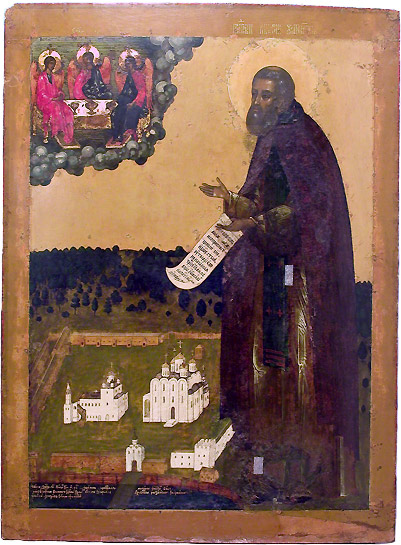
The settled Russian type shows Macarius as a very old monk — he died at ninety-five — with a long narrow beard, in the black mantiya and the great schema, the right hand raised in blessing or in prayer and the left holding an unrolled scroll bearing his testament to the brethren. Two things distinguish him. The first is the monastery in the lower field of the panel: he is one of the Russian founder-saints painted with a bird's-eye view of his own house — walls, gate, the white churches of the Trinity — laid out beneath his feet, so that the icon is at once a portrait and a topography. The second is the elk, which in later and more popular versions of the composition stands at the edge of the landscape, remembering the march from Kazan captivity. In the icons of the councils of the saints of Kostroma and of Nizhny Novgorod he stands in the first rank.
The stored image is the panel attributed to Simon Ushakov (1626–1686), the leading Moscow iconographer of the seventeenth century, painted about 1650: the saint stands full-length in the schema against a gold ground, an unrolled scroll of text in his hands, the Old Testament Trinity appearing to him in a cloud at the upper left — the dedication of both his monasteries — and beneath, in the lower third of the panel, the white churches and walls of the monastery with an inscription along the base. The painter died in 1686 and the work is long out of copyright.
Disputed questions
- The order of the foundations. Some modern English notices — the OCA life among them — place the Unzha foundation about 1435 and the Yellow Waters foundation after it. The Russian sources are consistent the other way: Yellow Waters first, about 1434–1435; its destruction in 1439; Unzha afterwards, in the five years before his death. That is the order followed here, and it is the only one that makes sense of the khan's condition and of the march west.
- The date of glorification. 1619 is the year usually given, on the strength of Patriarch Philaret's commission; some accounts give 1620, and others treat the uncovering of the relics in 1671 as the effective act. Local veneration long preceded all of these.
- A second feast. English lists occasionally attach a second commemoration to the uncovering of the relics of 1671. No such notice was found on the live jurisdictional day-pages consulted for this entry, and no second feast is entered in the entry's record; the 1671 uncovering is recorded in the Life instead.
- Not to be confused with the other Russian Macariuses of the same century and region — Macarius of Kalyazin (†1483), and the Macarius of Glushitsa commemorated on October 12 — nor with Macarius the Great of Egypt, Macarius of Alexandria, Macarius of Kios, or the metropolitan Macarius of Moscow. The epithets Zheltovodsky and Unzhensky belong to this saint alone.