
Commemoration of the Fifth Ecumenical Council
The Commemoration of the Holy One Hundred and Sixty-Five God-bearing Fathers of the Fifth Ecumenical Council, gathered at Constantinople in the year 553
On July 25 the Church keeps the memory of the one hundred and sixty-five God-bearing Fathers who assembled at Constantinople from 5 May to 2 June of the year 553, under the Emperor Justinian and the presidency of the patriarch Eutychius, in the council the Church numbers fifth among the Ecumenical Councils. It was called to settle what a century of quarrel after Chalcedon had left unsettled: whether the Definition of 451 could be read in the mind of Cyril of Alexandria, or whether it sheltered the Nestorianism that the Churches of Egypt and Syria accused it of sheltering. The Fathers condemned the Three Chapters — the person and writings of Theodore of Mopsuestia, the writings of Theodoret of Cyrus against Cyril and against the council of Ephesus, and the letter of Ibas of Edessa to Mari the Persian — set out fourteen anathemas confessing one incarnate hypostasis of God the Word and the theopaschite formula one of the Trinity suffered in the flesh, and rejected the Origenist doctrines of the pre-existence of souls and of a universal restoration. Pope Vigilius, in Constantinople throughout, refused to attend and was struck from the diptychs, and only assented six months later. The council secured the Cyrilline reading of Chalcedon that Orthodox theology has held ever since; it did not, as Justinian had hoped, bring back the anti-Chalcedonians; and in the West it opened the schism of Aquileia that lasted a century and a half.

The question Chalcedon left open
Chalcedon had confessed one Christ in two natures, without confusion, without change, without division, without separation. To the Latins and to the imperial church it was the settlement of the Christological question; to great parts of Egypt, Syria and Armenia it read as a betrayal of Cyril, whose formula "one incarnate nature of God the Word" it had not adopted, and a rehabilitation of the Antiochene theologians whom Ephesus had defeated. Two men in particular were the grievance. Theodoret of Cyrus and Ibas of Edessa, deposed at the Robber Council of 449, had been restored at Chalcedon on their acceptance of the Tome and their anathema against Nestorius, and Ibas's letter to Mari the Persian — a letter which called Cyril's Twelve Chapters heretical and praised Theodore of Mopsuestia — had been read at Chalcedon without condemnation. Behind them stood Theodore of Mopsuestia (†428), the master of the Antiochene school, teacher of Nestorius, and by the sixth century the acknowledged doctor of the Church of the East in Persia.
For a hundred years the empire tried compromise — Zeno's Henotikon, the Acacian schism, the reign of Anastasius, the reversal under Justin — and none of it held. When Justinian came to the throne in 527 he inherited an empire whose eastern provinces were slipping out of communion, an empress, Theodora, in open sympathy with the anti-Chalcedonians, and a theological programme of his own.
Justinian's edict on the Three Chapters
Justinian's solution, framed with the neo-Chalcedonian theologians of the capital and of Antioch — Ephraim of Antioch among them — was to demonstrate that Chalcedon was innocent of Nestorianism by condemning the three items in it that the anti-Chalcedonians found intolerable, while leaving the Definition itself untouched. About 544 he issued an edict anathematising:
- the person and the writings of Theodore of Mopsuestia;
- the writings of Theodoret of Cyrus against Cyril's Twelve Chapters, against the council of Ephesus, and in defence of Theodore and Nestorius;
- the letter of Ibas of Edessa to Mari the Persian.
These are the Tria Kephalaia, the "Three Chapters." The eastern patriarchs subscribed, some under protest. The West would not: it saw in the condemnation an attack on Chalcedon itself, since two of the three had been received at Chalcedon, and it made no distinction between condemning a man's writings and condemning a man whom a council had absolved. Pope Vigilius was brought to Constantinople in 547 and spent six years there being alternately pressed and defied, issuing a Iudicatum condemning the Chapters (548), withdrawing it under Western pressure, taking sanctuary at the church of St Peter in Hormisdas and then fleeing across to Chalcedon, to the church of St Euphemia, from which he addressed the empire.
The council: 5 May – 2 June 553
The council opened in the secretum of the Great Church on 5 May 553 and held eight sessions, closing on 2 June. Eutychius of Constantinople, newly enthroned, presided; Apollinaris of Alexandria, Domninus of Antioch and three bishops representing the vacant see of Jerusalem sat with him; the subscriptions number one hundred and sixty-five, and the Church has kept that number in the title of the feast. The emperor did not attend in person but was present in his edicts, which were read into the acts.
Vigilius, though a few hundred yards away, refused every summons, pleading illness and the fewness of the Western bishops. On 14 May he issued the Constitutum, in which he condemned sixty propositions of Theodore of Mopsuestia but declined to anathematise Theodore's person, and forbade any condemnation of Theodoret or Ibas. The council refused to receive it. At the seventh session Justinian laid before the Fathers the record of Vigilius's earlier assents, and the council struck the pope's name from the diptychs — carefully declaring that it did so without breaking communion with the see of Rome itself.
The eighth session pronounced the sentence. Theodore of Mopsuestia was anathematised in person and in writing; the offending writings of Theodoret were condemned, but not his person, since he had anathematised Nestorius at Chalcedon and been received; the letter to Mari was condemned as heretical, and the council held that the Chalcedonian fathers had received Ibas himself and not that letter. Fourteen anathemas were promulgated, confessing the union according to hypostasis, the legitimacy of Cyril's language, the propriety of saying that one of the Holy Trinity suffered in the flesh, and the title Theotokos in its strict sense; the twelfth and thirteenth deal with Theodore and Theodoret, the fourteenth with Ibas.
Origen and the Origenists
Alongside the Three Chapters the Fathers dealt with the Origenist crisis of the Palestinian monasteries, which had torn the lauras of the Judaean desert apart in the years after the death of Sabbas the Sanctified and against which Cyriacus the Hermit and the old fathers of the desert had stood. The doctrines condemned are those of the sixth-century Origenists of Palestine rather than everything Origen wrote: the pre-existence of souls and their fall into bodies; the pre-existence of the soul of Christ; the spherical resurrection body; and the apokatastasis, the final restoration of all rational beings, demons included, to their original unity, with the consequent end of punishment.
How the condemnation reached the acts is disputed. Fifteen anathemas against the Origenists are transmitted with the council's material, and Origen's name appears in the council's own list of condemned heretics in the eleventh anathema; but a substantial body of scholarship assigns the fifteen anathemas to a local synod at Constantinople in 543 (or to a session held just before the council opened) rather than to the ecumenical sessions themselves. What is not in doubt is that the Church has received the condemnation of these doctrines as the mind of the Fifth Council, and that the later councils and the Synodikon name Origen among the condemned.
Aftermath: Vigilius, Aquileia, and the Churches of the East
Vigilius held out until 8 December 553, then wrote to Eutychius accepting the council, and in February 554 issued a second Constitutum condemning the Three Chapters and withdrawing the first. He was allowed to leave for Rome and died at Syracuse on the way, in 555.
In the West the council was received slowly and at a price. North Africa resisted and was coerced. The metropolitan sees of Milan and Aquileia broke communion with Rome over it, and the schism of the Three Chapters in Istria and Venetia lasted until 698 — the longest-lived consequence of the council, and the reason it took the Latin West generations to number it among the ecumenical synods at all.
In the East it did not achieve what it was called for. The anti-Chalcedonians were not reconciled; the Syrian and Egyptian hierarchies consolidated in the same years under Jacob Baradaeus into the separate communions that persist. The condemnation of Theodore of Mopsuestia, on the other hand, hardened the separation of the Church of the East in Persia, for which Theodore is the Interpreter, and thereby fixed the third of the great Christological divisions of the Christian East.
What the council did achieve was internal and durable: it settled that Chalcedon is to be read through Cyril, gave the Church the hypostatic vocabulary that Leontius of Byzantium, Maximus the Confessor and John of Damascus would build on, and canonised the theopaschite confession sung at every Liturgy in the troparion Only-begotten Son — the hymn ascribed to Justinian himself.
Feast and commemoration
July 25 (church date; New Calendar civil July 25, Old Calendar civil August 7). The fixed notice stands in the synaxaria and is carried today by the Slavonic menologia and by the OCA, which prints "Commemoration of the Holy 165 Fathers of the Fifth Ecumenical Council" among the day's memories; the Greek books likewise attach the notice to July 25. The day belongs liturgically to the Dormition of the Righteous Anna, and the council is a commemoration beneath her feast rather than the office of the day: where it is sung, it is sung with the common apolytikion and kontakion of the Holy Fathers.
As with the earlier councils, the fixed date is not the whole of the observance. The Byzantine typikon prefers to sing the Fathers on a Sunday, and the Fifth Council is embraced in the Slavonic commemoration of the Fathers of the first six Ecumenical Councils kept on the Sunday falling between 13 and 19 July, and in the Greek observance of the same Sunday. Those Sunday commemorations are movable and belong to the movable sweep of this corpus; unlike the Fourth Council, the Fifth has no Sunday rule of its own, and none is entered in the entry's record here.
A note on the schema. As with the Second and Fourth Ecumenical Councils, the project's constitution offers no feast_type for the commemoration of the Fathers of a council; theotokos-synaxis is used as the corpus's interim generic synaxis value, exactly as in those two entries, and no new term is minted here. The standing question at the project's record of open questions §10 covers it.
The Antiochian interest in this council is unusually direct. Its whole theological programme was the work of the neo-Chalcedonian school in which the patriarch Ephraim of Antioch was a leading figure; Domninus of Antioch sat among the presidents; and the condemnation of the Three Chapters was, in its immediate effect, a judgement upon the exegetical tradition of Antioch itself — a reminder that the Antiochene school produced both the fathers the Church honours and the two names it condemned.
Hymns
Apolytikion
Most glorified art Thou, O Christ our God, who hast set our Fathers as beacons upon the earth, and by them hast guided us all into the true faith: O greatly merciful One, glory to Thee.
Kontakion
The preaching of the Apostles and the definitions of the Fathers have sealed the one faith of the Church; and she, wearing the garment of truth woven from the theology that comes from above, rightly divides and glorifies the great mystery of godliness.
Original translation from the Greek
Appointed readings
Epistle — Hebrews 13:7–16
7Remember them which have the rule over you, who have spoken unto you the word of God: whose faith follow, considering the end of their conversation. 8Jesus Christ the same yesterday, and to day, and for ever. 9Be not carried about with divers and strange doctrines. For it is a good thing that the heart be established with grace; not with meats, which have not profited them that have been occupied therein. 10We have an altar, whereof they have no right to eat which serve the tabernacle. 11For the bodies of those beasts, whose blood is brought into the sanctuary by the high priest for sin, are burned without the camp. 12Wherefore Jesus also, that he might sanctify the people with his own blood, suffered without the gate. 13Let us go forth therefore unto him without the camp, bearing his reproach. 14For here have we no continuing city, but we seek one to come. 15By him therefore let us offer the sacrifice of praise to God continually, that is, the fruit of our lips giving thanks to his name. 16But to do good and to communicate forget not: for with such sacrifices God is well pleased.
Gospel — John 17:1–13
1These words spake Jesus, and lifted up his eyes to heaven, and said, Father, the hour is come; glorify thy Son, that thy Son also may glorify thee: 2As thou hast given him power over all flesh, that he should give eternal life to as many as thou hast given him. 3And this is life eternal, that they might know thee the only true God, and Jesus Christ, whom thou hast sent. 4I have glorified thee on the earth: I have finished the work which thou gavest me to do. 5And now, O Father, glorify thou me with thine own self with the glory which I had with thee before the world was. 6I have manifested thy name unto the men which thou gavest me out of the world: thine they were, and thou gavest them me; and they have kept thy word. 7Now they have known that all things whatsoever thou hast given me are of thee. 8For I have given unto them the words which thou gavest me; and they have received them, and have known surely that I came out from thee, and they have believed that thou didst send me. 9I pray for them: I pray not for the world, but for them which thou hast given me; for they are thine. 10And all mine are thine, and thine are mine; and I am glorified in them. 11And now I am no more in the world, but these are in the world, and I come to thee. Holy Father, keep through thine own name those whom thou hast given me, that they may be one, as we are. 12While I was with them in the world, I kept them in thy name: those that thou gavest me I have kept, and none of them is lost, but the son of perdition; that the scripture might be fulfilled. 13And now come I to thee; and these things I speak in the world, that they might have my joy fulfilled in themselves.
Iconography
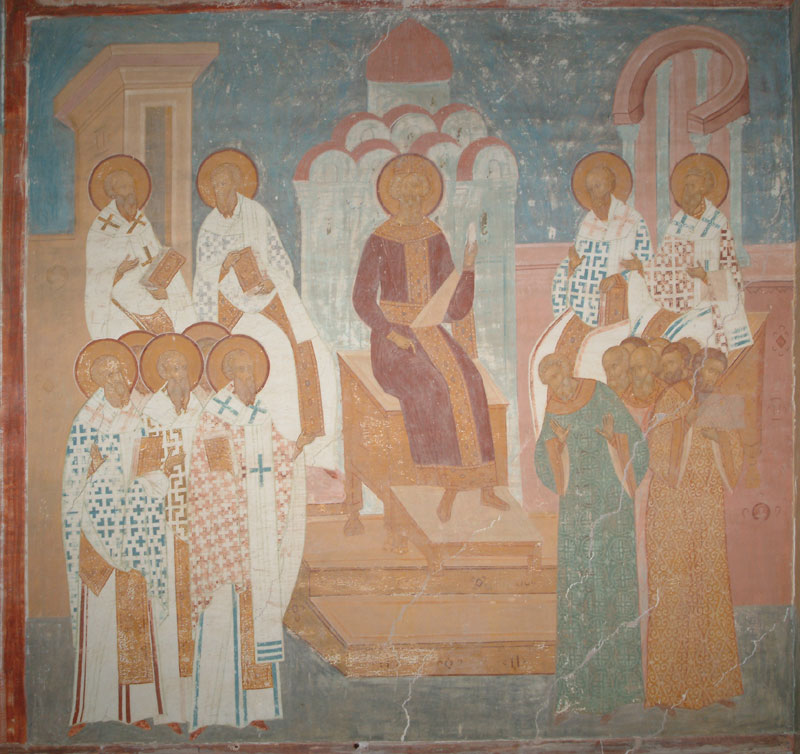
The councils are painted in a single settled composition, and the Fifth takes its place in it: the synod in session, hierarchs ranked in two facing groups, vested in phelonion and omophorion with scrolls in their hands; the emperor enthroned at the centre, raised on a dais, since this is pre-eminently Justinian's council; the open Gospel book or the empty throne of the hetoimasia declaring whose authority is exercised; and below or at the margin the condemned, in disorder, their scrolls falling. Where a cycle of the seven councils runs along a narthex — the standard programme of the Athonite, Serbian, Romanian and Russian katholika — the Fifth is the fifth in the row, and is identified in practice by its inscription rather than by any attribute, since it has no equivalent of Chalcedon's shrine of St Euphemia or Nicaea's Arius prostrate at the emperor's feet.
The stored image is from the council cycle frescoed about 1502 in the cathedral of the Nativity of the Theotokos at the Ferapontov monastery on the White Lake, the masterpiece of Dionisius and the most complete surviving Russian ensemble of the subject: the emperor enthroned at the centre with his hand raised in speech, six hierarchs in patterned polystavria to the left and right, and a knot of laymen and clerics at the right of the composition, the whole in the pale ochres, rose and blue-green of the Ferapontov palette. The identification of this particular compartment as the Fifth Council follows the source from which the photograph comes; in a narthex cycle the compartments are distinguished by inscription, and a reader working from the image alone should treat the numbering as the cycle's rather than as internally evident. The photograph is a frontal reproduction of a flat wall painting more than five centuries old, and is stored as a faithful reproduction of a public-domain two-dimensional work.
Disputed questions
- The number of Fathers. The subscriptions to the final session number 164 or 165 depending on the recension; the liturgical books have settled on 165, and the Church keeps the feast under that number.
- Origen's condemnation. Whether the fifteen anathemas against the Origenists belong to the ecumenical sessions of 553, to a preliminary session, or to the home synod of 543 is genuinely unsettled among historians. The entry records the question and does not resolve it; the Church's reception of the condemnation is not in doubt.
- Vigilius and papal authority. The council anathematised no pope, but it removed a living pope's name from the diptychs and proceeded without him, and a pope reversed himself twice on the substance. The episode is a standing item in both Orthodox and Roman Catholic accounts of the authority of councils, and is read very differently in each.
- Did it add to Chalcedon or interpret it? The Western objection of 553 — that condemning what Chalcedon had received amounts to correcting Chalcedon — has never wholly gone away, and reappears in the modern dialogue with the Oriental Orthodox Churches, for whom the Fifth Council is the point at which the imperial Church came closest to their own reading and still did not take the last step.