
Paschaltide, day 6 · 5 days since Pascha
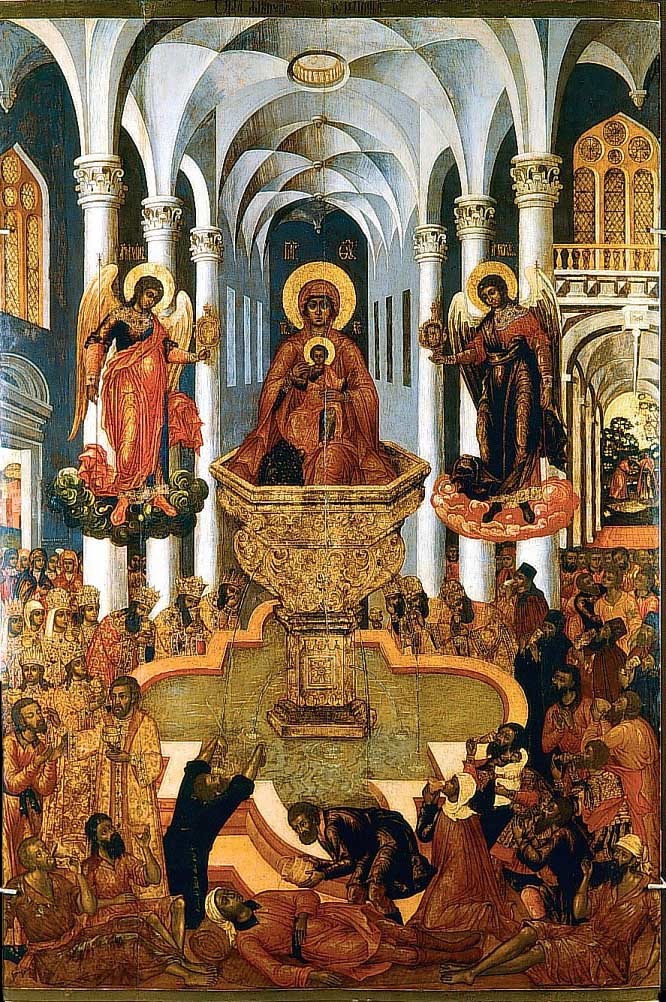
The Life-Giving Spring of the Most-holy Theotokos; St Alexis Toth, Confessor and Defender of Orthodoxy in America
About The Life-Giving Fountain → · About Sign of the Cross which appeared over Jerusalem →

Saints commemorated
-
Commemoration of the Apparition of the Sign of the Precious Cross over Jerusalem in 351 AD
-
Our Holy Fathers of Georgia (6th c.)
-
Martyr Acacius the Centurion at Byzantium (303)
Acacius was a Cappadocian officer of the Roman army — a centurion of the company called the Martesian — who confessed Christ before his own tribune at the opening of the Great Persecution, was tortured through a long series of hearings at Perinthus in Thrace, and was at last beheaded at Byzantium about the year 303. His grave in the small town that would within a generation become Constantinople made him one of the city's earliest martyrs: a church was raised over his relics in the reign of Constantine the Great, and he remained a familiar name in the capital's own devotion. In the West, where his passion travelled with his relics to Calabria, he is Saint Achatius or Agathius, counted among the Fourteen Holy Helpers.
-
St Lydia of Philippi (1st c.)
-
Alexis Toth
Alexis Toth (1854–1909) was a Carpatho-Russian priest of the Greek Catholic (Uniate) Church who came to Minneapolis in 1889, was refused recognition by the Roman Catholic archbishop of the place, and in consequence returned with his congregation to the Orthodox faith of his ancestors — the beginning of the largest single movement of return to Orthodoxy in the history of the American Church. For eighteen years he travelled the mining and mill towns of Pennsylvania and the Midwest, teaching the difference between Orthodoxy and the Union, and brought some seventeen parishes and many thousands of Carpatho-Russian and Galician immigrants into the Orthodox Church. He died at Wilkes-Barre on 7 May 1909, worn out and poor, and was glorified in 1994; his relics rest at Saint Tikhon's Monastery in South Canaan, Pennsylvania. He is styled Confessor and Defender of Orthodoxy in America.
-
John of Beverley
John of Beverley († 7 May 721) was a Northumbrian monk and hierarch, trained at Canterbury under Archbishop Theodore and in the monastery of Whitby under the Abbess Hilda, who became Bishop of Hexham in 687 and Bishop of York in 705, ordained the Venerable Bede both deacon and priest, and ended his life as a simple monk in the house he had founded in the woodland of Deira — the Inderawuda that grew into the town of Beverley. He is known almost entirely from Bede's Ecclesiastical History, which devotes a series of chapters to his healings, gathered from men who had been present at them; those chapters make him one of the best-documented wonderworkers of the Anglo-Saxon Church. His shrine at Beverley became one of the great pilgrimage places of medieval England, and he is kept among the saints of the undivided Church honoured by the Orthodox in the British Isles.
-
John of Zedazeni
John of Zedazeni was a Syrian monk, formed in the ascetic tradition of Antioch, who in the middle of the sixth century came into Georgia with twelve chosen disciples and settled on the mountain of Zedazeni above the old capital of Mtskheta — the very height that had carried the idol of the god Zaden overthrown two centuries before at the preaching of Saint Nina. From that mountain he sent his disciples out singly across Kartli and Kakheti, where each founded the monastery or took the see with which his name is still joined; and the company came to be remembered as the Thirteen Syrian Fathers, the founders of organised monasticism in Georgia and the second evangelisation of the country after Nina. John himself remained in his cave on the mountain, working healings, and reposed there about the 560s.
-
John Psychaites
John, called Psychaites from the monastery in which he lived, was a monk of the Lavra of Psicha near Constantinople in the last years of the eighth century and the first of the ninth, and one of the confessors of the holy icons. He had entered the monastery young, and the fame of his ascetic life and of the healings and exorcisms worked through his prayers had spread beyond it when the imperial power required of him a signature renouncing the veneration of images. He refused it, and called the emperor by his name — a heretic — to his face. For that he was arrested, ill-used and sent into banishment, and by the transmitted account he died in exile. His memory is kept on May 26 in the Slavic calendars and on May 7 in Greek usage.
-
Nilus the Myrrh-gusher
Nilus the Myrrh-gusher (c. 1601–1651) was a Greek hieromonk of Mount Athos who ended his life as a solitary in a nearly inaccessible cave on the mountain's south-eastern cliffs. He is called "Myrrh-gusher" because after his death a fragrant myrrh flowed in such abundance from his grave that it ran down the rock to the sea, drawing pilgrims who came by boat to gather it. In the following century he was believed to have appeared repeatedly to an Athonite monk, dictating a body of prophecies about the last times that circulated widely. He is commemorated on November 12.
-
Nilus of Sora
Nilus of Sora (c. 1433–1508), called in Russian Nil Sorsky, is the greatest representative of the contemplative tradition in the Russian Church and the founder of the skete life in Rus. Born of the Moscow gentry, tonsured at the monastery of Saint Cyril of White Lake, he spent years on Mount Athos and in the Christian East learning hesychasm at its source, and returned to build in the marshes of the river Sora a settlement of a few silent monks living apart in their cells under a written Rule of his own composition — the first sustained treatise on inward prayer written in Slavonic. He taught the guarding of the heart, the prayer of the mind, and the discernment of thoughts; he refused for his monastery all landed property, peasants, adornment and endowment; and as the acknowledged head of the "non-possessors" he stood at the Council of 1503 against monastic landholding. He asked in his testament that his body be thrown out into the wilderness for the beasts, since he had done nothing in this life worth honour.
Troparia & kontakia
Apolytikion — Tone 1
The figure of Thy Cross hath now shone forth brighter than the sun, that Cross which Thou didst stretch out from the holy mountain unto the place of the Skull, making plain thereby, O Saviour, the strength that is in it; and by it Thou hast given strength also to our faithful kings. Keep them evermore in peace, and by the intercessions of the Theotokos, O Christ our God, save us.
Exapostilarion
Thou art in very truth the fount of living water, O Lady; therefore thou dost wash away the grievous sicknesses of souls and of bodies by thy touch alone, who pourest forth Christ, the water of salvation.
Kontakion — Tone 8 (to the automelon *Τῇ ὑπερμάχῳ*)
Out of thine inexhaustible Fountain, O thou who art graced of God, thou bestowest upon me the waters of thy grace, which stream forth unfailingly and beyond all speech; for as thou didst bear the Word past all understanding, I entreat thee to bedew me with thy grace, that I may cry to thee: Rejoice, O water of salvation.
Kontakion — Tone 8
O thrice-blessed and all-venerable Cross, hymning thee and bowing down before thee I am now made holy; for upon thee was Christ lifted up, and saved the world. Make haste therefore and save me by thy power, and deliver me from every danger, that I may cry unto thee: Rejoice, O blessed Wood!
Kontakion — Tone 8
For the love of Christ thou didst withdraw from the turmoils of the world, and with a joyful soul didst make thy dwelling in the wilderness; and struggling nobly therein, O father Nilus, thou didst live as an angel upon the earth, for by vigil and by fasting thou didst wear away thy body for the sake of life eternal.
Megalynarion
Let us honour with faith the life-flowing water of the Fountain, which poureth out the immortal dew, the manna, the divine nectar, the strange ambrosia, the honey out of the rock.
Oikos — Tone 8
O immaculate Theotokos, who ineffably didst bear the pre-eternal Word of the Father, enlarge my mouth, O pure one, and take me with thee unto thy praise, that I may sing thy Fountain and cry aloud: Rejoice, fount of unceasing gladness; rejoice, stream of beauty past telling. Rejoice, undoing of every sickness; rejoice, flood that drowns the manifold passions. Rejoice, clearest current, that makest the faithful whole; rejoice, most gracious water, to them that are many times diseased.
Troparion — Tone 4 (common of a martyr)
Thy martyr Acacius, O Lord, in his contest received an incorruptible crown from Thee our God; for possessing Thy strength, he cast down the tyrants and shattered the feeble insolence of the demons. By his intercessions save our souls.
Troparion — Tone 4 (common of a confessor)
O righteous father Alexis, thou wast an unshaken pillar of the Church in a strange land, and by thy teaching thou didst lead a scattered people home to the faith of their fathers; enduring reproach and poverty for the truth, thou didst gather the flock of Christ in the new world. Wherefore intercede with Christ God that our souls may be saved.
Troparion — Tone 8 (common of a hierarch)
O guide of Orthodoxy and teacher of piety and holiness, luminary of the North and divinely inspired adornment of hierarchs, O wise John: by thy teaching thou hast enlightened all, and by thy prayers thou didst loose the tongue of the speechless and raise up the dying; O harp of the Spirit, intercede with Christ God that our souls may be saved.
Troparion — Tone 8 (common of a venerable father)
By the torrent of thy tears thou didst make the barren mountain to blossom, and by thy sighings from the depths thou didst bear fruit an hundredfold in thy labours; thou wast a beacon to the land of Georgia, shining forth in wonders, O our father John. Intercede with Christ God for the salvation of our souls.
Troparion — Tone 8 (common of a venerable confessor)
The image of God was truly preserved in thee, O Father, for thou didst take up the Cross and follow Christ; and by thy deeds thou hast taught us to despise the flesh, which passeth away, and to care for the soul, which is immortal. Wherefore thy spirit, O venerable John, rejoiceth with the angels.
Troparion — Tone 4
Withdrawing and fleeing from the world as David did, and counting all that is in it as refuse, thou didst make thy dwelling in a place of silence and wast filled with spiritual gladness, O our father Nilus; and choosing to serve God alone, thou didst flourish like a palm tree, and like a fruitful vine didst multiply the children of the wilderness. Therefore we cry aloud in thanksgiving: Glory to Him who strengthened thee in the struggle of the desert life; glory to Him who chose thee to be for the hermits of Russia an excellent lawgiver of their rule; glory to Him who by thy prayers saveth us also.
Readings
Vespers
Composite 2 - Proverbs 10, 3, 8
1The memory of a just man is praised, and the Lord’s blessing is upon his head. Blessed is one who has found wisdom; a mortal who knows understanding. To import her is better than treasures of gold and silver. She is more valuable than precious stones; nothing of value equals her worth. Justice proceeds from her mouth; she bears law and mercy on her tongue. Therefore, my children, listen to me, for I speak weighty things. And blessed is the one who keeps my ways. For my goings out are the goings out of life, and favour is prepared from the Lord. Therefore I exhort you, and utter my voice to the children of humankind. Because I, Wisdom, have prepared counsel, knowledge and understanding. I have called on them. Counsel and sureness are mine; prudence is mine, strength is mine. I love those who are my friends, while those who seek me will find grace. You innocent, then, understand cunning; you untaught, take it to heart. Listen to me, for I will speak weighty things, and I will open right things from my lips. Because my throat will meditate truth; lying lips are abominable before me. All the words of my mouth are with justice, there is nothing crooked in them nor twisted. They are all straight for those who understand, and right for those who find knowledge. For I teach you what is true, that your hope may be in the Lord and that you may be filled with spirit.
Composite 4 - Proverbs 10; Wisdom of Solomon 6, 7, 8, 9
1The mouth of a just man distils wisdom; the lips of men know graces. The mouth of the wise meditates wisdom; justice delivers them from death. When a just man dies hope is not lost; for a just son is born for life, and among his good things he will pluck the fruit of justice. There is light at all times for the just, and they will find grace and glory from the Lord. The tongue of the wise knows what is good, and wisdom will take its rest in their hearts. The Lord loves holy hearts; while all who are blameless in the way are acceptable to him. The wisdom of the Lord will enlighten the face of the understanding; for she anticipates those who desire her before they know it, and is easily contemplated by those who love her. One who rises for her at dawn will not toil, and one who keeps vigil because of her will be without care. For she goes about seeking those who are worthy of her, and shows herself favourably to those on her paths. Wickedness will never prevail against wisdom. Because of this I too became a lover of her beauty and became her friend, and I sought her out from my youth, and I sought to take her as my bride, because the Master of all things loved her, for she is an initiate of the knowledge of God and one who chooses his works. Her toils are virtues; she herself teaches sobriety and prudence; justice and courage, than which things nothing is more useful in human life. If anyone longs for much experience, she knows how to compare things of old and those that are to come. She knows the twists of words and the explanations of riddles. She foresees signs and wonders and the outcomes of seasons and times. And to all she is a good counsellor. Because immortality is in her, and fame in the fellowship of her words. Therefore I appealed to the Lord and besought him and said from my whole heart, ‘God of my Fathers and Lord of mercy, who made all things by your Word, and established humanity by your Wisdom to be sovereign over the creatures that had come into being by you, and to order the world in holiness and justice, give me Wisdom who sits by your throne, and do not reject me from among your children, for I am your servant and the son of your maid servant. Send her out from your holy dwelling and from the throne of your glory, that she may be present with me and teach me what is well pleasing before you. And she will guide me with knowledge and guard me with her glory. For all the thoughts of mortals are wretched and their ideas are unstable.’
Composite 5 - Wisdom of Solomon 4, 6, 7, 2
1When a just man is praised, peoples will be glad; for immortality is his memory, because it is known both to God and humankind, and his soul is pleasing to the Lord. Therefore, O men, desire wisdom, and long for it and be instructed. For her beginning is love and keeping of laws. Honour Wisdom, that you may reign for ever. I will declare the mysteries of God to you and not hide them from you. Because he is both the guide of Wisdom and the One who sets right the wise. In his hand are all prudence, and knowledge of works. Wisdom, the artificer of all things, taught me, for in her is an understanding spirit, holy, brightness of the eternal light and image of the goodness of God. She makes friends of God and prophets. She is more lovely than the sun, and beyond every order of the stars. If compared to light, she is found before it. She delivered her devotees from toils, and guided them in straight paths. She gave them holy knowledge and protected them from those who lay in ambush for them. She awarded them a mighty contest, that all might know that true religion is more powerful than all, and that wickedness can never prevail against Wisdom, nor will justice in passing sentence overlook evil people. For they said in themselves, not reasoning correctly, ‘Let us overpower the just one, let us not spare his saintliness, nor feel reverence for the aged grey hairs of an elder. Let our strength be law. Let us lie in ambush for the just, for he is a hindrance to us and he is opposed to our works and alleges the sins of our upbringing. He claims to have knowledge of God, and calls himself a child of the Lord. He has become a reproof to our thoughts. He is grievous for us even to look at, for his life is not like others and his paths are quite different. We are reckoned by him to be counterfeit, and he keeps away from our ways as from filth. He calls the end of just people blessed. Let us see if his words are true, and let us test what will happen to him at the end. Let us examine him by insult and torture, that we may know his forbearance and make trial of his patience. Let us condemn him to a shameful death, for he will have protection from his own words.’ This was how they argued, and they were deceived, for their wickedness had blinded them. And they did not know the mysteries of God, nor did they judge that you alone are God, who have authority over life and death, who save in time of tribulation and deliver from every ill; pitying and merciful, giving grace to your holy ones, and by your right arm resisting the proud.
Matins Gospel
John 10.9-16
9I am the door: by me if any man enter in, he shall be saved, and shall go in and out, and find pasture. 10The thief cometh not, but for to steal, and to kill, and to destroy: I am come that they might have life, and that they might have it more abundantly. 11I am the good shepherd: the good shepherd giveth his life for the sheep. 12But he that is an hireling, and not the shepherd, whose own the sheep are not, seeth the wolf coming, and leaveth the sheep, and fleeth: and the wolf catcheth them, and scattereth the sheep. 13The hireling fleeth, because he is an hireling, and careth not for the sheep. 14I am the good shepherd, and know my sheep, and am known of mine. 15As the Father knoweth me, even so know I the Father: and I lay down my life for the sheep. 16And other sheep I have, which are not of this fold: them also I must bring, and they shall hear my voice; and there shall be one fold, and one shepherd.
Epistle
Acts 3.1-8
1Now Peter and John went up together into the temple at the hour of prayer, being the ninth hour. 2And a certain man lame from his mother’s womb was carried, whom they laid daily at the gate of the temple which is called Beautiful, to ask alms of them that entered into the temple; 3Who seeing Peter and John about to go into the temple asked an alms. 4And Peter, fastening his eyes upon him with John, said, Look on us. 5And he gave heed unto them, expecting to receive something of them. 6Then Peter said, Silver and gold have I none; but such as I have give I thee: In the name of Jesus Christ of Nazareth rise up and walk. 7And he took him by the right hand, and lifted him up: and immediately his feet and ancle bones received strength. 8And he leaping up stood, and walked, and entered with them into the temple, walking, and leaping, and praising God.
Galatians 1.11-19 (St Alexis)
11But I certify you, brethren, that the gospel which was preached of me is not after man. 12For I neither received it of man, neither was I taught it, but by the revelation of Jesus Christ. 13For ye have heard of my conversation in time past in the Jews’ religion, how that beyond measure I persecuted the church of God, and wasted it: 14And profited in the Jews’ religion above many my equals in mine own nation, being more exceedingly zealous of the traditions of my fathers. 15But when it pleased God, who separated me from my mother’s womb, and called me by his grace, 16To reveal his Son in me, that I might preach him among the heathen; immediately I conferred not with flesh and blood: 17Neither went I up to Jerusalem to them which were apostles before me; but I went into Arabia, and returned again unto Damascus. 18Then after three years I went up to Jerusalem to see Peter, and abode with him fifteen days. 19But other of the apostles saw I none, save James the Lord’s brother.
Philippians 2.5-11 (Theotokos)
5Let this mind be in you, which was also in Christ Jesus: 6Who, being in the form of God, thought it not robbery to be equal with God: 7But made himself of no reputation, and took upon him the form of a servant, and was made in the likeness of men: 8And being found in fashion as a man, he humbled himself, and became obedient unto death, even the death of the cross. 9Wherefore God also hath highly exalted him, and given him a name which is above every name: 10That at the name of Jesus every knee should bow, of things in heaven, and things in earth, and things under the earth; 11And that every tongue should confess that Jesus Christ is Lord, to the glory of God the Father.
Gospel
John 2.12-22
12After this he went down to Capernaum, he, and his mother, and his brethren, and his disciples: and they continued there not many days. 13And the Jews’ passover was at hand, and Jesus went up to Jerusalem, 14And found in the temple those that sold oxen and sheep and doves, and the changers of money sitting: 15And when he had made a scourge of small cords, he drove them all out of the temple, and the sheep, and the oxen; and poured out the changers’ money, and overthrew the tables; 16And said unto them that sold doves, Take these things hence; make not my Father’s house an house of merchandise. 17And his disciples remembered that it was written, The zeal of thine house hath eaten me up. 18Then answered the Jews and said unto him, What sign shewest thou unto us, seeing that thou doest these things? 19Jesus answered and said unto them, Destroy this temple, and in three days I will raise it up. 20Then said the Jews, Forty and six years was this temple in building, and wilt thou rear it up in three days? 21But he spake of the temple of his body. 22When therefore he was risen from the dead, his disciples remembered that he had said this unto them; and they believed the scripture, and the word which Jesus had said.
John 10.1-9 (St Alexis)
1Verily, verily, I say unto you, He that entereth not by the door into the sheepfold, but climbeth up some other way, the same is a thief and a robber. 2But he that entereth in by the door is the shepherd of the sheep. 3To him the porter openeth; and the sheep hear his voice: and he calleth his own sheep by name, and leadeth them out. 4And when he putteth forth his own sheep, he goeth before them, and the sheep follow him: for they know his voice. 5And a stranger will they not follow, but will flee from him: for they know not the voice of strangers. 6This parable spake Jesus unto them: but they understood not what things they were which he spake unto them. 7Then said Jesus unto them again, Verily, verily, I say unto you, I am the door of the sheep. 8All that ever came before me are thieves and robbers: but the sheep did not hear them. 9I am the door: by me if any man enter in, he shall be saved, and shall go in and out, and find pasture.
Luke 10.38-42, 11.27-28 (Theotokos)
38Now it came to pass, as they went, that he entered into a certain village: and a certain woman named Martha received him into her house. 39And she had a sister called Mary, which also sat at Jesus’ feet, and heard his word. 40But Martha was cumbered about much serving, and came to him, and said, Lord, dost thou not care that my sister hath left me to serve alone? bid her therefore that she help me. 41And Jesus answered and said unto her, Martha, Martha, thou art careful and troubled about many things: 42But one thing is needful: and Mary hath chosen that good part, which shall not be taken away from her. 27And it came to pass, as he spake these things, a certain woman of the company lifted up her voice, and said unto him, Blessed is the womb that bare thee, and the paps which thou hast sucked. 28But he said, Yea rather, blessed are they that hear the word of God, and keep it.