
Paschaltide, day 1
The Resurrection of our Lord and Savior Jesus Christ
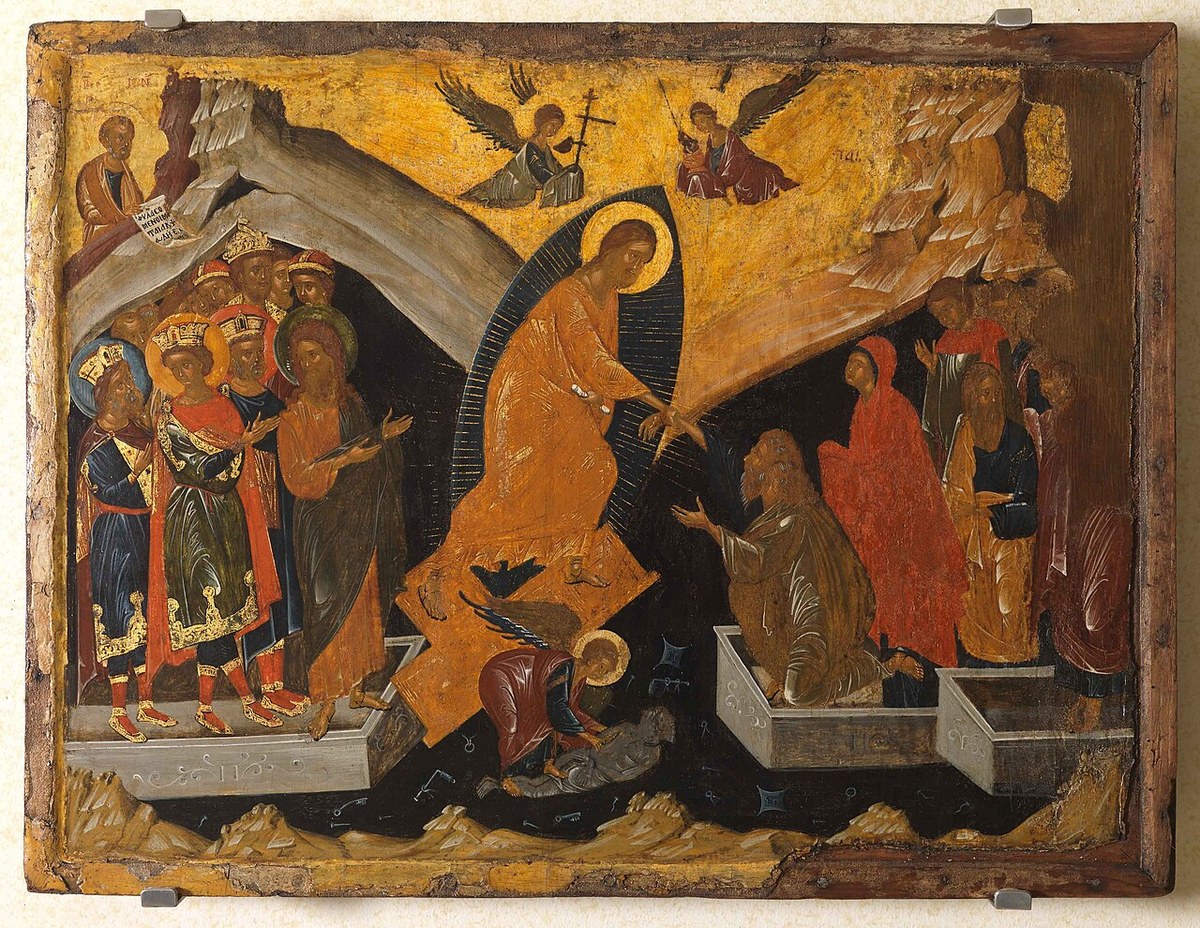
.jpg)
Saints commemorated
-
Beginning of the Pentecostarion
-
Apostles Jason and Sosipater of the Seventy
Jason and Sosipater are two apostles of the Seventy, disciples and kinsmen of the Apostle Paul, whom the Church honours together as the enlighteners of Corfu (Kerkyra). Both are greeted by name in the New Testament — Jason as Paul's host at Thessalonica whose house was stormed by the mob (Acts 17:5–9), and both as those who send greeting from Corinth, "Jason and Sosipater, my kinsmen" (Romans 16:21). The tradition makes Jason a native of Tarsus, its first-fruits and its bishop, and Sosipater a man of Achaia and bishop of Iconium. Leaving their sees, the two sailed west to the island of Corfu, built there the first church in the name of the Protomartyr Stephen, and were imprisoned by the island's ruler; from that prison they converted seven condemned robbers and the gaoler who guarded them, and at last the king's own daughter Kerkyra and the ruler himself, who was baptised Sebastian. They ended their days on the island in great old age, and Corfu keeps them as its apostles to this day.
-
The Nine Martyrs at Cyzicus (3rd c.)
-
Cyril of Turov
Cyril, Bishop of Turov, is the greatest preacher of Kievan Rus and one of the finest writers in the whole of Old East Slavonic literature — called by his own contemporaries "a Russian Chrysostom" and, in the troparion of his feast, "the golden-tongued teacher" whose learning "enlightened the ends of the Russian land." Born in the 1130s to a wealthy family in Turov on the river Pripyat, he refused his inheritance, was tonsured in the Turov monastery of Saints Boris and Gleb, and afterwards shut himself up on a pillar — the first named stylite of the Russian Church — where he wrote and expounded the Scriptures. Drawn from the pillar to the episcopate, he ruled the see of Turov, took part in the council of 1169 that condemned the schismatic bishop Theodore of Vladimir, and wrote letters of admonition to Prince Andrew Bogolyubsky. About 1182 he resigned his see for the sake of writing, and reposed on April 28, about 1183. There survive from his hand sermons for the feasts of the Lord through the year, allegorical parables, treatises on the monastic life, canons and a cycle of daily prayers — some forty pieces, gathered in the collected edition of 1880.
-
Kerkyra and the martyrs of Corfu
Kerkyra was, by the received account, the daughter of Kerkyllinos, the ruler of the island of Corfu in the first century, who confessed Christ when she learned why the apostles Jason and Sosipater and their fellow-prisoners were suffering in her father's gaol. She gave away her jewels and her goods to the poor, withstood her father's rage and his attempt to shame her, and was at the last hung upon a tree and shot to death with arrows. With her the Church keeps on this day the whole company of the island's first martyrs: the seven condemned robbers whom the apostles converted in prison and who were boiled in a cauldron of pitch, the gaoler who confessed Christ at the sight of their end and was mutilated and beheaded, the robber set upon Kerkyra who believed instead of harming her, and the martyrs Zenon, Vitalis, Eusebius and Neon, perfected by fire. They are the first-fruits of Corfu, and the company from which the church of the island grew.
-
Maximus, Quintilian and Dadas
Maximus, Quintilian (Kyntilianos) and Dadas were three kinsmen of the region of Dorostolum on the lower Danube (in Roman Moesia, now Silistra), martyred about the year 286 in the persecution of Diocletian and Maximian. Arrested for refusing to sacrifice at the pagan festival, they confessed Christ under interrogation and torture, and were beheaded at a place called Ozovia. The Church keeps their memory together on April 13.
British Isles and Ireland
- St. Cronan, abbot of Roscrea (7th C)
- St. Gerard the Pilgrim (639)
- SS. Probe and Germaine (4th C)
Troparia & kontakia
Apolytikion — Tone 3
Holy apostles, intercede with the merciful God, that he may grant our souls forgiveness of offences.
Exapostilarion — Tone 2
Having fallen asleep in the flesh as a mortal man, O King and Lord, on the third day thou didst rise again, raising Adam from corruption and abolishing death: O Pascha of incorruption, O salvation of the world.
Kontakion — Tone 4
Though thou didst descend into the tomb, O Immortal, yet didst thou bring down the power of Hades, and didst rise again as victor, O Christ God, saying to the myrrhbearing women, Rejoice!, and granting peace to thine apostles — thou who dost bestow resurrection on the fallen.
Kontakion — Tone 8 (common of a hierarch)
Having shone as a lamp upon the pillar and upon the episcopal throne alike, and having fed the Church with the honey of your words, O father Cyril, you were shown to be a second Chrysostom to the Russian land; wherefore we cry to you: Rejoice, O golden-worded teacher of Turov.
Kontakion — Tone 2
Illumined by the teachings of Paul, you became luminaries of the whole inhabited earth, O thrice-blessed ones; for you enlighten the world unceasingly with wonders — Jason, the fountain of healings, and Sosipater, the glory of the martyrs of Christ. O God-bearing apostles, protectors of those in distress, entreat God that our souls may be saved.
Kontakion — Tone 2 (common of several martyrs)
You who are the source of all light and the crown of those who contend, have strengthened the first-fruits of the island of Kerkyra: a king's daughter, and prisoners loosed from their chains, and men refined in the fire. By their prayers, O Christ, grant your mercy to us who honour them.
Oikos
The maidens bearing myrrh came before the dawn, seeking as men seek the daylight the Sun that was before the sun, who for a while had set within a tomb; and they cried out to one another: O friends, come, let us anoint with spices the life-bearing and buried Body, the flesh that raises up fallen Adam, lying now in the grave. Let us go, let us make haste like the Magi, and worship, and offer our myrrh as gifts to him who is wrapped not in swaddling bands but in a linen shroud; and let us weep and cry aloud: O Master, arise, thou who dost bestow resurrection on the fallen.
Oikos
O apostles who speak of God, heralds of true worship, teachers and ever-venerable protectors of the devout, who stand before God and are filled with the divine light and adorned with crowns: enlighten us, we pray, that we may keep your all-festal feast in reverence and in songs of praise. For we are all your flock, ransomed from error by grace; and since you are saviours of the faithful, hasten to the Creator, to plead with boldness that our souls may be saved.
Stichera
You left behind all that is pleasant, having loved Christ, and clave to him with your souls, O glorious ones, and followed in his footsteps in faith, all-wise Jason and Sosipater; wherefore intercede with him, that peace and great mercy be granted to our souls. Jason and Sosipater, enlighten my soul that is darkened by the passions — you who lit up the whole earth with your godly teachings, and lessened the darkness of the idols, and brought the whole human race, saved, to Christ our God.
Synaxarion
Learning that a robber's portion was Eden, the robbers made haste to obtain that same portion through burning pitch. Pierced with the shots of arrows, the king's daughter shone out from her wounds as from pearls. Do not be afraid before the flame, O Vitalios: for I will lead the way, and Zenon will enter first. What filth could that fire of yours scour away, O Eusebius, refined gold of Christ?
The
Christ is risen from the dead, trampling down death by death, and to those in the tombs bestowing life.
The
The women who were with Mary, having come before the dawn and having found the stone rolled away from the tomb, heard from the angel: Why do you seek among the dead, as though he were a man, him who dwells in everlasting light? Behold the grave-clothes! Run and proclaim to the world that the Lord is risen, having put death to death; for he is the Son of God who saves the race of men.
The
It is the day of Resurrection! Let us be radiant, O peoples: Pascha, the Lord's Pascha! For from death to life and from earth to heaven Christ our God has brought us over, as we sing the hymn of victory. Now all is filled with light — heaven, and earth, and the places beneath the earth. Let all creation therefore keep the feast of the rising of Christ, in whom it is made firm. We keep the feast of the putting to death of death, the pulling down of Hades, and the firstfruits of another life, the eternal one; and leaping for joy we hymn the Cause of it, the only blessed and exceedingly glorious God of our fathers. This is the chosen and holy day, the one and first of the sabbaths, the queen and the lady, the feast of feasts and the festival of festivals, on which we bless Christ unto the ages. Shine, shine, O new Jerusalem, for the glory of the Lord has risen upon thee! Dance now and be glad, O Sion; and do thou rejoice, O pure Theotokos, in the rising of him whom thou didst bear. O Pascha, great and most holy, O Christ! O Wisdom and Word and Power of God! Grant us to partake of thee more perfectly in the day of thy kingdom that knows no evening.
The
Today a sacred Pascha has been shown to us: a Pascha new and holy, a Pascha mystical, a Pascha all-venerable, a Pascha that is Christ the Redeemer; a Pascha unblemished, a Pascha great, the Pascha of the faithful, the Pascha that has opened to us the gates of Paradise, the Pascha that sanctifies all the faithful. It is the day of Resurrection! Let us be radiant for the festival, and let us embrace one another. Let us say, O brethren, even to those that hate us: Let us forgive all things for the Resurrection's sake. And so let us cry aloud: Christ is risen from the dead, trampling down death by death, and to those in the tombs bestowing life.
The
Christ, having gone down alone to wrestle with Hades, came up again bearing many spoils of victory.
Troparion — Tone 4
Zealot and lover of true piety, praise of monks and of stylites, most glorious hierarch of the flock of Turov, golden-tongued teacher, who with the shining doctrine of your knowledge of God enlightened the ends of the Russian land, gracious helper of sinners in prayer to God: O Cyril, wise in God, entreat Christ God that we, your countrymen, may be established in Orthodoxy, in piety and in oneness of mind.
Troparion — Tone 4 (common of a virgin-martyr)
Your ewe-lamb Kerkyra cries out to you with a great voice, O Jesus: I love you, my Bridegroom, and in seeking you I contend; I am crucified and buried together with you in your baptism, and I suffer for your sake, that I may reign with you; I die for you, that I may live in you. Receive me as a spotless sacrifice, offered to you in love. By her intercessions, as you are merciful, save our souls.
Troparion — Tone 4 (common of several martyrs)
Thy martyrs Maximus, Quintilian and Dadas, O Lord, in their contest received incorruptible crowns from Thee, our God; for possessing Thy strength, they cast down the tyrants and shattered the feeble insolence of the demons. By their intercessions save our souls.
Readings
Epistle
Acts 1.1-8
1The former treatise have I made, O Theophilus, of all that Jesus began both to do and teach, 2Until the day in which he was taken up, after that he through the Holy Ghost had given commandments unto the apostles whom he had chosen: 3To whom also he shewed himself alive after his passion by many infallible proofs, being seen of them forty days, and speaking of the things pertaining to the kingdom of God: 4And, being assembled together with them, commanded them that they should not depart from Jerusalem, but wait for the promise of the Father, which, saith he, ye have heard of me. 5For John truly baptized with water; but ye shall be baptized with the Holy Ghost not many days hence. 6When they therefore were come together, they asked of him, saying, Lord, wilt thou at this time restore again the kingdom to Israel? 7And he said unto them, It is not for you to know the times or the seasons, which the Father hath put in his own power. 8But ye shall receive power, after that the Holy Ghost is come upon you: and ye shall be witnesses unto me both in Jerusalem, and in all Judæa, and in Samaria, and unto the uttermost part of the earth.
Gospel
John 1.1-17
1In the beginning was the Word, and the Word was with God, and the Word was God. 2The same was in the beginning with God. 3All things were made by him; and without him was not any thing made that was made. 4In him was life; and the life was the light of men. 5And the light shineth in darkness; and the darkness comprehended it not. 6There was a man sent from God, whose name was John. 7The same came for a witness, to bear witness of the Light, that all men through him might believe. 8He was not that Light, but was sent to bear witness of that Light. 9That was the true Light, which lighteth every man that cometh into the world. 10He was in the world, and the world was made by him, and the world knew him not. 11He came unto his own, and his own received him not. 12But as many as received him, to them gave he power to become the sons of God, even to them that believe on his name: 13Which were born, not of blood, nor of the will of the flesh, nor of the will of man, but of God. 14And the Word was made flesh, and dwelt among us, (and we beheld his glory, the glory as of the only begotten of the Father,) full of grace and truth. 15John bare witness of him, and cried, saying, This was he of whom I spake, He that cometh after me is preferred before me: for he was before me. 16And of his fulness have all we received, and grace for grace. 17For the law was given by Moses, but grace and truth came by Jesus Christ.