
Cyril of Turov
Our Father among the Saints Cyril, Bishop of Turov, the Golden-tongued Teacher of the Russian Land
Bishop · Venerable · b. 1130s — d. c. 1183
Commemorated 28 April — Repose of the bishop of Turov
Cyril, Bishop of Turov, is the greatest preacher of Kievan Rus and one of the finest writers in the whole of Old East Slavonic literature — called by his own contemporaries "a Russian Chrysostom" and, in the troparion of his feast, "the golden-tongued teacher" whose learning "enlightened the ends of the Russian land." Born in the 1130s to a wealthy family in Turov on the river Pripyat, he refused his inheritance, was tonsured in the Turov monastery of Saints Boris and Gleb, and afterwards shut himself up on a pillar — the first named stylite of the Russian Church — where he wrote and expounded the Scriptures. Drawn from the pillar to the episcopate, he ruled the see of Turov, took part in the council of 1169 that condemned the schismatic bishop Theodore of Vladimir, and wrote letters of admonition to Prince Andrew Bogolyubsky. About 1182 he resigned his see for the sake of writing, and reposed on April 28, about 1183. There survive from his hand sermons for the feasts of the Lord through the year, allegorical parables, treatises on the monastic life, canons and a cycle of daily prayers — some forty pieces, gathered in the collected edition of 1880.
.jpg)
Origins and early life
Cyril was born in the 1130s in the town of Turov, on the Pripyat in the Turov–Pinsk country of the western Kievan realm (in what is now southern Belarus), the child of wealthy parents. The notices of his life stress that his family's rank gave him an education few in Rus could have had: he learned the sacred books from childhood and studied under both Russian and Greek teachers, so that he read and thought in the Byzantine manner. The evidence of his own writings bears this out at every turn — they move in the idiom of Greek homiletics, with the antitheses, apostrophes and dramatised speeches of the fourth-century Fathers, handled with a freedom that no translator's Slavonic can account for.
Coming to manhood, he renounced his inheritance and was tonsured in the monastery of Saints Boris and Gleb at Turov, the house dedicated to the passion-bearing princes. His own writings on monasticism, and the sayings preserved of him, show what kind of monk he was: he demanded absolute obedience to the abbot, and taught that a monk who is not obedient to his igumen does not fulfil his vow and therefore cannot be saved. Three of his works treat the monastic life, among them the Tale of the Monastic Order, from the Old Law and the New — an allegorical exposition of the tonsure and the habit against the pattern of the Tabernacle and the Temple.
The pillar
From the coenobium Cyril withdrew to a still stricter discipline: he enclosed himself upon a pillar (столпничество), the Byzantine ascetic form of Symeon and Daniel the Stylites, and there, in the words of the notice, "set forth much of the divine Scriptures." He is the first stylite named in the Russian record, and the pillar of Turov became a place to which people came for counsel: it was there that his reputation for holiness and learning was made, and from there that the Church took him.
Bishop of Turov
At the desire of the prince of Turov and of the people, Cyril was drawn from his pillar and consecrated Bishop of Turov — by the usual reckoning about 1169, in the metropolitanate of Kiev. His episcopate falls in the bitterest years of the breaking-up of Kievan Rus, when Andrew Bogolyubsky of Vladimir-Suzdal was making his own north-east into a rival centre of the Russian land.
In 1169 Cyril took part in the council which condemned Bishop Theodore of Vladimir — "Fedorets" to the chroniclers — who had sought to detach his diocese from the metropolitanate of Kiev and to have himself made an independent hierarch, and who had governed his church with violence. Cyril's part in the condemnation was not merely juridical: he wrote against Theodore, and the tradition reads his Parable of the Human Soul and Body — the tale of the blind man and the lame man who together rob their master's vineyard — as a coded indictment of the ambitious bishop and his prince, the blind man standing for the shepherd without spiritual sight and the lame for the ruler without a straight walk. He also addressed a series of epistles to Prince Andrew Bogolyubsky on the disorders of the churches, exercising the office of the hierarch as a teacher of princes.
About 1182 he left his see, whether by resignation or by withdrawal into retirement, and gave the last years wholly to writing and prayer. He reposed on April 28, about the year 1183.
Hymnographic and literary legacy
Cyril's surviving corpus is the largest and most accomplished body of original writing from twelfth-century Rus. It falls into four kinds:
- Sermons on the feasts. He composed slova for the cycle of the Lord's feasts through the church year, of which some dozen survive: on the Sunday of Thomas ("New Sunday"), on the Myrrh-bearing Women, on the Paralytic, on the Man Born Blind, on the Ascension, on the Fathers of the First Ecumenical Council, on the Deposition of Christ from the Cross. Not all that he wrote is preserved. Their manner is a dramatised, richly figured rhetoric — spring imagery for the renewal of the world at Pascha, invented laments and dialogues for the Mother of God and Joseph of Arimathea, question and answer, apostrophe to the congregation — Byzantine in technique and wholly assured in Slavonic. The Sermon on the New Sunday, with its famous comparison of the risen creation to the spring, is the single most anthologised page of pre-Mongol Russian literature.
- Parables and allegories. Besides the Parable of the Human Soul and Body, there is the parable of the white-robed monastic order and other extended allegories, in which a narrative is set out and then interpreted member by member in the manner of the Greek exegetes.
- Monastic writings. Three works on the monastic life, including the Tale of the Monastic Order from the Old Law and the New, and a letter to an abbot named Basil.
- Prayers and canons. A cycle of prayers for the days of the week, appointed to be said after the hours — devotional texts of great tenderness and compunction that passed into Russian prayer-books and were still being copied and printed centuries later — together with a canon and a penitential canon attributed to him.
A collected edition of his works was published in 1880 under Bishop Eugene, containing some forty pieces; the prayers and the festal sermons had circulated in manuscript for seven hundred years before that.
Veneration and later cultus
His contemporaries called him "a Russian Chrysostom", and the epithet stuck: the troparion of his feast styles him zlatoslovesnyi uchitel', the golden-worded teacher. His memory was kept from soon after his repose; the Prologue notices him, his prayers were copied in the household books of the pious, and his name stands in the general commemorations of the Russian saints. Turov itself declined and the see lapsed, and no relics of his are preserved.
In modern times he has become the chief patron of theological learning in Belarus, whose Church honours him as its foremost native writer and hierarch — a bishop of the Pripyat country claimed alike by the Belarusian, Ukrainian and Russian traditions of the one Kievan inheritance.
Feast and commemoration
April 28 (church date; New Calendar civil April 28, Old Calendar civil May 11) — the day of his repose. The commemoration is proper to the Russian tradition and its daughter churches, and is kept with especial honour in Belarus and in the Turov–Pinsk country; the Greek calendars do not carry him. He is commemorated again in the general synaxes of the saints of the Russian land and of the saints of Belarus.
Because Pascha may fall as late as May 8, April 28 comes either within Great Lent or in the Pentecostarion according to the year, and the hierarch's service is combined with the Lenten or the paschal propers as the Typikon appoints. In the Slavic Menaia he shares the day with the apostles Jason and Sosipater and the martyrs of Corfu, and with the martyrs Maximus, Quintilian and Dadas of Dorostolum, whom the Greek books keep on April 13.
Hymns
Troparion — Tone 4
Zealot and lover of true piety, praise of monks and of stylites, most glorious hierarch of the flock of Turov, golden-tongued teacher, who with the shining doctrine of your knowledge of God enlightened the ends of the Russian land, gracious helper of sinners in prayer to God: O Cyril, wise in God, entreat Christ God that we, your countrymen, may be established in Orthodoxy, in piety and in oneness of mind.
Original translation from the Slavonic
Kontakion — Tone 8 (common of a hierarch)
Having shone as a lamp upon the pillar and upon the episcopal throne alike, and having fed the Church with the honey of your words, O father Cyril, you were shown to be a second Chrysostom to the Russian land; wherefore we cry to you: Rejoice, O golden-worded teacher of Turov.
Original translation from the Slavonic
Iconography
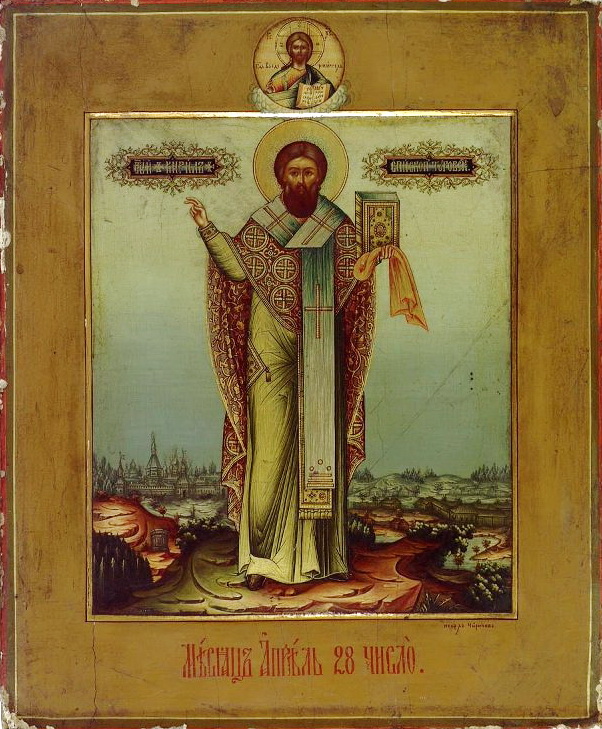
Cyril is shown as a Russian hierarch of the pre-Mongol period: full-length or bust-length, in phelonion or sakkos with the omophorion, the right hand blessing and the left holding the Gospel book, the head bare in the Russian manner, with a dark, forking beard of middle length and a high brow. Because his fame is that of a writer, he is often given a scroll or an open book with the words of one of his sermons instead of the Gospel; and because of his years on the pillar he may be shown with a column in the background, or, in fuller compositions, standing upon it. He frequently appears in the multi-figure icons of the Assembly of the Russian Saints and of the saints of Belarus.
The stored image is a menaion icon of about 1850 by the Moscow icon-painter Osip Semyonovich Chirikov (State Museum of the History of Religion, St Petersburg), signed by him at the lower right. The saint stands full-length in a red-and-gold phelonion with a green omophorion and epitrachelion, blessing with the right hand and holding a jewelled Gospel in the left; behind him lies the town of Turov with its churches on the far bank of the Pripyat, and above, in a cloud, Christ blesses with the book. The inscriptions read Ст҃ѣ́й Кѵрі́ллъ є̓пі́скопъ Ту́ровскїй and, along the lower border, Мѣ́сѧца Апрѣ́ль 28 число̀ — "the month of April, the 28th day" — the icon being one panel of a calendar cycle, which fixes both the identity and the feast beyond doubt.
Disputed questions
- The date of his repose. The notices give 1183, some 1182; where 1182 is given it usually marks his resignation of the see rather than his death, and "about 1183" is the safest form. The day, April 28, is firmly transmitted and is confirmed by the inscription on nineteenth-century menaion icons of him.
- Was he literally a stylite? The Slavonic столпъ is used both of the stylite's column and of a tower or an enclosed cell, and scholars differ over whether Cyril stood on a pillar in the Syrian manner or was a recluse in a tower attached to his monastery. The tradition of the Russian Church calls him a stylite, and the troparion pairs him with the stylites; the physical form of the discipline is uncertain.
- The authenticity of parts of the corpus. Twelfth-century attributions in Slavonic manuscripts are seldom secure. The festal sermons are generally accepted as his; the weekly prayer-cycle and some of the canons are attributed to him with more or less confidence, and a number of pieces once printed under his name have been removed from the corpus by later critics. The Parable of the Soul and Body is accepted, though its application to Bishop Theodore is an inference from the circumstances and not stated in the text.
- Not to be confused with the other Cyrils of the Slavonic calendars: Cyril the Philosopher, the apostle of the Slavs (February 14); Cyril of Novoezersk (February 4); nor with the great Greek hierarchs Cyril of Alexandria and Cyril of Jerusalem. Within the see of Turov itself he is distinct from — and earlier than — Laurence of Turov, the recluse of the Kiev Caves who held the same see and reposed in 1194 (January 29): the two are a preacher-bishop and an ascetic-bishop of one small diocese within a generation of each other, and Russian listings sometimes run their notices together.