
Paschaltide, day 1
The Resurrection of our Lord and Savior Jesus Christ
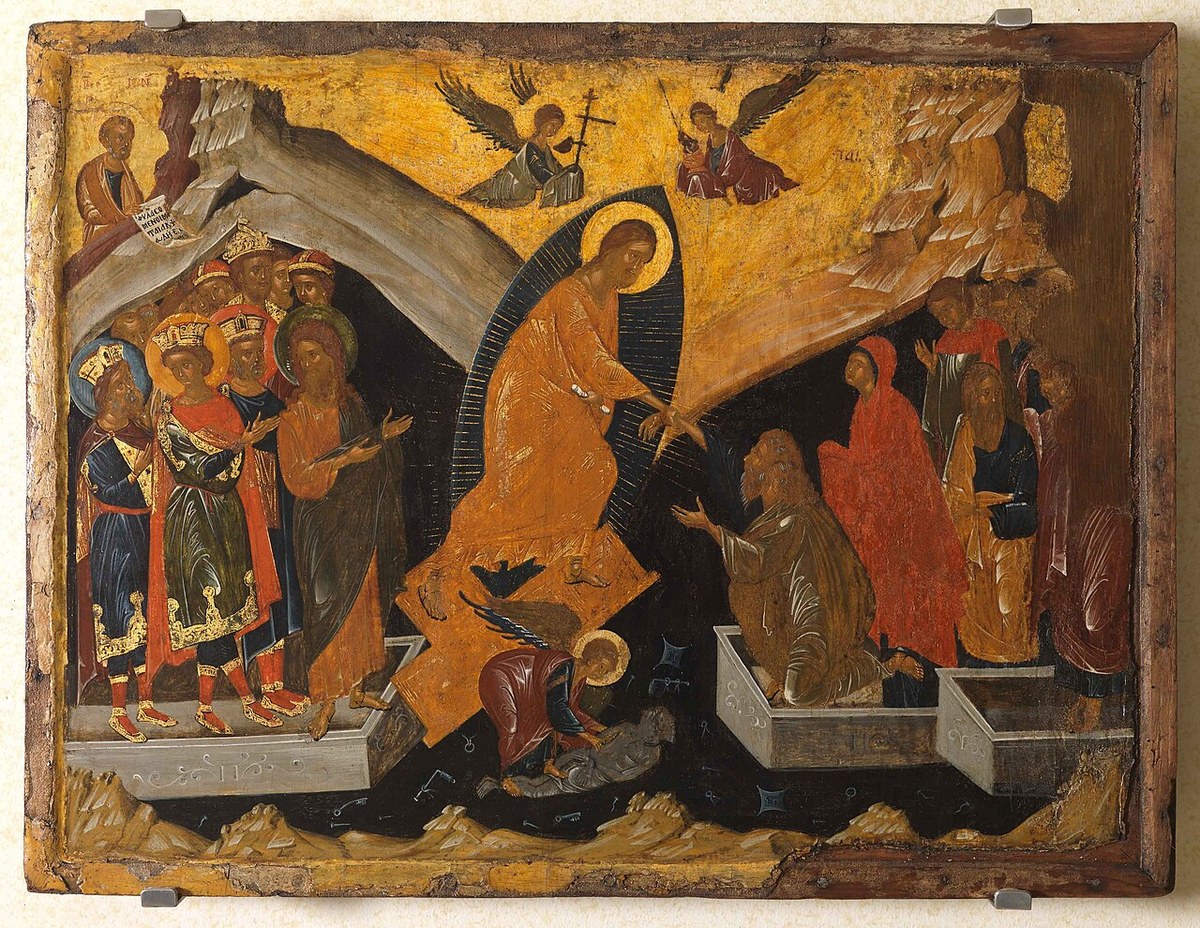
.jpg)
Saints commemorated
-
Beginning of the Pentecostarion
-
Nine Martyrs at Cyzicus
Nine Christians of differing rank and trade — Theognis, Rufus, Antipater, Theostichus, Artemas, Magnus, Theodotus, Thaumasius and Philemon — were arrested together at Cyzicus in Mysia, on the southern shore of the Propontis, in the persecutions of the later third century, and after imprisonment and torture were beheaded with a single sentence when none of them would consent to sacrifice. Their bodies, buried outside the walls, were taken up when the Church gained peace under Constantine and laid in a church built for them in the city, where the healing of the sick and of the mentally afflicted made the martyrs' company famous. In Russia they became the patrons invoked against fever and pestilence, and a monastery was raised in their honour near Kazan to house particles of their relics.
-
St Basil, bishop of Ostrog in Montenegro (Serbia) (1671)
Basil of Ostrog (Sveti Vasilije Ostroški, born Stojan Jovanović, c. 1610–1671) was the Serbian hierarch of Zahumlje and Skenderija who shepherded the Orthodox of Herzegovina and Montenegro under Ottoman rule and Venetian-Latin pressure, and who, after the Turks destroyed his monastery of Tvrdoš near Trebinje, withdrew to the cliff-face hermitage of Ostrog above the valley of the Zeta, where he lived out his last years in prayer and died on 29 April 1671. Seven years later his body was found incorrupt and fragrant and was enshrined in the little rock-cut church of the Presentation in the Upper Monastery. He is one of the most fervently venerated saints of the Serbian lands: Ostrog is the greatest pilgrimage place of the western Balkans, and Orthodox, Catholics and Muslims alike come to his relics for healing.
-
Diodorus and Rhodopianus
Diodorus and Rhodopianus were deacons of the church of Aphrodisias in Caria, on the south-western coastlands of Asia Minor, who were stoned to death by their own townspeople in the persecution of Diocletian, about the year 302. The synaxarion notice is short and gives no dialogue and no magistrate: the two were known in the city as Christians and as preachers of Christ among the pagans, were seized by the soldiery, endured insults and scourging, and were finally killed with stones — the mob's death rather than the executioner's, and one of the few martyrdoms by stoning in the Byzantine calendar after the age of the Apostles. The Greek books keep them on May 3 and the Slavonic books and the OCA on April 29; this entry, following the Greek placement, is primary on May 3 and secondary on April 29.
-
Memnon the Wonderworker
Memnon was an ascetic of the Egyptian desert who from his youth gave himself to the monastic life, was set over one of the Egyptian monasteries as abbot, and became famous for the gifts that followed his labours: clairvoyance, and a wonderworking power over the calamities of the countryside. The synaxarion remembers three of his miracles in particular — a spring of water opened in the waterless wilderness at his prayer, a plague of locusts destroyed as it stripped the harvest, and shipwrecked men saved who called on his name at sea — and adds that after his death the mere invocation of his name drove away locusts and broke the deceits of the demons. He is commemorated as "Memnon the Wonderworker," and no fuller Life of him has come down.
British Isles and Ireland
- St. Dictinus the Swineherd, of Ulster (5th C)
- St. Endellion, Virgin recluse in Cornwall (6th C)
- St. Fiachan of Munster (7th C)
- St. Senan, hermit of North Wales (7th C)
- St. Swithbert the Younger, bishop and missionary (807)
- St. Wilfrid the Younger, archbishop of York (744)
Readings
Epistle
Acts 1.1-8
1The former treatise have I made, O Theophilus, of all that Jesus began both to do and teach, 2Until the day in which he was taken up, after that he through the Holy Ghost had given commandments unto the apostles whom he had chosen: 3To whom also he shewed himself alive after his passion by many infallible proofs, being seen of them forty days, and speaking of the things pertaining to the kingdom of God: 4And, being assembled together with them, commanded them that they should not depart from Jerusalem, but wait for the promise of the Father, which, saith he, ye have heard of me. 5For John truly baptized with water; but ye shall be baptized with the Holy Ghost not many days hence. 6When they therefore were come together, they asked of him, saying, Lord, wilt thou at this time restore again the kingdom to Israel? 7And he said unto them, It is not for you to know the times or the seasons, which the Father hath put in his own power. 8But ye shall receive power, after that the Holy Ghost is come upon you: and ye shall be witnesses unto me both in Jerusalem, and in all Judæa, and in Samaria, and unto the uttermost part of the earth.
Gospel
John 1.1-17
1In the beginning was the Word, and the Word was with God, and the Word was God. 2The same was in the beginning with God. 3All things were made by him; and without him was not any thing made that was made. 4In him was life; and the life was the light of men. 5And the light shineth in darkness; and the darkness comprehended it not. 6There was a man sent from God, whose name was John. 7The same came for a witness, to bear witness of the Light, that all men through him might believe. 8He was not that Light, but was sent to bear witness of that Light. 9That was the true Light, which lighteth every man that cometh into the world. 10He was in the world, and the world was made by him, and the world knew him not. 11He came unto his own, and his own received him not. 12But as many as received him, to them gave he power to become the sons of God, even to them that believe on his name: 13Which were born, not of blood, nor of the will of the flesh, nor of the will of man, but of God. 14And the Word was made flesh, and dwelt among us, (and we beheld his glory, the glory as of the only begotten of the Father,) full of grace and truth. 15John bare witness of him, and cried, saying, This was he of whom I spake, He that cometh after me is preferred before me: for he was before me. 16And of his fulness have all we received, and grace for grace. 17For the law was given by Moses, but grace and truth came by Jesus Christ.
Troparia & kontakia
Exapostilarion — Tone 2
Having fallen asleep in the flesh as a mortal man, O King and Lord, on the third day thou didst rise again, raising Adam from corruption and abolishing death: O Pascha of incorruption, O salvation of the world.
Kontakion — Tone 4
Though thou didst descend into the tomb, O Immortal, yet didst thou bring down the power of Hades, and didst rise again as victor, O Christ God, saying to the myrrhbearing women, Rejoice!, and granting peace to thine apostles — thou who dost bestow resurrection on the fallen.
Oikos
The maidens bearing myrrh came before the dawn, seeking as men seek the daylight the Sun that was before the sun, who for a while had set within a tomb; and they cried out to one another: O friends, come, let us anoint with spices the life-bearing and buried Body, the flesh that raises up fallen Adam, lying now in the grave. Let us go, let us make haste like the Magi, and worship, and offer our myrrh as gifts to him who is wrapped not in swaddling bands but in a linen shroud; and let us weep and cry aloud: O Master, arise, thou who dost bestow resurrection on the fallen.
The
Christ is risen from the dead, trampling down death by death, and to those in the tombs bestowing life.
The
The women who were with Mary, having come before the dawn and having found the stone rolled away from the tomb, heard from the angel: Why do you seek among the dead, as though he were a man, him who dwells in everlasting light? Behold the grave-clothes! Run and proclaim to the world that the Lord is risen, having put death to death; for he is the Son of God who saves the race of men.
The
It is the day of Resurrection! Let us be radiant, O peoples: Pascha, the Lord's Pascha! For from death to life and from earth to heaven Christ our God has brought us over, as we sing the hymn of victory. Now all is filled with light — heaven, and earth, and the places beneath the earth. Let all creation therefore keep the feast of the rising of Christ, in whom it is made firm. We keep the feast of the putting to death of death, the pulling down of Hades, and the firstfruits of another life, the eternal one; and leaping for joy we hymn the Cause of it, the only blessed and exceedingly glorious God of our fathers. This is the chosen and holy day, the one and first of the sabbaths, the queen and the lady, the feast of feasts and the festival of festivals, on which we bless Christ unto the ages. Shine, shine, O new Jerusalem, for the glory of the Lord has risen upon thee! Dance now and be glad, O Sion; and do thou rejoice, O pure Theotokos, in the rising of him whom thou didst bear. O Pascha, great and most holy, O Christ! O Wisdom and Word and Power of God! Grant us to partake of thee more perfectly in the day of thy kingdom that knows no evening.
The
Today a sacred Pascha has been shown to us: a Pascha new and holy, a Pascha mystical, a Pascha all-venerable, a Pascha that is Christ the Redeemer; a Pascha unblemished, a Pascha great, the Pascha of the faithful, the Pascha that has opened to us the gates of Paradise, the Pascha that sanctifies all the faithful. It is the day of Resurrection! Let us be radiant for the festival, and let us embrace one another. Let us say, O brethren, even to those that hate us: Let us forgive all things for the Resurrection's sake. And so let us cry aloud: Christ is risen from the dead, trampling down death by death, and to those in the tombs bestowing life.
The
Christ, having gone down alone to wrestle with Hades, came up again bearing many spoils of victory.
Troparion — Tone 4 (common of a hierarch)
Thou wast shown to thy flock as a rule of faith, an image of gentleness and a teacher of abstinence; therefore by lowliness thou hast gained the heights, and by poverty riches. O father and hierarch Basil, intercede with Christ God that our souls may be saved.
Troparion — Tone 4 (common of two martyrs)
Thy martyrs Diodorus and Rhodopianus, O Lord, in their contest received incorruptible crowns from Thee, our God; for possessing Thy strength, they cast down the tyrants and shattered the feeble insolence of the demons. By their intercessions save our souls.
Troparion — Tone 8 (common of a venerable father)
With the streams of thy tears thou didst make the barren wilderness bring forth, and by thy sighing from the depths thou didst bear fruit an hundredfold in thy labours; thou becamest a light shining upon the world with miracles, O Memnon our father. Intercede with Christ God that our souls may be saved.
Troparion — Tone 4 (common of several martyrs)
Thy martyrs, O Lord, in their contest received from Thee, our God, the crowns of incorruption; for armed with Thy might they overthrew the tyrants and broke the feeble insolence of the demons. At their supplications, O Christ God, save our souls.