
Thursday 7 June 2035
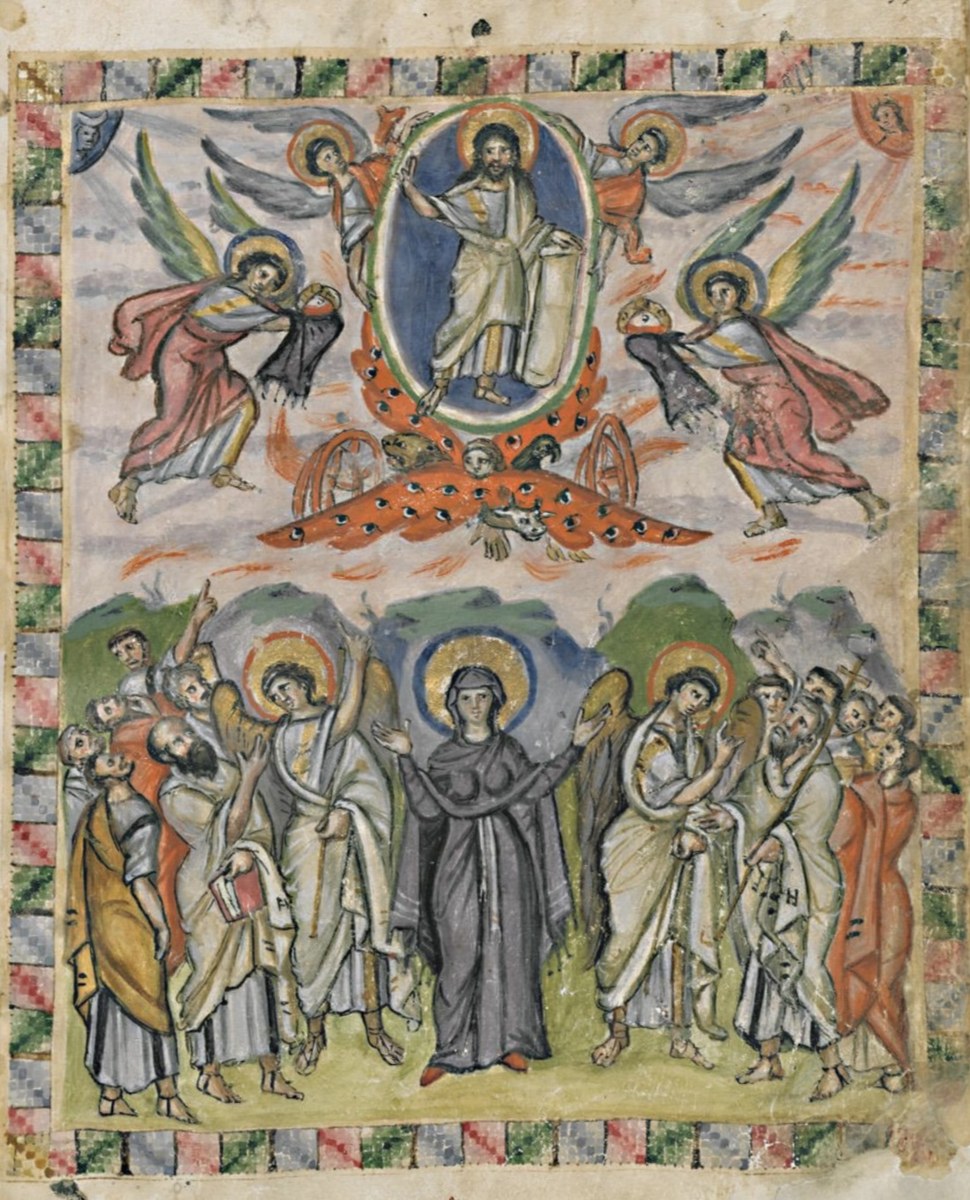
Ascension of the Lord
The Ascension of our Lord, God, and Saviour Jesus Christ
Ascensiontide, day 1 · 39 days since Pascha
Ascension of the Lord

Saints commemorated
-
Hieromartyr Theodotus, Bishop of Ancyra
Theodotus was an innkeeper of Ancyra in Galatia — a married layman, a wine-seller, whose tavern became in the Great Persecution the hiding-place of the hunted Church, the house where the Liturgy was served when the churches were pulled down, and the office from which the bodies of the martyrs were ransomed and buried. With him are honoured seven aged consecrated virgins — Tecusa his own aunt, Alexandra, Claudia, Phaina, Euphrasia, Matrona and Julitta — who were seized under the governor Theoteknos, refused to serve as priestesses at the washing of the images of Artemis and Athena, were handed over to be violated and preserved their purity, and were at last drowned in the lake outside the city with stones tied to them. Theodotus recovered their bodies by night and buried them, and for that act was betrayed, tortured and beheaded, about the year 303–304. Their passion, told by an eyewitness named Nilus, is one of the most vivid and most disputed documents of the Diocletianic persecution in Asia Minor.
-
Hieromartyr Marcellinus, pope of Rome (304)
Marcellinus was bishop of Rome from 296 to 304, and his pontificate ended inside the Great Persecution of Diocletian. The Byzantine synaxarion honours him as a hieromartyr and tells his story as a fall and a recovery: worn down by torture he offered incense to the idols, was rewarded by the emperor with honours and friendship, and then, undone by his conscience, confessed his apostasy before a synod of bishops at Sinuessa in Campania in sackcloth and ashes, judged himself unworthy of the priesthood and asked that his body be left unburied. The bishops refused to condemn him, reminding him that Peter also had denied Christ and had wept and been forgiven; and Marcellinus returned to Rome, renounced his compliance to the emperor's face, and was tortured and beheaded with three companions, Claudius, Cyrinus and Antoninus. His body lay unburied thirty-six days until the Apostle Peter appeared to his successor Marcellus and bade him bury it, and it was laid in the cemetery of Priscilla on the Via Salaria. His feast is June 7 in the Byzantine calendars and April 26 in the Latin.
-
St Daniel of Skete in Egypt (5th c.)
Daniel of Sketis was the great Egyptian elder of the sixth century, priest and hegumen of Sketis in the Nitrian desert, remembered less for sayings of his own than for a group of narratives — the Life and Tales of Abba Daniel of Sketis — which made him the Church's chief witness to the hidden saint: the holy man or woman whose sanctity is covered by folly, drunkenness, disguise, poverty or the ordinary business of a trade, and whom Daniel is repeatedly given to recognise. He himself is remembered as a penitent: taken captive twice in a barbarian raid on the desert, he killed one of his captors in escaping, and spent the rest of his life seeking a penance that no patriarch would impose, until he took one upon himself and served a leper in his inner cell in secret until he died. The cycle attached to his name gathers Mark the Fool of the Alexandrian hippodrome, Eulogius the Hospitable the stonecutter, Anastasia the Patrician hidden as a eunuch, Thomais of Alexandria the martyr for chastity, the nun who feigned drunkenness, and Andronicus and Athanasia; in one of them the elder himself is the man corrected. His memory is kept on June 7.
-
Kyriake, Kaleria and Mary of Caesarea
Kyriake, Kaleria — the name is also transmitted as Valeria — and Mary were three women of Caesarea in Palestine who turned from paganism to Christ during the persecution of Diocletian, left the city and settled together in a solitary place, and gave their lives to prayer, whose one recorded petition was that the persecution of the Christians might cease. Denounced and brought before the governor, they refused to worship the idols, confessed Christ before the tribunal, and were tortured to death, about the year 304. Nothing more of them is transmitted: no passion, no tomb, no relics, no proper hymn — three converts, a hut outside a city, one prayer, and a death. Their memory is kept on June 7.
-
Marcellus of Rome
Marcellus was bishop of Rome for a little under two years at the very end of the Great Persecution, about 308 to 309, taking up a see that had been vacant since the death of Marcellinus and a city divided over the readmission of Christians who had complied with the edicts. He reorganised the clergy and the cemeteries of Rome into twenty-five parish districts, and his severity toward the lapsi provoked riots that gave the emperor Maxentius his pretext: the bishop was deposed from his church and sentenced, the Roman account says, to labour at the catabulum, the public cattle-station and stable into which his own titular church had been turned, and there he died worn out about 309 or 310. In the Byzantine calendars he is remembered on June 7, at the head of the long company of Roman martyrs of the persecution — the deacons Sisinius and Cyriacus and those with them — whom the same cycle of Acts associates with him. The Latin calendars keep him on January 16.
-
Potamiaena of Alexandria
Potamiaena was a young Christian woman of Alexandria, in the household of a pagan master who desired her and could not have her. To his demands she answered — in the form the tradition has kept — that she was a Christian, and that she valued her honour above her life; and when he threatened her with the courts she told him plainly that she would rather die. He denounced her to the prefect of Egypt, who offered her the usual choice and, when she refused, had her lowered into a cauldron of boiling pitch, in which she died, keeping both her virginity and her faith; the older and better witness adds that her mother Marcella was burned with her, and that the executioner Basilides was converted by what he had seen and was himself martyred soon after, Potamiaena having appeared to him in the night and set a crown upon his head. The Byzantine calendars keep her on June 7, the Latin on June 28.
-
Sisinius, Cyriacus and the Martyrs of Rome
On June 7 the Byzantine calendars commemorate, in one long notice, the company of Roman martyrs formed around the relief of the Christian prisoners in the last years of the Great Persecution. A wealthy Christian of the city, Thrason, spent his fortune feeding and ransoming those condemned to the public works; his almoners Sisinius and Cyriacus were ordained deacons for the work by Marcellinus, and carried it on under Marcellus. Arrested for it, they turned the prison into a mission: the jailer Apronian was converted by the light that shone from Sisinius's face and was baptised with those he guarded, and the soldiers Papias and Maurus by the melting of the pagan incense-tripods at the prayer of Saturninus. The whole company was destroyed piecemeal between about 304 and 310 — Sisinius and Saturninus beheaded on June 7, Apronian beheaded, Papias and Maurus dying under the lash, and Cyriacus with Smaragdus, Largus and Crescentian perishing in the torments, together with the women Priscilla, Lucina and Artemia and, the account says, twenty-one others. They are honoured together as the martyrs of the works of mercy.
-
Zenais of Caesarea
Zenais — the name also appears as Zenaida — was born at Caesarea in Palestine in the year 284, and is remembered in the Byzantine books for two things only: that she was given the gift of working miracles, and that she ended her life by a martyr's death. Her surname in the Greek synaxaria is ἡ Θαυματουργός, "the Wonderworker," and the Menaion's couplet for her turns on the one fact transmitted about her: that she poured out wonders both in her life and after her end. Her cult was real and reasonably wide — the Synaxarion of Constantinople records a synaxis in her honour in the capital on June 6, and she is entered in a ninth-century calendar of Naples — but no passion of hers survives, and the Greek day-books say frankly that they have no details of her life. She is commemorated on June 7.
British Isles and Ireland
- St. Colman, bishop of Dromore (6th C)
- St. Meriadoc the Wonderworker, archbishop (7th C)
Readings
Vespers
Isaiah 2.2-3
2And it shall come to pass in the last days, that the mountain of the LORD’s house shall be established in the top of the mountains, and shall be exalted above the hills; and all nations shall flow unto it. 3And many people shall go and say, Come ye, and let us go up to the mountain of the LORD, to the house of the God of Jacob; and he will teach us of his ways, and we will walk in his paths: for out of Zion shall go forth the law, and the word of the LORD from Jerusalem.
Composite 21 - Isaiah 62.10-63.3, 7-9
1Thus says the Lord: Walk, go through my gates; prepare my way and make a way for my people, and cast the stones out of the way; raise up a standard for the nations. For see, the Lord has made it heard to the ends of the earth: Say to the daughter of Sion: See, your Saviour has come, and his reward is with him, and his work before his face. And he will call it a holy people, redeemed by the Lord; while you will be called a city sought after, and not forsaken. Who is this who comes from Edom, the scarlet of his garments from Bosor, thus beautiful in his apparel? He cries out with much strength. I reason of justice and judgement of salvation. Why are your garments red, and your clothing as from a trodden winepress? I am full of the trodden grape; I have trampled the winepress quite alone, and no man from the nations was with me. I have remembered the mercy of the Lord, I will recall the Lord’s virtues, the Lord’s praise for all the things with which He rewards us. The Lord is a good judge for the house of Israel; he deals with us according to his mercy and according to the multitude of his justice. And he said: Are you not my people? Children will surely not be rebellious; and he became for them salvation out of their every distress. It was not an emissary, not an Angel, but the Lord himself saved them because he loved them and spared them. He redeemed them and took them up and exalted them all the days of the age.
Composite 22 - Zechariah 14.1, 4, 8-11
1Thus says the Lord: See, the day of the Lord is coming, and on that day his feet will stand upon the mount of Olives, opposite Jerusalem, where the sun rises. And on that day living water will come out from Jerusalem, half towards the first sea and half towards the last sea; in spring and in summer it shall be so; and the Lord will be for a King over all the earth; in that day there shall be one Lord, and his name, compassing all the earth and the wilderness from Gabaa as far as Remmon, south of Jerusalem; and he shall be exalted and remain on his place from the gate of Benjamin as far as the place of the first gate, as far as the gate of Gomor and as far as the tower of Anameël and as far as the tower of the corners and as far as the king’s winepresses; they shall dwell in it and there shall be no more curse and Jerusalem shall dwell confidently.
Matins Gospel
Mark 16.9-20
9Now when Jesus was risen early the first day of the week, he appeared first to Mary Magdalene, out of whom he had cast seven devils. 10And she went and told them that had been with him, as they mourned and wept. 11And they, when they had heard that he was alive, and had been seen of her, believed not. 12After that he appeared in another form unto two of them, as they walked, and went into the country. 13And they went and told it unto the residue: neither believed they them. 14Afterward he appeared unto the eleven as they sat at meat, and upbraided them with their unbelief and hardness of heart, because they believed not them which had seen him after he was risen. 15And he said unto them, Go ye into all the world, and preach the gospel to every creature. 16He that believeth and is baptized shall be saved; but he that believeth not shall be damned. 17And these signs shall follow them that believe; In my name shall they cast out devils; they shall speak with new tongues; 18They shall take up serpents; and if they drink any deadly thing, it shall not hurt them; they shall lay hands on the sick, and they shall recover. 19So then after the Lord had spoken unto them, he was received up into heaven, and sat on the right hand of God. 20And they went forth, and preached every where, the Lord working with them, and confirming the word with signs following. Amen.
Epistle
Acts 1.1-12
1The former treatise have I made, O Theophilus, of all that Jesus began both to do and teach, 2Until the day in which he was taken up, after that he through the Holy Ghost had given commandments unto the apostles whom he had chosen: 3To whom also he shewed himself alive after his passion by many infallible proofs, being seen of them forty days, and speaking of the things pertaining to the kingdom of God: 4And, being assembled together with them, commanded them that they should not depart from Jerusalem, but wait for the promise of the Father, which, saith he, ye have heard of me. 5For John truly baptized with water; but ye shall be baptized with the Holy Ghost not many days hence. 6When they therefore were come together, they asked of him, saying, Lord, wilt thou at this time restore again the kingdom to Israel? 7And he said unto them, It is not for you to know the times or the seasons, which the Father hath put in his own power. 8But ye shall receive power, after that the Holy Ghost is come upon you: and ye shall be witnesses unto me both in Jerusalem, and in all Judæa, and in Samaria, and unto the uttermost part of the earth. 9And when he had spoken these things, while they beheld, he was taken up; and a cloud received him out of their sight. 10And while they looked stedfastly toward heaven as he went up, behold, two men stood by them in white apparel; 11Which also said, Ye men of Galilee, why stand ye gazing up into heaven? this same Jesus, which is taken up from you into heaven, shall so come in like manner as ye have seen him go into heaven. 12Then returned they unto Jerusalem from the mount called Olivet, which is from Jerusalem a sabbath day’s journey.
Gospel
Luke 24.36-53
36And as they thus spake, Jesus himself stood in the midst of them, and saith unto them, Peace be unto you. 37But they were terrified and affrighted, and supposed that they had seen a spirit. 38And he said unto them, Why are ye troubled? and why do thoughts arise in your hearts? 39Behold my hands and my feet, that it is I myself: handle me, and see; for a spirit hath not flesh and bones, as ye see me have. 40And when he had thus spoken, he shewed them his hands and his feet. 41And while they yet believed not for joy, and wondered, he said unto them, Have ye here any meat? 42And they gave him a piece of a broiled fish, and of an honeycomb. 43And he took it, and did eat before them. 44And he said unto them, These are the words which I spake unto you, while I was yet with you, that all things must be fulfilled, which were written in the law of Moses, and in the prophets, and in the psalms, concerning me. 45Then opened he their understanding, that they might understand the scriptures, 46And said unto them, Thus it is written, and thus it behoved Christ to suffer, and to rise from the dead the third day: 47And that repentance and remission of sins should be preached in his name among all nations, beginning at Jerusalem. 48And ye are witnesses of these things. 49And, behold, I send the promise of my Father upon you: but tarry ye in the city of Jerusalem, until ye be endued with power from on high. 50And he led them out as far as to Bethany, and he lifted up his hands, and blessed them. 51And it came to pass, while he blessed them, he was parted from them, and carried up into heaven. 52And they worshipped him, and returned to Jerusalem with great joy: 53And were continually in the temple, praising and blessing God. Amen.
Troparia & kontakia
Apolytikion — Tone 4
Thou wast taken up in glory, O Christ our God, and didst gladden thy disciples with the promise of the Holy Spirit; and by the blessing they were made certain that thou art the Son of God, the Redeemer of the world.
Apolytikion — Tone 8 (common of a venerable father)
By the flowing of thy tears thou didst make the waterless desert bear fruit, and by thy groanings out of the depths thou didst make thy labours yield a hundredfold; and thou wast shown to be a lamp for the whole world, shining with wonders, O Daniel our father: intercede with Christ God that our souls may be saved.
Apolytikion — Tone 4 (common of several martyrs)
Thy martyrs, O Lord, in their contests received crowns of incorruption from Thee our God; for having Thy strength they laid low the tyrants and broke the powerless insolence of the demons. At their supplications, O Christ God, save our souls.
Apolytikion — Tone 4 (common of a hieromartyr)
Sharing the manner of life of the Apostles and succeeding to their thrones, thou didst find in the practice of virtue the way of ascent to the things of God, O inspired one; therefore, rightly dividing the word of truth, thou didst contend for the faith even unto blood, O hieromartyr Marcellinus: intercede with Christ God that our souls may be saved.
Apolytikion — Tone 4 (common of a hieromartyr)
Sharing the manner of life of the Apostles and succeeding to their thrones, thou didst find in the practice of virtue the way of ascent to the things of God, O inspired one; therefore, rightly dividing the word of truth, thou didst contend for the faith even unto blood, O hieromartyr Marcellus: intercede with Christ God that our souls may be saved.
Apolytikion — Tone 4 (common of a virgin-martyr)
Thy lamb Potamiaena cries aloud to Thee, O Jesus: Thee do I love, my Bridegroom, and seeking Thee I contend; I am crucified and buried with Thee in Thy baptism, and I suffer for Thy sake that I may reign with Thee, and I die for Thee that I may live in Thee. Accept me as a spotless sacrifice, offered to Thee in love; and by her prayers, O merciful one, save our souls.
Apolytikion — Tone 4 (common of several martyrs)
Thy martyrs, O Lord, in their contests received crowns of incorruption from Thee our God; for having Thy strength they laid low the tyrants and broke the powerless insolence of the demons. At their supplications, O Christ God, save our souls.
Apolytikion — Tone 4 (common of several martyrs)
Thy martyrs, O Lord, in their contests received incorruptible crowns from Thee, our God; for possessing Thy strength, they cast down the tyrants and shattered the feeble insolence of the demons. By their supplications, O Christ God, save our souls.
Apolytikion — Tone 4 (common of a woman martyr)
Thy martyr Zenais, O Lord, in her contest received from Thee our God an incorruptible crown; for having Thy strength she laid low the tyrants and broke the powerless insolence of the demons. At her supplications, O Christ God, save our souls.
Exapostilarion — Tone 2 (sung three times)
Before the eyes of thy disciples thou wast taken up, O Christ, to be enthroned together with the Father; and the angels running on before thee cried aloud: Lift up the gates, lift them up, for the King has gone up to the glory that is the source of light.
Kontakion — Tone 6
Having fulfilled the dispensation for our sake, and united the things of earth with the things of heaven, thou wast taken up in glory, O Christ our God, in no way parted from us, but remaining inseparable and crying to those who love thee: I am with you, and no one is against you. Leaving on earth the things of earth, and yielding the ashes to the dust, come, let us wake and lift up our eyes and our thoughts on high; let us mortals send our sight and our senses together flying toward the gates of heaven; let us reckon that we are on the Mount of Olives and are gazing upon the Redeemer as he is borne upon a cloud.
Kontakion — Tone 2
Thou didst seek a penance and wast given none, and so didst appoint thyself the leper and the hidden cell; wherefore God entrusted to thee His hidden ones, and thou didst uncover the fool, the mocked woman and the lantern of the poor man, O father Daniel, new Abraham and host of Christ.
Kontakion — Tone 2
Broken for an hour by the torments, thou didst offer the incense of denial; but rising up with the tears of Peter thou didst confess Christ before the tyrant, and didst wash thy word away in thy blood, O shepherd Marcellinus: and the Church, taught by thee that repentance is received, will not leave thy memory unhonoured.
Kontakion — Tone 2
They took thy church from thee and made it a stable, and set the shepherd of Rome to serve among the beasts; but thou didst not lay down thy priesthood, O Marcellus, and didst finish thy course in the dung and the chains, a bishop to the end: wherefore Christ has numbered thee with the martyrs.
Kontakion — Tone 2
Thou wast a bought slave and a free woman, O Potamiaena, and when thy master demanded what was not his thou didst answer that thy honour was dearer to thee than thy life; wherefore the cauldron and the pitch became thy bridal chamber, and thy crown was seen by the very hands that killed thee.
Kontakion — Tone 2
Ye carried bread to the pits and the quarries, and bought back the bodies of the slain, and for this alms ye were reckoned criminals; wherefore the prison became your church, the jailer your brother and the soldiers your fellow-martyrs, O deacons Sisinius and Cyriacus with all your company: entreat Christ for the imprisoned and the forgotten.
Kontakion — Tone 2 (common of martyrs)
O athletes who shone forth as stars in the firmament of the Church, ye did not spare your bodies for the love of the Master; the wine-seller and the seven aged virgins are glorified together, for the lake became for them a font, and the grave a fountain of healing.
The
O Lord, having in thy goodness fulfilled the mystery hidden from the ages and from the generations, thou didst come with thy disciples to the Mount of Olives, having with thee her who bore thee, the Maker and Fashioner of all things; for she who as a mother grieved above all others in thy Passion had also to enjoy the surpassing joy of the glorifying of thy flesh — in which we too, sharing it, glorify at thine ascent into the heavens, O Master, thy great mercy that has come upon us.