
Potamiaena of Alexandria
The Holy Virgin-Martyr Potamiaena of Alexandria
Martyr · Virgin · d. c. 202, or under Maximian (286–305), at Alexandria
Commemorated 7 June — Martyrdom at Alexandria in the cauldron of boiling pitch, 28 June — Second commemoration in Greek usage
Potamiaena was a young Christian woman of Alexandria, in the household of a pagan master who desired her and could not have her. To his demands she answered — in the form the tradition has kept — that she was a Christian, and that she valued her honour above her life; and when he threatened her with the courts she told him plainly that she would rather die. He denounced her to the prefect of Egypt, who offered her the usual choice and, when she refused, had her lowered into a cauldron of boiling pitch, in which she died, keeping both her virginity and her faith; the older and better witness adds that her mother Marcella was burned with her, and that the executioner Basilides was converted by what he had seen and was himself martyred soon after, Potamiaena having appeared to him in the night and set a crown upon his head. The Byzantine calendars keep her on June 7, the Latin on June 28.

Alexandria and the two accounts
Potamiaena is one of the small number of early martyrs for whom two independent narratives survive, and they do not agree. Both are Alexandrian and both are early, and the difference between them shapes everything about her entry.
Eusebius tells her story in the Ecclesiastical History, among the martyrs of the persecution in which Origen's father Leonides died — that is, at Alexandria under Septimius Severus, about the year 202. There Potamiaena is a "famous" maiden, one of the young people gathered around Origen's teaching, celebrated for the guarding of her chastity; she is handed over to a soldier named Basilides, put to death by fire, and her mother Marcella burned with her. Eusebius adds the sequel that gives the episode its force: Basilides, some time afterwards, refused for conscience' sake to swear the customary oath, declared himself a Christian to his astonished fellow-soldiers, was imprisoned and baptised and beheaded — and told the brethren who visited him that Potamiaena had appeared to him three nights after her death and placed a crown upon his head, and that she had asked for him.
Palladius, two centuries later in the Lausiac History, tells it differently. His Potamiaena is not a pupil of Origen but a household slave or servant, and the cause of her death is her master's lust: he tried to force her, she resisted for a long time, and at last he handed her over to the prefect with a bribe, accusing her of insulting the emperors. Before the judge she asked that she might not be stripped, and the sentence carried out on her was the cauldron of boiling pitch; the story of her modesty in the manner of her dying — she asked to be lowered by degrees — belongs to this version.
The Byzantine synaxarion, and the modern Orthodox calendars that depend on it, follow Palladius: a slave, a master's demand, the answer about honour, the denunciation, the boiling pitch — and they place her under Maximian (286–305) rather than under Severus. What the East commemorates on June 7, therefore, is Palladius's Potamiaena, and this entry gives that narrative as the calendar gives it while recording that the older witness is Eusebius and that his date is a century earlier.
The answer about honour
The line the tradition preserved from her is worth setting out, because it is the whole reason she is in the calendar and because it makes an argument that the Church afterwards found it necessary to think about very carefully. Pressed by her master, she said that she was a Christian, and that she valued her honour far above her life; and she added — this is the sharpest part — that although her faith forbade her to take her own life, she would sooner die than be defiled, and would find a way to die if he forced her.
That is a claim about the ordering of goods, and it is exactly the claim on which the calendar's other martyrs for chastity stand: Thomais of Alexandria, the young wife of the same city cut down by her father-in-law and buried among the monks by Daniel of Sketis; the seven aged virgins of Ancyra who died in the lake rather than walk in the procession of Artemis, whose burial cost Theodotus his life — and who are commemorated with Potamiaena on this same June 7. Read together, the day makes a coherent statement, and Potamiaena's is its plainest formulation.
The cauldron
The prefect's sentence — boiling pitch, not the sword and not the beasts — was chosen for its cruelty and its slowness, and the accounts dwell on her composure in it: the bystanders were amazed, the notice says, at how she bore herself, and it is that public endurance, rather than the sentence itself, that made the story travel. Her mother, in Eusebius's version, went into the fire with her. What became of the master is not recorded.
Feast and commemoration
June 7 (church date; New Calendar civil June 7; Old Calendar civil June 20) in the Byzantine calendars, which style her simply Ἁγία Ποταμιαίνη; the Greek day-books and the OCA both carry her, the latter as "Saint Potamiani of Alexandria." In the Latin books she is kept on June 28, with her mother Marcella beside her, and it is under that date and in that pairing that Western art depicts her.
She shares the day with the Palestinian women martyrs Kyriake, Kaleria and Mary and Zenais, with her fellow-Egyptian Daniel of Sketis, with Theodotus of Ancyra and the memory of the seven virgins, and with the Roman martyrs of Marcellinus and Marcellus. No proper office is appointed; the common of a virgin-martyr serves.
Hymns
Apolytikion — Tone 4 (common of a virgin-martyr)
Thy lamb Potamiaena cries aloud to Thee, O Jesus: Thee do I love, my Bridegroom, and seeking Thee I contend; I am crucified and buried with Thee in Thy baptism, and I suffer for Thy sake that I may reign with Thee, and I die for Thee that I may live in Thee. Accept me as a spotless sacrifice, offered to Thee in love; and by her prayers, O merciful one, save our souls.
Kontakion — Tone 2
Thou wast a bought slave and a free woman, O Potamiaena, and when thy master demanded what was not his thou didst answer that thy honour was dearer to thee than thy life; wherefore the cauldron and the pitch became thy bridal chamber, and thy crown was seen by the very hands that killed thee.
Original translation from the Greek
Iconography
In Orthodox painting Potamiaena has no developed type and would be shown by the standard formula for a young virgin-martyr: frontal, in the long chiton and the maphorion, haloed, the small cross of witness in her right hand; where the manner of her death is signalled, the attribute is the cauldron, and in a narrative scene she stands or kneels in it with the fire beneath and the executioner at the bellows — a composition close to the standard image of saints boiled in oil or pitch, and distinguished from them only by the inscription.
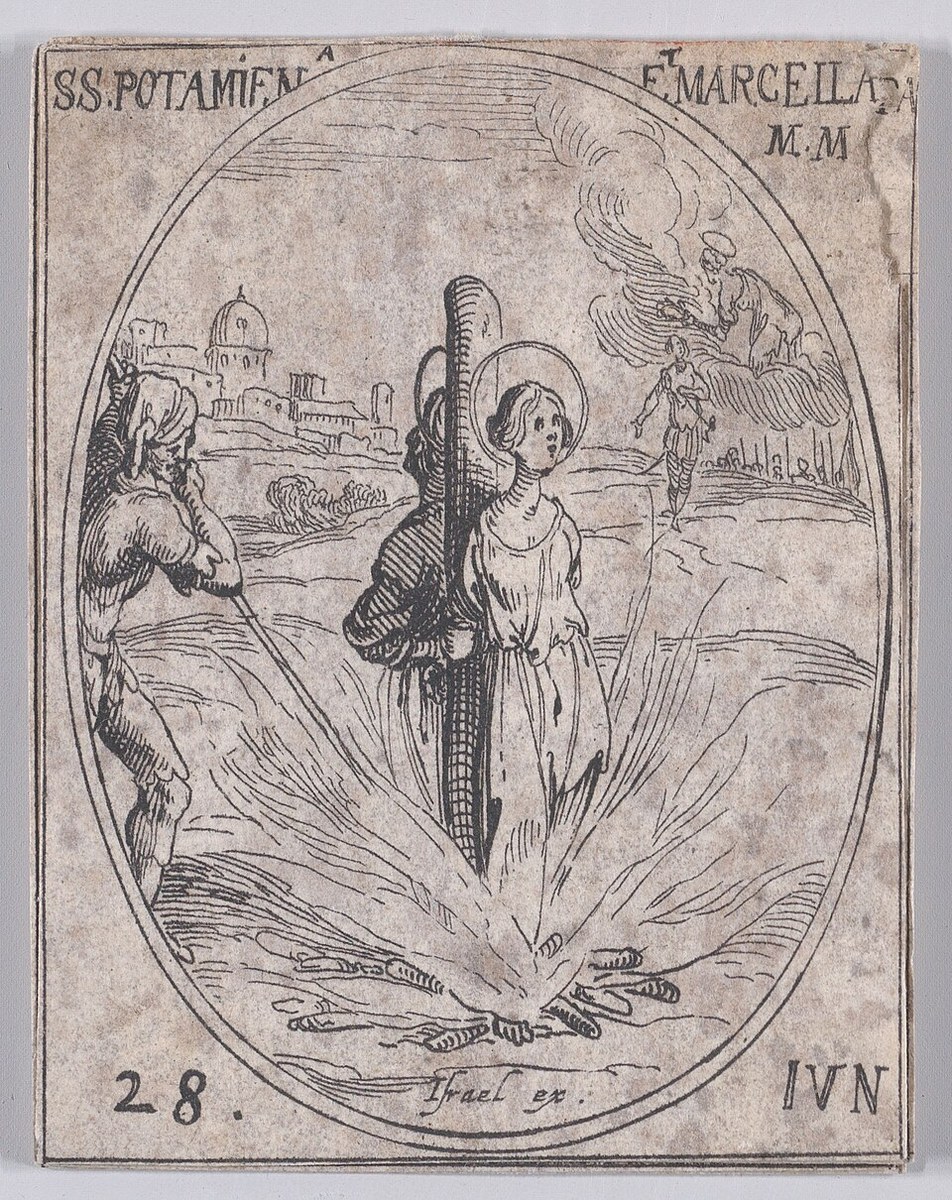
The stored image is not an Orthodox icon but the small etching of 1636 by Jacques Callot, one plate of his day-by-day series Les Images de tous les Saincts et Saintes de l'Année, lettered "SS. POTAMIENA ET MARCELLA M.M." above and "28. IVN" below — the Latin date. It is stored because the sheet names her unambiguously and because the composition is a remarkably faithful visual summary of the tradition: Potamiaena stands haloed and bound to a stake in the midst of flames that spring from faggots at her feet, calm and looking upward; at the left an executioner crouches blowing or fanning the fire; and in the background another figure burns in a second fire on the hillside — her mother Marcella — with the domes and ruins of the city behind. The reading of the fire rather than the cauldron follows Eusebius rather than the Byzantine notice, which is itself a useful record of how the Western tradition understood her. It should be taken for what it is: a seventeenth-century Latin devotional print, not a witness to Byzantine iconography.
Disputed questions
- One Potamiaena or two? The differences between Eusebius and Palladius are large enough that the Bollandists and others have entertained two distinct saints — an elder Potamiaena, the pupil of Origen who died about 202, and a younger one, the slave-girl of Palladius under Maximian — and the Roman Martyrology has at times carried both. The simpler and now commoner view is that there is one martyr, that Palladius (or his source) retold Eusebius's story with the details of the master's lust supplied, and that the shift of reign is the ordinary drift of a persecution-story toward the persecution everyone remembered. This repository treats her as one saint, records the doubling, and gives the death-date as "c. 202, or under Maximian (286–305)" without choosing.
- The date and the century. If Eusebius is right she belongs to the third century (c. 202); if the synaxarion is right, to the very end of the third or the start of the fourth. The entry indexes her under the third century on the strength of the earlier and better witness, and states the alternative.
- Fire or pitch? Eusebius says she perished by fire; Palladius and the synaxarion say boiling pitch. The two are not far apart in substance — a cauldron of pitch is heated over a fire — and the difference is most likely one of narrative focus. The Latin iconography, including the print stored with this entry, shows a stake and flames, following Eusebius.
- Basilides. The soldier converted by her martyrdom and crowned three nights later is part of Eusebius's account and not of the Byzantine notice, which is why he is treated here as part of her story and not as a separate commemoration. He is not the Basilides of Bassus, Eusebius, Eutychius and Basilides, nor the Basilides of the Ten Martyrs of Crete, nor the Alexandrian gnostic teacher of the same name and the same city and roughly the same period — a coincidence that has caused confusion more than once.
- Marcella. Potamiaena's mother, burned with her according to Eusebius and named beside her in the Latin books, is not Marcella of Rome (January 31), the Roman widow and friend of Jerome, nor the Marcella of the passion of Sebastian of Rome. She has no separate Byzantine commemoration and no independent story.
- Virgin or wife? Every witness makes her unmarried and her chastity the point at issue, and Palladius's version turns on her refusal of an illicit union; virgin is therefore recorded among her types. Whether she was a formally consecrated virgin, as the parthenoi of the later third century were, is not stated.
- Not to be confused with Potamia the Wonderworker (August 7), a virgin-martyr of the Byzantine calendar known from a single line — "perfected by the sword" — with no city, no date and no acta. The names are all but identical and both women are virgin-martyrs, but Potamiaena has a full passion told by Eusebius and Palladius, and Potamia has none; they are separate entries in the synaxarion and are kept apart here.