
Donskaya Icon of the Mother of God
The Donskaya Icon of our Most Holy Lady the Theotokos
The Donskaya is a small double-sided panel of the 1390s, attributed to Theophanes the Greek or to a painter of his circle, and it is one of the three or four most venerated images in Russia. On the front is the Mother of God in the Eleousa type, cheek pressed to her Son's, the Child's bare feet resting on her hand; on the reverse is the Dormition of the Theotokos — the panel whose single tall candle is the most famous detail in Russian icon painting, and which this repository stores with the feast of the Dormition itself. The icon takes its name from a tradition, first written down three centuries after the event, that the Don Cossacks gave it to Grand Prince Dmitry before the battle of Kulikovo on 8 September 1380, and that it stood with the Russian army on the Don. What the feast of August 19 actually commemorates is later and better documented: the deliverance of Moscow in 1591, when the icon was carried in procession round the walls and then set in the field-church among the troops facing the Crimean khan Kazy-Girey, whose horde withdrew overnight. On that ground the Donskoy Monastery was founded the following year, and the feast dates from the same moment. That the day falls in the afterfeast of the Dormition is not a coincidence of the calendar but a fitness: the panel carries the Dormition on its back.
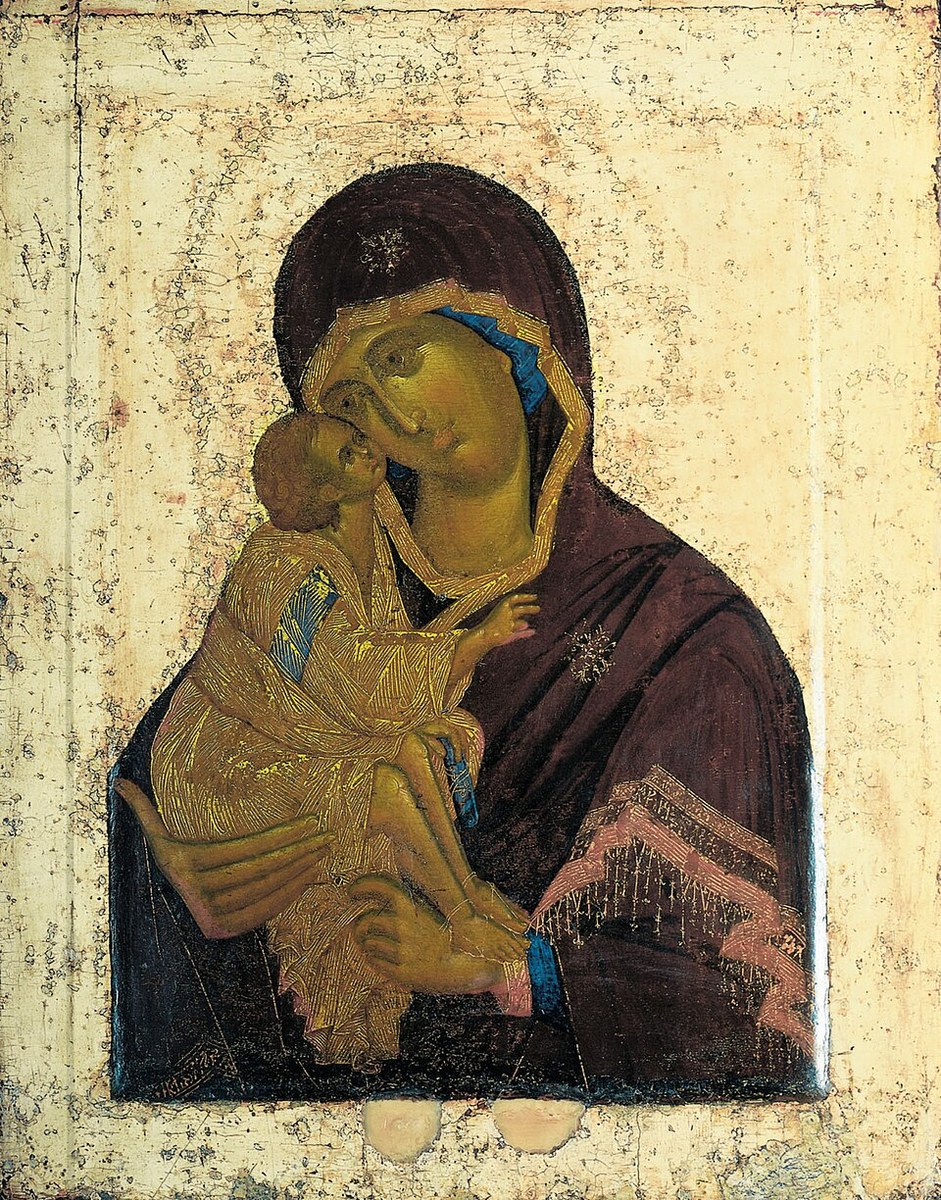

The panel
The Donskaya is not large — a portable panel, not an iconostasis image — and it is painted on both sides, which means it was made to be carried: a processional icon, mounted on a staff, showing one face to the people going out and the other coming back.
The obverse is an Eleousa, the "tenderness" type that Russian calls Umilenie: the Mother of God in half-length, her head inclined to the Child who is held on her left arm and presses his cheek to hers, one small hand at her neck. The distinguishing detail, and the one by which the type is recognised at a glance, is that the Child's feet are bare and drawn up onto his Mother's hand, so that she supports them — a motif of the Byzantine painting of the Palaiologan period which the Russian copies preserve faithfully. The maphorion is a deep brown-purple; the Child's tunic is worked over with the fine gold striations (assist) that are the signature of the workshop.
The reverse is the Dormition: Christ standing in a dark green mandorla with the swaddled soul of his Mother in his arm, a scarlet seraph above him, two hierarchs and the crowding apostles at the bier — and, alone on the empty floor at the centre of the lower edge, a single tall candle with a small flame. This repository stores that reverse as the icon of the feast of August 15; the two entries are two faces of one board.
The attribution to Theophanes the Greek, the Byzantine master who worked at Novgorod and then in Moscow and taught the generation of Andrei Rublev, is traditional and is carried by most catalogues, including the Wikimedia and Wikidata records for the panel. It is not unanimous: some scholars propose a Novgorodian trained in his manner, others a painter of another origin altogether, and it has been argued that the two faces are not by the same hand. The dating to the 1380s–1390s is secure on style.
The Kulikovo tradition
The name of the icon, and the whole popular story of it, come from the Don. In the tradition as the Russian church books give it, the Don Cossacks brought the icon to Grand Prince Dmitry Ivanovich as a gift and a blessing before the battle of Kulikovo Field, fought on 8 September 1380 — the feast of the Nativity of the Theotokos — where the Muscovite army broke the horde of Mamai and Dmitry earned the surname Donskoy, "of the Don." The icon, the account says, was carried with the army through the battle, and afterwards presented to the prince, who took it to Moscow.
The historical difficulties with this are plain and are stated here rather than smoothed over. The earliest written record of the Kulikovo gift is a monastery inventory of 1692, three centuries after the fact. The panel itself is dated by style to the 1380s or 1390s, that is to after Kulikovo — a memorial of the victory is chronologically easier than a blessing before it, and it has been plausibly suggested that the icon was commissioned by Dmitry's widow Evdokia in memory of her husband and of the battle. The Don Cossacks as an organised body are not attested in 1380. Most modern scholarship therefore treats the Kulikovo story as a later foundation-legend — which is not the same as calling it worthless: it records, with the compression that legends practise, the perfectly real fact that this image became the palladium of Moscow's wars against the steppe, and that the name it bears is the name of the battle that began them.
Where the icon spent its first two centuries is likewise contested. One tradition puts it in the Dormition cathedral of Kolomna, the church Dmitry Donskoy built, whence Ivan the Terrible brought it to Moscow; another, followed by the OCA's notice, has it first in the Dormition cathedral of the Kremlin and then in the Annunciation cathedral. Both agree that Ivan IV prayed before it before setting out for Kazan in 1552, and that from the sixteenth century it was a war-icon of the Muscovite state.
1591: the horde before Moscow
The event the feast actually keeps is precisely dated. In the summer of 1591 the Crimean khan Kazy-Girey (Ghazi II Giray) came up against Moscow with a large army — the Russian notices name with him Nuradin and Murat-Girey — and encamped on the Sparrow Hills above the city.
The Donskaya was taken in procession around the walls of Moscow, and then carried out to the Russian position and set in the field church pitched among the troops, in the ranks themselves. The fighting on the following day went against the Tatars, and in the night the horde broke camp and withdrew; the Russian sources describe a rout and a flight. The day of the deliverance was 19 August.
In 1592 — the Russian accounts differ between 1591 and 1593 for the building — the Donskoy Monastery was founded on the very ground where the field church had stood and the icon had been set among the soldiers, and the wonderworking image was placed in it. The feast of the icon was fixed on August 19, the day of the deliverance, and it has been kept ever since. What was being commemorated was not an apparition, as with most Russian icon-feasts, but a rescue: the icon-feasts of the Theotokos in the Russian calendar are, in the main, memorials of sieges that did not succeed.
Later history
The Donskaya remained the icon of the Donskoy Monastery through the imperial centuries, and its cult was a state cult: sovereigns went out to it, and the Moscow processions of August 19 were among the great public observances of the city. Certain of its copies became famous in their own right — the earliest known, of the late fourteenth century, given to the Trinity–Sergius Lavra by Vladimir the Brave, Dmitry's cousin and fellow-commander at Kulikovo; two ordered by Ivan the Terrible for Kolomna; and the copy painted in 1668 by Simon Ushakov for the small cathedral of the Donskoy Monastery, which stood in for the original when the original could not be moved.
After the Revolution the panel was taken into the museums and has been, since 1930, in the State Tretyakov Gallery in Moscow. For decades the practice was that the icon left the gallery once a year, under museum escort, and was brought to the Donskoy Monastery for the patriarchal Liturgy on its feast — the civil 1 September, the Old-Calendar equivalent of August 19 — and returned the same day. In the Russian Church the preparation of the Holy Chrism, which the Patriarch of Moscow performs in the small cathedral of the Donskoy Monastery dedicated to this icon, is likewise attached to it. The Russian encyclopaedic accounts report a further change in 2025–2026, the panel passing on long-term loan from the gallery into ecclesiastical custody, with the Cathedral of Christ the Saviour named as its place; the arrangement is recent and this entry records it as reported rather than as settled fact.
Feast and commemoration
August 19 (church date; New Calendar civil August 19, Old Calendar civil September 1). The feast is Russian — it is carried by the Moscow Patriarchate, the Russian Church Abroad and the OCA, and is absent from the Greek and Antiochian books, which keep the day for Andrew Stratelates. It falls on the fifth day of the afterfeast of the Dormition, and where a full polyeleos service of the icon is served the Russian rubrics appoint the Dormition's own readings for it: at Matins the Visitation and the Magnificat (Luke 1:39–49, 56), and at the Liturgy the readings of the day together with those of the Mother of God, Philippians 2:5–11 and Luke 10:38–42 with 11:27–28. The coincidence is fitting rather than accidental, since the reverse of the panel is the Dormition itself.
The Donskoy Monastery in Moscow keeps the day as its patronal feast, with a patriarchal Liturgy; the Donskaya is also the patronal icon of the Don Cossack host, and the name recurs across the Russian south — Novocherkassk, Rostov and the Don country generally — in church dedications.
Hymns
Troparion — Tone 4
O most gracious and swift protectress of the faithful, most pure Virgin Theotokos: we pray thee before thy holy and wonderworking image, that as of old thou didst grant thy defence through it to the city of Moscow, so now also thou wouldst mercifully deliver us from every evil and calamity, and save our souls, for thou art merciful.
Original translation from the Slavonic
Second
All-hymned and all-glorious Queen and Theotokos, Mother of the Maker of every creature, hope and protectress of Christians, swift expectation of those who have no hope and are in despair: we pray thee, be merciful to us sinners; forsake not thy servants, and reject not the prayer of the unworthy. We pray, looking upon thine honoured likeness in this thy holy and wonderworking icon, and we cry: let thy mercy be with those who sail and those who travel; O Sovereign Lady, shelter us with thy precious veil, keep the faithful safe in every evil place, and pray to Christ our God who was born of thee, that he may save our souls from sin.
Kontakion — Tone 2
Having passed over in the body to the dwellings of heaven, thou hast in no way forsaken those who are on earth, O Theotokos; for thou hast granted to those who love thee to look upon the divine and much-wondrous likeness of thy most pure face, and to venerate it, as a sign of thy grace: which we honour, and kiss.
Original translation from the Slavonic
Appointed readings
Epistle — Philippians 2:5–11
5Let this mind be in you, which was also in Christ Jesus: 6Who, being in the form of God, thought it not robbery to be equal with God: 7But made himself of no reputation, and took upon him the form of a servant, and was made in the likeness of men: 8And being found in fashion as a man, he humbled himself, and became obedient unto death, even the death of the cross. 9Wherefore God also hath highly exalted him, and given him a name which is above every name: 10That at the name of Jesus every knee should bow, of things in heaven, and things in earth, and things under the earth; 11And that every tongue should confess that Jesus Christ is Lord, to the glory of God the Father.
Gospel — Luke 10:38–42; 11:27–28
38Now it came to pass, as they went, that he entered into a certain village: and a certain woman named Martha received him into her house. 39And she had a sister called Mary, which also sat at Jesus’ feet, and heard his word. 40But Martha was cumbered about much serving, and came to him, and said, Lord, dost thou not care that my sister hath left me to serve alone? bid her therefore that she help me. 41And Jesus answered and said unto her, Martha, Martha, thou art careful and troubled about many things: 42But one thing is needful: and Mary hath chosen that good part, which shall not be taken away from her. 27And it came to pass, as he spake these things, a certain woman of the company lifted up her voice, and said unto him, Blessed is the womb that bare thee, and the paps which thou hast sucked. 28But he said, Yea rather, blessed are they that hear the word of God, and keep it.
Iconography
The Donskaya is an Eleousa (Umilenie, "tenderness") of the Palaiologan manner, and the features that identify a copy as a Donskaya rather than as one of the other great Russian tenderness-icons are three. The Child sits on the Mother's left arm and turns his face up into hers, cheek to cheek. His legs are bare to the knee and drawn up, and his feet rest on her right hand, which supports them from below — this is the mark of the type, and it distinguishes the Donskaya from the Vladimir Icon, where the Child's feet are not so held. And the Child's tunic is a light gold, worked with dense gold striations, against the deep brown-purple maphorion of the Mother, whose head is bowed low over him.
The stored image is the original panel, in the State Tretyakov Gallery: the Mother's face long and grave, the eyes turned away from the Child rather than to him, the gold ground and the raised border worn through to the gesso in a fine crackle over the whole surface, and, at the lower edge, the two pale semicircular losses where a metal revetment once bore on the paint. It is one of the most damaged and one of the most beautiful of all Russian panels.
For the reverse of this same board — the Dormition with its solitary candle — see the icon stored with the Dormition of the Theotokos.