
Andrew Stratelates
The Holy Martyr Andrew the Stratelates and the Two Thousand Five Hundred and Ninety-three Martyrs with him
Martyr · d. c. 300, beheaded in the passes of the Taurus in Cilicia
Commemorated 19 August — Martyrdom of the general and the 2,593 soldiers baptised with him, in the Taurus passes of Cilicia
Andrew, called Stratelates — "the General" — was a Roman field commander of the eastern armies under Maximian who won a victory over a Persian invasion of the Syrian frontier with a small detachment of pagan soldiers whom he had first persuaded to call, in the battle, upon a God they did not yet worship. Denounced for it, tried, tortured and released by an emperor who feared what the army would do if its favourite were executed, he was baptised at Tarsus with his men, and then hunted down and beheaded with them in the passes of the Taurus on the pretext of desertion, about the year 300. The synaxarion numbers the company 2,593. A spring of water broke out at the place of their blood, for which Andrew had prayed as he died, and the Greek verses for the day turn on the exchange: the lakes of blood they set up, and the lakes of water he set up for them. He is one of the great soldier-martyrs of the Byzantine calendar, and the largest single company of martyrs kept on any day of August.

The general on the eastern frontier
The passion places Andrew in the reign of Maximian (284–305), in the eastern commands of the Roman army, under a governor named Antiochus. He was, the account says, loved by the soldiers for three things — courage, an unbroken record in the field, and fairness — and it is worth noticing that the third is named with the other two, since it is the quality that explains what follows. Men do not follow a commander into a new religion because he is brave.
When a Persian army crossed into the Syrian territories in force, Antiochus gave Andrew the field command and with it the title στρατηλάτης, stratelates, "leader of the host" — the title by which the Church has known him ever since, and which is not a name but a rank. Andrew did not take the whole army. He picked a small detachment of men he judged brave, and marched against a numerically far superior enemy.
His soldiers were pagans. Andrew himself was not yet baptised, though he already believed in Christ — a state the passion records without embarrassment, and which is historically the most credible detail in it: the army of the late third century was full of men who had heard the preaching and had not yet been able, or willing, to take the irreversible step. Before the engagement he spoke to the detachment, and what he told them was not a sermon on doctrine but an argument about power: the gods they were about to invoke were demons and could not help them; the God of heaven and earth, Jesus Christ, helps everyone who calls on him. They went into the battle calling on the Saviour, and they routed the Persian host.
The denunciation and the first trial
Andrew came back in triumph, and the triumph destroyed him. He was denounced to Antiochus — the passion says by men who envied him — on the charge that he was a Christian and had converted the soldiers of his own command. Summoned to trial, he did not equivocate: he declared his faith openly.
The tortures follow the pattern of the soldier-passions. Andrew was laid on a bed of white-hot copper, and at his prayer the metal went cold. His soldiers were crucified on trees, and not one of them renounced Christ. Antiochus, unable to decide what to do with a man the army adored, locked the company in prison and sent the file to the emperor.
The emperor's response is the most politically shrewd thing in the whole account, and the reason the passion is worth reading as more than edification. He knew what Andrew was worth to the troops, and he was afraid of a mutiny. So he ordered the martyrs released — and simultaneously gave secret orders that each was to be killed later, separately, on some other pretext. It is a recognisable piece of imperial administration: the sentence is carried out, and the government is not seen to have carried it out.
Baptism at Tarsus
Freed, Andrew went with his fellow soldiers to Tarsus in Cilicia — the city of the Apostle Paul — and there the whole company was baptised by the local bishop Peter and by Nonnus, bishop of Beroea. The detail is precise and unusual: two bishops, named, one local and one from the Syrian city, brought in for what must have been a mass baptism of soldiers. From Tarsus they moved on into the district the sources call Taxanata.
Antiochus meanwhile wrote to Seleucus, governor of Cilicia, with the emperor's real instruction: overtake Andrew's company and kill them, on the charge that they had deserted their standards. The pretext matters. It was a capital offence that no one would query, it removed the word "Christian" from the record entirely, and it made the execution of two and a half thousand men a matter of military discipline rather than of persecution.
The martyrdom and the spring
Seleucus came up with them in the passes of Mount Taurus, the high defiles between Cilicia and the interior, and it was plain to the martyrs at once what was about to happen. Andrew addressed the men as his brothers and his children and told them not to fear death. Then he prayed — for all who would afterwards honour their memory, and, specifically, that God would open a healing spring on the ground where their blood was about to be shed.
They were beheaded with the sword, the whole company together; the synaxarion gives the number as 2,593. And as they died, water came up out of the ground.
The two bishops, Peter and Nonnus, had followed the column secretly with their clergy, and they came out and buried the bodies. One of the clergy, long tormented by an evil spirit, drank at the new spring and was freed on the spot. The report of it spread through the district, and the place became a pilgrimage — which is, in the end, the reason the passion survives at all: the Church remembered a spring, and the spring kept the story attached to the ground.
The Greek couplets printed with the synaxarion notice make the whole martyrdom turn on this one exchange, and the pun is untranslatable but the sense is not: the multitude, beheaded, set up lakes of blood — for thee, who didst set up for them lakes of water. Blood in exchange for water; and a third line dates it, on the nineteenth they cut Andrew's shining neck.
Veneration
Andrew belongs to the class of soldier-martyrs — with George, Demetrius, Theodore, Menas, Eustathius Placidas, Sabbas Stratelates and the Forty of Sebaste — whose cult grew in the fourth and fifth centuries around the frontier garrisons and then spread through the whole empire. The Greek Menaion prints him a full service for August 19 with three proper stichera at Vespers, an exapostilarion of his own, and a synaxarion notice that titles him μεγαλομάρτυς, great-martyr, though the heading of the same office calls him simply martyr and the Slavonic books keep him as a martyr.
In Russia he acquired a distinct and rather military patronage: a proper troparion and kontakion in the Slavonic books that the Greek books do not have, and a prayer, still printed in the Russian devotional collections, asking his intercession against earthquake, flood, fire, the sword, foreign invasion and civil war. The saint who died on a charge of desertion is invoked in Russian usage as a protector against the disintegration of a country.
Feast and commemoration
August 19 (church date; New Calendar civil August 19, Old Calendar civil September 1). The feast falls on the fifth day of the afterfeast of the Dormition (August 15–23), and the office of the day is accordingly a combined one: at Vespers three stichera of the feast are sung before three of the saint, the kontakion and the exapostilarion of the Dormition stand beside the saint's own, and the apolytikion of the Dormition follows his. The Greek Menaion gives Andrew the day's principal service; the Slavonic and OCA calendars head the day with him likewise, and the Russian books add the proper troparion and kontakion translated below. He is kept universally.
On the same day the Church commemorates the martyrs Timothy, Agapius and Thecla of Palestine, the martyrs Eutychian and Strategius, and Theophanes the New of Naousa; the Russian Church keeps also the Donskaya Icon and Pitirim of Great Perm, whose murder fell on this day.
Hymns
Troparion — Tone 5
Leaving behind the glory of earthly rank, thou didst inherit the Kingdom of Heaven; with the drops of thy blood, as with jewels of wondrous price, thou hast adorned the crowns that fade not, and hast led to Christ a whole company of passion-bearers. With the choirs of the angels, in the light that knows no evening, thou hast found Christ, the Sun that never sets, O holy Andrew Stratelates: pray to him without ceasing, together with those who suffered with thee, that he may save our souls.
Original translation from the Slavonic
Kontakion — Tone 4
Standing before the Lord in prayer, like the morning star that runs before the sun, thou hast beheld the longed-for treasure of the Kingdom and art filled with joy unspeakable; and to the immortal King, whom the angels praise unceasingly, thou singest through the ages without end, O Andrew Stratelates. With them pray thou also, without ceasing, for us all.
Original translation from the Slavonic
Apolytikion
Thy martyrs, O Lord, in their contest received incorruptible crowns from thee our God; for possessing thy strength, they cast down the tyrants and shattered the feeble insolence of the demons. By their supplications, O Christ our God, save our souls.
Exapostilarion — Tone 2
Andrew the all-lauded, the general and the martyr, by the divine grace of the Cross brought down the boldness of the tyrant and took up the crown of glory; and with him shines the godly host of the martyrs, a phalanx bearing the trophy, a shield-wall unbreakable and unconquered — whose memory we keep in gladness, hymning Christ.
Appointed readings
Epistle — Ephesians 6:10–17
10Finally, my brethren, be strong in the Lord, and in the power of his might. 11Put on the whole armour of God, that ye may be able to stand against the wiles of the devil. 12For we wrestle not against flesh and blood, but against principalities, against powers, against the rulers of the darkness of this world, against spiritual wickedness in high places. 13Wherefore take unto you the whole armour of God, that ye may be able to withstand in the evil day, and having done all, to stand. 14Stand therefore, having your loins girt about with truth, and having on the breastplate of righteousness; 15And your feet shod with the preparation of the gospel of peace; 16Above all, taking the shield of faith, wherewith ye shall be able to quench all the fiery darts of the wicked. 17And take the helmet of salvation, and the sword of the Spirit, which is the word of God:
Gospel — Luke 21:12–19
12But before all these, they shall lay their hands on you, and persecute you, delivering you up to the synagogues, and into prisons, being brought before kings and rulers for my name’s sake. 13And it shall turn to you for a testimony. 14Settle it therefore in your hearts, not to meditate before what ye shall answer: 15For I will give you a mouth and wisdom, which all your adversaries shall not be able to gainsay nor resist. 16And ye shall be betrayed both by parents, and brethren, and kinsfolks, and friends; and some of you shall they cause to be put to death. 17And ye shall be hated of all men for my name’s sake. 18But there shall not an hair of your head perish. 19In your patience possess ye your souls.
Iconography
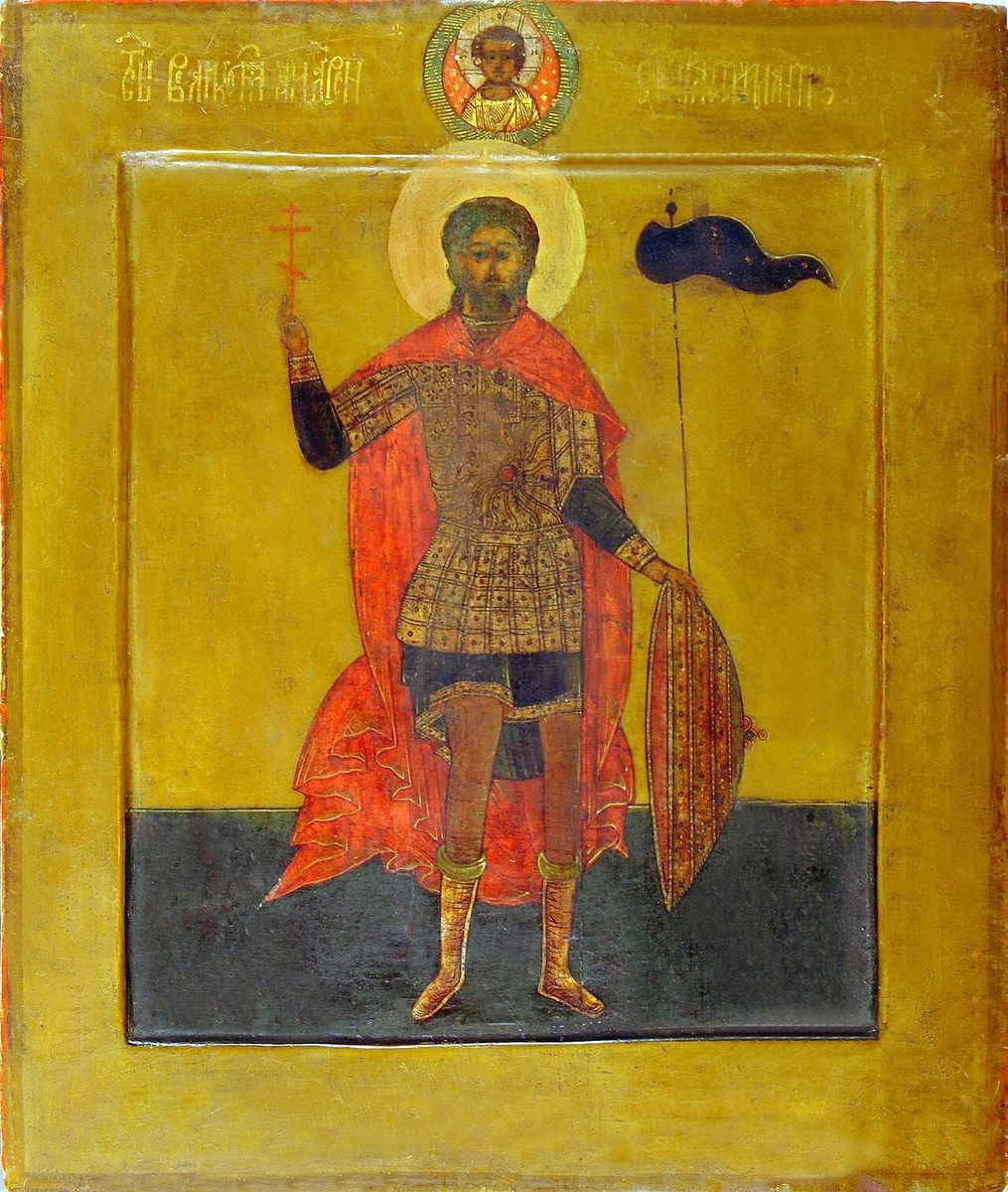
Andrew is painted as a warrior-saint in the full type: standing frontally at full length, young or in early middle age with a short dark beard, in lamellar or scale armour with the pteryges at the skirt, a red or crimson cloak clasped at the shoulder and falling behind him, and greaves and military boots. In the right hand he holds the martyr's cross — never a drawn sword, the point of the type being that the general's victory was won by the Cross and that he went to the block unarmed — and in the left a shield, often oval and jewelled, with a standard or banner planted beside him. Where the soldiers are shown with him they are a dense crowd of small figures behind or below, and in menologion compositions the scene of the day is the mass beheading in the mountain defile, with the spring breaking out at the foot of the picture.
The stored icon is a Russian panel of the first half of the seventeenth century from the Andrei Rublev Central Museum of Ancient Russian Culture and Art in Moscow (tempera on wood, 31 × 26.5 cm; it carries an Old Believer restoration of the nineteenth century). The saint stands on a dark green ground against gold, in gilded scale armour over a dark tunic, the scarlet cloak sweeping to his left; his right hand is raised holding a small red cross, his left rests on a great tapering shield, and a dark banner on a slender staff rises behind his shoulder. The inscription across the top names him great-martyr Andrew Stratelates, and above his head, in a round medallion, is the blessing Christ Emmanuel.
Disputed questions
- The number 2,593. The precision is ancient and universal — Greek, Slavonic and modern jurisdictional calendars all give the same figure, and the Greek synaxarion spells it out in words (δισχιλίων πεντακοσίων ἐνενήκοντα τριῶν). Precision of this kind in a passion is not itself evidence of an archive; the round-numbered companies of the martyrologies (the Forty, the Ten Thousand) show how easily numbers become traditional. What can be said is that the number is not a round one, that it is transmitted without variation, and that it is far too large for a "small detachment" picked for a raid — so that either the detachment grew into a legion in the telling, or the company baptised at Tarsus was drawn from more than the men of the original engagement. The entry records the figure as the tradition gives it and does not attempt to correct it.
- The date and the war. The passion names Maximian as emperor, Antiochus as governor and Seleucus as governor of Cilicia, and a Persian invasion of the Syrian provinces. A Persian war on that frontier is well attested in 296–298, in the tetrarchic period, and a martyrdom about 300 would sit naturally after it; but the passion's officials are not otherwise documented, and the synchronism is a plausible fit rather than a demonstrated one. Some Western notices place the martyrdom slightly earlier.
- Not to be confused with the other Andrews of this corpus. The name is one of the commonest in the calendar, and four of the confusions are easy: Andrew of Crete the Martyr (†767, feast October 17) was a Cretan monk beaten to death at Constantinople for the holy icons four and a half centuries later, and shares with this saint neither century, nor place, nor manner of death; Andrew of Crete (†c. 740, July 4) is the hymnographer, archbishop of Gortyna, author of the Great Canon; Andrew the Fool-for-Christ (October 2) is the tenth-century salos of Constantinople who saw the Protecting Veil at Blachernae; Andrew the First-Called is the Apostle. Neither is this saint the Andrew of the pair Andrew and Probus (July 9). The soldier-martyr with whom he genuinely belongs in a class — and with whom Russian usage occasionally muddles him, both being generals of the persecutions — is Sabbas Stratelates (†c. 272, April 24), who bore the same rank and had seventy of his own soldiers martyred with him; the two are quite distinct in century, place and manner of death.