
Entry of the Lord into Jerusalem
The Entry of our Lord and God and Saviour Jesus Christ into Jerusalem
The Entry of our Lord into Jerusalem — Palm Sunday, in Greek Ἡ Κυριακὴ τῶν Βαΐων, the Sunday of the Palm-Fronds — is the Great Feast of the Lord on which the Church keeps the one public acclamation of Christ recorded in his earthly life: how, coming up from Bethany where he had raised Lazarus from a four-days' tomb, he sent two disciples for a colt on which no man had ever sat, seated himself upon it, and rode down the Mount of Olives into the city, while the crowds cut branches from the trees, spread their garments in the road, and cried "Hosanna to the Son of David: blessed is he that cometh in the name of the Lord." All four Evangelists tell it, which is true of almost nothing else between the Baptism and the Passion. The feast is unique among the Twelve in being at once the only universally celebrated triumph of Christ before the Resurrection and the shortest-lived: it has no afterfeast, because Holy Week begins the same evening, and the branches are still in the people's hands when the Church starts to sing of the Bridegroom who comes at midnight. Its whole weight lies in that collision. What the crowd meant by the palms was a nationalist coronation; what the Lord was doing, by deliberately fulfilling Zechariah's "meek, and riding upon an ass," was refusing it — entering his capital on the beast of peace and of the poor, on the day the Passover lambs were chosen, to be killed. With Lazarus Saturday, which it cannot be separated from, it forms a single two-day paschal festival set between the close of the Forty Days and the beginning of the Passion; the two days share one troparion, and the raising of Lazarus is the reason John gives for the crowd. On the day the branches — palm and olive in the south, pussy-willow in the Slavic north — are blessed and given to the faithful with lighted candles, and fish is permitted within the fast.
.jpg)
The Gospel narrative
The Entry is one of the very few episodes narrated by all four Evangelists (Matthew 21:1–17; Mark 11:1–11; Luke 19:28–44; John 12:12–19), and each tells it for a different reason. The Church reads two of them liturgically — Matthew at Matins, John at the Liturgy — and its hymns quarry all four.
Matthew (21:1–17) gives the fullest ceremonial. Coming to Bethphage at the Mount of Olives, Jesus sends two disciples into the village: "Ye shall find an ass tied, and a colt with her: loose them, and bring them unto me. And if any man say ought unto you, ye shall say, The Lord hath need of them." Matthew alone breaks off to name the prophecy being fulfilled — "Tell ye the daughter of Sion, Behold, thy King cometh unto thee, meek, and sitting upon an ass, and a colt the foal of an ass" — a citation that fuses Isaiah 62:11 with Zechariah 9:9. The disciples bring the animals, put their garments on them, "and they set him thereon." A very great multitude spread their garments in the way, others cut branches from the trees and strewed them, and the crowds before and behind cry, "Hosanna to the Son of David: Blessed is he that cometh in the name of the Lord; Hosanna in the highest." The city is "moved," asking who this is. Matthew then runs the Entry straight into the cleansing of the Temple and adds the detail on which the whole hymnography of the feast turns: the children crying in the Temple, "Hosanna to the Son of David," the indignation of the chief priests and scribes, and the Lord's answer out of the Psalter — "Have ye never read, Out of the mouth of babes and sucklings thou hast perfected praise?" (Psalm 8:3 LXX).
Mark (11:1–11) is the most circumstantial about the animal and the least about the crowd. He has one beast, "a colt tied, whereon never man sat," and he alone says where it stood: "in a place where two ways met," and that the bystanders challenged the disciples and were answered with the formula the Lord had given them. Mark's crowd spreads garments and "cut down branches off the trees" — his word (στιβάδας) means leafy bedding cut from the fields, not palm fronds — and cries "Hosanna; Blessed is he that cometh in the name of the Lord: Blessed be the kingdom of our father David that cometh in the name of the Lord." In Mark, unforgettably, the triumph ends in nothing: "And Jesus entered into Jerusalem, and into the temple: and when he had looked round about upon all things, and now the eventide was come, he went out unto Bethany with the twelve." He inspects and withdraws; the cleansing waits until the next day.
Luke (19:28–44) makes the acclamation the disciples' own — "the whole multitude of the disciples began to rejoice and praise God with a loud voice for all the mighty works that they had seen" — and, alone among the four, drops the word Hosanna altogether, substituting "Blessed be the King that cometh in the name of the Lord: peace in heaven, and glory in the highest," which is deliberately the song of the angels at the Nativity turned round: there, peace on earth; here, peace in heaven, because earth will not have it. Luke alone records the Pharisees' demand that he rebuke his disciples and the answer, "I tell you that, if these should hold their peace, the stones would immediately cry out." And Luke alone, at the crest of the ridge where the city comes into view, has the Lord weep over it: "If thou hadst known, even thou, at least in this thy day, the things which belong unto thy peace! but now they are hid from thine eyes… because thou knewest not the time of thy visitation" — with the prophecy of the siege, the encircling trench, and not one stone left upon another. In Luke the triumphal entry is a funeral for the city that is cheering.
John (12:12–19) supplies what the others do not: the reason for the crowd, and the palms. He has already told of the supper at Bethany six days before the Passover, of Mary's ointment, and of the chief priests' resolution to kill Lazarus as well as Jesus "because that by reason of him many of the Jews went away, and believed on Jesus." So in John the multitude comes out from the city to meet him, and it comes out because of Lazarus: "The people therefore that was with him when he called Lazarus out of his grave, and raised him from the dead, bare record. For this cause the people also met him, for that they heard that he had done this miracle." They take "branches of palm trees" (τὰ βαΐα τῶν φοινίκων) and cry "Hosanna: Blessed is the King of Israel that cometh in the name of the Lord." John notes that Jesus "found a young ass, and sat thereon," quoting Zechariah in a form of his own — "Fear not, daughter of Sion: behold, thy King cometh, sitting on an ass's colt" — and then makes the most honest admission in the four accounts: "These things understood not his disciples at the first: but when Jesus was glorified, then remembered they that these things were written of him, and that they had done these things unto him." John closes on the Pharisees, defeated and exact: "Perceive ye how ye prevail nothing? behold, the world is gone after him." And immediately afterwards, in the same chapter, certain Greeks come asking to see Jesus, and he answers that the hour is come for the Son of Man to be glorified, and that a grain of wheat must fall into the ground and die — the Gentiles arriving at the door in the very hour of the Entry, which is exactly what the feast's hymns will make of the colt.
Only one word in the Greek of the whole New Testament gives this feast its name, and it occurs in John and nowhere else: βαΐον, a palm-frond, an Egyptian loanword. Ἡ Κυριακὴ τῶν Βαΐων — the Sunday of the Palm-Fronds — is named from a single hapax legomenon in the Fourth Gospel.
"Six days before the Passover": the day and the Lamb
John dates the supper at Bethany "six days before the Passover" (12:1) and puts the Entry "on the next day" (12:12). Counting as the ancients counted, that places the Entry five days before the Passover — on the tenth day of the first month. And the tenth day of the first month is the day given in the Law for selecting the lamb: "In the tenth day of this month they shall take to them every man a lamb… and ye shall keep it up until the fourteenth day of the same month: and the whole assembly of the congregation of Israel shall kill it in the evening" (Exodus 12:3, 6). On the day when every household in Jerusalem was bringing its lamb in from the flock and shutting it up to be killed four days later, the Lamb of God walked into the city on his own feet, was received into it, and was killed on the fourteenth. The Church does not always press the point in so many words, but the whole shape of the Triodion from this Sunday onward depends on it, and the doxastikon of the feast begins by quoting John's date verbatim: Πρὸ ἓξ ἡμερῶν τοῦ Πάσχα — "six days before the Passover."
That the Entry belongs to the Passover pilgrimage also explains the crowd. The city in the week before Passover held a vastly swollen population of pilgrims, the Hallel psalms (113–118 LXX 112–117) were the songs of the pilgrim feasts, and Psalm 118 in particular — from which both the Hosanna and the "Blessed is he that cometh" are taken — was sung in procession up to the Temple. What the crowd shouted was not invented for the occasion. It was the liturgy of the festival, redirected onto a man.
Zechariah 9:9 and the deliberate choice of the colt
Nothing in the Entry is accidental, and the Gospels are at pains to show it. Christ does not find a mount; he sends for one, with instructions, a password and a prophecy in hand. Matthew and John both name the text:
Rejoice greatly, O daughter of Sion; shout, O daughter of Jerusalem: behold, thy King cometh unto thee: he is just, and having salvation; lowly, and riding upon an ass, and upon a colt the foal of an ass. (Zechariah 9:9)
The verse is read entire at the Great Vespers of the feast, in the third of the three Old Testament lessons (Zechariah 9:9–15), and the Church's stichera do not merely allude to it but quote it and name the prophet: "Come, let us also today, all the new Israel, the Church gathered out of the nations, cry aloud with the prophet Zechariah: Rejoice greatly, O daughter of Sion…" The feast is, liturgically, an exegesis of one prophetic verse.
Its force lies in the next verse, which the lesson also contains: "And I will cut off the chariot from Ephraim, and the horse from Jerusalem, and the battle bow shall be cut off: and he shall speak peace unto the heathen: and his dominion shall be from sea even to the sea" (Zechariah 9:10). The horse is the animal of war and of empire; the ass is the animal of the farm, of burden, of the poor, and — in the older layers of Israel's memory — of the peaceable judges and of Solomon's anointing. A king who comes on a colt has disarmed himself in advance. Set beside the Roman adventus, the formal entry of a victorious general or emperor into a city with troops, spoils and captives, the Entry into Jerusalem is a systematic inversion: no army, no plunder, no captives, a borrowed animal, and a road paved not with laurel but with the cloaks off the backs of the poor. Those who make the Entry a parody of the Roman triumph are reading it as the Fathers read it, though with a different vocabulary; the Byzantine hymnographers put it in the language of thrones — "He who hath heaven for a throne and the earth for a footstool… has this day humbled himself upon a dumb colt."
Two further things about the animal are pressed hard by the tradition. First, that it was unbroken — Mark and Luke both specify "whereon never man sat." An animal never yoked was, by the Law's instinct, the animal fit for a sacred use: the red heifer must be one "upon which never came yoke" (Numbers 19:2), and the cart that carried the Ark from Philistia was drawn by cows that had never been worked (1 Kingdoms 6:7). The colt is consecrated by never having served. Second, that it was the mount of the nations. The Greek for a beast is ἄλογον, literally "the irrational," "the speechless," and the hymnographers pounced: the colt is πῶλος ἄλογος, and the Gentiles are the ἀλογία, the unreason, which the Word — ὁ Λόγος — mounts, masters and makes his own. The synaxarion's distich for the day is built entirely on the pun:
Astride a colt (πώλῳ) is he who by a word stretched out the vault (πόλον); he seeks to loose mortals from unreason (ἀλογίας).
The Matins prokeimenon-verse says it flatly — "Today Christ enters the holy city, seated on a colt, undoing the ancient, barren unreason of the nations" — and the canon reads Zechariah's "daughter of Sion" as the Church of the Gentiles. That the Greeks came asking for Jesus in the same chapter of John was not lost on anyone.
The ass and the colt: Matthew's two animals
Matthew has two beasts where the other three have one: "ye shall find an ass tied, and a colt with her"; "they brought the ass, and the colt, and put on them their clothes, and they set him thereon." The Greek of the last clause (ἐπάνω αὐτῶν, "upon them") has been a standing crux since antiquity, and it has often been urged as evidence that Matthew misread Hebrew poetry — that he took the parallelism of Zechariah 9:9, where "an ass" and "a colt the foal of an ass" are the same animal named twice, for a statement about two animals, and duly supplied a second one.
The entry records the case as it stands. In favour of the objection: Hebrew parallelism plainly does intend one beast; Mark, Luke and John all have one; and Matthew's fulfilment citations elsewhere show him willing to read a text with great literalism. Against it: a young unbroken colt, taken from its dam and led into a shouting crowd, would in fact be far more manageable with the mother walking beside it, which is a stockman's observation rather than an exegete's, and Matthew's "upon them" most naturally refers to the garments rather than the animals — the garments were laid on both beasts, and he sat on the ones that were on the colt. Patristic commentators, who had no anxiety about the number, read the pair allegorically: the mother the synagogue long under the yoke, the colt the untamed Gentiles; or the mother the Law and the colt the Church. The Byzantine iconographers, characteristically, split the difference and simply painted a foal trotting under the ass, so that both Gospels are satisfied on one board.
The palms and the Hosanna
Hosanna is not praise. It is a petition. Hebrew hôšîʿâ nnā — "save now, we beseech thee" — is the cry of Psalm 118:25 (LXX 117:25), immediately before "Blessed is he that cometh in the name of the Lord" in verse 26; and at the pilgrim feasts, and above all at Tabernacles, the verse was chanted by the crowds in the Temple court while they shook bundles of palm, myrtle and willow (Leviticus 23:40). By the first century the imperative had hardened into an acclamation, in the way that "God save the King" is no longer felt as a request, and the Evangelists transliterate rather than translate it — which is why the word entered every Christian language untranslated. But the grammar underneath it never went away, and the Church has always known what it says. The people in the road were shouting Save us, and did not know that this was the week in which they would be answered.
The palm was, in the Judaea of the period, an emblem of national victory and not merely a festal decoration. When Simon Maccabee took the citadel of Jerusalem the people "entered into it with thanksgiving, and branches of palm trees, and with harps, and with cymbals" (1 Maccabees 13:51); when the Temple was purified they "bare branches, and fair boughs, and palms also" (2 Maccabees 10:7); and when the nation rose against Rome in 66 it struck the palm on its coins. To wave palms at a man coming down the Mount of Olives — the very place where, as Josephus records of more than one first-century agitator, deliverers were expected to appear, and where Zechariah 14:4 sets the feet of the Lord in the day of his coming — was to make a political declaration, and the authorities read it correctly. The Fourth Gospel's Pharisees say "the world is gone after him"; four days later the Sanhedrin will tell Pilate that this man makes himself a king.
The garments in the road say the same thing in a different register: when the army proclaimed Jehu king, "they hasted, and took every man his garment, and put it under him on the top of the stairs, and blew with trumpets, saying, Jehu is king" (4 Kingdoms 9:13). Spreading cloaks under a rider was enthronement. The crowd was crowning him.
What the crowd meant, and what the Lord was doing
The two are not the same, and the feast exists in the space between them.
The crowd meant a king in the old style: a son of David to break the Roman yoke, cleanse the Temple, restore the kingdom, and do it now, this Passover, with the city full of pilgrims. Mark preserves the wording of that hope unedited — "Blessed be the kingdom of our father David that cometh." Their expectation was not wicked; it was scriptural, and it was too small. They wanted the Messiah to save Israel from Rome; he had come to save Adam from death, which meant that the enemy to be defeated was not the garrison in the Antonia but the grave, and that the battle would be fought in the one way that could reach it — from inside it.
So he took every element of a royal entry and turned it. He came from Bethany, that is, from a tomb he had just emptied, so that the credentials he offered were not military but resurrectional. He rode the beast of peace. He accepted the acclamation — this is important, and the Fathers stress it: he did not refuse the Hosanna, he defended the children who sang it, and he told the Pharisees that the stones would take it up if the crowd fell silent, because the acclamation was true. And he wept, because those who made it did not know what they were saying. Then he went into the Temple, overturned the tables of the money-changers, and by that single act guaranteed his own death within the week.
The hymnography of the feast holds the two together with startling directness. The first sticheron of Great Vespers does not put palms in the hands of the faithful at all:
Today the grace of the Holy Spirit hath gathered us together, and all of us, taking up thy Cross, say: Blessed is he that cometh in the name of the Lord; Hosanna in the highest.
We are given the Cross to carry in the procession, not a branch. And the stichera repeat, in half a dozen forms, that he is riding πρὸς τὸ Πάθος, "toward the Passion," and ἐπὶ σφαγήν, "to the slaughter," of his own will. The triumph is not undone by the Passion in these texts; it is identified with it. He is a victor on the colt because he is on his way to be killed.
"With branches before, with staves afterwards"
The oldest homiletic commonplace of the day is that the mouths which cried Hosanna on Sunday cried "Crucify him" on Friday, and the Church sings it in the hypakoe of the Matins:
Having hymned him before with branches, afterwards with staves the thankless Judaeans seized Christ, who is God. But we, honouring him unchangeably in faith as our benefactor, cry to him without ceasing: Blessed art thou that comest to call Adam back again.
The rhetorical point is real and the Church applies it to itself: as the Orthodox Church in America's own catechetical account of the day puts it, the faithful who carry branches "are judged together with the Jerusalem crowd." That is the intended use of the text — a mirror, not an indictment of a people. Historically, the identification of the two crowds is doubtful and modern exegesis generally rejects it: the Sunday multitude was largely Galilean and Diaspora pilgrims camped outside the walls, while the party assembled before Pilate on Friday morning was a small, early-morning, city crowd gathered by the Temple authorities, and the Gospels themselves say that those authorities acted by stealth precisely because they feared the pilgrims (Mark 14:1–2; Luke 22:6). Nor does the New Testament allow the collective reading: Luke's crowd goes home from Golgotha beating its breast (Luke 23:48), and thousands of the same city are baptised at Pentecost. The Church's own liturgical antisemitic inheritance in texts of this kind is a matter the Orthodox world has begun to address explicitly in the last century, and this entry records the text as it stands in the Triodion while noting both its intended penitential use and its historical unlikelihood.
The children and the babes
No feature of the Entry is dwelt on by the Byzantine hymnographers as insistently as the children. The prokeimenon of the Matins is Psalm 8:3 LXX, "Out of the mouth of babes and sucklings hast thou perfected praise"; the first troparion of the canon begins from the same verse; the kontakion pairs "the praise of the angels" with "the hymn of the children"; sticheron after sticheron speaks of οἱ Παῖδες, the children, and τὰ νήπια, the infants — "the guileless multitude, a nature still in infancy." The scriptural warrant is Matthew's Temple scene (21:15–16), where it is the children and not the crowd who go on shouting after the procession has dispersed, and the Lord answers the chief priests out of the Psalter.
The oikos of the kontakion draws from this a connection nobody expects. The children who sing Hosanna are set against the children of Bethlehem:
…for no longer, he says, shall infants be slaughtered for the sake of Mary's infant, but for all, infants and elders alike, thou alone art crucified. No longer shall the sword come at us: for thine own side shall be pierced with a lance.
The Innocents died in the place of the Child; now the Child dies in the place of all, and the sword that fell on Bethlehem becomes the lance in his own side. That is the theology of the feast in four lines, and it is put into the mouths of children.
One feast of two days: Lazarus Saturday and the Entry
Lazarus Saturday and Palm Sunday are not two feasts near each other but one festival in two days, and every layer of the tradition says so.
The Forty Days end before them. At Vespers on the Friday evening the Triodion formally closes the Great Fast — "having accomplished the forty days for the profit of our souls, we pray thee, O Lover of mankind, that we may see the holy week of thy Passion" — so that the two days stand outside both Lent and Holy Week, a bridge of paschal joy laid between the fast and the Passion. Uniquely in the year, the resurrectional service of Sunday is sung on a Saturday; the church is vested in resurrectional splendour for both days and stays so; and at the Liturgy of Lazarus Saturday the baptismal verse "As many as have been baptised into Christ have put on Christ" replaces the Trisagion, a survival from the days when that Saturday was one of the great baptismal days of the year — which is why the second apolytikion of Palm Sunday itself is about baptism: "Buried together with thee through baptism…"
They share a troparion. The apolytikion in Tone 1 sung at every service of both days, Τὴν κοινὴν Ἀνάστασιν, is about Lazarus in its first half and about the palms in its second; it cannot be assigned to one day rather than the other.
The Gospel of the Liturgy binds them. John 12:1–18 begins at the supper in Bethany "six days before the Passover, where Lazarus was which had been dead," takes in Mary's ointment, Judas's complaint and the plot to kill Lazarus, and only then goes out to the palms. The festal Gospel of Palm Sunday is a Lazarus reading with an entry at the end of it.
And the causality runs from one to the other. In John it is the raising of Lazarus that brings the crowd out of the city, and the raising of Lazarus that decides the Sanhedrin. The Church's own reading of the sequence is that the last and greatest sign — a man four days dead and stinking, called out by name — is what makes the Passion inevitable: Christ gave the pledge of the general resurrection first, and then went to his death. The apolytikion states the order as doctrine: "Giving assurance of the common resurrection before thy Passion, thou didst raise Lazarus from the dead."
The history of the feast
The Entry is celebrated wherever Christians keep a calendar, and it began where it happened.
The earliest description is in the Itinerarium of Egeria, the pilgrim diary of a Western woman who kept the Holy Week of Jerusalem about 381–384 and wrote down what she saw. On the Saturday the people go out to the Lazarium at Bethany, where the priest announces the coming Pascha and reads John's "six days before the Passover"; on "the next day, that is, the Lord's Day, which begins the Paschal week, and which they here call the Great Week," the ordinary services are held at the Martyrium on Golgotha, and then the archdeacon gives notice: "Let us all be ready today in Eleona at the seventh hour." In the afternoon the whole city goes up the Mount of Olives to the Eleona church, and at the ninth hour higher still to the Imbomon, the place of the Ascension. There, as the eleventh hour approaches, the Gospel of the children and the branches is read; and then, in the sentence that has fixed the shape of this feast for sixteen centuries:
…the bishop immediately rises, and all the people with him, and they all go on foot from the top of the Mount of Olives, all the people going before him with hymns and antiphons, answering one to another, Blessed is He that cometh in the Name of the Lord. And all the children in the neighbourhood, even those who are too young to walk, are carried by their parents on their shoulders, all of them bearing branches, some of palms and some of olives; and thus the bishop is escorted in the same manner as the Lord was of old.
Everything is already there: the afternoon hour, the descent of the Mount of Olives, the palms and the olive branches, the children carried on shoulders, the antiphon out of Psalm 118, and the bishop deliberately taking the Lord's place in a re-enactment. The contemporary Armenian Lectionary of Jerusalem confirms the arrangement from the other side, appointing Matthew 21:1–11 for the day and the psalm-verse "Blessed is he that cometh in the name of the Lord" for the descent.
From Jerusalem the observance travelled. In the Byzantine world it was fixed by the seventh and eighth centuries in the form the Triodion still preserves: the canon of the day is the work of Cosmas of Maiuma, of the great Palestinian generation around the year 700, and the office is built around the blessing and carrying of branches rather than around a long procession outside the walls. In the West the day appears from the fifth to seventh centuries and acquires, in the medieval Ordines, an elaborate procession with a gospel-book or a sculpted Palmesel standing for Christ. In Rus' the ceremonial went furthest of all: from the sixteenth century, and in developed form through the seventeenth, Moscow kept the шествие на осляти, the "procession on the little ass," in which the Patriarch, representing Christ, rode from the Dormition Cathedral through the Spassky Gate to the chapel of the Entry into Jerusalem on a horse caparisoned to look like a donkey — and the Tsar walked, leading it by the bridle, while musketeers' children spread coloured cloth in the road. It is one of the most extraordinary liturgical statements of the relation of empire to Church ever staged, and it ended with the seventeenth century: the rite is documented until 1693 and did not survive the reforms of Peter I.
The names of the day
The feast's names are a map of where palms grow and where they do not. Greek Κυριακὴ τῶν Βαΐων, the Sunday of the Palm-Fronds, with the older adjectival title ἡ Βαϊοφόρος, "the Palm-bearing," used both of the day and of its icon. Slavonic Вход Господень в Иерусалим, the Entry of the Lord into Jerusalem — the official name, beside which stands the universal popular Russian Вербное воскресенье, Willow Sunday. Serbian Цвети and Bulgarian Цветница, Romanian Duminica Floriilor — "Flowers," "Flower Sunday" — in lands where the first blossom of the year is what the faithful carry. And in the Arabic of the Antiochian patriarchate, أحد الشعانين, Aḥad ash-Shaʿānīn, "the Sunday of the Hosannas," where shaʿānīn is the Syriac ūshaʿnē — the Hosanna itself, borrowed through Aramaic and worn down into an Arabic plural. In Syria and Lebanon it is the children's feast of the year: they lead the procession round the church carrying tall decorated candles dressed with flowers and plaited palm.
The blessing of the branches, and the pussy-willow
The rite of the day is the blessing and distribution of branches, which the faithful hold, with lighted candles, through the rest of the service and then carry home to the icon corner, where they stay until the next year.
The prayer appointed for the blessing is one of the finest in the Euchologion, and its logic is worth following. It addresses the Father "who sittest upon the Cherubim," recalls that he sent his only-begotten Son to save the world "by his Cross and burial and resurrection," and that when he came to Jerusalem to his voluntary Passion "the people that sat in darkness and the shadow of death, taking the emblems of victory, the branches of trees and the fronds of palms, foretold the Resurrection"; and then it asks that we who in imitation of them carry branches "on this fore-festal day" may be preserved, and may be counted worthy of the life-giving Resurrection of the third day. Two things are being said. The branches are not decorations but τὰ τῆς νίκης σύμβολα, the emblems of victory — the same phrase as in the troparion — and they are prophetic: the crowd was announcing the Resurrection without knowing it. And the Church's own prayer calls this Great Feast a προεόρτιος ἡμέρα, a forefeast — of Pascha. The greatest day the Triodion has is officially the eve of something else.
In Greek practice the branches are blessed at Matins toward the end of the canon, after the "Holy is the Lord our God" and before the Praises, which is where the Triodion sets the prayer; in Slavic practice they are blessed after the Gospel and Psalm 50, sprinkled with holy water, and distributed with candles at the veneration of the festal icon. Where palms are had, palm and olive are used, and the fronds are commonly plaited into small crosses.
Where palms are not had, the Church uses what the spring gives. In Russia, Ukraine, Belarus and the Slavic north the branch is the pussy-willow — верба, the goat willow Salix caprea — and the reason is precise and practical: at the season of Palm Sunday in the northern latitudes almost nothing is in leaf, but the willow is already in catkin, having flowered before its own leaves, so that the only living, budding, visibly resurrected thing available in a landscape still coming out of winter is a willow wand. It is a substitution made on exactly the logic of the feast — the branches are emblems of life defeating death, and the willow is the first plant in that country to prove it. The name of the day followed the branch: Вербное воскресенье, Willow Sunday. Willow markets before the feast were a fixture of Russian city life, and among the domestic customs attached to the blessed verba is the gentle tap given with it to children and household, with the words "It is not I who strike; the willow strikes." The Bulgarian Вербница preserves the same name, and in the Balkans generally the first flowers of spring do the work of the palm.
Feast and commemoration
Palm Sunday is a Great Feast of the Lord, one of the Twelve, and the first of the three that are movable — Palm Sunday, the Ascension and Pentecost — kept seven days before Pascha (7 days before Pascha), so that it always falls on a Sunday and always at the very end of Great Lent. Its position and its rank make it unlike every other Great Feast in the calendar, in four ways.
It has no forefeast and no afterfeast. Every other Great Feast is surrounded by days of preparation and an octave of continuation closed by a leavetaking. Palm Sunday has neither: Lazarus Saturday does the work of a forefeast without being called one, and the afterfeast is impossible, because the day after Palm Sunday is Great and Holy Monday. Its leavetaking is on the day itself — the shortest festal cycle in the Orthodox year, one day for the greatest triumph.
It cannot be transferred and cannot be displaced. A Dominical feast overrides the resurrectional propers where it falls on a Sunday; this one falls on a Sunday always, and its Sunday is the last of the Triodion, so there is nothing to displace and no possibility of a collision. Where the Annunciation coincides with it — as happens when March 25 falls on Palm Sunday — the two are kept together under the Triodion's elaborate rubrics, the only Great Feast that Palm Sunday ever has to share.
Its Matins keeps a resurrectional shape without being resurrectional. There is no Gospel of the eleven resurrection readings; the festal Gospel of Matthew 21:1–11, 15–17 is read instead. But after the ninth ode, in place of the usual exapostilarion, the Church sings "Holy is the Lord our God" three times — the acclamation that belongs to Sunday Matins throughout the year — carrying the resurrectional note over from Lazarus Saturday into the last hours before Holy Week.
The fast is relaxed but not lifted. Fish, wine and oil are permitted on the day. Within the Forty Days and Holy Week together this happens on two days only, Palm Sunday and the Annunciation, so that Palm Sunday is one of the two fish days of the Great Fast — Lazarus Saturday, immediately before, admits wine, oil and in Greek use fish roe, but not fish. In Greece the customary table is salt cod with garlic sauce, the same dish eaten on March 25. Where a liturgical colour is appointed, Slavic practice commonly vests in green, for the branches and the springing life they stand for; gold or white is used elsewhere, and Greek practice keeps no fixed colour scheme.
The threshold of Holy Week, and the turn of the evening
The most characteristic thing about this feast is how quickly it is over.
The Liturgy ends; the people go home with blessed branches in their hands; and at Vespers the same evening the Church begins Holy Week. In the received practice the Matins of Great and Holy Monday is sung by anticipation on Palm Sunday evening — the first of the three Bridegroom services — and the change of register is total and deliberate. The troparion that has been sung all day, with its Hosanna and its emblems of victory, gives way to:
Behold, the Bridegroom cometh at midnight, and blessed is that servant whom he shall find watching; and again, unworthy is he whom he shall find heedless. Beware therefore, O my soul, lest thou be borne down with sleep, lest thou be given up to death and shut out from the Kingdom.
And the exapostilarion that follows is the most desolate line in the Byzantine repertory: "I see thy bridal chamber adorned, O my Saviour, and I have no wedding garment that I may enter there." Within a few hours the themes are Joseph sold by his brethren, the barren fig tree cursed on the road back from Bethany, and the ten virgins with their lamps. The church is still green, the willows are still in the hands of the faithful, and the Church has already turned to face the Cross.
This is not a change of subject but the completion of one. The feast has spent all day singing that he rides toward the Passion and to the slaughter, of his own will; the evening simply follows him there. Palm Sunday is, in the Church's own reckoning, the last day on which anything may be enjoyed before the strictest week of the year — and the day whose own prayer of blessing calls it a forefeast of the Resurrection. It stands between the two, holding both.
Hymns
Apolytikion — Tone 1
Giving assurance of the common resurrection before thy Passion, thou didst raise up Lazarus from the dead, O Christ God. Wherefore we also, like the children, bear the emblems of victory and cry aloud to thee, the Conqueror of death: Hosanna in the highest; blessed is he that cometh in the name of the Lord.
Second
Buried together with thee through baptism, O Christ our God, we have been accounted worthy of deathless life by thy Resurrection; and singing praise we cry aloud: Hosanna in the highest; blessed is he that cometh in the name of the Lord.
Kontakion — Tone 6 (plagal of the second)
Borne upon a throne in heaven and upon a colt on earth, O Christ God, thou didst accept the praise of the angels and the hymn of the children as they cried aloud to thee: Blessed art thou that comest to call Adam back again. Since thou hast bound Hades, O Immortal One, and put death to death, and raised up the world, with palms the infants praised thee, O Christ, crying out to thee this day as to a victor: Hosanna to the Son of David! For no longer, he says, shall babes be slain for the sake of the babe of Mary; but for all, infants and elders alike, thou alone art crucified. No longer shall the sword come against us: for thine own side shall be pierced with a lance. Wherefore, rejoicing, we say: Blessed art thou that comest to call Adam back again.
Original translation from the Greek
The
Astride a colt is he who by a word stretched out the vault of heaven; he seeks to loose mortals from unreason.
The
**ὩΣΑΝΝΑ ΧΡΙΣΤΟΣ ΕΥΛΟΓΗΜΕΝΟΣ ΘΕΟΣ** — *Hosanna! Christ, blessed, is God.* God is the Lord and hath appeared unto us: keep the feast, and come, let us exult and magnify Christ, with palms and branches crying aloud in hymns: Blessed is he that cometh in the name of the Lord, our Saviour.
The
O Lord our God, who sittest upon the Cherubim, who hast raised up thy might and sent thy only-begotten Son, our Lord Jesus Christ, to save the world by his Cross and burial and Resurrection: when he came to Jerusalem unto his voluntary Passion, the people that sat in darkness and the shadow of death took the emblems of victory, the branches of trees and the fronds of palms, and foretold the Resurrection. Do thou thyself, O Master, preserve us also, who in imitation of them carry palms and branches of trees in our hands on this fore-festal day; and keep us, as those crowds and those children offered thee the Hosanna, that in hymns and spiritual songs we may be counted worthy of the life-giving Resurrection on the third day, in Christ Jesus our Lord…
Appointed readings
Epistle — Philippians 4:4–9
4Rejoice in the Lord alway: and again I say, Rejoice. 5Let your moderation be known unto all men. The Lord is at hand. 6Be careful for nothing; but in every thing by prayer and supplication with thanksgiving let your requests be made known unto God. 7And the peace of God, which passeth all understanding, shall keep your hearts and minds through Christ Jesus. 8Finally, brethren, whatsoever things are true, whatsoever things are honest, whatsoever things are just, whatsoever things are pure, whatsoever things are lovely, whatsoever things are of good report; if there be any virtue, and if there be any praise, think on these things. 9Those things, which ye have both learned, and received, and heard, and seen in me, do: and the God of peace shall be with you.
Gospel — John 12:1–18
1Then Jesus six days before the passover came to Bethany, where Lazarus was which had been dead, whom he raised from the dead. 2There they made him a supper; and Martha served: but Lazarus was one of them that sat at the table with him. 3Then took Mary a pound of ointment of spikenard, very costly, and anointed the feet of Jesus, and wiped his feet with her hair: and the house was filled with the odour of the ointment. 4Then saith one of his disciples, Judas Iscariot, Simon’s son, which should betray him, 5Why was not this ointment sold for three hundred pence, and given to the poor? 6This he said, not that he cared for the poor; but because he was a thief, and had the bag, and bare what was put therein. 7Then said Jesus, Let her alone: against the day of my burying hath she kept this. 8For the poor always ye have with you; but me ye have not always. 9Much people of the Jews therefore knew that he was there: and they came not for Jesus’ sake only, but that they might see Lazarus also, whom he had raised from the dead. 10But the chief priests consulted that they might put Lazarus also to death; 11Because that by reason of him many of the Jews went away, and believed on Jesus. 12On the next day much people that were come to the feast, when they heard that Jesus was coming to Jerusalem, 13Took branches of palm trees, and went forth to meet him, and cried, Hosanna: Blessed is the King of Israel that cometh in the name of the Lord. 14And Jesus, when he had found a young ass, sat thereon; as it is written, 15Fear not, daughter of Sion: behold, thy King cometh, sitting on an ass’s colt. 16These things understood not his disciples at the first: but when Jesus was glorified, then remembered they that these things were written of him, and that they had done these things unto him. 17The people therefore that was with him when he called Lazarus out of his grave, and raised him from the dead, bare record. 18For this cause the people also met him, for that they heard that he had done this miracle.
Iconography
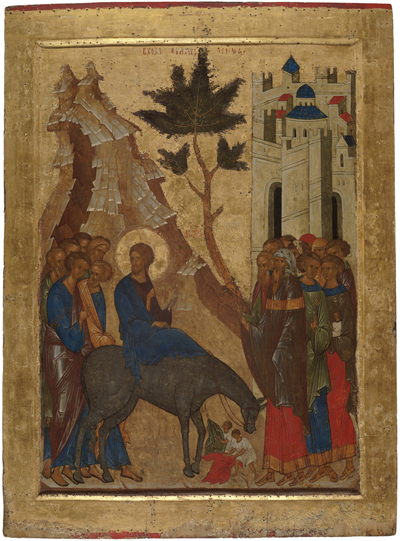
The Entry into Jerusalem is one of the settled great-feast types, present in the festal cycle from the earliest surviving monumental programmes and standardised by the tenth century. Its Greek name is a title of the feast itself: ἡ Βαϊοφόρος, "the Palm-bearing." Unlike most festal icons it is composed as a journey — read from left to right, from a wilderness into a city — and its tension is horizontal rather than vertical.
At the left, on a rocky slope, comes the procession. Christ is seated on the colt, almost always side-saddle, legs together and both feet on the near side, in the posture of a Byzantine ruler rather than a rider; his right hand blesses or gestures forward, his left holds a scroll. The single most eloquent detail of the type is the position of his head: while the animal moves toward the city, Christ turns his face back over his shoulder toward the apostles behind him. The body goes to the Passion; the eyes stay on the disciples. Behind him the Twelve are massed in a compact block, some gesturing, one or two conversing — John commonly at the front, since it is John who will note that they understood none of it at the time.
Behind and above them rises the Mount of Olives, painted as the stepped, faceted rock of Byzantine landscape, its ledges often gilt-highlighted; the mountain closes the composition on the left and marks the road as a descent.
At the centre stands the palm tree, and it is the hinge of the picture: a slender trunk with a dark crown, in which one or two children have climbed to cut branches, leaning out with a frond in one hand. In Russian recensions the tree is often not a palm at all but a generalised dark evergreen, which is itself a small record of the willow substitution.
At the right is Jerusalem — a walled city with crenellated towers, an arched gate, and behind the wall a domed structure standing for the Temple, sometimes hung with a veil or garland between the towers. Out of the gate comes the crowd: elders in mantles, bearded and often ill-disposed, young men, women, a knot of heads receding into the wall. Some hold branches; some raise their hands.
Between the two groups, on the ground under the colt's hooves, are the details the painters loved. Children spread their garments in the road, small figures pulling a tunic off over the head or laying a folded cloth flat. And very often one child sits at the very bottom of the panel with a foot drawn up in both hands, pulling a thorn from his heel — a motif taken over, consciously or not, from the antique Spinario, and a piece of pure observed childhood inserted into a theophany. Beneath the ass, in many versions, trots its foal, which is Matthew's second animal painted rather than argued about.
The stored icon is a fully developed example of the Russian type: the panel of the Entry from the festal tier of the iconostasis of the Kirillo-Belozersky Monastery, painted in the fifteenth century (the ensemble is dated to about 1450) and now in the Kirillo-Belozersky Museum-Reserve. Christ, in blue chiton and dark mantle, sits side-saddle on a grey colt and turns his head back to the apostles crowded behind him in blue and vermilion; the white-crested rock of the Mount of Olives rises at the left; the dark crown of the tree stands at the centre of the gold ground with a Slavonic inscription above it; at the right the towered city with its blue-domed buildings sends out its crowd of elders, one of whom carries a child on his shoulders — the children Egeria saw carried on shoulders down the Mount of Olives, still being carried a thousand years later; and beneath the colt a small figure in white spreads a garment across the road.
The second stored image shows the same type in its Greek recension three centuries later, and shows it under its own name: an eighteenth-century Greek panel in the Byzantine and Christian Museum at Athens (Lambikis donation, inv. BXM 11691), inscribed across the top Η ΒΑΪΟΦΟΡΟΣ. Here Christ rides a white ass, the apostles press behind him at the left, and the tree at the upper left is a great dark leafy mass with two children up in the branches, one reaching to break a bough. The city at the right is a fantasia of grey crenellated walls and red-and-gold domes; the crowd at the gate is led by an old man in vermilion. At the bottom, three children work at the road: one unfastening his sandal, one laying down a cloth, and one bent double spreading his garment under the hooves. It is a good instance of how little the type changed between Byzantium and the Greek eighteenth century, and of how the feast's Greek title was written straight onto the board.
Provenance and rights note. The underlying panel is an eighteenth-century
icon and is out of copyright; the Commons photograph of it, however, is
released by its photographer (George E. Koronaios) under CC BY-SA 4.0 and shows
the panel on the museum wall rather than as a flat plate reproduction, so the
photographer's terms are recorded rather than assumed away: license_basis: cc-license, CC BY-SA 4.0, attribution to George E. Koronaios, from
File:Icon depicting the Entry into Jerusalem (Byzantine and Christian Museum of Athens, 1-15-2023).jpg.
Beyond the panel icons, the Entry is one of the commonest scenes in Byzantine monumental painting, where it regularly occupies a lunette or vault on the south or west side of the naos, so that the faithful process beneath a painted procession; and it is among the earliest identifiable Christian subjects, appearing on fourth-century sarcophagi in a form borrowed directly from the Roman imperial adventus — which is the visual counterpart of everything the hymns say about thrones and colts.