
First and Second Finding of the Head of the Forerunner
The First and Second Finding of the Precious Head of the Holy and Glorious Prophet, Forerunner and Baptist John
On February 24 the Church keeps together the first and second discoveries of the Precious Head of John the Baptist — the severed head of the greatest of the prophets, hidden after his beheading and twice brought to light. The tradition holds that Herodias buried the head apart from the body in a dishonourable place, that the pious Joanna, wife of Herod's steward Chuza, secretly recovered it and laid it in a vessel on the Mount of Olives, and that in the fourth century it was found there by two monks on pilgrimage to Jerusalem, to whom the Forerunner himself revealed it — the First Finding. Passing thereafter through a long chain of keepers, and hidden at last in a cave near Emesa in Syria, it was revealed a second time in the year 452 to the archimandrite Marcellus and enshrined at Emesa — the Second Finding. A Third Finding, at Comana of Cappadocia about the year 850, is kept separately on May 25. The relic-feast belongs to the cycle of six fixed commemorations of the Forerunner; his full Life is given in his own entry, John the Forerunner.
.jpg)
The hiding of the Head
The feast reaches back to the murder recounted in the Gospels (Mark 6:14–29; Matthew 14:1–12): the Forerunner beheaded in the fortress-prison of Herod Antipas at the demand of the dancing daughter of Herodias, his head brought in on a charger and given to the girl, and by the girl to her mother. There the Gospel account ends, and the tradition of the relic begins. The synaxaria relate that Herodias, not content with the killing, would not suffer the head to be buried with the body lest the prophet who had rebuked her be made whole again; she pierced the holy tongue that had condemned her marriage and buried the head apart, in an unclean and dishonourable place within the precincts of Herod's residence. The Forerunner's body his own disciples took and laid in the tomb at Sebaste in Samaria, but the head was lost to sight.
It was recovered, the received account continues, by Joanna, the wife of Chuza, Herod's steward — the same Joanna whom the Evangelist Luke numbers among the women who ministered to the Lord of their substance and who came to the tomb on the morning of the Resurrection (Luke 8:3; 24:10). Unable to bear that the head of the prophet should lie in filth, she took it secretly, laid it in an earthen vessel, and buried it with honour on the Mount of Olives, on the estate of Herod. There it rested, its hiding-place unknown, until the age of the Christian empire.
The First Finding
In the fourth century — the age of Constantine, when the holy places of Palestine were being opened and honoured — two monks came from the East on pilgrimage to Jerusalem to venerate the tomb of the Lord and the sites of the Gospel. As they kept vigil, the tradition tells, the Forerunner appeared to one of them and made known the place where his head lay hidden on the Mount of Olives. Rising, they went to the spot he had shown, dug, and found the Precious Head in the vessel of Joanna's hiding; and, wrapping it in a bag of camel's hair, they set out to carry it home. This is the First Finding.
What followed the synaxaria recount with unsparing candour, as a parable of how the honour of a relic is kept or lost by the character of its keepers. On the road the monks fell in with a poor potter of the city of Emesa; and the Forerunner, appearing again — this time to the potter — bade him take the sack from the careless and idle monks and flee. The potter kept the Head reverently to the end of his days and bequeathed it to his sister, and from her it passed through a succession of keepers until it fell into the hands of an Arian priest named Eustathius, who used the healings that flowed from the relic to lend credit to his heresy. When his imposture was exposed and he was driven from the city, he buried the Head in a cave near Emesa and fled, telling no one; and over that cave, in the providence of God, a monastery in time arose, its monks unaware of the treasure in the ground beneath them.
The Second Finding at Emesa
About the year 452, under the emperor Marcian and Pulcheria, the Head was revealed a second time. The Forerunner appeared to Marcellus, the archimandrite of the monastery that had grown up over the cave, and showed him where his Head lay hidden in the earth. The monks dug at the place he had shown and found the Precious Head set in a water-jar within the cave, and it was glorified with a stream of healings and wonders. This is the Second Finding, kept with the First on this day. The Head was enshrined with honour at Emesa, and thence in time translated to Constantinople, where it was received into the imperial city among its greatest relics. The tradition of the Byzantine Church identifies the Marcellus of the Second Finding with Marcellus of the Akoimetoi, the abbot of the "Unsleeping" monastery kept on December 29 — an identification the synaxaria transmit, though it is not beyond question and the two figures' dates sit uneasily together.
The Third Finding, and the fate of the relic
The later history is kept in a third feast. During the iconoclast persecution the Head was carried from Constantinople to Comana of Cappadocia and hidden; after the restoration of the holy icons it was found there once more, about the year 850, and returned in triumph to the capital — the Third Finding, commemorated on May 25. The medieval West later multiplied claimants after the sack of Constantinople in 1204 — the cathedral of Amiens in Picardy has honoured the face of the Forerunner since the Fourth Crusade, and Rome's San Silvestro in Capite keeps a rival head-relic — while in the patriarchate of Antioch's own city the shrine of the Forerunner's head stands to this day within the Umayyad Mosque of Damascus, built over the ancient basilica of St. John. The competing relics cannot be reconciled with documentary certainty; the calendar canonises not a chain of custody but the three Findings as the Church received them, and it is these the feast keeps. The fuller treatment of the surviving relics and their disputes belongs to the saint's own entry.
Feast and commemoration
February 24 (church date; New Calendar civil February 24; Old Calendar civil March 9). The day gathers the First and Second Findings into one commemoration, the Third being kept on May 25; in a common year the feast falls within Great Lent, and where it meets a weekday of the Fast its full festal office is transferred or combined with the Triodion according to the Typikon. It is one of the six fixed feasts of the Forerunner's cycle, and in this collection is listed in his entry with the rank translation-of-relics (the nearest per-feast rank for a relic-finding). The Menaion appoints a proper festal office — apolytikion, kontakion and oikos, stichera, and a canon of the Finding — distinct from the propers of his other days. Because the feast so often falls in Lent, its solemnity varies with the year more than that of the Forerunner's other commemorations.
Taxonomy flag — feast_type. The controlled feast_type vocabulary of the project's constitution
(indiction | theotokos-synaxis | icon-of-the-theotokos | angelic | dominical | theotokian | dedication | deliverance) has no value for the finding, veneration
or translation of a saint's relics. This feast is precisely a relic-finding feast
of the Forerunner: neither a Theotokos nor an angelic nor a dominical commemoration,
and not, strictly, the dedication of a church. dedication is chosen here as the
nearest existing term, following the settled precedent by which this collection
types saints' relic-feasts as dedication — the
Veneration of the Chains of Peter (Jan 16),
the Translation of the relics of Ignatius of Antioch
(Jan 29), and the Translation of the relics of John Chrysostom
(Jan 27) all use it — and the feast is in character a translation-of-relics, a
value that exists only in the per-feast rank list, not among feast_types. No new
term is minted. The gap is flagged for a deliberate decision — a relic /
relic-veneration / relic-finding feast_type, or the generalisation of an existing
one — extending the standing feast_type question at the project's record of open questions, whose
relic-feast note already records the parallel absence for the Chains of Peter.
Note on the Forerunner's own entry. John the Forerunner already possesses a full saint file, John the Forerunner, whose feasts: list carries this February 24 commemoration (rank translation-of-relics); per §4 he is not re-minted here. This feast file supplies the account, propers, and icon of the Finding itself; the Baptist's Life, veneration, and the full history of his relics belong to his own entry, which this file cross-links.
Hymns
Troparion
Risen like the sun out of the earth, the head of the Forerunner sendeth forth upon the faithful the rays of incorruption and of healing; from on high it gathereth together the multitude of the angels, and from below it summoneth the race of mankind, to send up with one voice glory to Christ our God.
Original translation from the Greek
Kontakion — Tone 2
O Prophet of God and Forerunner of grace, having found thy head from the earth as a most sacred rose, we receive healings at all times; for again, as of old, thou preachest repentance in the world.
Original translation from the Greek
Appointed readings
Epistle — 2 Corinthians 4:6–15
6For God, who commanded the light to shine out of darkness, hath shined in our hearts, to give the light of the knowledge of the glory of God in the face of Jesus Christ. 7But we have this treasure in earthen vessels, that the excellency of the power may be of God, and not of us. 8We are troubled on every side, yet not distressed; we are perplexed, but not in despair; 9Persecuted, but not forsaken; cast down, but not destroyed; 10Always bearing about in the body the dying of the Lord Jesus, that the life also of Jesus might be made manifest in our body. 11For we which live are alway delivered unto death for Jesus’ sake, that the life also of Jesus might be made manifest in our mortal flesh. 12So then death worketh in us, but life in you. 13We having the same spirit of faith, according as it is written, I believed, and therefore have I spoken; we also believe, and therefore speak; 14Knowing that he which raised up the Lord Jesus shall raise up us also by Jesus, and shall present us with you. 15For all things are for your sakes, that the abundant grace might through the thanksgiving of many redound to the glory of God.
Gospel — Matthew 11:2–15
2Now when John had heard in the prison the works of Christ, he sent two of his disciples, 3And said unto him, Art thou he that should come, or do we look for another? 4Jesus answered and said unto them, Go and shew John again those things which ye do hear and see: 5The blind receive their sight, and the lame walk, the lepers are cleansed, and the deaf hear, the dead are raised up, and the poor have the gospel preached to them. 6And blessed is he, whosoever shall not be offended in me. 7And as they departed, Jesus began to say unto the multitudes concerning John, What went ye out into the wilderness to see? A reed shaken with the wind? 8But what went ye out for to see? A man clothed in soft raiment? behold, they that wear soft clothing are in kings’ houses. 9But what went ye out for to see? A prophet? yea, I say unto you, and more than a prophet. 10For this is he, of whom it is written, Behold, I send my messenger before thy face, which shall prepare thy way before thee. 11Verily I say unto you, Among them that are born of women there hath not risen a greater than John the Baptist: notwithstanding he that is least in the kingdom of heaven is greater than he. 12And from the days of John the Baptist until now the kingdom of heaven suffereth violence, and the violent take it by force. 13For all the prophets and the law prophesied until John. 14And if ye will receive it, this is Elias, which was for to come. 15He that hath ears to hear, let him hear.
Iconography
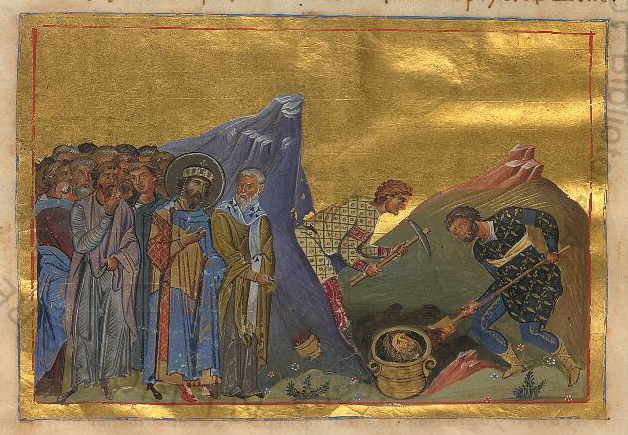
The Finding of the Head is a distinct iconographic subject, not to be confused with the Baptism, the Deesis, or the Beheading. Its narrative type shows the discovery of the Head — the monk or archimandrite bending to lift the Precious Head from the ground, from the cave, or from the water-jar in which it was hidden, sometimes with the vessel itself prominent — the moment the feast commemorates. A second, emblematic type, common on festal icons and in the border scenes of the Forerunner's vita icons, shows the Head alone upon a charger or dish, or set within a well or a bowl, an image the day's own hymns enact when they sing of the Head "risen from the earth" and "found as a most sacred rose." The stored image is the miniature for the day from the Menologion of Basil II (Constantinople, c. 985; Vatican, Vat. gr. 1613): the finding of the head of the Forerunner, rendered in the manuscript's characteristic gold-ground style (source, public domain, pd-old-work).