
Synaxis of the Forerunner
The Synaxis of the Holy and Glorious Prophet, Forerunner and Baptist John
On January 7, the day after the Theophany, the Church keeps the Synaxis of the Holy and Glorious Prophet, Forerunner and Baptist John — the assembly of the faithful in honour of the one whose hand was laid upon the head of the incarnate God in the Jordan. It follows the ancient pattern by which the morrow of a Great Feast honours the chief human minister of the mystery just celebrated: as December 26 honours the Theotokos after the Nativity of Christ, and September 9 the righteous Joachim and Anna after the Nativity of the Theotokos, so the day after the Baptism of Christ is given to the Baptist. This is the Forerunner's principal commemoration in the order of the church year — the first of his feasts to fall after the Theophany — though it is by nature an appendage of that feast — kept within its afterfeast, sharing its festal apolytikion, and looking back to the bank of the Jordan. His full Life — Conception, desert asceticism, preaching of repentance, the Baptism of the Lord, the rebuke of Herod, the Beheading, and the finding of his relics — is given in his own entry, John the Forerunner; this feast file treats the synaxis itself.

The meaning of the "synaxis"
A synaxis (σύναξις, "a gathering, an assembly") is, in the language of the liturgical books, a service at which the faithful come together to honour a particular person or event of sacred history — most often the person who stood closest to a mystery just celebrated. The Byzantine calendar keeps a recurring rhythm: the day of a Great Feast glorifies the central act of God, and the day after "assembles" in honour of the human being through whom that act was accomplished. So the day after the Nativity of Christ (December 26) is the Synaxis of the Theotokos, who gave the incarnate God his flesh; the day after the Nativity of the Theotokos (September 9) is the synaxis of her parents, the righteous Joachim and Anna; the day after the Annunciation (March 26) the synaxis of the Archangel Gabriel, who brought the message; the day after the Meeting the synaxis of Symeon and Anna. By the same logic the morrow of the Theophany — the manifestation of the Holy Trinity at the Baptism of Christ — is the synaxis of the one who baptized him: the Forerunner and Baptist John. On the feast itself the Church glorifies the Lord who came to the streams of the Jordan to be baptized and to sanctify the waters; on the day after she turns to honour, "in an appropriate manner," the servant who was found worthy to lay his hand upon the head of his Master.
The choice of the Forerunner for this office is not incidental. Of all human beings, he alone touched the mystery of the Theophany with his own hands: he it was who withstood the Lord ("I have need to be baptized of thee"), who yielded at the word of righteousness, who stood as an eyewitness of the opened heavens, the descending Spirit, and the Father's voice, and who bore witness afterward, "Behold the Lamb of God." The synaxis therefore gathers the whole meaning of the Baptist's vocation into a single day: he is the friend of the Bridegroom present at the wedding of God and the world, the last and greatest of the prophets who saw with his eyes what they had foretold, and the herald whose office is not ended even by the Jordan — for the tradition sings that, going down to the dead before his Lord, he preached the Theophany to those in Hades as well.
The Forerunner at the Jordan
The event the synaxis looks back to is the summit of the Forerunner's whole ministry. In the fifteenth year of Tiberius he had come into all the country about the Jordan, preaching a baptism of repentance for the remission of sins, and naming himself only "the voice of one crying in the wilderness." When the Lord himself came to be baptized, John recognised him and drew back — until, obedient to the word "suffer it to be so now, for thus it becometh us to fulfil all righteousness," he baptized the sinless One in the flood. At that moment the heavens were opened, the Spirit descended as a dove, and the Father's voice bore witness to the Son: the first open manifestation of the Holy Trinity, from which the whole feast of Theophany takes its name and from which John takes his title "Baptist." The fuller narrative — with its exegesis, its patristic titles, and the theology of the Forerunner "going before" from the womb to Hades — belongs to the saint's own entry and is not repeated here; the synaxis simply sets the Church, on the morrow of the great mystery, before the man who ministered at it.
The day after the Theophany
The synaxis is kept as the first full day of the Theophany's afterfeast, which runs to the leavetaking on January 14. The festal hymns of the Baptism continue to govern the services, and the Menaion joins to them a proper office of the Forerunner — stichera, a proper apolytikion, and a canon — so that the two strands, the mystery and its minister, are sung together. The most beloved of the day's proper hymns, the doxastikon "Thy hand which touched the most pure head of the Master," makes the logic of the synaxis explicit: it prays the Baptist to lift up toward Christ the very hand that baptized him and the very eyes that saw the Spirit descend, and so to intercede for the world. Anciently, in some usages, the day of the synaxis also carried the memory of the translation of the Forerunner's right hand — the hand of the Baptism — to Constantinople; the principal keeping of that relic-feast, however, belongs to the Russian calendar on October 12, and is treated there.
Feast and commemoration
January 7 (church date; New Calendar civil January 7; Old Calendar civil January 20), the day after the Theophany and the first full day of its afterfeast. The rank is that of a synaxis kept within a Great Feast's afterfeast: there is no independent vigil, but the Menaion appoints a proper festal service of the Forerunner sung together with the hymns of the Theophany, which continue until the leavetaking on January 14. In the Forerunner's own cycle of six fixed feasts this day has the strongest claim to be the one devoted purely to his person that is neither a relic-feast nor, like the Beheading, shadowed by a fast. This repository nevertheless ranks the Nativity of June 24 as his primary feast, on the ground that a saint may carry only one primary and that January 7 remains, in the tradition's own description, "an appendage of the Theophany" — kept within its afterfeast and sharing its festal apolytikion. The decision is recorded at the project's record of open questions; all six files of the cluster now agree in his own calendar. The strict fast of the season belongs to the eve of the Theophany (January 5); the day of the synaxis is festal.
Taxonomy flag — feast_type. The controlled feast_type vocabulary of PRD
§5.3 (indiction | theotokos-synaxis | icon-of-the-theotokos | angelic | dominical | theotokian | dedication | deliverance) has **no genericsynaxis
value**, and no honoree-category that fits the Forerunner (synaxes are otherwise
typed by their honoree: the angelic synaxes as angelic, the Theotokos synaxes
as theotokos-synaxis). This feast is the same liturgical species as the
Synaxis of the Theotokos — the morrow-synaxis of
the chief human minister of a Great Feast — so theotokos-synaxis is chosen here
as the nearest existing term, though its name wrongly implies the Theotokos as
subject. No new term is minted. The gap is flagged for a deliberate decision:
either generalise theotokos-synaxis to a subject-neutral synaxis, or add a
sibling term (e.g. forerunner-synaxis or saint-synaxis). See the project's record of open questions
§3 on the handling of synaxis commemorations.
This is one of the very few feasts/ files whose subject already possesses a full saint file. The Forerunner's Life is not duplicated here; his entry John the Forerunner already carries the January 7 synaxis in its feasts: list (rank synaxis), and this file supplies the synaxis's own account, propers, and icon.
Hymns
Troparion — Tone 4
The memory of the righteous is kept with praises; but for thee, O Forerunner, the witness of the Lord sufficeth. For thou wast shown to be truly more honourable than the prophets, in that thou wast counted worthy to baptize in the streams the One whom thou didst proclaim. Therefore, having contended for the truth, thou didst rejoice to bring the good tidings even to those in Hades: that God was made manifest in the flesh, taking away the sin of the world and granting us great mercy.
Original translation from the Greek
Apolytikion
When thou wast baptized in the Jordan, O Lord, the worship of the Trinity was made manifest; for the voice of the Father bore witness to thee, naming thee his beloved Son, and the Spirit in the form of a dove confirmed the sureness of the word. O Christ our God, who hast appeared and enlightened the world, glory to thee.
Kontakion — Tone 6
Dreading thy bodily presence, the Jordan turned back in trembling; and John, fulfilling his spiritual ministry, drew back in fear. The ranks of the angels were struck with wonder, beholding thee baptized in the flesh amid the streams; and all that were in darkness were flooded with light, hymning thee who hast appeared and enlightened all things.
Original translation from the Greek
Stichera
Thy hand which touched the most pure head of the Master, and with which thou didst point him out to us with thy finger — lift it up on our behalf, O Baptist, since thou hast great boldness before him; for by him thou hast been witnessed to be greater than all the prophets. And thine eyes again, which beheld the all-holy Spirit descending in the form of a dove — raise them up to him, O Baptist, and make him merciful to us; and come, stand with us, sealing our praise.
Appointed readings
Epistle — Acts 19:1–8
1And it came to pass, that, while Apollos was at Corinth, Paul having passed through the upper coasts came to Ephesus: and finding certain disciples, 2He said unto them, Have ye received the Holy Ghost since ye believed? And they said unto him, We have not so much as heard whether there be any Holy Ghost. 3And he said unto them, Unto what then were ye baptized? And they said, Unto John’s baptism. 4Then said Paul, John verily baptized with the baptism of repentance, saying unto the people, that they should believe on him which should come after him, that is, on Christ Jesus. 5When they heard this, they were baptized in the name of the Lord Jesus. 6And when Paul had laid his hands upon them, the Holy Ghost came on them; and they spake with tongues, and prophesied. 7And all the men were about twelve. 8And he went into the synagogue, and spake boldly for the space of three months, disputing and persuading the things concerning the kingdom of God.
Gospel — John 1:29–34
29The next day John seeth Jesus coming unto him, and saith, Behold the Lamb of God, which taketh away the sin of the world. 30This is he of whom I said, After me cometh a man which is preferred before me: for he was before me. 31And I knew him not: but that he should be made manifest to Israel, therefore am I come baptizing with water. 32And John bare record, saying, I saw the Spirit descending from heaven like a dove, and it abode upon him. 33And I knew him not: but he that sent me to baptize with water, the same said unto me, Upon whom thou shalt see the Spirit descending, and remaining on him, the same is he which baptizeth with the Holy Ghost. 34And I saw, and bare record that this is the Son of God.
Iconography
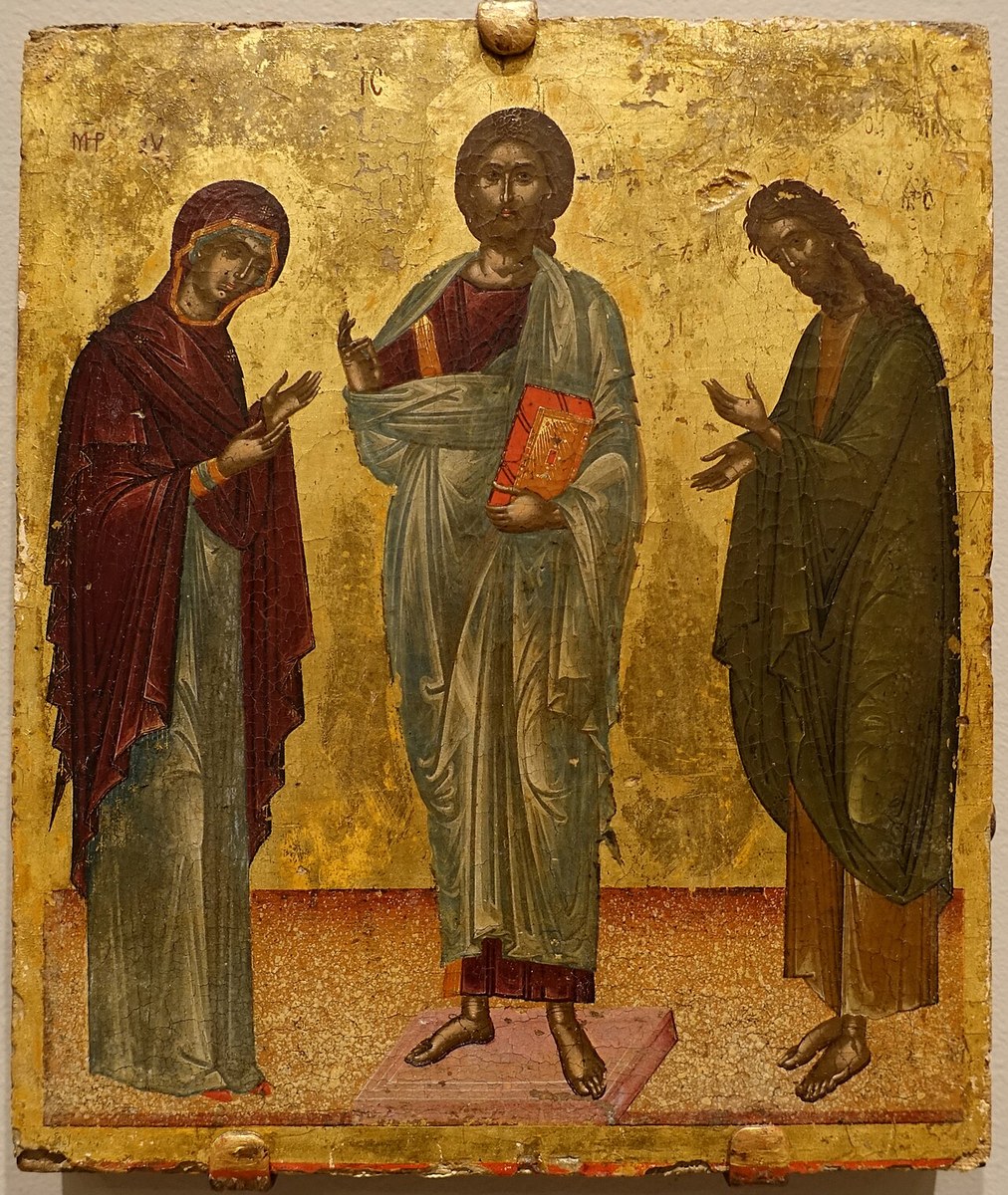
The synaxis has no single festal icon of its own in the way the Synaxis of the Theotokos has the "Собор Богоматери" composition; the day is served under the icons of the Forerunner and of the Theophany together. Two types answer to it most closely. The first is the Baptism (Theophany) icon itself — John standing on the bank, his hand on the Lord's head, the Spirit descending in a shaft of light — the very moment the synaxis honours; it belongs properly to the feast of January 6 and is treated in the Theophany entry. The second, and the one stored here, is the Deesis: the "supplication" composition in which the Forerunner stands at Christ's left as the Theotokos stands at his right, the two greatest intercessors of the human race turned toward the enthroned Lord with hands raised in prayer. The Deesis is the pictured theology of the synaxis — the greatest born of women beside the greatest of women, the Old Covenant's last voice and the New Covenant's first dwelling, praying for the world — and it is the image the day's own hymns enact when they ask the Baptist to "lift up" hand and eyes toward Christ on our behalf.
The stored image is a Cretan Deesis panel of the early sixteenth century (Late Byzantine, tempera and gold on wood; Princeton University Art Museum): Christ enthroned at the centre, the Theotokos inclining from the left and John the Forerunner from the right, both in the ancient gesture of intercession. The Forerunner's portrait icons proper — the winged "Angel of the Desert" and the Deesis panel of the Vysotsky chin — are stored with his own entry; a distinct Deesis is kept here so that the feast file carries an image of its own rather than duplicating the saint's.