
Abramius of Galich
Our Venerable Father Abramius of Galich and Chukhloma, Wonderworker
Venerable · Wonderworker · d. 20 July 1375
Commemorated 20 July — Repose at the Protection monastery on Lake Chukhloma
Abramius — in Russian usage Avraamy, and in English commonly Abraham — of Galich and Chukhloma was a disciple of Sergius of Radonezh who carried the Trinity Lavra's monastic renewal into the wild forest country north-east of the Volga. About the year 1350 he found, on a mountain above Lake Galich, an icon of the Mother of God shining with light, and around it built the first of four monasteries which he founded in succession through the Galich and Chukhloma lands — leaving each in turn to a disciple and withdrawing deeper into the forest as soon as a community gathered. He died at the last of them, the Protection monastery on Lake Chukhloma, on 20 July 1375. He is one of the northern "colonisers", the generation of Sergius's disciples through whom the Russian monastic movement crossed into the forests of Kostroma and Vologda, and he is venerated as a wonderworker of the Galich country.

Disciple of Sergius
Of Abramius's birth and family nothing certain is recorded; the redactions of his Life differ, and one strand of the tradition brings him first to the Caves (Pechersky) monastery at Nizhny Novgorod before he came to the Trinity. What all the accounts agree on is the decisive fact: that he was formed at the Trinity monastery under Sergius of Radonezh, passed through the long novitiate that Sergius required, and was there ordained to the priesthood. He belongs to the great cohort of Sergius's disciples — with Methodius of Peshnosha, Sabbas of Zvenigorod, Sylvester of Obnora, Athanasius of Serpukhov and the rest — who went out from the Trinity in the second half of the fourteenth century and refounded Russian monasticism as a forest movement.
Abramius's own vocation was for solitude, and it declared itself early. He asked Sergius's blessing to leave, and went north-east, beyond the Volga, into the principality of Galich Mersky — a frontier country of lakes and dense forest, thinly settled, and still inhabited in part by the Finnic Merya, among whom paganism had not wholly died. There he lived alone in the woods on the eastern shore of Lake Galich.
The finding of the icon
About 1350, according to his Life, Abramius received a revelation to climb a mountain above the lake, and found there an icon of the Mother of God, standing on a tree and shining with a light he could not look at. The image — of the Umilenie or tenderness type, known ever since as the Galich and afterwards the Chukhloma icon — became the treasure of the country. Word reached Prince Dimitry Feodorovich of Galich, who sent for it and had it brought across the lake to his city with a great procession; healings followed, and the prince gave money to build a church on the mountain where it had been found, and a monastery around it, dedicated to the Dormition of the Mother of God.
Four monasteries
Abramius governed the Dormition house until it was established, and then did what he did three more times: he set a disciple over it and went further into the forest. The tradition of the Galich–Chukhloma country counts four foundations:
- The Dormition monastery on the mountain above Lake Galich, at the place of the icon — later known as the Novozaozersky house.
- The monastery of the Placing of the Robe on the river Viga, some thirty versts off, called in the local sources "the Great Abramian wilderness" (Velikaya pustyn), which he founded when the crowds that followed him at the first house drove him away.
- A monastery of the Synaxis of the Mother of God, which he left to his disciple Porphyrius.
- The Protection (Pokrov) monastery on the northern shore of Lake Chukhloma, on the site of an abandoned settlement — whence his further epithet Gorodetsky, "of the town-site" — where he spent his last years.
Everywhere the same pattern repeats: solitude, a cell, disciples gathering, a church built, a brotherhood organised with a rule, and then flight. The Life records that a year before his death he appointed his disciple Innocent to govern the Protection monastery, and withdrew to a cell apart to prepare for the end. He reposed on 20 July 1375, and was buried in the monastery church.
Relics and veneration
His tomb at the Protection monastery on Lake Chukhloma became the centre of a local cult which grew steadily through the sixteenth and seventeenth centuries; miracles of healing recorded at it gave him the title of wonderworker of the Galich land. He was glorified for local veneration twice, in 1553 and again in 1621, the second act extending his commemoration through the region. A stone cathedral was raised over his relics between 1608 and 1631, and rebuilt in the nineteenth century (1857–1867); the monastery, suppressed and ruined in the Soviet period, has since been returned to monastic use. His relics rest there under a shrine.
He is commemorated among the Saints of Radonezh with the rest of Sergius's disciples, and among the saints of the Kostroma land.
Feast and commemoration
July 20 (Old Calendar civil August 2), the day of his repose. He is kept by the Russian Church and by the OCA, and in the Kostroma diocese with local solemnity; his feast falls on the great day of the Prophet Elijah, so that in parish practice his office is sung alongside the prophet's. He is commemorated again in the Synaxis of the Saints of Radonezh (July 6) with the other disciples of Sergius, and in the synaxis of the saints of the Kostroma land. The Chukhloma (Galich) icon of the Mother of God, which he found, is commemorated on this same July 20 as well as on its other dates.
Hymns
Troparion — Tone 4
Thou didst leave the community of thy teacher for the wilderness, and in the forests beyond the Volga didst raise up houses of prayer, fleeing from glory as often as it found thee, O our father Abramius; and having found the icon of the Mother of God shining upon the mountain, thou didst enrich all that land: intercede with Christ God that our souls may be saved.
Original translation from the Slavonic
Kontakion — Tone 8
Illumined by the light that shone from the holy icon, thou wast thyself made a lamp to the northern forests, O venerable Abramius; and building four habitations of the Spirit, thou didst depart from each of them into stillness. Wherefore we cry to thee: Rejoice, wonderworker of the Galich land.
Original translation from the Slavonic
Iconography
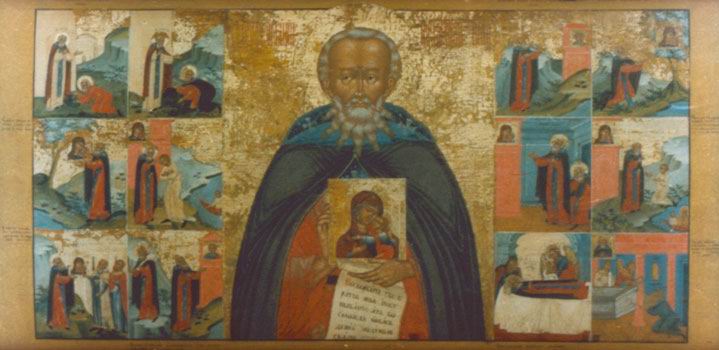
Abramius is painted as a Russian monastic elder: an old man in the black mantiya and koukoulion or with the head uncovered, a long narrow beard tapering to a point and streaked with white, the right hand raised in blessing or in prayer and the left holding a scroll. His distinguishing attribute is the icon of the Mother of God he found: in the fuller compositions he is shown either receiving the image from a tree on a wooded hill, or kneeling before it, or holding it before his breast; and in some northern panels he stands beside a schematic view of his monastery on the lake shore, in the manner of the Russian founder-portraits, with the church and walls rendered small at his feet. Local Kostroma iconography also pairs him with Sergius of Radonezh, teacher and disciple facing one another with the Mother of God above.
The stored image is an eighteenth-century Russian vita icon: the saint stands at the centre in the black mantiya over a red-brown undergarment, white-bearded, holding before his breast the icon of the Mother of God he found on the mountain and, in his left hand, an inscribed scroll; around him run twelve border scenes (klejma) of the life — the finding of the image on the tree, the carrying of it to the prince, the building of the churches, and his repose and burial.
Disputed questions
- The year of his repose. The received date is 20 July 1375; some scholars, weighing the chronology of the four foundations and the local documents, place his death later, about 1389. The Church keeps the traditional date, which is also the calendar date of his feast.
- The order and number of the foundations. The four monasteries are firmly held by the local tradition, but the redactions of the Life differ over their sequence, their dedications and the names of the disciples left in charge; the Placing of the Robe house on the Viga in particular is variously described. The account above follows the ordering given in the Russian synaxaria and the OCA life.
- His origins. The Life as transmitted says nothing of his birthplace or parentage; the Nizhny Novgorod episode is a later addition in some manuscripts and is not universally accepted.
- Name forms. Russian sources call him Avraamy; English lives render this both "Abramius" and "Abraham," which has caused him to be confused in Western lists with the several older saints Abraham. He is not to be confused with Abraham of Carrhae, Abramius of Arbela, or Abraham the Recluse.