
Abramius of Smolensk
Our Venerable Father Abramius the Wonderworker, Archimandrite of Smolensk
Venerable · Wonderworker · b. mid-12th century, at Smolensk — d. after 1224, at Smolensk
Commemorated 21 August — Repose of the archimandrite of Smolensk
Abramius of Smolensk (mid-12th century – after 1224) is the greatest figure of monastic learning in the Russian principalities before the Mongols, and the most fully documented: his disciple Ephraim wrote his Life within living memory, and it is one of the finest pieces of early Russian hagiography. Born to wealthy Smolensk parents who had had twelve daughters before him, he gave away his inheritance, was tonsured at the monastery of the Theotokos at Selishche, and spent more than thirty years copying and reading books — Greek fathers in Slavonic translation, and everything the Russian north then possessed. Ordained priest in 1198, he became a preacher of repentance and of the Dread Judgement to the whole city, was slandered as a heretic and a seducer, was forbidden to serve, and was cleared and restored when a drought that would not break ended after his prayer. Bishop Ignatius built for him the monastery of the Placing of the Robe, where he governed a small brotherhood as archimandrite until his death.
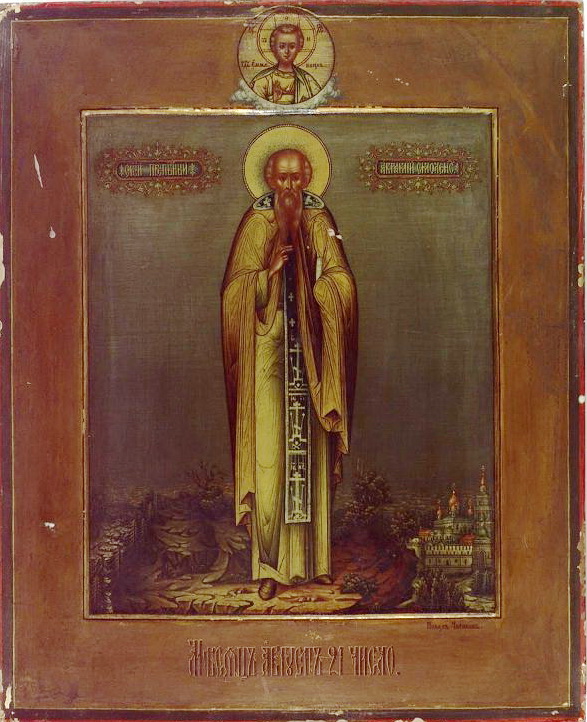
.jpg)
Birth and youth
He was born at Smolensk about the middle of the twelfth century, the son of rich and devout parents who had been given twelve daughters and no son, and who had begged God for one; the Life is careful to say that they were charitable people who kept an open house for the poor before ever their prayer was answered. The boy was raised in that house, taken to church, and — the significant thing in a principality that had had letters for less than two centuries — given books.
When he came of age his parents pressed marriage on him and he refused it. At their death he came into a considerable inheritance, and disposed of it in the classical manner: he distributed it to monasteries, churches and the poor, and went about the city in poor clothing, "as one of the beggars," praying that God would show him the way of salvation.
Selishche: thirty years among books
He received the monastic tonsure at the monastery of the Most Holy Theotokos at Selishche, some five versts from Smolensk, under the abbot who then governed it, and there he remained for more than thirty years. What he did in them is stated exactly and is the reason his memory matters: he copied books, and he read them.
The library he assembled in his own head is visible in the Life and in the two things we are told he taught from. He knew the Greek fathers in Slavonic — John Chrysostom, the Paterica, Ephrem the Syrian, the Ladder — and he knew the Kievan writers; and the learning was not decorative. Ephraim's account of Abramius's reading is, incidentally, the best single source we possess for what education actually consisted of in the remote north-west of Rus' in the generation before the Mongol invasion, and it is on that ground, quite apart from the sanctity of its subject, that the Life is a document of the first rank.
He was ordained presbyter in 1198, and thereafter served the Liturgy daily. He would not eat before serving, and he served with tears.
The preacher of the Dread Judgement
Abramius did what few Russian monks of his century did: he preached, and he preached to laypeople, in numbers, continually. His subject was repentance and the Last Judgement. To make it visible he had two icons painted and set up where they would be seen — one of the Dread Judgement at the Second Coming, and one of the trial of souls at the aerial toll-houses — and he expounded them. The townspeople of Smolensk, of every condition, came out to Selishche to hear him; some abandoned their own parishes to do it; penitents besieged his cell.
This is exactly the kind of success that in a small ecclesiastical city produces enemies, and it did. The clergy and the monks of the town accused him of taking their people, of heresy, of reading forbidden and apocryphal books, and — the standard charge against a confessor whom women came to in numbers — of seducing women. The abbot of Selishche, worn down, drove him out; he went into the city, to the monastery of the Holy Cross, where he was received, and continued exactly as before.
The trial, the interdict, and the drought
The accusations were carried to the bishop, Ignatius of Smolensk, and to the prince, and a formal hearing was held. The Life describes a mob scene: clergy shouting that he should be exiled, or drowned, or burnt. At the trial itself nothing was proved, and the princely and boyar judges who heard the evidence acquitted him. But the ecclesiastical authorities, to quiet the city, forbade him to serve as a priest and sent him back to Selishche under an interdict. Two men are named as having defended him and refused to join the outcry: the priest Luke and the monk Lazarus, afterwards himself bishop of Smolensk.
Then the rain stopped. A drought settled on Smolensk and its fields and did not break; processions and prayers were made and nothing came of them. It was said to the bishop that the land was suffering for the wrong done to Abramius. Ignatius — whom the Life treats with real sympathy, as a man who had acted under pressure and knew it — sent for him, asked his forgiveness, lifted the ban and restored him to the priesthood and to his preaching. Abramius prayed, and before the people had reached their homes the rain fell on Smolensk. The city thereafter held him in a reverence it never withdrew.
Archimandrite of the Placing of the Robe
Bishop Ignatius, to give him a house of his own and to put him beyond the reach of the old quarrel, built and endowed a monastery of the Placing of the Robe of the Most Holy Theotokos (the Rizopolozhensky monastery) outside the city, and set Abramius over it as its archimandrite. He governed it for the rest of his life.
The house never grew. The Life records without embarrassment that the brotherhood numbered seventeen, and says why: he received novices with extreme strictness, tested them long, and tonsured few — the discipline of a man who had watched what happened when zeal outran formation. He continued to preach and to hear confessions, and the city continued to come out to him.
He died after 1224, having spent about fifty years in the monastic habit. The exact year is not transmitted; the Life was written when those who had known him were still alive, and does not give one.
Veneration
The cultus began at once and locally, in the Smolensk land, where he is joined with Mercurius — the soldier-martyr of the Tatar invasion — as one of the two patrons of the city; the two are shown together on the classic Smolensk icons, with the wonderworking Smolensk icon of the Mother of God above them. A proper liturgical service for him, in which his disciple Ephraim is commemorated with him, was in use by the later thirteenth century, which is very early indeed for a Russian saint and is itself the strongest evidence of how he was regarded. The veneration was confirmed for the whole Russian Church in the sixteenth century among the saints reviewed under Metropolitan Macarius, and he is named in the synaxis of the Saints of Smolensk.
Feast and commemoration
August 21 (church date; New Calendar civil August 21, Old Calendar civil September 3), within the afterfeast of the Dormition. The commemoration is Russian — kept by the Moscow Patriarchate, the Orthodox Church in America and the Russian diaspora, and not found in the Greek or Antiochian books, whose day belongs to the Apostle Thaddaeus and the martyr Bassa. His disciple Ephraim is commemorated with him on the same day, and the proper service names them together. He is kept also in the Synaxis of the Saints of Smolensk.
Hymns
Troparion — Tone 8 (common of a venerable father)
In thee, O Father, that which was made after the image of God was preserved unimpaired; for taking up the Cross thou didst follow Christ, and by thy deeds thou hast taught us to despise the flesh, which passeth away, and to care for the soul, which is immortal. Wherefore, O venerable Abramius, thy spirit rejoiceth with the angels.
Original translation from the Slavonic
Iconography
Abramius is painted as a Russian monastic elder of middle years, brown- or grey-bearded and balding, in the dark mantle with the great schema over it, bare-headed or in the pointed koukoulion. His distinguishing attribute is the paraman cross of the schema held upright before him in both hands — the tall cross-and-ladder emblem with the instruments of the Passion and the skull of Adam — and behind or beside him, at the lower right, the walled city of Smolensk with its towers and cathedral, marking him as the city's own. Where the Smolensk patrons are shown together he stands with the warrior Mercurius under the Smolensk Hodegetria. Because he preached from painted images, the Russian tradition occasionally gives him an icon of the Dread Judgement in the background, which is as close as the iconography comes to narrative in his case.
The stored image is a Russian menaion icon of about 1850 by Osip Semyonovich Chirikov, from the church of the Marble Palace and now in the State Museum of the History of Religion in St Petersburg. The saint stands full-length in ochre monastic robes on a dark green ground, holding the schema-cross with both hands before him, with the city of Smolensk in gold at the lower right and Christ blessing in a medallion above; he is inscribed across the upper field Ст҃ый преподобный Авраамiй Смоленскiй and, along the bottom margin, Мцъ Августъ 21 число — "the month of August, the twenty-first day," which confirms both the identity and the feast against the other Abramii of the calendar. The panel is nineteenth-century, out of copyright, and carries a public-domain mark on Wikimedia Commons.
Disputed questions
- The year of his death. "After 1224" is what can be defended; the older Russian literature gives 1221 and some later lists 1220 or c. 1222. The Life supplies no year, and the terminus is inferred from the persons it names.
- Which Abramius. The calendar carries several. This is not Abramius of Galich (†1375), the disciple of St Sergius who evangelised the Chukhloma country; not the Abramius the lover-of-labour of the Kiev Caves, who shares this very day; not Abramius of Paleostrov, who also shares it; not Abramius of Arbela, the Persian hieromartyr; and not Abraham of Carrhae or the Old Testament patriarch. Four distinct Abramii stand in the Russian calendar of August 21, which is the single most confusing thing about the day.
- The charges against him. The Life is written by a disciple and is frankly partisan, and it must be read as such. What it establishes, and what no later source contradicts, is that a formal process was held, that the charges failed, and that the bishop afterwards publicly reversed himself. The suggestion of some modern Russian scholarship that the "forbidden books" charge points to a real interest of Abramius in apocryphal apocalyptic literature — which would suit a preacher of the toll-houses and the Judgement — is plausible and unproven, and is noted here as a question rather than a finding.