
Andrei Rublev
Our Venerable Father Andrei Rublev, the Iconographer, of Moscow
Venerable · b. c. 1360 — d. 1428 (or 1430), at the Spaso-Andronikov monastery, Moscow
Commemorated 4 July — Commemoration on the feast of his patron, Andrew of Crete
Andrei Rublev (c. 1360 – 1428/1430) is the greatest of Russian iconographers and the only one the Church has glorified as a saint for the painting itself. A monk of the Spaso-Andronikov monastery in Moscow, formed in the spiritual world of Sergius of Radonezh and working for forty years beside his elder-companion Daniel the Black, he painted in the Annunciation cathedral of the Kremlin with Theophanes the Greek (1405), the Dormition cathedral at Vladimir (1408), and the Trinity cathedral of the Trinity–Sergius Lavra, for which he made, "in praise of Saint Sergius," the icon of the Holy Trinity — the most famous icon in the world and the standard against which the Stoglav council of 1551 ordered all later Trinities to be measured. He died at the Andronikov monastery and was buried there. Venerated from the fifteenth century and named a saint by the Life of Joseph of Volokolamsk's tradition, he was formally glorified in 1988, at the millennium of the Baptism of Rus, with his feast on July 4, the day of his patron Andrew of Crete.

Origins
Almost nothing is known of Rublev's birth. He was born about 1360, probably within the Moscow principality; the surname Rublev, unusual for a peasant and formed like the family names of the artisan and service classes, suggests a household of some standing and education — it is likely a craftsman's name, from the rubel, a tool of the leather- and cloth-workers. Andrei is his monastic name, taken at tonsure; his baptismal name is unknown. That monastic name is the reason his feast stands where it does: July 4, the day of Andrew of Crete, is his name-day, and the Church set his commemoration on his patron's feast rather than on the disputed day of his death.
He was tonsured at the Spaso-Andronikov monastery in Moscow — the house founded by Andronicus, a disciple of Sergius of Radonezh — and the Andronikov brotherhood remained his home for the rest of his life. Through Andronicus, and through Nikon of Radonezh who commissioned his greatest work, he belongs directly to the family of Saint Sergius, and his art is the visible face of the hesychast renewal that came into Russia in that generation, in part through the Bulgarian metropolitan Cyprian of Moscow. Where he learned to paint is not recorded; the suggestion that he studied in Byzantium or Bulgaria is a modern conjecture, and what is certain is that he worked in his youth alongside the greatest Greek painter then in Russia.
The documented works
Rublev appears in the chronicles for the first time in 1405, already a monk and already ranked with masters: the chronicle names "Theophanes the icon-painter, a Greek, and Prochorus the elder from Gorodets, and the monk Andrei Rublev" as the painters of the Cathedral of the Annunciation in the Moscow Kremlin. He is listed last, as the youngest — but he is listed.
In 1408 the chronicle names him again, with Daniel the Black (Daniil Chorny), as painter of the Dormition cathedral at Vladimir, the metropolitan church of the old capital. Their frescoes survive in part, and among them is the great Last Judgement of the western vaults — a Judgement without terror, in which the elect come forward with the lightness of people going to meet someone they know. To the same campaign belongs the tall Deesis tier of the Vladimir iconostasis.
To Rublev is attributed the Zvenigorod Deesis — three surviving panels, among them the Saviour of Zvenigorod, found in 1918 in a woodshed near the Dormition cathedral on the Gorodok — a face which, even in its ruin, is the most quoted single image in Russian painting.
In the 1420s, at the commission of Nikon of Radonezh, Rublev and Daniel painted the new stone Trinity cathedral of the Trinity–Sergius monastery and made its iconostasis. For it Rublev painted the icon of the Holy Trinity — the three angels at the table of Abraham, the Hospitality of Mamre stripped of Abraham, Sarah, the servant and the calf, so that nothing remains but the three and the cup and the silent inclination of their heads. The chronicler of the house says it was made "in praise of Saint Sergius," whose monastery was dedicated to the Trinity and whose whole teaching was that men should overcome "the hateful divisions of this world by contemplation of the Holy Trinity." (The icon is described in more detail, with the image, in the entry for Abraham and Lot, where it stands as the classic form of the Old Testament Trinity.)
His last work, in the early 1420s or shortly after, was the painting of the Saviour cathedral of his own Andronikov monastery, of which fragments of ornament survive.
The manner of his life
The one contemporary testimony to Rublev's sanctity, as distinct from his skill, is preserved in the Josephite tradition — Joseph of Volokolamsk, reporting the memory of the elder Spiridon — and it is worth stating exactly, because it is the ground of his glorification. It says that Andrei and Daniel lived together in the highest concord and love, that they were never idle, and that on feast days, when they did not paint, they sat before the icons and gazed at them without distraction, and were filled with light and gladness; and that their painting was the overflow of that contemplation. The same source calls them both holy men. In the fifteenth and sixteenth centuries Rublev is repeatedly called prepodobny — venerable — in the monastic literature, long before any formal act.
Repose
Rublev died at the Andronikov monastery in Moscow and was buried within it, by tradition near the bell tower. The date is disputed (see below). Daniel the Black, who had been his companion for some twenty years, died shortly after him and, the account says, saw Andrei in glory and was called by him.
Veneration and glorification
The veneration was continuous but informal. In 1551 the Stoglav council, legislating on the correctness of icons, made Rublev the standard: painters were to write the image of the Holy Trinity "as the Greek painters wrote, and as Andrei Rublev wrote." No other Russian painter was ever given such authority, and the ruling effectively canonised his composition as the received form of the feast.
He was formally glorified by the Local Council of the Russian Orthodox Church in June 1988, at the celebration of the millennium of the Baptism of Rus, on the grounds of his holy life, the ascetic labour of icon-painting, and the ancient testimony to his sanctity; his feast was appointed for July 4. His Trinity, taken from the Lavra to the Tretyakov Gallery in the Soviet period, was transferred back to the Russian Orthodox Church in 2023.
Feast and commemoration
July 4 (church date; New Calendar civil July 4, Old Calendar civil July 17), appointed at his glorification in 1988 as the feast of his heavenly patron, Andrew of Crete. He is kept by the Russian Orthodox Church, by the Orthodox Church in America and by the Churches in communion that have received the 1988 glorifications; he is not on the Greek or Antiochian calendars. He is also commemorated among the Synaxis of the Saints of Moscow and the Synaxis of the Saints of Radonezh (July 6). The Andronikov monastery, where he lived, died and was buried, houses the Central Andrei Rublev Museum of Early Russian Culture and Art.
Hymns
Apolytikion — Tone 8 (common of a venerable father)
By a flood of tears thou didst make the barren desert bear fruit, and by thy sighing from the depths thou didst bring forth increase a hundredfold in thy labours; and thou didst become a beacon, shining upon the whole world by thy miracles. O Andrei our venerable father, entreat Christ God that our souls may be saved.
Iconography
Rublev is painted as a venerable monk: middle-aged or elderly, in the dark mantle and koukoulion of the Russian monastic habit, with a rounded beard. Because he was glorified only in 1988, his iconographic type was fixed in the late twentieth century, and it fixed on the one thing that identifies him — the icon in his hands. He is shown holding, or seated painting, a small panel of the Holy Trinity, sometimes with brush and palette, sometimes with the Trinity displayed frontally like a Gospel book; occasionally he is paired with Daniel the Black, and in Radonezh synaxis icons he stands with the disciples of Saint Sergius.
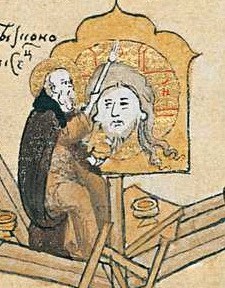
No pre-1900 depiction of Rublev himself has been located for this collection, and it is unlikely that a securely identified one exists: he was not painted as a saint before his glorification, and the sixteenth- and seventeenth-century illuminated Lives of Sergius that show iconographers at work do not inscribe them. All modern icons of him are the copyrighted work of living or recently living iconographers and are not storable under the icon policy — the licence a photographer or uploader may attach to a photograph of such a panel does not touch the painter's rights in the painting. What is storable — and stored — is not a modern icon at all but a 16th-century chronicle miniature (c. 1592, Russian State Library): the iconographer on the scaffolding of the Spassky cathedral of the Andronikov monastery, brush raised to the great Mandylion image he is painting — the earliest depiction of Rublev at his work, made within living tradition of the monastery he adorned. The reproduction is small; a larger scan is listed among the upgrade-wanted icons. His own work, by contrast, is long out of copyright: the Trinity is stored in this collection with the entry for Abraham and Lot, as the classic form of the Hospitality of Mamre.
Disputed questions
- The date of his death: 1430 or 1428? The traditional date is 29 January 1430, taken from an inscription on his grave-slab reported in the nineteenth century by G. D. Filimonov and since lost. The Russian scholar O. G. Ulyanov, working from the Andronikov monastery's commemoration books, has argued for 17 October 1428, when a plague carried off a great part of the Moscow monastic population; this dating is now widely followed in Russia and is the one given in the current synaxarial notices. Neither date is his feast: the Church keeps him on July 4, his name-day.
- What is actually his. Only the works named in the chronicles — the Annunciation cathedral of 1405 (whose surviving iconostasis panels are themselves debated), the Vladimir frescoes and iconostasis of 1408, and the Trinity–Sergius commission of the 1420s — rest on documents. The Trinity itself is attributed on the strength of the monastery's own tradition and the Stoglav ruling rather than a contemporary notice, and its date is argued between about 1411 and 1425–27. The Zvenigorod Deesis, long given to Rublev without question, has been reattributed by some recent technical study. This entry follows the received attributions and records that they are attributions.
- His teachers. That he worked with Theophanes the Greek in 1405 is documented; that he was Theophanes' pupil is inference, and their manners are profoundly unlike — Theophanes fierce and abrupt, Rublev quiet and rounded. Suggestions that he trained in Byzantium or Bulgaria are unevidenced.
- Not to be confused with Andrew of Crete, his patron, whose feast he shares; nor with the prince Andrew Bogoliubsky, also commemorated on July 4; nor with Andrew of Crete the Martyr (October 17). July 4 carries three saints named Andrew, which is a consequence of the name-day custom rather than a coincidence.