
Andrew of Crete
Our Father among the Saints Andrew the Jerusalemite, Archbishop of Crete, author of the Great Canon
Bishop · Venerable · b. c. 650, at Damascus — d. 4 July, c. 740, at Eresos on Lesbos
Commemorated 4 July — Repose on Lesbos while returning from Constantinople to Crete
Andrew of Crete (c. 650 – c. 740), called the Jerusalemite, is the archbishop of Gortyna in Crete who stands at the head of Byzantine hymnography as the maker — or at least the first great master — of the kanon, and who composed the Great Canon, the two hundred and fifty stanzas of penitential dialogue with his own soul that the Church still sings through the first week of Great Lent and entire on the Thursday of the fifth week. Born at Damascus under Arab rule and mute until his seventh year, healed at the chalice, tonsured in Jerusalem and formed in the brotherhood of the Holy Sepulchre, he was sent to Constantinople with the acceptance of the Sixth Ecumenical Council, served as deacon of the Great Church and warden of its orphanage, and was made metropolitan of Crete under Justinian II. His episcopate spans the last convulsion of Monothelitism — in which he briefly and disastrously subscribed the synod of Philippikos in 712, and afterwards repented — and the eve of the iconoclast crisis, against which his homilies on the holy images were read as patristic proof at the Seventh Ecumenical Council. He is not the monk-martyr Andrew of Crete of October 17.

Damascus, and the child who could not speak
Andrew was born about the year 650 at Damascus, in a Christian family of the Syrian capital that had passed from Roman to Arab rule only a decade and a half before, in 636. His parents are named by the later tradition as George and Gregoria; the Life credits them with piety and with the patience their son required, for the child was mute — speechless, the accounts say, from birth. In his seventh year, when he was brought to the chalice and received the Holy Mysteries, his tongue was loosed and he spoke. The Church has always taken the detail as more than a wonder-story: the greatest of her hymn-writers had his speech from the Eucharist, and the Great Canon, which is nothing but speech to God about oneself, is the return he made for it.
The world into which he was born matters for what he became. Damascus, Jerusalem and the Palestinian monasteries were now outside the empire, and the Chalcedonian ("Melkite") communities under the Umayyads were thrown back on their own learning. This is the milieu that within a single lifetime produced Andrew, John of Damascus and Cosmas of Maiuma — the three men who between them fixed the shape of the Byzantine liturgical book. That the hymnography of the imperial rite was essentially made in Arab-ruled Syria and Palestine is one of the quiet ironies of the period, and it belongs to the Antiochene and Jerusalemite inheritance rather than to Constantinople.
Jerusalem and the Holy Sepulchre
At about fourteen Andrew left Damascus for Jerusalem and was received into the monastic brotherhood attached to the Church of the Holy Anastasis (the Holy Sepulchre), from which he takes his standing epithet ὁ Ἱεροσολυμίτης, "the Jerusalemite." A parallel strand of the tradition, followed by the Slavonic Menologion and by the Orthodox Church in America's life, places his tonsure in the Great Lavra of Sabbas the Sanctified in the Judaean desert; the two are not incompatible, since the Sabbaite typikon governed the services of the Anastasis and men moved between the desert and the city. What is agreed is that his formation was Palestinian: the desert-and-Sepulchre synthesis of psalmody and hymnody out of which the kanon would grow.
His gifts were recognised early. He was made notary (secretary) of the patriarchate and then archdeacon, and so entered the service of a see that had, in these years, no patriarch: under Muslim government the throne of Jerusalem stood vacant and was administered by a locum tenens, the priest-monk Theodore.
The Sixth Ecumenical Council and the Great Church
When the Sixth Ecumenical Council met at Constantinople in 680–681 and condemned Monothelitism — the doctrine of a single will in the incarnate Word — Jerusalem could send no patriarch. Theodore the locum tenens sent instead a small delegation of monks, and the young Andrew went with it (some accounts make him one of the delegates at the sessions themselves, others say he was sent afterwards, in 685, carrying the Jerusalem church's formal acceptance of the council's acts to the emperor). Either way he arrived in the capital as the bearer of the orthodoxy of the Holy City on the question of the two wills — the very question on which he would later stumble.
He did not return. Kept at Constantinople, he was ordained deacon of the Great Church of Hagia Sophia and given charge of two of its great charitable foundations: the orphanage of Saint Paul (the orphanotropheion, the largest such institution in the empire), which he rebuilt and enlarged, and the Diakonia of Eugenios, a hostel and poorhouse for the aged. For something like twenty years he was, in effect, the Great Church's chief almoner. It is a fact worth setting beside the Great Canon: the man who wrote the most searching self-accusation in Christian poetry spent his working life feeding orphans and burying the destitute.
Archbishop of Gortyna in Crete
Under Justinian II (685–695), and probably in the early 690s, Andrew was consecrated metropolitan (archbishop) of Gortyna, the see of the whole island of Crete — the throne first held by Titus, the disciple of the Apostle Paul, and held in the persecutions by the hieromartyr Cyril of Gortyna (June 14). The Cretan books style him simply ἀρχιεπίσκοπος Κρήτης, archbishop of Crete, and it is under that title that he is inscribed on his icons.
As bishop he built. The accounts credit him with a church of the Theotokos of Blachernae at Gortyna and with a hostel for the poor and the sick, in the same charitable pattern as his Constantinopolitan work. Two deliverances are attached to his prayers. When famine and drought afflicted the island, the people gathered at his intercession and rain came; and when the Saracens — the Arab fleets that would eventually take Crete in the ninth century — besieged the fortress of Drimeus in the district of Kissamos, the tradition says that the enemy withdrew at the prayers of the archbishop, who had come out to stand with his people. The island's affection for him is old and unbroken; he is one of the patrons of Crete.
The synod of 712, and the repentance
In 711 Justinian II was overthrown by Philippikos Bardanes, an Armenian officer with Monothelite convictions, who set out to undo the Sixth Ecumenical Council. In 712 he had a synod convened at Constantinople which repudiated the council of 680–681 and restored the doctrine of the one will; the emperor had the council's portrait removed from the palace and its acts struck from the diptychs. Andrew of Crete subscribed that synod. So did Germanus, then metropolitan of Cyzicus, afterwards the patriarch and confessor of the icons. Both were, on any reading, coerced or intimidated; both recanted.
Philippikos was blinded and deposed in 713, and Anastasius II at once restored the council. Andrew's palinode survives in substance: he professed the two wills and two energies openly, and in a letter to the deacon Agathon — the archivist who compiled the record of these years — acknowledged and repudiated his subscription. The Church has never concealed the lapse and has never let it define him. The hymnography of his feast is untroubled; his standing as a father of the Church, and the reading of his works at the Seventh Ecumenical Council, presuppose that the repentance was accepted as complete. It is, in fact, difficult not to hear the episode in the Great Canon's relentless first person: I have sinned above all men, I have made an idol of my own will.
The images, and the eve of iconoclasm
Andrew's episcopate ended at the very edge of the iconoclast century. If the Slavonic and synaxarial date of 740 for his repose is right, he lived fourteen years into the open persecution begun by Leo III in 726 and died in it; if the shorter chronology is right, he died before it began. Either way, his witness for the holy images belongs to the period before the controversy, and this is precisely what gave it its weight afterwards. His discourse on the veneration of the holy images, and passages from his festal homilies, were entered as patristic testimony at the Seventh Ecumenical Council (Nicaea II, 787) in favour of the icons; a defender who wrote when nobody was yet arguing is the most valuable kind of witness, and the iconophile florilegia used him heavily.
Popular Slavonic accounts go further and present him as an active opponent of Leo III. The sober position is that no contemporary source shows Andrew confronting the iconoclast emperor; the confrontation belongs to his namesake, the monk Andrew who died in 767 under Constantine V. The confusion of the two Andrews of Crete on this point is very old (see Disputed questions).
The Great Canon and the making of the kanon
Andrew's place in the history of worship rests on a change of form. Before him the great sung poem of the Byzantine rite was the kontakion, the long metrical sermon perfected by Romanus the Melodist, sung after the sixth ode of the biblical canticles at the night office. Andrew turned the canticles themselves into the frame: he wrote stanzas to be interpolated among the verses of the nine biblical odes — the songs of Moses, of Hannah, of Habakkuk, of Isaiah, of Jonah, of the Three Children, of the Theotokos and of Zacharias — each ode opening with an heirmos that links the biblical song to the day's theme. The result is the kanon, which within two generations displaced the kontakion almost entirely and remains the backbone of Orthros to this day. Whether Andrew invented the genre or gave decisive form to something already stirring in Palestine is argued; that the earliest surviving kanons are his is not.
The Great Canon (ὁ Μέγας Κανών) is the largest of them and unlike anything else in the corpus: about 250 troparia over the nine odes — it is the only canon to retain the sombre second ode, dropped from ordinary canons — with the refrain Have mercy on me, O God, have mercy on me between the verses, and, at the end of each ode, prostrations. Its matter is the whole of Scripture read as a mirror of the singer's own conscience: Adam, Cain, Lamech, Esau, the sons of Jacob, David, Solomon, Ahab, Manasseh, the harlot, the publican, the thief — every figure of the Old and New Testaments turned upon the poet with the same accusation, thou art the man. It is sung in four parts at Great Compline on the Monday to Thursday of the first week of Great Lent, and entire at Orthros on the Thursday of the fifth week — the service universally called the Standing of Saint Mary of Egypt, because the Life of Mary of Egypt is read within it and Andrew himself added to the canon a series of troparia addressed to her, together with troparia to Saint Mary and to himself.
Beyond the Great Canon he left a very large body of work: canons and triodia for the Nativity of the Theotokos, the Conception of Saint Anna, the Exaltation of the Cross, Lazarus Saturday and Palm Sunday, for Mid-Pentecost, for the Great Week; idiomela for the forefeasts of the Nativity and Theophany; and about fifty homilies, among them four on the Nativity of the Theotokos and three on her Dormition — the earliest developed Byzantine preaching on that feast, and a principal source for its theology. He was reckoned by the Byzantines among the foremost orators of the age.
Repose on Lesbos
In his old age Andrew went once more to Constantinople on the business of his church. Returning to Crete by sea he fell ill, and the ship put in at Lesbos; at the place called Eresos (in some accounts Hierissos) he reposed, on 4 July, as he had himself foretold. He was buried there in the church of the martyr Saint Anastasia. His relics were afterwards translated to Constantinople, to the monastery that bore his name; the Russian pilgrim Stephen of Novgorod venerated them there in 1350, and they are recorded in the capital until the fall.
Feast and commemoration
July 4 (church date; New Calendar civil July 4, Old Calendar civil July 17) — the day of his repose on Lesbos. The feast is universal and of high standing: the Menaion appoints a full service, and in Crete, where he is a patron of the island and the greatest of the successors of Titus in the see of Gortyna, it is kept as a local solemnity. Andrew is also present in the calendar in a second way, not as a name but as a voice: the Great Canon carries his commemoration into the first week of Great Lent and into the Thursday of the fifth week, and the Triodion's rubrics for those days name him.
The day is shared with the venerable Martha, mother of Symeon the Stylite of the Wonderful Mountain; with the hieromartyr Theodore of Cyrene; with the martyrs Theodotus and Theodota; and, in the Russian books, with the iconographer Andrei Rublev — whose feast is on this day precisely because Andrew of Crete was his patron and name-day saint — with the passion-bearer prince Andrew Bogoliubsky, and with the Royal Martyrs of Russia.
Hymns
Apolytikion — Tone 4
O God of our fathers, who dealest with us ever according to thy gentleness: take not thy mercy from us, but by the prayers of thy hierarch Andrew, govern our life in peace.
Kontakion — Tone 2
Thou didst sound the trumpet of repentance over all the earth, and with the words of the Scriptures thou didst wound thine own soul, that ours might be healed; O Andrew, hierarch of Crete and lyre of the Spirit, cease not to entreat forgiveness for us who sing thy canon.
Original translation from the Greek
Iconography
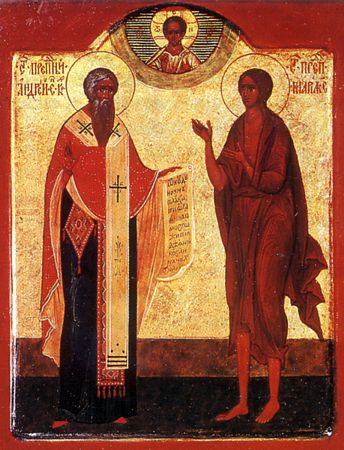
Andrew is painted as a hierarch: an aged man with a broad, rounded white beard, in phelonion (or, in the Slavic and Balkan types, the jewelled sakkos and mitre) with the crossed omophorion, blessing with the right hand and holding the Gospel book in the left. Where the painter wishes to name his work rather than his office he gives him an unrolled scroll instead of the Gospel, inscribed with the opening of the Great Canon — Whence shall I begin to lament the deeds of my wretched life? — and this scroll is the one attribute that identifies him beyond doubt. He is very often paired with Mary of Egypt, because their memories meet in the service of the fifth Thursday of Lent; that pairing is itself an identification, since no other Andrew is set beside her. The omophorion is decisive against his monastic namesake, who is always shown in the habit.
The stored image is a Russian panel icon of Andrew of Crete with Mary of Egypt: the hierarch at the left in a russet phelonion and white cross-omophorion, holding a long unrolled scroll of Slavonic text — the incipit of the Great Canon — and the emaciated, barefoot penitent of the Jordan at the right, her hand raised toward the blessing Christ in the cloud above. The source does not date the panel; its craquelure, worn gold ground and drawing point to a pre-modern Russian work of the sixteenth or seventeenth century, and it is stored on that basis, with the estimate recorded rather than asserted.
A second, securely dated image is stored as the control: the fresco-icon of 1843 by Dimitur Khristov and Zafir in the western narthex of the church of the Nativity of the Theotokos at the Rila Monastery in Bulgaria, inscribed in Church Slavonic АНДРЕЙ АРХІЕПКⲠ КРУТСКІИ — "Andrew, Archbishop of Crete." He is shown half-length in mitre and omophorion, blessing, with the jewelled Gospel: the hierarch type in its late Balkan form, and an unambiguous naming of this Andrew and not the martyr.
Disputed questions
- Not to be confused with Andrew of Crete the Martyr (†767, October 17), the "Andrew in Krisei" — a Cretan monk, not a bishop, who came to Constantinople to denounce the iconoclast emperor Constantine V Copronymus to his face and was beaten and dragged to death, dying when a partisan of the emperor cut off his foot. The two men are a generation apart, are of different rank, and died in different ways and places; but both were Cretans, both are called "of Crete," and both belong to the age of the first iconoclasm, so that the confusion is ancient and constant. It is responsible for the common popular claim that this Andrew, the hymnographer, denounced Leo III — a claim no contemporary source supports. In iconography the distinction is plain: the hymnographer wears the phelonion and omophorion of a hierarch and carries the Gospel or a scroll; the martyr wears the monastic habit and carries the martyr's cross. Neither is Andrew the Fool-for-Christ (October 2), nor the Apostle Andrew the First-Called.
- The year of his repose: 712, 720, 726 or 740? The synaxarial and Slavonic tradition, followed by the Orthodox Church in America and by the Russian books, gives 740, which makes him ninety and sets his death inside the iconoclast persecution. Western scholarship has argued for 712, 720 or 726 on the ground that no securely dated act of his is later than the synod of 712 and that his surviving works nowhere mention the iconoclast decrees. 4 July is agreed by every witness, and the calendar is unaffected; this entry follows the synaxarial 740 while recording the alternatives, and treats his supposed personal resistance to Leo III as unproven.
- The date and manner of his subscription in 712. That Andrew signed the Monothelite synod of Philippikos is recorded and is not seriously contested; the degree of coercion is not recoverable, and a minority of devotional writers deny the subscription altogether or transfer it to another Andrew. The repentance is likewise attested, in his profession of the two wills and in the letter to the deacon Agathon. This entry records both, as the tradition does, without either concealing the fall or making it the measure of the man.
- Where he was tonsured. The Greek Life attaches him to the brotherhood of the Holy Sepulchre; the Slavonic tradition and most English lives say the Lavra of Saint Sabbas. The sources are not reconcilable in detail and nothing of substance depends on it.
- Did he invent the kanon? The manuals repeat that Andrew "invented" the form. The safer statement is that the kanon emerges in Palestinian usage in his lifetime, that the earliest extant examples are his, that the Great Canon may well be the earliest of all, and that John of Damascus and Cosmas of Maiuma brought the form to its classical shape a generation later.
- Eresos or Hierissos? The place of his death on Lesbos is given as Ἐρεσός (Eresos, on the west of the island) in most sources and as Ἱερισσός in others, the two names being easily confused in manuscript; the burial in the church of Saint Anastasia is common to both.