
Nikon of Optina
Our Venerable Father and Confessor Nikon, Elder of Optina
Venerable · Confessor · b. 26 September 1888, at Moscow — d. 25 June 1931, at Valdokurye near Pinega in the Arkhangelsk region
Commemorated 25 June — Repose in exile in the Arkhangelsk north
Nikon (Belyaev) was the last of the elders of Optina. A Moscow merchant's son who entered the hermitage at eighteen and became the cell-attendant and secretary of the elder Barsanuphius, he was tonsured in 1915 and ordained priest in 1917 — that is, he received the whole tradition of Optina in the four years before it was destroyed. When the monastery was closed and made a museum in 1923 he stayed at his post until the authorities removed him, then carried on hearing confessions in the town of Kozelsk, gathering to himself what was left of the Optina flock. Arrested in 1927, he was sent to the transit camp at Kem and thence into exile on the Pinega in the Arkhangelsk north, where he died of tuberculosis on 25 June 1931, aged forty-two. The Russian Church restored his veneration at Optina in 1996 and glorified him with the New Martyrs and Confessors in 2000, as a venerable confessor.

Moscow, and the drawing of lots
He was born Nicholas Mitrofanovich Belyaev in Moscow on 26 September 1888, into a merchant family of real piety. The tradition of the house recorded that St John of Kronstadt, visiting when Nicholas was an infant, had blessed his mother Vera; and both Nicholas and his elder brother Ivan grew up drawn to the spiritual life rather than to the family business. Nicholas read mathematics at Moscow University and left it.
The brothers decided together to enter a monastery, and — unable to choose — wrote the names of several houses on slips of paper and drew lots. The lot fell on the Optina Hermitage, and in February 1907 they went there. Ivan was afterwards tonsured Innocent and died at Optina in 1917.
Under the elder Barsanuphius
In 1908 Nicholas was made cell-attendant and secretary to the elder Barsanuphius, the head of the skete and the last of the great Optina startsy in the unbroken succession from Leo, Macarius, Ambrose, Joseph and the rest. The relationship is unusually well documented, because Nicholas kept a diary of his elder's sayings — one of the most valuable records of Optina eldership from the inside, and the reason a good deal of Barsanuphius's teaching survives at all.
Barsanuphius, the sources agree, told the young man plainly what was coming: that the monasteries would be taken, that Christians would be persecuted, and that he was to be ready. Nicholas was tonsured Nikon in 1915, ordained deacon in 1916 and priest in 1917, in the year the world Barsanuphius had warned him of arrived.
Optina under the Soviets
He was arrested in 1919 and released. The community's position after the revolution was precarious and improvised: the monastery was nationalised, reconstituted as an "agricultural artel," and finally, in 1923, closed outright and turned into a museum. Nikon was the last priest serving in the Kazan church at Optina, and he stayed until the authorities removed him.
He then moved into Kozelsk, the town across the river, and continued. He served where he could, heard confessions, and above all received the people — monks scattered from the closed house, the nuns of Shamordino, and the laity who had made Optina their spiritual home for a century — so that the eldership itself, rather than any building, went on for another four years in a rented room. It is for this that he is called the last of the Optina elders: not because he was formally appointed to the office, but because the succession functioned in him until it was physically stopped.
Arrest, camp and exile
In June 1927 he was arrested again, with others of the Optina brotherhood. He was sent to Kem — the transit camp at Kemperpunkt on the White Sea, the gate of the Solovki system — and then into administrative exile in the Arkhangelsk region, where he was moved from place to place along the Pinega.
He was already ill with tuberculosis, and the exile finished him. In his last months he was taken in and cared for by another exiled priest, Father Peter (Drachev), at the settlement of Valdokurye; and there, unable at the end to speak, he received communion almost daily. The accounts of his last weeks record a vision of St Macarius of Optina, one of the elders of the golden age, coming to him. He died on 25 June 1931, aged forty-two.
Glorification
Veneration was restored locally, at the reopened Optina Hermitage, in 1996, when the Optina elders were glorified for local veneration; the Jubilee Council of Bishops of 2000 enrolled him in the general calendar of the Russian Church among the New Martyrs and Confessors. His title is преподобноисповедник — venerable confessor — the class of monastic saints of the Soviet persecution who died of it without being shot: exhaustion, disease, and the north.
His relics were not recovered; his place of burial in the Arkhangelsk north is not certainly known.
Feast and commemoration
June 25 (church date; New Calendar civil June 25, Old Calendar civil July 8), the day of his repose. The commemoration is Russian, kept by the Moscow Patriarchate and by the Orthodox Church in America, and appears in North American Antiochian parish listings that follow the OCA calendar; it is absent from the Greek books. He is also commemorated with the whole company of the Optina Elders at their Synaxis on October 11, and among the New Martyrs and Confessors of Russia on their movable feast (the Sunday nearest 25 January).
The day is otherwise dominated by the leavetaking of the Nativity of the Forerunner, Febronia of Nisibis and Peter and Fevronia of Murom.
Hymns
Apolytikion — Tone 8 (common of a venerable father)
By a flood of tears thou didst make the barren desert fruitful; with sighs from the depth thou didst bring thy labours to a hundredfold increase; and thou wast made a beacon to the whole world, shining with miracles, O Nikon our father. Intercede with Christ God that our souls may be saved.
Iconography
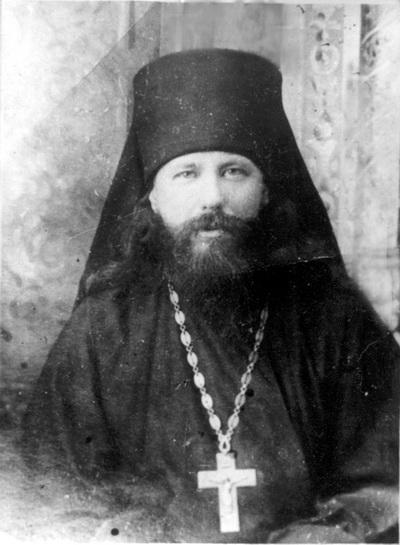
Nikon is painted as a young hieromonk-confessor: dark hair and a full dark beard — he died at forty-two, and the icons keep him young against the white-bearded Optina elders around him — in the black mantiya and klobuk, with the pectoral cross of a priest-monk, holding a cross in the right hand (the confessor's attribute) and a scroll in the left. In the collective icon of the Synaxis of the Optina Elders he stands at the end of the row, the last of the fourteen; where a background is given him it is the Kazan church at Optina, or the timber and snow of the Arkhangelsk exile.
No painted icon of him can be public domain: he was glorified in 1996 and 2000, and every icon of him is the work of a living or recently living iconographer, whose rights are untouched by any photographer's or uploader's licence. None has been stored. What is stored instead is an anonymous photograph of the saint taken before 1931, out of copyright by expiry of term — the young hieromonk in klobuk and riasa with the priestly cross on his breast. It is documentary rather than liturgical, and is presented as such; the repository takes the same course for Ambrose of Optina.
Disputed questions
- Confessor, not martyr. He was not executed; he died of tuberculosis contracted and aggravated in camp and exile. The Russian Church's own designation for him, prepodobnoispovednik, is exact, and this entry follows it: confessor and venerable, not new-martyr.
- "The last of the Optina elders." The title is traditional rather than canonical. Other Optina fathers survived him in the camps, and the hermitage's own list of the Optina Elders, glorified together, closes with fourteen names of which his is the last chronologically. The phrase means that the living practice of eldership at Optina ended with his arrest.
- Not the other Nikons of the calendar. He is not Nikon of Radonezh (†1426), the disciple and successor of Sergius; nor Nikon Metanoeite (†998), the preacher of repentance in Crete and the Peloponnese; nor the patriarch Nikon of the seventeenth century, who is not a saint.
- The date of birth. 26 September 1888 is the date the Optina sources give (Old Style); some English accounts give the Gregorian equivalent, 8 October, without saying so.