
Athanasius Patelarios
Our Father among the Saints Athanasius III Patelarios, Patriarch of Constantinople, Wonderworker of Lubny
Patriarch · Bishop · Wonderworker · b. 1560 (so the Russian tradition) on Crete; 1597 by modern reckoning — d. 1654, at the Transfiguration monastery of Mgar near Lubny
Commemorated 2 May — Commemoration fixed at his glorification (1662), when his relics were found incorrupt and seated
Athanasius III Patelarios, a Cretan of the noble Greek house of Patelarios, was three times Patriarch of Constantinople in the harried decades of the mid-seventeenth century, never for long: forty days at his first accession in 1634, fifteen at his last in 1652. Learned in many tongues, a preacher and a translator, he spent most of his life travelling — Athos, Palestine, Thessalonica, Italy, the Danubian principalities — and came at last to Moscow in April 1653, where Tsar Alexis Mikhailovich and Patriarch Nikon received him with honour and where he wrote for the Russians an account of the episcopal Liturgy as it was served in the East. On the journey home he fell ill and died at the Transfiguration monastery of Mgar near Lubny in the Ukrainian land, in 1654. He was buried, in the Greek manner, seated in his chair; in 1662 the grave was opened and the body was found incorrupt and still seated, and he was glorified with his feast on May 2. Russian piety knows him as "Athanasius the Sitting" and as the Wonderworker of Lubny, and his relics rested latterly in the Annunciation Cathedral at Kharkov.

Crete, Athos, and the monastic years
He was born on Crete, in the world Alexis, into the pious and well-connected Greek family of the Patelarioi, which claimed kinship with the Palaiologoi. He received the broad education available to a Cretan gentleman under Venetian rule and became fluent, the accounts say, in Greek and Latin and also in Hebrew, Arabic and Italian — an equipment that would make him useful to patriarchs and to tsars alike.
After his father's death he left the world. He was received as a novice at a monastery of Thessalonica under the name Ananias, then went to the Holy Mountain, to the monastery of Esphigmenou, and afterwards spent a period in the monasteries of Palestine. Returning, he was given the monastic name Athanasius and ordained priest at Thessalonica, where among his labours was a translation of the Psalter from the Greek for the use of the Vlach and Moldavian faithful — the earliest sign of the vocation to serve churches not his own by language that would mark his whole career.
Metropolitan and Patriarch
His gifts as a preacher brought him to the notice of Patriarch Cyril I Loukaris, who made him a preacher of the Great Church and then consecrated him Metropolitan of Thessalonica (from about 1631). In the chaos of the Constantinopolitan throne under Ottoman pressure — where patriarchs were made and unmade by the intrigues of the Porte and the rivalry of parties — Athanasius was raised to the patriarchal throne on 25 March 1634, and deposed after forty days. He held it briefly a second time, and a third time in 1652, for fifteen days, before the same forces drove him out. Between and after these tenures he lived as a wanderer for the Church's sake: in Italy, in Moldavia and Wallachia, and finally in the Russian lands, gathering alms for his monastery and for the ransom of Christians under the Turk.
Moscow and the Liturgy of the East
In April 1653 he reached Moscow, and was received "with great honour" by Tsar Alexis Mikhailovich and Patriarch Nikon, who was then in the first years of his liturgical reform. Athanasius's authority as a Greek hierarch was directly useful to Nikon, and he composed for the Russians the treatise known as The Order of the Episcopal Liturgy in the East, describing the hierarchical Liturgy as it was actually served at Constantinople — a document of real value for the history of the rite, and one of the sources of the Russian pontifical usage that followed. The tradition also remembers him urging on the tsar the cause of the Christians under Ottoman rule, and speaking of Moscow as the heir of the imperial city's dignity.
Repose at Lubny, and the seated relics
He left Moscow in December 1653, laden with alms, intending to return to the East by way of the Ukrainian lands. Winter, age and illness overtook him, and he was received at the Transfiguration monastery of Mgar, near Lubny on the Sula, where he fell asleep in the Lord in the spring of 1654, the sources giving 5 April. Because he was a patriarch, and after the manner of the Greek East, he was buried vested and seated in his episcopal chair, in a vault beneath the church.
In 1662 — the accounts connect the opening of the grave with a vision granted to Metropolitan Joseph Tukalsky of Kiev — the vault was entered and the body was found incorrupt, still upright in its chair, with the vesture and the dikanikion intact. He was glorified in that year, and the commemoration was fixed on May 2. Healings were recorded at the shrine, and the Mgar monastery became a place of pilgrimage; from the posture of the relics comes the popular Russian and Ukrainian name Афанасий Сидящий, "Athanasius the Sitting."
The relics were moved more than once in the upheavals that followed. In the nineteenth century a portion was carried to Kharkov, and after the closure of Mgar they rested in the Annunciation Cathedral of that city, where they are venerated still.
Feast and commemoration
May 2 (Old Calendar civil May 15), the day appointed at his glorification in 1662. He is kept by the Russian and Ukrainian Churches — with particular solemnity at Mgar, Lubny and Kharkov, where he is a local patron — and by the Orthodox Church in America; the Greek calendars commemorate him as a patriarch of the Great Church. His commemoration shares May 2 with Athanasius the Great, the translation of the relics of the passion-bearers Boris and Gleb, and Boris of Bulgaria.
Hymns
Apolytikion — Tone 4 (common of a hierarch)
O God of our fathers, who ever dealest with us according to Thy gentleness: take not away Thy mercy from us, but by the prayers of Thy hierarch Athanasius guide our life in peace.
Iconography
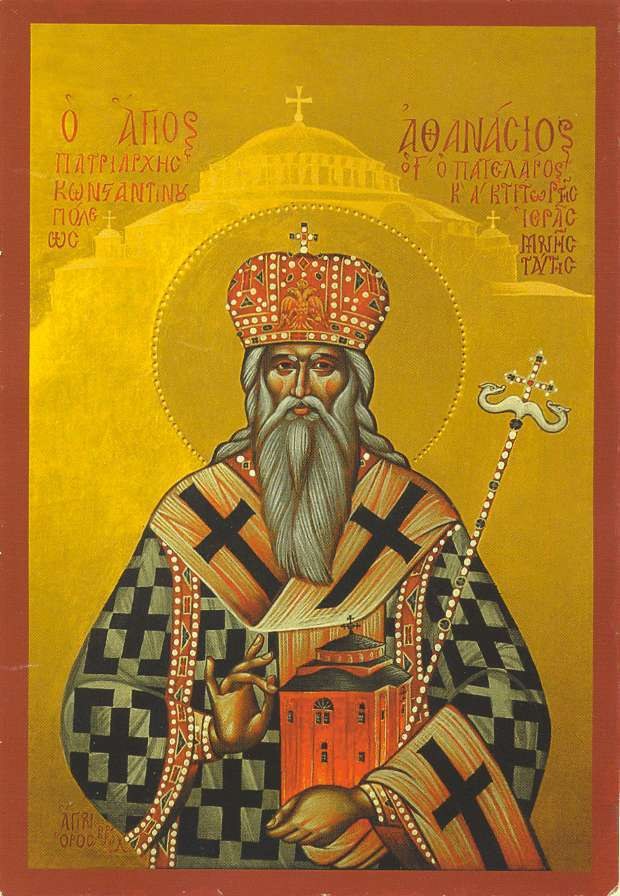
Athanasius is painted in a manner peculiar to himself, dictated by the state of his relics: seated in the patriarchal chair, vested in sakkos and omophorion, the white patriarchal kamilavkion or mitre on his head, the pastoral staff in his hand and the Gospel or a scroll before him — a seated hierarch, where the icons of bishops are almost always standing. He is shown as an old man with a long white beard. Standing versions exist, in which the chair appears beside him or beneath his feet as his attribute, and the scene of the opening of the vault at Lubny in 1662 — the hierarchs discovering the seated body — is painted on the borders of his icons and in the churches of Kharkov and Poltava. The stored image is a late-18th-century portrait-icon of the patriarch.
Disputed questions
- The year of his birth. The Russian synaxaria and the OCA life give 1560, which would make him ninety-four at his death and a metropolitan at seventy. Modern prosopography of the Constantinopolitan patriarchate gives 1597, which agrees far better with the chronology of his career. Both are recorded here; the later date is the more probable, the earlier the more traditional.
- The date of his repose. 5 April 1654 is given by the standard accounts; some Russian sources give 5 February, and the feast itself is May 2, the day fixed at the glorification of 1662 and not the day of death. Entries that treat May 2 as his death-date are in error.
- How many patriarchates. He is numbered Athanasius III and is generally credited with three tenures; the second is so short and so poorly documented that some lists give only two. The dates 1634 and 1652 are secure.
- Not to be confused with Athanasius I of Constantinople, the ascetic patriarch of the years around 1300 (October 28), nor with Athanasius the Great of Alexandria, whose own commemoration falls on this same day, May 2 — a coincidence that has caused the two Athanasii to be conflated in more than one calendar note.