
Callinicus of Gangra
The Holy Martyr Callinicus, who suffered at Gangra in Paphlagonia
Martyr · d. c. 250, at Gangra in Paphlagonia, in a furnace
Commemorated 29 July — Martyrdom by fire at Gangra
Callinicus (†c. 250) was a Christian of Cilicia who left his own country to preach Christ through the cities of Asia Minor, and was seized at Ancyra in Galatia. Refusing to sacrifice, he was torn with iron hooks and ox-hide thongs, then shod in iron sandals studded with nails and driven on foot toward Gangra, the metropolis of Paphlagonia, to be executed there. On the road his own guards, perishing of thirst, were saved when at his prayer a spring broke out of a dry rock; and at Gangra he gave thanks and walked into a burning furnace, where he gave up his soul. His body was found unconsumed and was buried by the faithful. His name — Kallinikos, "gloriously victorious" — has been turned into a proverb by the hymnographers, who say that he was rightly so called, since the fire he entered became his crown.

Origins and preaching
Callinicus was a native of Cilicia, the coastal province of south-eastern Asia Minor whose cities — Tarsus, Anazarbus, Aegae — already had old and well-taught churches by the middle of the third century. He was, the passion insists, a Christian from childhood and not a convert of later life: he was raised in the faith by Christian parents and formed in it before he had anything to renounce.
What moved him out of Cilicia was not persecution but grief. The account represents him as unable to bear the thought of the multitudes around him perishing in the service of idols, and so he took up a wandering apostolate, going from city to city and from village to village and preaching Christ publicly wherever he could gather a hearing. The passion credits him with many conversions; he is described in the synaxarion not as a bishop or a cleric but simply as a man of the laity who taught, which places him among that class of third-century itinerant confessors — freelance evangelists of no rank — whose work the Church remembers precisely because the imperial courts noticed them.
Trial at Ancyra
His preaching carried him north-west into Galatia, and at Ancyra (the modern Ankara) he was arrested and brought before the governor, whom the passion names Sacerdon. The interrogation follows a shape familiar from the Ancyran acts: the governor demands sacrifice to the gods of the city, offering the usual mixture of honour and threat, and the accused refuses.
Callinicus's answer, as the tradition preserves it, does not argue about the gods at all. He replies that a believer receives from Christ the strength for whatever ordeal is set before him; that he is not depending on his own endurance, and therefore has nothing to negotiate. The tortures followed at once: he was beaten and his sides raked with iron claws, and scourged with ox-hide thongs — the nervi of the Roman torture-chamber, thongs of dried sinew that cut like wire.
When neither the flattery nor the hooks moved him, Sacerdon determined to make the punishment itself a public sermon against the faith, and sentenced him to be burned — not at Ancyra, but at Gangra, the chief city of Paphlagonia, some days' march to the north. Callinicus was shod in sandals of iron set with nails driven through into the flesh of his feet, and a detachment of soldiers was ordered to drive him the whole distance on foot.
The spring in the wilderness
The march is the heart of the story as the Church has kept it. Under a summer sun, on a bad road, it was the escort and not the prisoner who broke. The soldiers, the passion says, came to the point of collapse from thirst, with no water anywhere on the route; and it was to Callinicus, whom they were driving to his death and whose feet were leaving blood on the stones, that they finally appealed.
He prayed, and water gushed out of a dry rock — a deliberate echo of Moses at Horeb and Rephidim, and one that the hymnography does not let pass. The soldiers drank and were revived; and, the account adds with unusual candour, they were moved to pity and would have let him go, but were more afraid of what the governor would do to them than of what they were doing to him. So they went on to Gangra together, guards and martyr, the whole company kept alive by the prayer of the man they were escorting to the fire. Some copies of the passion name the place of the miracle — a station on the Ancyra–Gangra road — but the name varies in transmission and is best left as the tradition leaves it: a dry place, eighty stades or so short of the city.
The furnace at Gangra
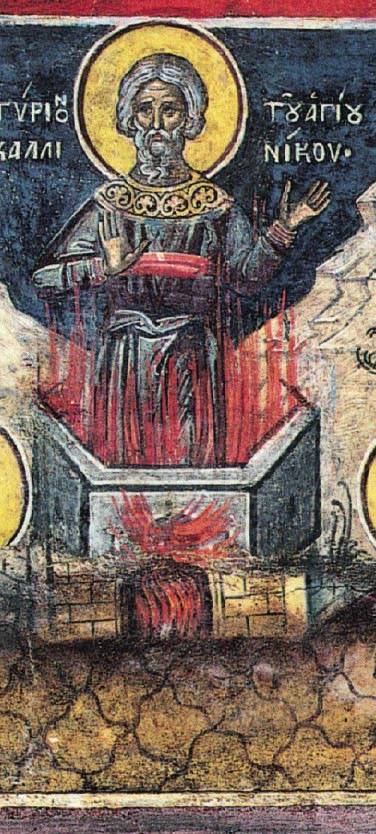
At Gangra a furnace had been prepared. Callinicus, arriving, is shown neither resisting nor being dragged: he gave thanks aloud to God for having brought him to the end of his course, prayed for those who had condemned him, and walked into the flames of his own accord. He died in the furnace.
The passion closes with the detail that the Christians of Gangra, coming to the place afterwards, found the body whole and untouched by the fire, and carried it away and buried it with honour. Gangra kept his tomb. The city — later famous for the fourth-century council held there, and as the see of the hieromartyr Hypatius of Gangra — thus had two martyr-patrons in its short list of glories, and it is as "Callinicus of Gangra" rather than "of Cilicia" that the calendars have fixed his name.
Feast and commemoration
July 29 (church date; New Calendar civil July 29, Old Calendar civil August 11). Callinicus is the day's principal commemoration in the Greek and the Slavic books alike, and he heads the July 29 synaxarion; the Antiochian Archdiocese keeps him on the same day, ranked with the Martyr Theodota and her three sons, whose principal feast this also is. The day falls in the last days of July, immediately before the Dormition fast (August 1–14) opens, and the July 29 office is therefore the last martyr's commemoration of the pre-Dormition summer in the Menaion's ordering. He has no separate translation-of-relics commemoration; his tomb remained at Gangra.
Hymns
Apolytikion — Tone 4 (common of a martyr)
Thy martyr Callinicus, O Lord, in his contest received an incorruptible crown from Thee, our God; for possessing Thy strength, he cast down the tyrants and shattered the feeble insolence of the demons. By his intercessions save our souls.
Kontakion — Tone 2
Shod with iron and driven upon a hard road, thou didst give drink from the rock to them that drove thee to death; and entering the furnace with thanksgiving, thou wast shown to be in very truth what thy name declared, O gloriously victorious Callinicus: entreat Christ God for us who honour thee.
Original translation from the Greek
Iconography
Callinicus is painted as a young or middle-aged layman-martyr, dark-haired and short-bearded, in tunic and mantle and holding the cross of martyrdom; he is not given clerical vesture, since the tradition knows him as a layman. Two narrative motifs are proper to him and identify him wherever the inscription is lost: the iron sandals — sometimes shown being nailed to his feet, sometimes simply lying beside him — and the furnace, in which he is shown standing upright with hands raised in prayer while the flames rise about him. The spring from the rock appears in the fuller cycles, with the soldiers stooping to drink.
The stored image is the martyrdom scene from the wall-paintings of the Monastery of Dionysiou on Mount Athos, dated 1547, inscribed Τ(Ο) ΜΑΡΤΥΡΙΟ(Ν) Τ(ΟΥ) ΑΓΙΟΥ ΚΑΛΛΙΝΙΚΟΥ: the saint stands in the mouth of a built furnace with both hands lifted, the fire visibly drawn burning beneath the brickwork, his face calm and turned slightly aside — the standard Athonite treatment of a martyrdom by fire, and the composition on which most later Greek and Bulgarian versions depend. (A nineteenth-century fresco of him also survives at the Rila Monastery in Bulgaria.)
Disputed questions
- Date and reign. The synaxaria do not name an emperor, and the martyrdom is variously placed under Decius (249–251), under Valerian, or as late as the Diocletianic persecution. The mid-third century, around 250, is the usual reckoning and is adopted here; the governor's name, Sacerdon, is not independently attested in the fasti of Galatia, and may be a corruption.
- Not to be confused with the martyr Callinicus of Apollonia in Phrygia, whose feast is kept in the Western books on July 2 and who is the subject of the Wikidata item labelled "Callinicus, 3rd-century martyr" — the two are regularly conflated in reference works and in the Wikimedia category naming, but the Phrygian martyr has a distinct passion and a distinct day, and no Wikidata identifier for the Gangra martyr of July 29 was found to exist at the time of writing.
- Nor with the martyrs named Callinicus who appear as companions in other companies — with Thyrsus and Leucius (December 14), among the martyrs of Melitene (November 7), or with the patriarchs Callinicus of Constantinople.
- The manner of death. A minority of the Slavonic transmission has him die on the road, before reaching the furnace, so that the fire consumed a body already dead. The Greek synaxarion and the Athonite iconography both have him alive and standing in the flames, and the received tradition is that he was burned alive.