
Clement of Ohrid
Our Father among the Saints Clement, Equal to the Apostles, Archbishop of Ohrid and Enlightener of the Bulgarians
Equal to the Apostles · Bishop · b. c. 840 — d. 916
Commemorated 27 July — Repose at the monastery of St Panteleimon, Ohrid, 25 November — Autumn commemoration, kept in Bulgarian and Macedonian usage
Clement of Ohrid (c. 840 – 916) was the chief of the disciples of Cyril and Methodius, the first bishop of the Slavs to preach, serve and write in the Slavonic tongue, and the founder of the Ohrid Literary School. Driven out of Great Moravia after Methodius's death in 885, he came down into Bulgaria, was set by prince Boris I over the region of Kutmichevitsa in south-western Macedonia, and there in some seven years is said to have taught three and a half thousand pupils, of whom the ablest were ordained. In 893 Tsar Symeon made him bishop of Drembica (Velitsa) — the first Slav to hold a Bulgarian see. He built the monastery of St Panteleimon at Ohrid, wrote the first original body of Slavonic Christian literature — sermons, panegyrics, lives, and hymns — and reposed there on 27 July 916, in a coffin he had made with his own hands. With Naum, Gorazd, Sabbas and Angelar, and with the two brothers themselves, he is one of the Seven Enlighteners of the Slavs, the Sedmochislenitsi.

Origins
Nothing certain is known of Clement's birth. The Greek Long Life attributed to Theophylact of Ohrid makes him a Slav, "of Bulgarian race," and modern estimates put his birth about 840; the Macedonian and Bulgarian traditions dispute the region between them, and no source settles it. He enters the record already grown, as the closest and most gifted of the disciples of the brothers Constantine-Cyril and Methodius of Thessalonica, whom he followed on the Moravian mission from its beginning. He was with them at Rome about 867–868, where Pope Adrian II blessed the Slavonic books; he was ordained priest; and after Cyril's death in Rome in 869 he remained with Methodius through the whole of the Moravian archbishopric, sharing in the translation of the Scriptures and the service books.
The breaking of the Moravian mission
Methodius died in 885, and the Frankish party in Moravia moved at once. The quarrel was not only about language: the questions in dispute were the Slavonic liturgy, the Filioque added to the Creed by the Frankish clergy, and the Saturday fast of Latin observance. The partisans of what the Slavonic sources call the three-tongued heresy — the doctrine that God may be worshipped only in Hebrew, Greek and Latin — brought the disciples to trial before prince Svyatopolk. Pope Stephen VI forbade the Slavonic liturgy. Clement and his companions were dragged through thorns, imprisoned, and finally expelled; the younger among them were sold to slave-traders and appeared for sale in the market at Venice in 886, where the ambassador of the emperor Basil the Macedonian happened on them, ransomed them, and sent them to Constantinople. The senior confessors were simply driven over the frontier.
Clement, with Naum and Angelar, made the crossing of the Danube into Bulgaria. What had been a catastrophe for Moravia — where the Slavonic rite died out within a generation, and where the state itself collapsed under the Magyars in 907 — became the making of Slavonic Christianity, because Bulgaria received what Moravia had thrown away.
Kutmichevitsa: the school
Boris I, baptised in 864 and looking for men who could give his people the faith in their own language, received the exiles as a gift. Angelar died soon after the journey. Clement was sent south-west, into the region called Kutmichevitsa, with Ohrid and Devol as its centres, and given the revenues of estates to support the work.
What he did there was the decisive act of Slavonic church history. He set up separate schools for adults and for children, taught reading and writing in Slavonic — forming the letters himself for the youngest pupils — trained readers, singers and clergy, and multiplied copies of the books. The Long Life puts the total of his pupils at 3,500, of whom the worthiest were ordained: whatever the exact figure, it means that within a decade the south-west of Bulgaria had a native Slavonic-speaking clergy, and that the Byzantine Greek church of the region was replaced from below. He also organised a court school at the capital, which under Symeon became the Preslav literary school.
Bishop of Drembica
In 893, at the council of Preslav which made Symeon prince and declared Slavonic the language of church and state, Clement was consecrated bishop of Drembica or Velitsa — the first Slav to be made a Bulgarian bishop. Naum took over the teaching at Ohrid in his place. He held the see for the rest of his life; when his strength failed he asked Symeon to release him, and Symeon refused, so he continued.
He withdrew for his last years to the monastery he had built at Ohrid, dedicated to St Panteleimon — on whose feast, by the providence that the Slavonic books enjoy pointing out, he would die. There he went on translating, and finished, among other things, a substantial part of the Pentecostarion. He fell ill and reposed on 27 July 916, and was buried in his own monastery church, in a coffin he had made with his own hands. The church of St Panteleimon at Ohrid, rebuilt and rebuilt again over his grave, remains the centre of his cult and the burial place of his relics.
Hymnographic and literary legacy
Clement is, on any reckoning, the first named author in Slavonic literature. Beyond continuing the translation work of Cyril and Methodius he composed original works: praises and panegyrics of the Theotokos, of John the Baptist, of the apostles and prophets and of Cyril himself; catechetical sermons of a deliberately plain and repetitive style, made to be read aloud to newly-baptised villagers by clergy of limited learning; a Life of Methodius; and liturgical hymnography, including canons and the earliest Slavonic services to be composed rather than translated. His sermons travelled: they were copied in Rus' from the eleventh century onwards, where they were read and loved without their author's name always travelling with them.
Veneration
He was venerated at Ohrid immediately, and his cult is the oldest continuous Slavonic saint's cult in the Balkans. The Ohrid archbishopric took him for its patron and traced its own dignity to him; his relics at St Panteleimon's have never left the city; and the Bulgarian, Macedonian and Serbian Churches keep him among their first fathers. Bulgarian usage keeps him twice a year — 27 July, the day of his repose, and 25 November; Greek books that carry him place him on 22 November. He is patron of the universities of Sofia and Bitola and of a great deal else besides, and in the modern national historiographies of Bulgaria, North Macedonia and Serbia his memory has been claimed and re-claimed with an energy that the saint himself would probably have found bewildering.
Feast and commemoration
July 27 (church date; New Calendar civil July 27, Old Calendar civil August 9), the day of his repose, kept in the Bulgarian, Macedonian, Serbian, Russian and OCA calendars together with his companions Naum, Sabbas, Gorazd and Angelar; the day is dominated everywhere else by Panteleimon, to whose monastery at Ohrid Clement's own death and burial belong. A second commemoration is kept on November 25 in Bulgarian and Macedonian usage, and Greek books that carry him give November 22. At Ohrid the July feast is the city's own, with the procession to St Panteleimon's over his relics.
Hymns
Apolytikion — Tone 4 (common of a hierarch)
A rule of faith and an icon of gentleness, a teacher of self-restraint: so did the truth of things show thee to thy flock. Therefore hast thou gained by lowliness the things on high, and riches by poverty. O father and hierarch Clement, intercede with Christ our God, that our souls may be saved.
Iconography
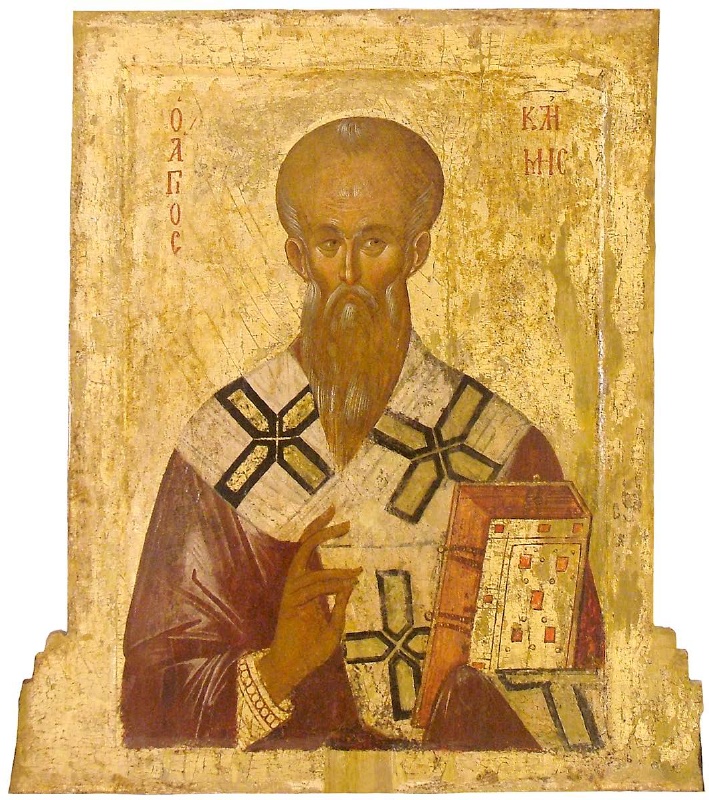
Clement is painted as a hierarch: in the phelonion and the crossed omophorion, blessing with the right hand and holding the jewelled Gospel in the left. His face is one of the most individual in the Slavic repertory and is remarkably consistent from the eleventh century onwards — a high, bald, domed forehead, deeply lined, with sparse hair at the temples, and a long, narrow, pointed grey beard falling to the chest. The inscription is Ο ΑΓΙΟΣ ΚΛΗΜΗΣ or, in Slavonic, СВ. КЛИМЕНТ ОХРИДСКИ. He is very frequently shown beside Naum, or with Cyril and Methodius, or within the full company of the Seven Enlighteners, where the seven stand in a row and Clement is placed at the right hand of the two brothers.
The stored image is a panel of the last quarter of the fourteenth century from the Church of St Mary Perivleptos at Ohrid, now in the Ohrid Icon Gallery — the same series as the Naum icon stored in this collection — clearly inscribed Ο ΑΓΙΟΣ ΚΛΗΜΗΣ, with the white omophorion and the red-bound Gospel.
Disputed questions
- The Cyrillic alphabet. A persistent tradition — and a great many Bulgarian and Macedonian textbooks — credits Clement with the invention of the Cyrillic script, which he is said to have devised out of the Glagolitic of his teachers and named after Cyril. Modern scholarship generally attributes Cyrillic instead to the Preslav school in the same decades, and holds that Clement himself wrote and taught in Glagolitic. The tradition is old and the question is genuinely open at the edges; what is not in doubt is that Clement taught the letters, whichever letters they were.
- Nationality. The sources call him a Bulgarian and place his work in what is now North Macedonia, Albania and Bulgaria. The modern quarrel over whether he is a "Bulgarian" or a "Macedonian" saint reads a nineteenth-century category back into a ninth-century life and is not a question the record can answer.
- The Long Life. The principal source, the Greek Life under the name of Theophylact of Ohrid (archbishop there c. 1090), was written some two centuries after the events, probably on the basis of an older Slavonic life now lost. It is invaluable and it is not contemporary.
- Not to be confused with Clement of Rome (November 25 — the shared date is why Clement of Ohrid's autumn feast falls where it does), Clement of Ancyra (January 23), or Clement the Hymnographer of the Studion (April 30).