
Damiane of Georgia
The Holy and Right-Believing King Demetre, in monasticism Damiane, Hymnographer of Georgia
Venerable · King · b. c. 1093 — d. 1156
Commemorated 23 May — Commemoration of the king-monk and hymnographer
Damiane was King Demetre I of Georgia (reigned 1125–1156), the son and successor of St David the Builder, who held together the great kingdom his father had made, resettled its emptied border provinces, finished the monastery and academy of Gelati, and then — worn down by a conspiracy of his nobles and by the rebellion of his own son — laid down the crown and became a monk in the wilderness of David-Gareji under the name Damiane. In the cell he wrote hymns, among them the Shen khar venakhi, "Thou art a Vineyard," the most beloved chant of the Georgian Church and one of the great Marian hymns of Christendom. When his son David V died after six months on the throne he was obliged to resume the government, naming his other son George as co-ruler; he reposed in 1156 and was buried at Gelati. Georgia honours him on May 23 as a king, a monk and a hymnographer.
.jpg)
Son of the Builder
Demetre was born about 1093, the son of David IV the Builder (Davit Aghmashenebeli), the king who broke the Seljuk hold on the Caucasus at Didgori in 1121 and made Georgia the dominant power of the region. He was trained for rule from boyhood and made co-ruler by his father, who is reported to have said that his son would govern Georgia better than he had done himself — a remark preserved in the Georgian chronicle and worth reading as policy rather than sentiment: David was securing an undisputed succession.
The young prince's competence was shown early. In 1117 his father sent him against Shirvan, where he stormed the fortress of Kaladzori and came back with prisoners and spoil; the Georgian historians treat the campaign as the making of his military reputation.
King
He succeeded on his father's death in 1125 and reigned thirty-one years. The reign has never had the glamour of his father's or of his great-granddaughter Tamara's, and its achievement is of a duller and harder kind: he kept what had been conquered, in the face of the Seljuk successor-states, of Shirvan and of the Armenian marches, and he repopulated the provinces that a century of invasion had emptied — the chronicle names Hereti, Somkhiti, Tashiri, Javakheti, Artaani and the border of Tao — settling them, restoring their agriculture and their churches, and so consolidating in a generation what a battle had won in a day.
He was, by every account, personally devout, and he continued his father's church-building. Above all he completed Gelati, the monastery and academy near Kutaisi that David had founded in 1106 and where David lay buried under the gate; the great church and its mosaic of the Theotokos belong to Demetre's reign.
The conspiracy, the abdication, and the cell
The trouble of his reign was internal. A party of the nobility, led by Ioane of Abuleti, conspired to depose him in favour of his half-brother Vakhtang; and — the wound the sources dwell on — his own eldest son David rose against him. Between the treachery of his lords and the rebellion of his heir, Demetre would no longer carry "the vanity of the world." He abdicated, entered the desert monastery of David-Gareji in the semi-arid country south-east of Tbilisi, and was tonsured with the name Damiane.
There he wrote. The Georgian Church attributes to him a body of hymnography, and one hymn above all: შენ ხარ ვენახი — Shen khar venakhi, "Thou art a Vineyard" — an address to the Mother of God as the vine newly planted in Eden, whose fruit is Christ, ending in a prayer that she may increase and be praised for ever. It is sung throughout Georgia in three-voice polyphony, has been carried into Orthodox use far beyond the Caucasus, and it is the reason the calendars call this king a hymnographer. An icon of the Theotokos named from the hymn's opening words — the icon "Thou art a Vineyard" — is commemorated on the same day, May 23, in Georgian usage.
The return to the throne, and repose
His son David V reigned only about six months and died. The Georgian nobles came to the monastery for the monk, and Damiane — unwillingly, the accounts insist, and for the sake of the kingdom rather than of himself — resumed the government, naming his younger son George (the future George III, Tamara's father) as co-ruler and successor. He reposed in 1156 and was buried in his father's monastery of Gelati.
Veneration and portraits
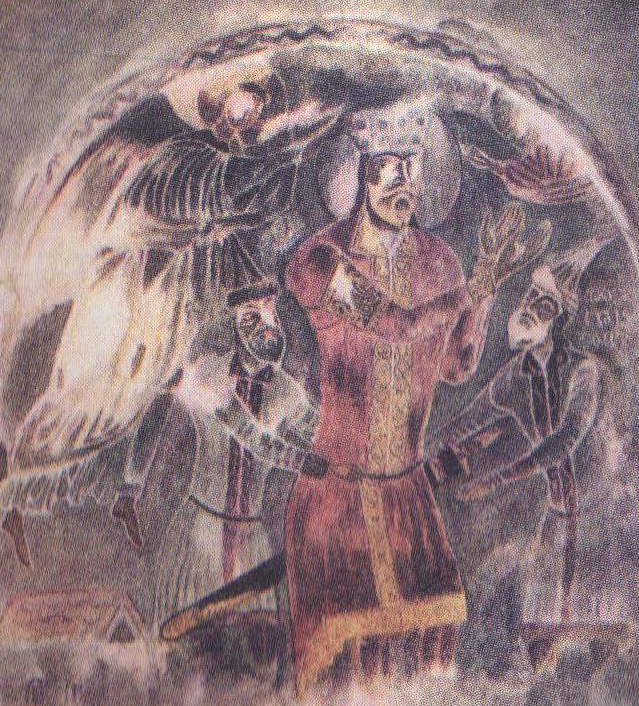
He is honoured as a saint of the Georgian Church under his monastic name. Two twelfth-century frescoes preserve his portrait — at Matskhvarishi in Svaneti and in the cave-churches of David-Gareji — which is unusually good fortune for a Georgian monarch, and makes him one of the few saints of this collection whose stored image is a contemporary likeness rather than a type.
Feast and commemoration
May 23 (church date; New Calendar civil May 23, Old Calendar civil June 5). The commemoration is Georgian, and is carried into English by the Orthodox Church in America's calendar, which keeps it alongside the Georgian icon of the Mother of God "Thou art a Vineyard" (Shen khar venakhi), named from the saint's own hymn. He is not in the Greek, Slavonic or Antiochian books for this day. In Georgia he is honoured with his father David the Builder (January 26) among the holy kings of the Bagrationi line, and at Gelati, where both are buried.
Hymns
Apolytikion — Tone 8 (common of a venerable one)
Thou didst put off the purple and put on the habit, and didst exchange a throne for a cell in the wilderness; and there, singing to the Mother of God, thou wast made a harp of the Spirit. O venerable Damiane, crowned king and monk, intercede with Christ God that our souls may be saved.
Kontakion — Tone 2
Thou didst keep the kingdom thy father built and didst people its wasted lands; and when thy lords and thine own son turned against thee, thou didst flee to the desert of Gareji and there didst name the Maiden a Vineyard newly planted. O king Demetre, monk Damiane, sing for us also before the throne of God.
Original translation from the Georgian
Iconography
Damiane is painted in either of his two states, and sometimes in both at once. As king he wears the Georgian royal costume of the twelfth century — the long, front-opening qaba with bands of ornament, the jewelled crown, the loros — and holds a model of a church or a scroll; as monk he is shown in the dark mantle and koukoulion, with the scroll of his hymn. Late Georgian icons combine the two by giving him the monastic habit and setting the crown beside him, and often place the icon "Thou art a Vineyard" above his head, or paint the vine itself climbing beside the figure — the vine being simultaneously the emblem of the Theotokos in his hymn and the national emblem of Georgia.
The stored image is a contemporary portrait: the fresco of the coronation of King Demetre I, painted in 1142 by Michael Maghlakeli in the church of the Saviour at Matskhvarishi in Latali, Svaneti. The king stands frontally at the centre in a deep-red patterned robe with a broad embroidered orphrey, nimbed and crowned, his right hand raised; two angels descend above him to set the crown on his head, and smaller attendant figures — clergy and courtiers with censers — flank him below. It is one of the earliest surviving Georgian royal portraits and is reproduced from a photograph of the fresco released into the public domain; the underlying work is of the saint's own lifetime.
Disputed questions
The dates of the reign, and the "second reign." The Georgian chronicle's account of an abdication, a six-month reign of David V, and a restoration is generally accepted in outline, but the length and the dating of the monastic interval vary in the literature, and some reconstructions place the abdication as late as 1154–1155, giving Damiane only a very short time in the cell. The year of his repose is given as 1156 (occasionally 1155 or 1157).
How much of the hymnography is his? Shen khar venakhi is ascribed to King Demetre-Damiane by a firm and early Georgian tradition, and the ascription is not seriously contested; the extent of the other hymns attributed to him is less certain, as is usual with royal hymnographers.
Not to be confused with the Great Martyr Demetrius of Thessalonica — the confusion is easy, because the Georgian king's Christian name is the same and the Georgian churches of Demetre may be dedicated to either — nor with the unmercenary Damian of the pairs of holy physicians, whose name he took in religion.