
Demetrius of Uglich
The Holy Right-believing Tsarevich Demetrius of Uglich and Moscow, Passion-bearer and Wonderworker
Passion Bearer · Prince · Wonderworker · b. 19 October 1582, at Moscow — d. 15 May 1591, at Uglich
Commemorated 15 May — His death at Uglich, 1591, 3 June — Translation of the relics from Uglich to the Archangel Cathedral in Moscow, 1606, 19 October — His birth, 1582
Demetrius (Dimitry) Ivanovich, youngest son of Ivan IV the Terrible, was born at Moscow in 1582 and died at Uglich on 15 May 1591, aged eight, of a knife-wound in the throat: his mother's family cried murder, the government's commission of inquiry found that he had fallen on his own knife in an epileptic fit, and the question has never been settled. The consequences were enormous — his name was taken up by a succession of impostors who carried the Time of Troubles to the walls of Moscow — and the Church's answer was to glorify him. On 3 June 1606, three weeks after the first false Demetrius was killed, his body was raised at Uglich and carried to the Cathedral of the Archangel Michael in the Kremlin, where it remains. He is honoured not as a martyr for the faith but as a passion-bearer, an innocent child who suffered a violent death without guilt, and as a wonderworker at whose shrine healings were recorded from the day of the translation onward.
.jpg)
Birth and the exile to Uglich
Demetrius was born on 19 October 1582 at Moscow, the son of Tsar Ivan IV and his last consort Maria Feodorovna Nagaya, and the only child of that marriage. He was born into a canonical shadow: the Church permits a widower two remarriages at the outside, and this union was Ivan's fourth or later — the count varies with how the unblessed ones are reckoned — so that even in his cradle the legitimacy of the tsar's youngest son was open to challenge, and the challenge was in due course made.
Ivan died in 1584. Demetrius's half-brother Feodor Ivanovich, mild and childless, came to the throne, and effective government passed to his brother-in-law Boris Godunov. The child, his mother, and the whole clan of the Nagoys were sent from the capital to Uglich on the upper Volga, the appanage assigned to Demetrius by his father's will. The removal was in form an endowment and in substance an internal exile: the boy was named in the liturgy nowhere, his uncles were kept from office, and a government official, the diak Mikhail Bitiagovsky, was set over the household to administer — and to watch — it.
The fifteenth of May, 1591
On Saturday 15 May 1591, after the Liturgy, the tsarevich was in the palace courtyard at Uglich with four other boys and his nurses, playing at svaika — a game in which a heavy pointed knife is thrown to stick in a ring on the ground. He was found with his throat cut and died within minutes.
His mother, coming out to the body, accused Bitiagovsky, his son Daniel and their kinsman Nikita Kachalov of murder. The cathedral alarm bell was rung — Uglich tradition names the sacristan Feodot Ogurets who rang it — the town rose, and the crowd killed some fifteen people, the Bitiagovskys and Kachalov among them, before order could be restored.
A commission arrived from Moscow within days: Metropolitan Gelasius of Sarsk, the boyar Prince Vasily Ivanovich Shuisky, the okolnichy Andrei Kleshnin and the diak Elizary Vyluzgin. Their record — the Uglich investigation file, which survives — took testimony from the playmates, the nurses, the household and the townspeople, and concluded that the tsarevich, who was subject to "the black sickness," had suffered a fit while holding the knife and had fallen upon it; that no one had killed him; and that the men lynched by the crowd had died innocent. The mother was tonsured under the name Martha and confined to a northern convent, her brothers were exiled, the town was punished, and — the detail that Uglich has never forgotten — the bell that raised the riot was taken down, and was itself "exiled" to Tobolsk in Siberia, where it hung until it was returned to Uglich in 1892.
What happened, and what could not be settled
Three explanations have been argued since the seventeenth century, and all three are still argued.
- Accident. The finding of the 1591 commission: an epileptic seizure and a self-inflicted wound. Its strength is that it rests on sworn testimony taken within days by men who had no single interest between them, and that the file was not tampered with afterwards even when it became politically inconvenient. Its weakness is that a fit-driven fall producing exactly a severed throat has always struck readers as improbable.
- Murder on Godunov's orders. The version of the Nagoys in 1591, and — from 1606 — of Vasily Shuisky, who had signed the accident finding and now swore the opposite. It became the received account, was fixed in the popular mind for ever by Karamzin's History and by Pushkin's Boris Godunov, and is what most Russians still assume. Modern scholarship, however, tends to exonerate Boris: he had little to gain, since the boy's legitimacy was already doubtful and Feodor might yet have had an heir; the crime was never proved; and the man who most loudly asserted it had already sworn to the contrary under oath.
- A failed attempt. That an assassination was attempted, the child was substituted or escaped, and another boy was buried in his place — the version required by the impostors, and the only one that would make sense of them. It has no evidence but their existence.
The Church, in glorifying him, did not adjudicate between (1) and (2). The office and the icons speak of a blameless child slain; the Life composed for the glorification follows the murder account; but the veneration itself rests on the innocence of the death and the manifestation of grace at the tomb, and it is for this reason that he is classed a passion-bearer — in the company of Boris and Gleb — and not a martyr, since he did not die for confessing Christ.
The impostors and the glorification
The consequence of an unsettled death was fifteen years of catastrophe. In 1604 a pretender appeared in Poland claiming to be the rescued tsarevich; Boris Godunov died in April 1605, and in June the man now called the first False Demetrius entered Moscow and was crowned. Demetrius's own mother, brought back from her convent, was made to acknowledge him publicly as her son. He reigned eleven months, and was killed in the rising of 17 May 1606, which put Vasily Shuisky — the author of the 1591 report — on the throne.
Shuisky's need was immediate and obvious: to make a second impostor impossible. The way to do it was to produce the body. A commission was sent to Uglich under Metropolitan Philaret of Rostov — Feodor Nikitich Romanov, father of the future tsar — with Bishop Feodosius of Astrakhan, Archimandrite Abraham of the Andronikov monastery, and boyars of the first rank; the nun Martha, the mother, was brought to identify her son. On 3 June 1606 the grave in the Church of the Transfiguration at Uglich was opened. The body, fifteen years buried, was reported incorrupt, the clothing whole, and — the detail that entered every telling of the story and every vita icon — in the child's hand a fistful of nuts, stained with blood, such as he had been eating when he was struck down.
The relics were carried to Moscow in solemn procession and met outside the city by the Tsar, by Patriarch Hermogenes and by the people, healings being recorded along the road and at the halts. They were laid in the Cathedral of the Archangel Michael in the Kremlin — the burial church of the Muscovite sovereigns — in the chapel of St John the Forerunner, beside his father and brothers, on 3 June 1606, and the Church appointed three commemorations: his birth (October 19), his death (May 15) and this translation (June 3). A silver shrine and canopy were made for the relics in the reign of Michael Feodorovich, and they lie there still.
The Uglich veneration developed in parallel: over the place of the killing was raised the church of St Demetrius on the Blood (the present building of 1692), which keeps the memory of the day, and the returned exile-bell with it.
Miracles and traditions
The healings recorded at the translation and afterwards — of the blind, the lame and the possessed — were gathered into the Life written for the glorification, and made the shrine in the Archangel Cathedral one of the chief places of pilgrimage in Moscow. The tsarevich came to be invoked especially for sick children, and for those suffering from the falling sickness that the inquiry attributed to him. The nuts in his hand became a fixed iconographic and popular motif, and in Uglich the spot where he fell is shown to this day.
Feast and commemoration
Three fixed feasts: May 15 (primary, the death at Uglich, 1591); June 3 (translation of the relics to Moscow, 1606); October 19 (his birth, 1582). All three were appointed at the glorification of 1606. Old Calendar civil dates are May 28, June 16 and November 1 respectively.
The commemoration is Russian, kept also by the Ukrainian Church and by the Orthodox Church in America, and is not found in the Greek or Antiochian Menaia; Greek lists that carry him on June 3 do so as "the translation of the relic of St Demetrius of Moscow the Wonderworker," an importation from the Slavonic books. He is one of the saints of the Synaxis of the Saints of Rostov and Yaroslavl (May 23), Uglich lying in that region, and is named among the Wonderworkers of Moscow.
Hymns
Troparion — Tone 2
The bright star of the Russian land hath risen, the right-believing Tsarevich Demetrius, slain in his childhood without guilt: as a lamb undefiled thou wast offered unto Christ, and He hath glorified thy body with incorruption and thy tomb with healings. Wherefore, O passion-bearer, entreat Him for the children of thy people, and for the peace of the land that honoureth thee.
Original translation from the Slavonic
Kontakion
Uglich gave thee to the grave, and Moscow received thee living: for thy holy body was borne from the one city to the other, whole after many years, that the mouths of liars might be stopped and the eyes of unbelievers opened. Rejoicing, we keep the feast of thy coming, and cry unto thee: rejoice, O Demetrius, wonderworker of Moscow.
Original translation from the Slavonic
Iconography
Demetrius is painted as a crowned boy — a child's round face, no beard, long fair or brown hair — in the full dress of a Muscovite tsarevich: a long brocaded sarafan or caftan of gold and red, a jewelled collar, a fur-trimmed cap or an open crown, and often a fur-lined mantle. In his hands are the martyr's or passion-bearer's cross, and very frequently a handful of nuts or a small cloth holding them, the attribute proper to him alone. His wound is sometimes indicated at the throat. Because his cult is Muscovite and post-medieval, there is no Byzantine type behind him: the earliest images are of the seventeenth century, contemporary with the glorification, and the type is fixed from the first.
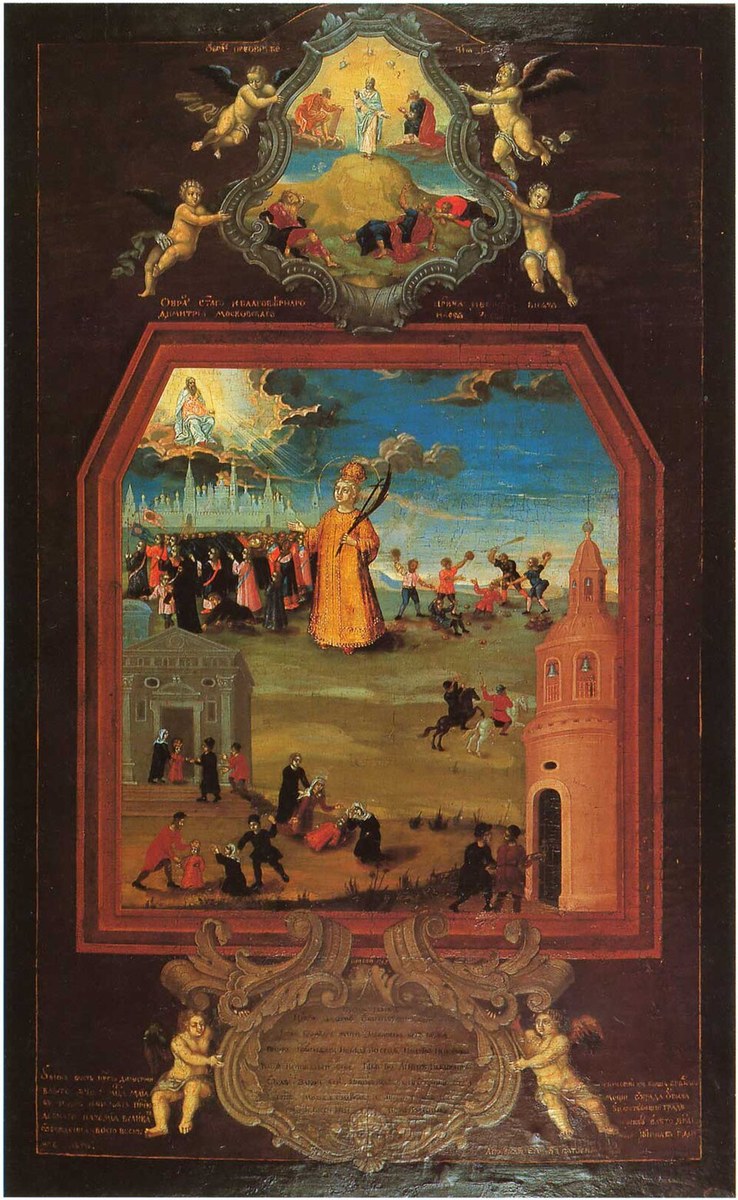
Two developed forms are common. The first is the standing single figure, frequently paired with other Moscow or Rostov wonderworkers on multi-saint panels. The second is the vita icon (ikona s zhitiem), which surrounds or accompanies the standing figure with the scenes of the story: the game in the courtyard, the murderers, the mother lamenting over the body, the ringing of the alarm bell in its tower, the killing of the Bitiagovskys by the crowd, the raising of the grave, and the procession with the reliquary to Moscow.
The stored image is such a vita icon, dated 1745, in the State Museum of the History of Religion at St Petersburg: an eighteenth-century Russian panel in a baroque idiom, inscribed at the top ОБРАЗЪ СТАГО И БЛАГОВѢРНАГО ДИМИТРІА МОСКОВСКАГО ("the image of the holy and right-believing Demetrius of Moscow"). The crowned child stands at the centre in gold-red royal robes holding the cross; behind and around him, in one continuous landscape rather than in the older ranged frames, are the procession with the covered bier and its banners on the left, the attack with knives on the right, the red bell-tower of Uglich with its ringer, the mother fallen over the body in the foreground, and above, in a cartouche upheld by angels, the tsarevich received in glory. The lower cartouche carries the inscription of the story.
Disputed questions
- Which is the principal feast? May 15, the day of his death, is his primary commemoration and carries the fuller office; June 3 is the feast of the translation of the relics of 1606, and is the day on which most calendars head him "the translation of the relics of the right-believing tsarevich Demetrius from Uglich to Moscow." October 19, his birth, is the least observed of the three. This entry ranks the feasts accordingly.
- Passion-bearer or martyr? Passion-bearer (strastoterpets). He did not die for the faith, and Russian usage is consistent in styling him blagoverny tsarevich and strastoterpets, as it does Boris and Gleb. Greek lists that call him simply ὁ θαυματουργός, "the wonderworker," reflect the shrine's reputation rather than a different classification.
- Was he murdered? Unresolved; see above. The entry records the three positions and asserts none, and notes that the veneration does not depend on the answer.
- Whose relics? The identification of the body raised in 1606 was made by an interested government and by the mother it had itself imprisoned, and hostile contemporaries said as much at the time. No later examination has been made. The tradition of incorruption rests on the 1606 report alone.
- Not to be confused with Demetrius Donskoy the Grand Prince (†1389, May 19), nor with Demetrius of Priluki (†1392, February 11), nor with the great-martyr Demetrius of Thessalonica (October 26); nor, though both are princes of Uglich, with John of Uglich (†1523) or Paisius of Uglich.