
Demetrius Donskoy
The Holy Right-believing Grand Prince Demetrius Donskoy of Moscow
Prince · Righteous · b. 12 October 1350, at Moscow — d. 19 May 1389, at Moscow
Commemorated 19 May — Repose at Moscow
Demetrius Ivanovich (12 October 1350 – 19 May 1389), Grand Prince of Moscow, is honoured by the Russian Church as a right-believing prince: the ruler who, having received the blessing of Sergius of Radonezh, defeated the army of Mamai on the field of Kulikovo between the Don and the Nepryadva on 8 September 1380, and so broke for the first time the assumption that the Horde could not be beaten in the open field. He came to the throne a child of nine and was brought up under the guardianship of the metropolitan Alexis of Moscow; he built the first stone walls of the Kremlin, gathered the Russian principalities under Moscow, and paid for his victory two years later when Tokhtamysh burned the city. He died at thirty-eight, and the epithet Donskoy, "of the Don," which he earned at Kulikovo, has been his name ever since. He was numbered among the saints in 1988, at the millennium of the Baptism of Rus.

A child on the throne
Demetrius was born at Moscow on 12 October 1350, the son of the Grand Prince Ivan II the Fair. His father died in 1359, and the boy of nine inherited a title that at that moment was not securely his: the patent (yarlyk) of the grand principality was in the gift of the khan, and rival princes of Suzdal and Nizhny Novgorod pressed their claims. The guardianship of the child and the direction of Moscow's policy fell to the metropolitan Alexis, and the Lives are unanimous that the prince's Christian formation was Alexis's work. In 1362 the yarlyk was secured, and by his teens Demetrius was ruling in fact.
Two things characterise his reign before Kulikovo. The first is building: in 1367 he replaced the wooden defences of Moscow with walls of white stone, the first stone fortress in the north-east, which enabled the city to survive the Lithuanian sieges of the following years. The second is gathering: by treaty, marriage and war he subordinated Tver, Ryazan and the Suzdal line to Moscow's leadership, so that when the confrontation with the Horde came, he could summon the levies of many principalities as one army. In 1366 he married Evdokia of Suzdal, who as a widow took the veil and is honoured as Euphrosyne of Moscow (May 17); the marriage was itself an act of the same policy, and it was by all accounts a devoted one.
He was not undefeated. A campaign against Volga Bulgaria in 1376 succeeded and a Tatar force was destroyed at the river Vozha in 1378; but in 1377 a Russian army was cut to pieces on the Pyana. The lesson he drew was that the Horde could be fought, and that it had to be fought with a coalition.
Kulikovo
In 1380 Mamai, the effective ruler of the western Horde, moved north with a great army, expecting to be joined by the Lithuanians and by Oleg of Ryazan. Demetrius decided not to wait behind his walls but to cross the Oka and meet him on the open steppe before the allies could combine — a decision that staked the existence of Moscow on one battle.
On 18 August 1380, before setting out, he went to the Trinity monastery to Sergius of Radonezh for his blessing. Sergius blessed him, foretold the victory, and sent with him two of his own monks — the schema-monks Alexander Peresvet and Andrew Oslyabya, men of military background — a gesture whose meaning the tradition has never doubted: the Church was committing itself publicly to the campaign. The Russian army crossed the Don, so that retreat was impossible, and on 8 September, the feast of the Nativity of the Mother of God, met Mamai on the field of Kulikovo between the Don and the Nepryadva.
The battle was fought at close quarters through the day, the Russian line nearly broken, and decided at last by a concealed reserve which struck the Tatar flank. The slaughter on both sides was enormous; Demetrius, who had fought in the ranks in the armour of a common man, was found afterwards unconscious and bruised but alive. From that day he was called Donskoy, "of the Don."
The victory did not end the yoke — that took another century — but it ended its inevitability, and the Russian consciousness has treated Kulikovo ever since as the beginning of the liberation.
Thanksgiving, and the reckoning
His acts of thanksgiving are all remembered as churches. He founded the monastery and church of St Nicholas at the place where an icon of the saint had been shown him on the march — the Nikolo-Ugreshsky house; a monastery of the Dormition on the river Dubenka, vowed before the battle; and the church of the Nativity of the Most Holy Theotokos in the Kremlin, on the day of whose feast the battle had been won, as its memorial. He also established the annual commemoration of the fallen of Kulikovo on the Saturday before the feast of the Great Martyr Demetrius of Thessalonica, his own patron — the Demetrius Saturday of the Russian calendar, which grew into a general commemoration of the dead and is still kept.
The reckoning came in 1382, when Tokhtamysh, having destroyed Mamai, appeared before Moscow, took the city by a promise he did not keep, and burned it with great slaughter while Demetrius was raising troops in the north. Tribute was resumed. The last years were spent repairing what had been lost, and in 1385 it was again Sergius who went as peacemaker and brought the prince and Oleg of Ryazan to terms.
He died at Moscow on 19 May 1389, not yet thirty-nine, and was buried in the cathedral of the Archangel Michael in the Kremlin, where his tomb remains. His will, which passed the grand principality to his son Basil I as a patrimony without reference to the khan's patent, is one of the decisive documents of Russian history.
Veneration and glorification
Demetrius was venerated locally almost at once: the Discourse on the Life and Repose of Grand Prince Demetrius Ivanovich, composed within a generation of his death, is a work of frank hagiography, and the cycle of Kulikovo literature — the Zadonshchina and the Tale of the Battle with Mamai — carried his memory as a Christian ruler through the following centuries. Formal canonisation, however, came only in 1988, when the Russian Orthodox Church numbered him among the saints at the council held for the millennium of the Baptism of Rus. His proper hymns date from that glorification.
Feast and commemoration
May 19 (church date; Old Calendar civil June 1) — the day of his repose — in Russian and OCA usage; he is not kept in the Greek calendars, his glorification being both recent and national. The Moscow diocese keeps him with particular solemnity, and the Russian calendars name him on this day together with his wife Euphrosyne (Evdokia), Grand Princess of Moscow (†1407), whose own feasts are May 17 (her tonsure) and July 7 (her repose). He is commemorated further in the Synaxis of the Saints of Moscow. The proper troparion (Tone 3) and kontakion (Tone 2) composed for the 1988 glorification are sung; being modern texts, they are cited here by incipit only, and the hymn given below is the common of a righteous man in a fresh translation. The day always falls within the Pentecostarion, whose movable hymns take precedence.
Hymns
Troparion — Tone 4 (common of a righteous man)
Thou didst take up thy cross and follow Christ, O right-believing Demetrius, and in the midst of the tumult of this world thou wast found faithful; wherefore, having laid down thy labours and thy sword before the Lord, thou dost now intercede for the land thou didst defend, that our souls may be saved.
Original translation from the Slavonic
Iconography
Demetrius is painted as a holy prince in the Russian manner: standing, in the long brocaded shuba and the fur-trimmed princely cap, or bare-headed with the hair to the shoulders; in the right hand a cross, in the left sometimes a sword sheathed or held downward — the sword of a ruler who is not making war in the icon — and sometimes a model of the Kremlin or of a church. Since his glorification he is very often shown in the Kulikovo scene, receiving the blessing of Sergius of Radonezh at the Trinity monastery, which has become his identifying subject, and he appears in the ranks of the composite icon of the Synaxis of the Saints of Moscow. His face is given a short beard and the strongly marked brow of the surviving portrait tradition.
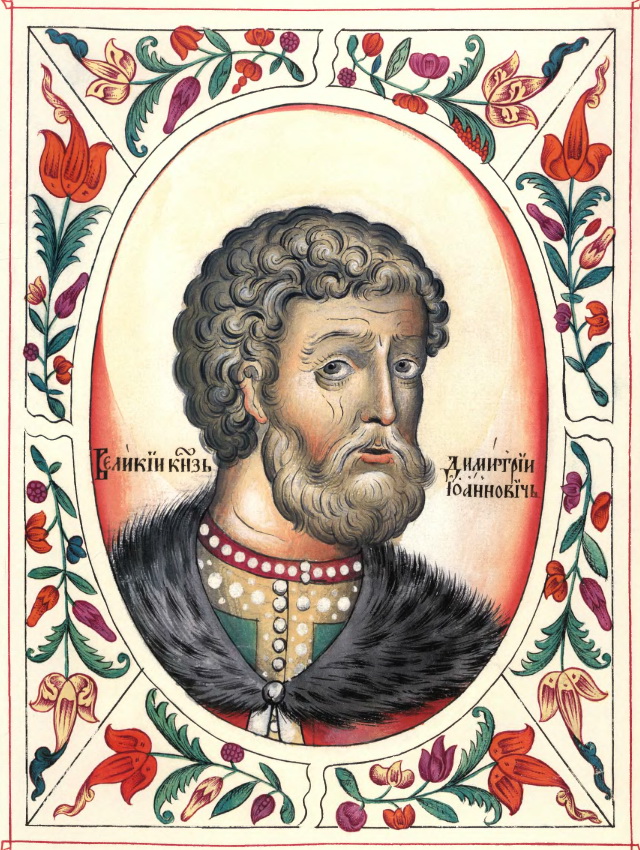
The stored image is not an icon and is not offered as one. It is a Russian manuscript portrait of the type of the Tsarsky Titulyarnik of 1672 — the illuminated book of titles in which the Muscovite court had the succession of its rulers painted — showing the prince bust-length in an oval medallion within a painted border of tulips and berries, in a pearl-worked collar and a fur mantle, with the Slavonic inscription Великій кнзь Димитрій Іоанновичь ("Grand Prince Demetrius Ivanovich") written across the field, which secures the identification. It carries no halo, because it was painted three centuries before his canonisation, and it is stored as the earliest licence-clean likeness available rather than as a liturgical image. A pre-1900 icon of him cannot exist in the ordinary sense: he was glorified in 1988, and every true icon of him is a modern and copyrighted work.
Disputed questions
- The Kulikovo narrative. The literary sources for the battle — the Zadonshchina, the chronicle accounts, and above all the Tale of the Battle with Mamai — are later than the event and increasingly elaborate; the single combat of Peresvet with the Tatar champion, the exchange of armour, and much of the direct speech belong to that developing tradition rather than to the earliest record. The blessing by Sergius and the sending of the two monks are attested early and are not in doubt; the details of the field are.
- "Andrew Oslyabya and Alexander Peresvet." The two monks' names appear in several forms and pairings, and which of them fell in the battle is variously reported.
- The date of the repose is 19 May 1389 in all accounts; his age is given as thirty-eight or thirty-nine according to the reckoning from 12 October 1350.
- Not to be confused with the Great Martyr Demetrius of Thessalonica (October 26), his patron saint, after whom the "Demetrius Saturday" he founded is named; nor with Demetrius of Priluki (February 11); nor with the child Demetrius of Uglich of the following century.