
Emmelia
Our Righteous Mother Emmelia of Caesarea
Righteous · b. late 3rd century — d. c. 375
Commemorated 1 January — Commemorated with her son Basil the Great, 30 May — Repose of Emmelia (Greek commemoration)
Emmelia (late third century – c. 375) was the mother of one of the most remarkable households of saints in the history of the Church. Herself the daughter of a martyr, she married Basil the Elder, a Christian rhetorician of Cappadocia, and bore ten children, of whom the Church numbers five as saints: Basil the Great, Archbishop of Caesarea; Macrina the Younger, teacher and monastic mother; Gregory of Nyssa, the theologian; Peter of Sebaste, bishop; and, in the ascetic tradition, Naucratius (June 8). Widowed, she gave herself under her daughter Macrina's guidance to the ascetic life, turning the family estate at Annesi in Pontus into a household of prayer, and died there in Macrina's arms. She is honoured as a righteous mother whose sanctity bore the fruit of a whole company of saints; the Greek Church keeps her on May 30, and she is commemorated on January 1 together with her son Basil.

Daughter of a martyr, mother of saints
Emmelia was born in Cappadocia in the late third century, into a Christian family of standing that had suffered in the persecutions: the tradition remembers her as the daughter of a martyr, her father having lost his life and goods for the faith in the last of the persecutions before the peace of the Church. Left orphaned and an heiress of great beauty, she wished (the sources say) to remain unmarried, but in the unsettled times chose marriage rather than the dangers that beset an unprotected woman, and was wedded to Basil the Elder, a well-born and Christian teacher of rhetoric of Neocaesarea and Caesarea, whose own mother was the confessor Macrina the Elder, a disciple of the disciples of Gregory the Wonderworker. Into this doubly sanctified family — a martyr on the one side, a confessor on the other — Emmelia brought her children.
She bore ten in all, five sons and five daughters by the common reckoning, and raised them in the faith with a care the tradition never tires of praising. Of them the Church honours as saints her eldest, Macrina the Younger (commemorated July 19), who after the death of her betrothed embraced virginity and became the spiritual guide of the whole family; Basil the Great (January 1), the archbishop and Ecumenical Teacher; Naucratius (June 8), who withdrew to the ascetic life and died young; Gregory of Nyssa (January 10), the theologian who has left us the family's story; and Peter of Sebaste (January 9), the youngest, who became a bishop. That a single mother should be glorified together with so many of her children is without parallel in the calendar of saints, and it is chiefly to Emmelia's Christian nurture that the tradition ascribes the flowering of the household.
The ascetic life at Annesi, and repose
After the death of her husband, Emmelia, guided and at length led by her daughter Macrina, turned from the cares and rank of the world to the ascetic life. Together the mother and daughter withdrew to the family lands at Annesi, on the river Iris in Pontus, where they freed their servants, laid aside the distinctions of wealth, and lived in common with them as sisters in a household of prayer, fasting, and labour — one of the earliest communities of women in the Christian East, and the counterpart across the river of the men's monastery that Basil founded. There, having seen her children grown to sanctity, Emmelia grew old in peace. Gregory of Nyssa, in his Life of Macrina, has left the tender account of her death: worn with years, she reposed about the year 375 with her two youngest at her side, Macrina and Peter, and with her last strength blessed all her children and gave her soul to God, praying that the firstfruits and the tenth of her offspring might be accepted by the Lord — for, she said, her firstborn Macrina and her last-born Peter were both consecrated to him.
Feast and commemoration
Emmelia's principal commemoration is kept in the Greek Church on May 30 (church date; Old Calendar civil June 12); she is also commemorated on January 1 (Old Calendar civil January 14) together with her son Basil the Great, on which day the Orthodox Church in America and the Slavic calendars name her. Her memory is bound to that of her mother-in-law Macrina the Elder, her daughter Macrina the Younger, and her sons, whose feasts fall through the same season of the year. Her cultus is modest — she has no widely-received proper service — but her name is honoured wherever the family of Basil is remembered.
Iconography
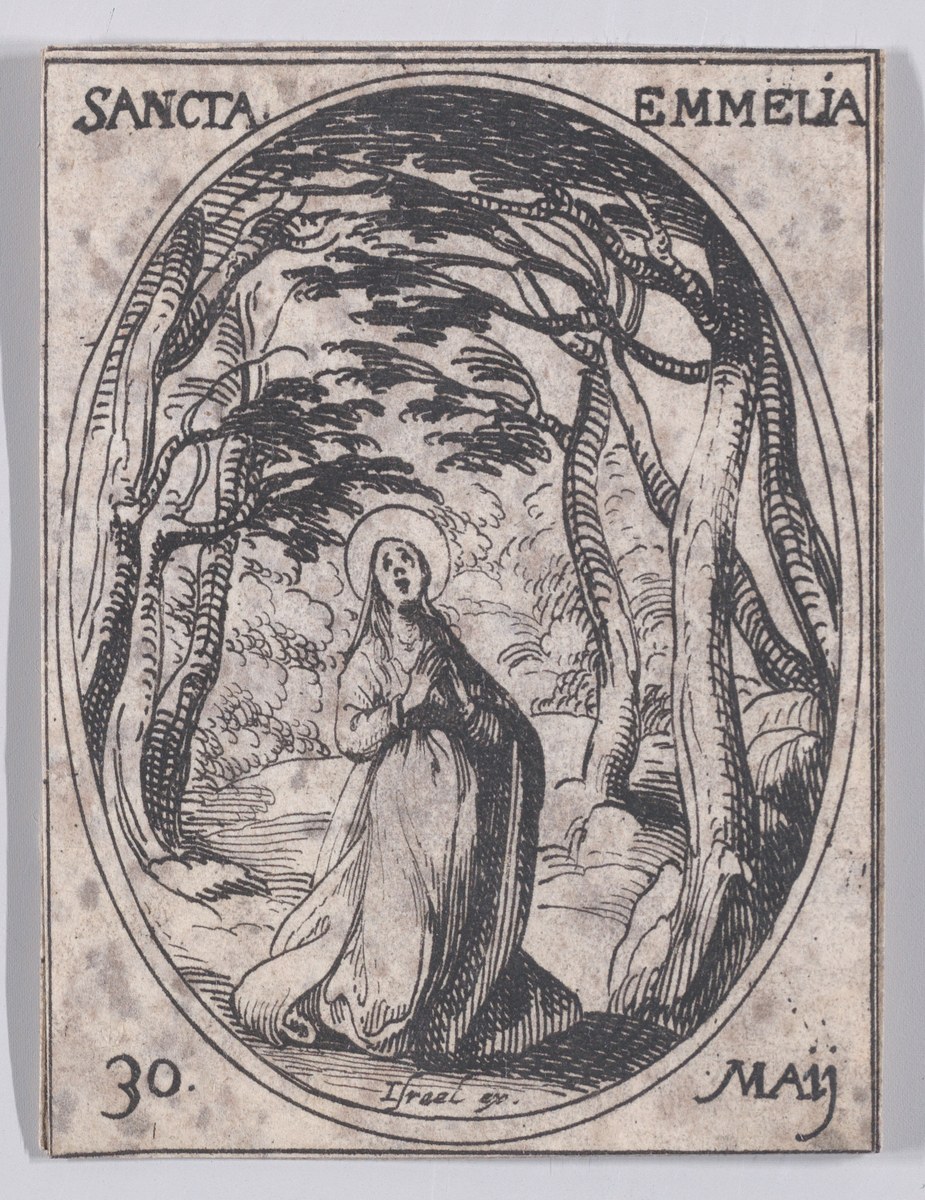
Emmelia is depicted as a matron and ascetic mother — veiled and in the dark garments of a widow or nun — and most characteristically at the centre of her holy family, surrounded by her sainted children, or beside her daughter Macrina. No identity-verified pre-1900 icon of Emmelia alone has been located for storage; the entry is noted as wanting an image.
The stored image is a Western work per §34: Callot's etching captioned Sancta Emmelia (1636, for the May 30 Western day) — the mother of saints kneeling in prayer beneath the trees. An Eastern image remains wanted and is listed among the upgrade-wanted icons.