
Macrina the Younger
Our Venerable Mother Macrina, sister of Basil the Great
Venerable · Virgin · b. c. 327, at Caesarea in Cappadocia — d. 19 July 379, at Annisa in Pontus
Commemorated 19 July — Repose at the community of Annisa on the Iris
Macrina (c. 327 – 19 July 379) was the eldest child of a Cappadocian household that gave the Church more saints than any other, and the hidden centre of it. Widowed of a betrothed husband before she was married, she refused a second engagement, kept her father's house, and then turned the family estate at Annisa on the river Iris in Pontus into an ascetic community in which mistress and maidservant lived as sisters. She formed her youngest brother Peter of Sebaste, steadied the house at the death of Naucratius, and — on her brother Gregory of Nyssa's testimony — turned Basil the Great from the vanity of rhetoric to the philosophic life. Gregory wrote her Life, and set down her deathbed conversation as the dialogue On the Soul and the Resurrection, in which she, not he, is "the Teacher." She is honoured as the model of the consecrated virgin and, with justice, as the fourth of the Cappadocians.

Origins and early life
Macrina was born about the year 327, at Caesarea in Cappadocia, the eldest of the ten children of Basil the Elder, a Christian rhetorician and landowner, and Emmelia. The family's Christianity was already two persecutions deep: Basil the Elder's mother was the confessor Macrina the Elder, who with her husband had hidden in the forests of Pontus during the persecution under Galerius and Maximinus, and who had received the faith in the tradition of Gregory the Wonderworker of Neocaesarea; Emmelia was herself a martyr's daughter. The child was given her grandmother's name openly, but Gregory records that in the pains of labour her mother saw a figure who three times named the unborn girl Thecla, after the protomartyr among women — a private name, Gregory says, that was less a title than a prophecy of the life she would lead.
Her education was deliberately unusual. Emmelia set aside the tragedies and comedies on which a girl of her rank would ordinarily have been trained — Gregory remarks drily that these were thought unsuitable to a soul still soft and formable — and gave her instead the Wisdom of Solomon and above all the Psalter, which Macrina learned entire and recited at the fixed hours of the day: rising, meals, the day's tasks, the lamp-lighting, the night watches. Alongside this she was taught wool-work and the management of a great household, and she proved formidable at both.
At about twelve she was betrothed, by her father's arrangement, to a young advocate of good family. He died before the marriage. When further offers came — and they came, for Gregory says her beauty was such that painters were said to have attempted it — Macrina refused them all with an argument that was already theological: marriage is one, and her husband was not dead but away on a journey; to take another man would be to deny the resurrection, and to behave "unlawfully" toward one who was living to God. Under cover of this reasoning, Gregory notes, her real purpose was to stay with her mother and never leave her. It was the first recorded instance of a habit that shaped her whole life: she got what she wanted by making it look like a duty to someone else.
The house at Annisa
At the death of Basil the Elder — Macrina was still young — the widowed Emmelia was left with the estates and with a household of children to settle. Macrina took the burden of it on herself: Gregory describes her as sharing in her mother's anxieties, managing the property, and refusing all the diversions proper to her rank. When the children were married or launched, she began to work on her mother, and by degrees persuaded her to give up her establishment, her retinue, and the distinctions of birth.
They withdrew to the family property at Annisa (Annesi) on the river Iris in Pontus, and there Macrina did a thing more radical than her asceticism. She abolished the difference between mistress and servant: the maidservants of the household were made sisters and equals, sharing one table, one rule, one rank, and the two great ladies of Cappadocia lived on their own labour. Gregory presents this not as a social experiment but as an eschatological one — a household living now as human beings will live when rank has been taken away. From it grew a community of virgins, drawn from noble and from poor families alike, of which Macrina was the head; and across the river, in time, a parallel brotherhood formed round her youngest brother Peter. The Annisa foundation stands at the head of the coenobitic tradition of Asia Minor, and behind Basil's Asketika.
The making of her brothers
Four of Macrina's brothers are counted among the saints, and she had a hand in all of them.
Naucratius, the second son, brilliant and athletic, abandoned a public career at twenty-one to live as a hermit on the Iris, hunting and fishing to feed a household of destitute old men. About 357, some five years into that life, he was killed in an accident on the river. The news broke Emmelia utterly; Gregory's account of what followed is one of the great scenes of the Life. Macrina, herself grieving, would not let her mother collapse, but "raised her up by reasoning," and held the house together by refusing to be undone.
Peter of Sebaste (January 9), the last-born, never knew his father. Macrina took him from infancy and, in Gregory's phrase, was to him father, teacher, guide, mother and counsellor at once; she formed him from the cradle in the ascetic life, so that he passed into it without ever having had to be converted to it. He became abbot at Annisa, and afterwards bishop of Sebaste.
Basil returned from the schools of Athens, Gregory writes, "monstrously conceited about his rhetoric," despising every dignity in the province and thinking himself above all the notables of the place. It was Macrina who took him in hand and drew him "with such speed to the mark of philosophy" — that is, to the ascetic life — that he renounced worldly reputation and went off to the solitary life on the Iris, within sight of her community. Between them stands the founder of Eastern monastic legislation. Gregory himself, who wrote all this down, was her debtor too, and says so.
Emmelia died about 373, in her own bed with her two youngest children beside her — Macrina at her right hand and Peter at her left — praying that God would give the firstfruits and the last of her womb to him. Macrina then governed the community alone.
Famine, and the ordinary miracles
Gregory reports without emphasis that in the famine that struck Cappadocia and Pontus (the great dearth of 368–369, in which Basil also laboured) Macrina's community took in the starving, and that women found abandoned on the roads were gathered up, fed, and raised in the sisterhood. The Life also records two healings that belong to the household rather than to the shrine. Emmelia developed a tumour of the breast and would not go to a physician for shame of exposing herself; Macrina spent a night on the church floor in prayer, wet the ground with her tears, and in the morning made the sign of the Cross over the place with the mud of her own weeping — and the growth vanished, leaving only a small scar, which Emmelia kept as a reminder. Macrina afterwards bore a like affliction herself and treated it in the same way, and it was only when her body was being prepared for burial that the deaconess Vetiana, who had known her, saw the mark and told Gregory the story.
The last conversation
Basil died on 1 January 379. Nine months later Gregory, coming back from the synod at Antioch, turned aside to Annisa. He found the community in mourning for Basil, and his sister on the floor of her cell: she had refused a bed, and was lying on two planks with a board under her head, burning with the fever that was killing her. She raised herself on her elbow — she could not stand — and spent what strength she had in giving thanks aloud for the whole course of her life.
What followed is the substance of Gregory's dialogue Περὶ ψυχῆς καὶ ἀναστάσεως, On the Soul and the Resurrection, written afterwards from that conversation. Gregory casts himself as the grieving, protesting pupil and Macrina as ἡ διδάσκαλος, "the Teacher" — the term is used of her throughout — who argues him through the immateriality and simplicity of the soul, the nature of the passions, the meaning of the parable of the rich man and Lazarus, the resurrection of the body, and the final purification of all that is capable of being purified. The form is openly Platonic: it is Socrates' last day in the Phaedo, with the positions reversed, and it is among the very few philosophical dialogues of antiquity in which the philosopher is a woman.
She spoke on, Gregory says, until her voice failed. At the hour of the lamp-lighting she turned her face to the east and prayed aloud — a prayer he sets down, ending with the plea that the flaming sword might be withdrawn and the thief's word said to her also — and then, no longer able to speak, she traced the sign of the Cross upon her eyes, her mouth and her heart, drew a deep breath, and died with the prayer. It was 19 July 379.
Burial
There was nothing to bury her in. Gregory found that his sister owned no property whatever: her whole estate was the coarse garment she wore, a veil, and — worn at her throat under it — an iron cross and an iron ring containing a fragment of the wood of the Cross. Vetiana and Lampadion, the head of the community's choir of virgins, laid out the body; Gregory covered it with the dark cloak his mother had left, and it shone, he says, even under that.
The bier was carried to the church of the Forty Martyrs at Ibora, where Basil the Elder and Emmelia lay, in a procession of lamps and psalmody so slow, with the crowd of mourners so dense, that a journey of a few miles took most of the day. Gregory himself and the local bishop Araxius bore the bier at the front, with two others of the clergy at the back. The stone was lifted, and Macrina was laid in her parents' tomb; Gregory, overcome, could hardly look at what he was doing.
Returning, he heard from a soldier at Sebastopolis the story of a small daughter with a diseased eye, brought years before to Annisa, whom Macrina had kissed and blessed and who was found whole; and the soldier's telling of it, Gregory says, was the point at which he understood what the Church had lost.
Legacy
Gregory wrote the Life of Macrina (Βίος τῆς ὁσίας Μακρίνης) within a few years of her death, addressing it to a monk named Olympius whom he had met at Antioch, in answer to a request for an account of her. With On the Soul and the Resurrection it forms a diptych, and the two together are the reason we know her: no letter of Macrina's survives, and Basil, strikingly, never mentions her in his own writings. What comes down is therefore her brother's portrait — but a portrait drawn by a man who was in a position to know, and who had every reason of family pride to make her smaller rather than larger than she was.
Modern scholarship has consequently taken to calling her the fourth Cappadocian. The description is a fair one: the household ascetic community, the doctrine of the soul's ascent, the refusal of rank, and the theology of the resurrection that shaped Gregory's mature work all pass through her. She is also, in the Byzantine tradition, the pattern to which later foundresses of women's communities are assimilated, and the standing proof in the synaxaria that the teaching office in the Church has never been confined to the ordained.
Feast and commemoration
July 19 (church date; Old Calendar civil August 1), universally: Greek, Slavonic, Antiochian, Romanian and Georgian calendars all keep her on this day, as does the Roman martyrology, and she is one of the small number of saints whose Eastern and Western feasts have never diverged. The day falls in the open season between the Apostles' Fast and the Dormition Fast, and carries no fasting rule of its own.
Her memory is bound to her family's: Emmelia her mother on May 30 and January 1, Basil on January 1, Gregory of Nyssa on January 10, Peter of Sebaste on January 9, and Naucratius on June 8 in Greek usage — so that the household is commemorated in pieces across the whole year, with the first days of January carrying most of it. The Greek Menaion keeps her office with a full canon; the Antiochian Archdiocese lists her simply as "Macrina, sister of Basil the Great."
Hymns
Apolytikion — Tone 8
In thee, O Mother, was that which is according to the image kept whole and unhurt; for thou didst take up the Cross and follow after Christ, and by thy doing thou hast taught us to look past the flesh, since it passes away, and to attend upon the soul, which is a thing immortal. Wherefore, O venerable Macrina, thy spirit keeps festival with the angels.
Kontakion — Tone 4
The radiance of righteousness shone out in thee, and thou wast shown to all a pattern of the godly life, teaching the virtues to those who cry to thee: Rejoice, O Macrina, boast of virginity.
Original translation from the Greek
Iconography
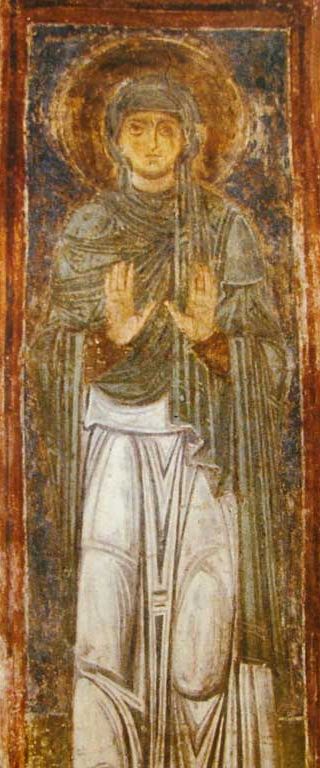
Macrina is written as a venerable mother: standing or half-length, in the dark monastic maphorion and tunic, the head wholly covered, with the hand raised in blessing or held open in prayer, and often with a scroll. The scroll, where it is inscribed, carries a sentence on the soul or on the resurrection — the one point of iconographic individuality she has, and a direct reference to the dialogue Gregory set down from her. She has no martyr's cross and no abbatial staff; the type is deliberately plain. Where she appears in family groups she stands beside Emmelia, or among her brothers Basil, Gregory of Nyssa and Peter of Sebaste, and in some Byzantine menologia she is set with the choir of holy women for July.
The image stored here is a fragment of the eleventh-century fresco programme of the Cathedral of the Holy Wisdom at Kyiv (c. 1050): a standing holy woman in a mantle over a pale undergarment, both hands raised in the orant gesture, within a painted arch. It is carried under her name by the source from which it comes, and the attributes are right for her — a venerable woman, not a martyr, not a crowned figure. The identification is not independently confirmed from the image itself: the surviving paint carries no legible inscription in this fragment, and the Kyivan programme contains a series of holy women in the same attitude. It is recorded here on the source's attribution, with that reservation stated. A securely inscribed pre-1900 icon of Macrina remains wanted.
Disputed questions
- Her dates. The Life gives no year. Her birth is placed c. 327 by the usual reconstruction, working back from her age at her betrothal and from the sequence of her brothers' births; c. 324 and c. 330 are also defended. Her repose is fixed by the narrative — nine months after Basil's death on 1 January 379 — to the summer of 379, and the calendars give 19 July; a minority of modern chronologies push it to 380, on a later dating of Gregory's return from Antioch.
- Macrina or Eustathius? Gregory credits Macrina with turning Basil from rhetoric to asceticism. Basil's own account credits Eustathius of Sebaste, whose ascetic movement he sought out and travelled to observe, and Basil's later break with Eustathius over the Holy Spirit gave his family reason to prefer another origin for his monasticism. The two claims are not strictly exclusive — Macrina could have made the decision and Eustathius formed it — but the tension between them is real and should not be smoothed over.
- How much of the portrait is Gregory's? The Life and the dialogue are consciously literary: the Teacher is a Christian Diotima, the deathbed is the Phaedo, the "secret name" Thecla points to the Acts of Paul and Thecla, and Gregory is writing hagiography and philosophy at once. Some scholars therefore read Macrina as substantially a construction. Against this stands the sheer quantity of unliterary domestic detail Gregory supplies — the wool-work, the household accounts, the tumour and the scar, the two planks, the iron ring, the soldier's daughter — much of it sourced to named women still living who could have contradicted him.
- Universal restoration. On the Soul and the Resurrection puts into Macrina's mouth the fullest statement in the Cappadocian corpus of the final purification of every rational creature. Whether this is her theology or Gregory's own, and how far it goes, is debated; the entry records the question and does not resolve it.
- Not to be confused with Macrina the Elder, her paternal grandmother, the confessor of the Galerian persecution and hearer of the tradition of Gregory the Wonderworker. The elder Macrina has no securely attested day in the Greek, Russian or Antiochian calendars — the May 30 date sometimes given for her rests on tertiary sources alone — and she has no entry in this corpus. Where an older English list says simply "St Macrina, July 19," the Younger is meant.