
Ephraim of Perekom
Our Venerable Father Ephraim of Perekom, Wonderworker of Novgorod
Venerable · Wonderworker · b. 20 September 1412, at Kashin in the land of Tver — d. 26 September 1492, at his monastery on Lake Ilmen
Commemorated 16 May — Translation of the relics on the removal of the monastery from the flooded shore, 26 September — Repose at the Perekom monastery
Ephraim of Perekom (1412–1492) was a monastic founder of the Novgorod land, the builder of the Perekom monastery of St Nicholas on the marshy western shore of Lake Ilmen. Born at Kashin in Tver and baptised Eustathius, he left his father's house as a young man, was tested at Kalyazin, and took the habit at the monastery of Sabbas of Vishera, where he received the name Ephraim. About 1450 he went out to the mouth of the river Verenda and settled in the wet forest by the Black River; brethren gathered, the archbishop of Novgorod ordained him priest, and the community dug a channel through the low ground to carry the water away — the perekop that gave the house, and its founder, their name. He reposed on 26 September 1492 and was numbered among the saints at the Moscow council of 1549; May 16 keeps the translation of his relics, made when the flooding of the lake at last forced the monastery to move.

Origins and monastic beginnings
Ephraim was born on 20 September 1412 at Kashin, a town of the Tver land on the Volga, and was baptised Eustathius. His father Stephen was a merchant, his mother Anna a woman of prayer; the Life makes them childless for years and the boy the answer to their vow. He was taught letters early and, from boyhood, kept away from the amusements of his age. When his parents pressed marriage on him he left the house secretly.
He went first to the monastery of the Life-giving Trinity at Kalyazin, then newly founded, and was received as a novice under the guidance of its founder, Macarius of Kalyazin. He did not remain: drawn northward, he came to the monastery of Sabbas of Vishera near Novgorod, one of the strictest houses of the Novgorod land, and there was tonsured in 1437 with the name Ephraim. His mother, widowed, followed him into the monastic life in Novgorod herself, and died there.
The founding at Perekom
About the year 1450 Ephraim went out to live alone. He chose the low western shore of Lake Ilmen, near the mouth of the river Verenda, and set his cell on the bank of the Black River (Chernaya) — a place of reeds, standing water and fever, which is exactly why it was empty. Brethren found him there, as they always did, and would not be sent away; at their entreaty he consented to receive them, and was ordained hieromonk by Euthymius II, Archbishop of Novgorod, who also gave the new house its charter. A wooden church of the Theophany was raised first, and afterwards a stone church of St Nicholas the Wonderworker, finished in 1466 with the help of the great princes and of Novgorod.
The name of the monastery came from its labour. The ground would not drain, and the water stood among the cells; Ephraim set the brethren to cut a channel from the river through to the lake — to perekopat', to dig through — and from that work the house was called the Perekom (or Perekop) monastery, and its founder Ephraim of Perekom. It is a characteristic detail of the northern Russian monasticism of that century: sanctity inseparable from drainage, land reclamation and forest clearing.
He governed the community forty-odd years, in the discipline he had learnt at Vishera — manual labour, unbroken psalmody, poverty of the cell — and reposed on 26 September 1492, aged eighty, and was buried in the monastery church.
Relics, translation, and glorification
The lake did not leave the monastery in peace. The spring floods of Ilmen repeatedly came up over the low shore and into the buildings, and at length the house was moved to higher ground; on that removal the relics of the founder were translated, and found incorrupt, and the day of the translation, 16 May, became his second and in Russian practice his more prominent feast. The year of the translation is given differently by different sources — 1509 in one line of tradition, 1545 in another (see Disputed questions).
Ephraim was formally numbered among the saints at the Moscow council of 1549, in the great enrolment of Russian saints under Metropolitan Macarius; a Life and a service were composed in the same period. His monastery survived, with interruptions, until the twentieth century; healings at his relics — of fevers and of diseases of the eyes above all — are recorded in the Novgorod tradition, and he is styled wonderworker in the Russian calendars.
Feast and commemoration
May 16 (church date; Old Calendar civil May 29) keeps the translation of his relics, and is the day on which he is most commonly named in Russian and OCA calendars; September 26 keeps his repose and is his primary feast. He is a saint of the Novgorod land and is commemorated with the Synaxis of the Saints of Novgorod; the feast is not kept in Greek or Antiochian usage. The May commemoration falls in the same week as Pachomius the Great and Theodore the Sanctified, the fathers of cenobitic monasticism whose pattern of life his own community followed at four centuries' remove.
Hymns
Troparion — Tone 8 (common of a venerable father)
In thee, O Father, the image of God was preserved unimpaired, for taking up the Cross thou didst follow Christ, and by thy deeds thou hast taught us to despise the flesh, which passeth away, and to care for the soul, which is immortal. Wherefore, O venerable Ephraim, thy spirit rejoiceth with the angels.
Original translation from the Slavonic
Iconography
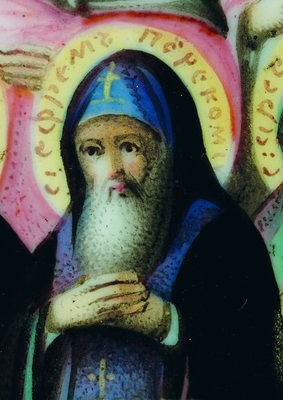
Ephraim is painted in the Novgorod manner as a monastic founder: a thin elder with a long grey beard, in the dark mantle and the blue or dark skhima cowl, his hands folded at the breast or one hand raised in prayer and the other holding a scroll; in the fuller type he holds a model of his monastery church — the stone church of St Nicholas — as founders do. He appears most often not alone but in the ranks of the Synaxis of the Saints of Novgorod, the great composite icon in which the whole company of the Novgorod land stands in tiers. The stored image is a detail of exactly such a composition: an enamel icon of the Synaxis of the Saints of Novgorod of 1866, in which he is inscribed С ЕѲРЕМЪ ПЕРЕКОМ[СКІЙ] — bearded, in the pointed blue cowl, hands crossed on the breast.
Disputed questions
- The year of the translation of the relics. The day, 16 May, is constant; the year is not. Some sources put the removal of the monastery and the translation in 1509, others in 1545 — the latter perhaps by attraction to the glorification of 1549 and to the composition of his service, the former perhaps to an earlier and partial removal. The Life as transmitted does not settle it, and both years are here left standing.
- Whether he was at Kalyazin under Macarius. The chronology is tight — Macarius's Trinity monastery at Kalyazin is dated to the 1430s — and some accounts have Ephraim pass through Kalyazin only briefly, or make Vishera his first house altogether.
- Not to be confused with Ephraim of Pereyaslavl, the eleventh-century bishop of the Kiev Caves (January 28), whose name in Russian is easily read for his; nor with Ephrem the Syrian (January 28), nor with the new-martyr Ephraim of Nea Makri.