
Eugenia of Rome
The Holy Venerable-martyr Eugenia of Rome, and her Companions the Martyrs Protus, Hyacinth and Claudia
Venerable Martyr · Martyr · Virgin · b. c. 240 — d. c. 262
Commemorated 24 December — Martyrdom at Rome, on the Eve of the Nativity
Eugenia of Rome (†c. 262) is the venerable-martyr commemorated on the Eve of the Nativity. A senator's daughter reared at Alexandria, where her father Philip governed Egypt, she read the Epistles of Paul, fled the world disguised as a man with her servants Protus and Hyacinth, and lived undetected as the monk "Eugene," rising to lead the community as abbot. Falsely accused by a woman named Melanthia, she revealed her identity to her own father the prefect, who came to faith and died a bishop-martyr. She removed to Rome with her mother Claudia, and under Gallienus was beheaded on the day of Christ's birth, as the Saviour had foretold to her. Protus, Hyacinth and Claudia are commemorated with her.
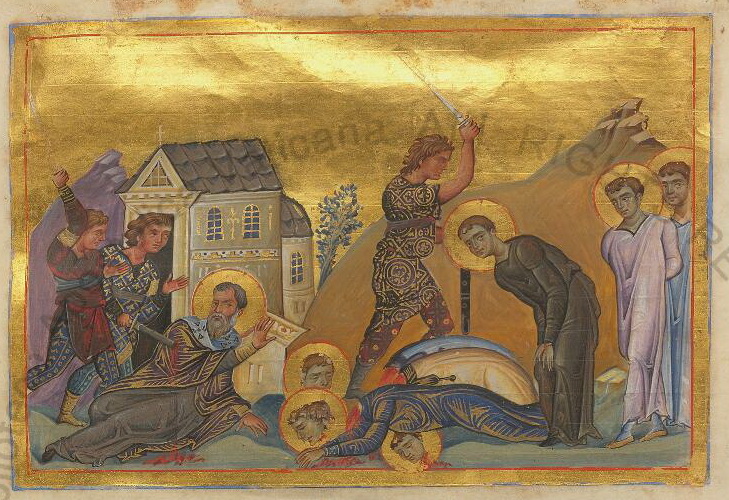

The story of Eugenia is transmitted in a much-loved late-antique passio, preserved in both Greek and Latin recensions and summarised in the Byzantine synaxaria under December 24. It belongs to the family of tales of the "transvestite saint" — the woman who enters the ascetic life disguised as a man — and stands beside the accounts of Theodora of Alexandria and Pelagia the Penitent; the synaxarist of Matrona of Constantinople names Eugenia among these women who "took the form and the name of men" for the Kingdom's sake. What follows synthesises the transmitted narrative, noting where the witnesses diverge.
Origins and early life
Eugenia was a Roman of high birth, daughter of Philip, a nobleman whom the emperor sent to Egypt as prefect (praefectus Augustalis) at Alexandria, and of his wife Claudia. She was raised in the learning of the age, fluent in Greek and Latin letters and philosophy, and was sought in marriage by many distinguished young men; but she had resolved to keep her virginity and put them all off. Coming upon the Epistles of the Apostle Paul — and, the Latin account adds, upon the passion of the martyr Thecla — she was pierced with the desire to become a Christian, though the faith was then proscribed and she dared not disclose herself to her pagan parents.
Ascetic struggle as "the monk Eugene"
When an edict drove the Christians out of Alexandria, Eugenia obtained her parents' leave to visit a country estate for the air, and used the journey to make her escape. With her two trusted servants and fellow-seekers, Protus and Hyacinth, she put on men's clothing, presented herself at a monastery outside the city, and was received. The bishop of the place — named Helenus in the Greek tradition, Elias in the Slavic and OCA accounts — had been shown her coming in a vision; he baptised the three and blessed Eugenia to live in the community disguised as the monk Eugene. For years she laboured unrecognised, excelling the brethren in humility and prayer, and was granted the gift of healing; at the abbot's death the monks, knowing nothing of her sex, chose "Eugene" to govern them.
The crisis of her hidden life came through a wealthy woman of Alexandria named Melanthia, whom "Eugene" had healed of a fever. Mistaking the young abbot's comeliness, Melanthia conceived a passion for him, and when her advances were refused she turned on him, charging him before the prefect — Eugenia's own father Philip, who did not know her — with having attempted to violate her. Brought to trial and unable to clear herself without betraying the community, Eugenia at last tore open her garment before the tribunal and disclosed to Philip that the accused monk was his own lost daughter. The false witness was confounded; parents, brothers and household, who had long mourned her as dead, received her with joy, and in time the whole family was baptised.
Philip, bishop and martyr
Denounced by the pagans of the city for his new faith, Philip was removed from the prefecture; but the Christians of Alexandria, esteeming him, chose him for their bishop. The prefect who succeeded him, not daring to strike so well-loved a man openly, sent assassins, who fell upon Philip as he prayed and left him with wounds of which he died three days later. He is honoured as a bishop and martyr with his family.
Repose to Rome, and martyrdom
The widowed Claudia now returned to Rome with her sons, her daughter and her servants. There Eugenia resumed the monastic life, gathering and instructing many young women in virginity, while Claudia built a hostel for pilgrims and strangers and spent her wealth on the poor. After some peaceful years the persecution under the emperor Gallienus (260–268) fell heavily on the Roman Church, and the household of Eugenia became a refuge for the faithful.
A young noblewoman of imperial blood, an orphan named Basilla, hearing of Eugenia, sent to ask her for instruction in the faith; Eugenia sent Protus and Hyacinth to teach her, and Basilla was baptised. When Basilla refused to marry her betrothed, a pagan named Pompeius, he denounced the Christians to the emperor for preaching celibacy and despising the gods. Basilla was put to the sword. Protus and Hyacinth, dragged into a temple to sacrifice, saw the idol shatter at their entrance, and were beheaded. Eugenia herself was carried to the temple of Diana, which is said to have collapsed with its idol before she crossed its threshold. She was then flung into the Tiber with a stone about her neck, but the stone came loose and she floated unharmed; she was cast into a furnace, and the fire did not touch her; she was shut up in a dark prison-pit and left ten days without food. There, the tradition relates, Christ appeared to her and told her she would come to Him on the day of His own Nativity. When that feast dawned the executioner was sent, and she was beheaded — by the reckoning of the synaxaria, on the very Eve or dawn of the Nativity, December 25. After her death she is said to have appeared to her mother Claudia to foretell her the day of her own repose.
Relics and later cultus
At Rome the memory of Eugenia was early and strong. A basilica on the Via Latina, at the cemetery of Apronianus where she was buried, bore her name from at least the fifth century, and her feast is entered in the ancient Roman liturgical books. Her companions Protus and Hyacinth were venerated at the catacomb of Basilla (Basileus) on the Via Salaria; the tomb of Hyacinth, found intact in 1845 with its original inscription and burnt bones, is one of the securely attested martyr-burials of early Rome, and confirms that the two were historical martyrs whatever the growth of the surrounding legend. In the Christian East Eugenia's veneration is universal, kept on December 24 with a proper service in the Menaion.
Feast and commemoration
Eugenia's feast falls on December 24 (church date; Old Calendar civil January 6), the Paramony or Eve of the Nativity of Christ. Because the day is wholly given over to the forefeast of the Nativity — the Royal Hours, the strict fast, and the Vesperal Liturgy of Basil the Great with its cycle of prophecies — her service in the Menaion is joined to that of the forefeast, and her own propers give place to the hymns of the coming feast. The synaxaria present her martyrdom as providentially timed to the Nativity, so that her commemoration on the eve is fitting: she goes to her Bridegroom's birth as He had promised her. The Eastern calendars keep Protus, Hyacinth and Claudia with her on this day; the Roman tradition, while keeping Eugenia herself, commemorates Protus and Hyacinth separately on September 11, at their tomb on the Salarian Way.
Hymns
Troparion — Tone 4
Thy ewe-lamb Eugenia crieth out to Thee, O Jesus, with a loud voice: Thee, my Bridegroom, do I love, and seeking Thee I strive in contest; I am crucified and buried together with Thee in Thy baptism, and I suffer for Thy sake, that I may reign in Thee; I die for Thee, that I may live with Thee. As an unblemished sacrifice receive me, who am offered up in love to Thee. By her intercessions, as Thou art merciful, save our souls.
Original translation from the Greek
Kontakion — Tone 2
The Lord who deifies thee hath adorned thee, O venerable one, with the beauty of noble virtue, He who in the form of a servant was joined to us, born of the Virgin; He it is who hath numbered thee in the choir of the lamp-bearing virgins and joined thee to the martyrs, O Eugenia, for thou hast in truth attained the crown of the divine glory of nobleness.
Original translation from the Greek
Iconography
Eugenia is depicted as a woman in the dark robe and veil of a nun, holding the martyr's cross; her paradoxical life is sometimes signalled by her being shown as the young beardless monk "Eugene" before her disclosure. The stored image is the miniature from the Menologion of Basil II (Constantinople, c. 1000; Vatican, Vat. gr. 1613, p. 270), which depicts the martyrdom of Eugenia together with those who suffered with her — the earliest datable image of the commemoration and identified as such in the manuscript.
Disputed questions
- Chronology (Commodus or Gallienus?). The transmitted passio sets Eugenia's Alexandrian youth under an emperor identified in the Greek and Slavic synaxaria as Commodus (180–192), yet places her martyrdom at Rome under Gallienus (260–268) — a span of some seventy years that no single lifetime can bridge. The Latin tradition and the Roman Martyrology keep her under Valerian and Gallienus (c. 257–258), and Wikidata records c. 258; this entry follows the mid-third-century placement (†c. 262). The discrepancy is a feature of the legend's transmission, not resolved by the sources.
- Historical kernel. The tomb and inscription of Hyacinth, recovered in the catacomb of Basilla in 1845, attest a genuine Roman martyr of that name, and the early Roman cultus of Eugenia and of Protus and Hyacinth is well documented; the elaborate romance of the disguised abbot is a later hagiographic development around these historical commemorations.
- The baptising bishop. Named Helenus in the Greek synaxarion and Elias in the Slavic-OCA account; the same figure.
- Not to be confused with the several other Eugenias of the calendars, nor is her father Philip the prefect to be confused with the Apostle Philip or Philip the deacon; her mother Claudia is distinct from the other Claudias of the synaxaria (the Claudia of 2 Timothy 4:21, and the several virgin-martyrs of that name).