
Eustathius of Mtskheta
The Holy Martyr Eustathius of Mtskheta, the Persian
Martyr · b. early 6th century, in Persia (Arshaketi) — d. 589 (some reckonings the 540s–550s), at Tbilisi, by beheading
Commemorated 29 July — Martyrdom by beheading at Tbilisi
Eustathius (†589) was a Persian by birth and a fire-worshipper by upbringing, the son of a mobed, who came as a young craftsman to Mtskheta, the old capital of Kartli, and there was drawn to the Christian faith of the Georgians among whom he worked. He was baptised by the Catholicos Samuel, married a Georgian wife, and became to all appearance a Georgian. Denounced by his own countrymen as an apostate from the religion of the Persian king, he was tried twice: released the first time, under the marzban Arvand Gushnasp, after the intercession of the Georgian nobles; re-arrested under Vezhan Buzmihr, who ordered him beheaded in prison by night and his body thrown over the fortress wall. The Christians recovered it and Catholicos Samuel buried it beneath the altar of Svetitskhoveli, where it remains. His Martyrdom, written by a contemporary, is among the oldest surviving works of Georgian literature.

A Persian in Mtskheta
He was born Gvirobandak, a Persian of the region the Georgian text calls Arshaketi, and was raised in the religion of the Sasanian state: Zoroastrian fire-worship, in which his father served as a mobed, a priest of the fire. He learned the craft of a shoemaker, and in his thirtieth year came north over the mountains into Kartli — eastern Georgia, then a Persian dependency ruled through a marzban — and settled at Mtskheta, the ancient royal city at the confluence of the Aragvi and the Kura, which was and remains the ecclesiastical capital of the Georgian Church.
The Martyrdom is unusually good on the ordinary texture of the conversion. He worked at his trade in the city among Georgian craftsmen; he went with them, at first out of companionship, into the churches; he listened; and what he heard persuaded him. What he says of the religion he left is preserved almost as testimony: that the Persians honour the sun and the moon and the fire and the water, and pray towards the fire while eating what the fire consumes, and that having seen the faith of the Christians he could no longer regard this as knowledge of God. He asked for baptism, and was baptised by the Catholicos Samuel with the name Eustathius. He married a Georgian woman, and was, in the phrase of the account, wholly received into the people among whom he had come a stranger.
The first trial: Arvand Gushnasp
Under Sasanian law the abandonment of the Zoroastrian religion by a Persian was not a religious matter but a political one — apostasy from the king's own faith, punishable by death. Persians resident at Mtskheta denounced him, and Ustam, the commander of the Mtskheta fortress, sent him under guard to Tbilisi, to the marzban Arvand Gushnasp.
Seven other Persian converts were arrested with him. Under interrogation two of them — the account names Bakhdiad and Panagushnasp — gave way and returned to the fire-religion; the rest, with Eustathius, held. Arvand Gushnasp had them beaten and their hair and beards shorn in mockery, and cast them into prison, where they lay for six months. They were released at last through the intervention of the Georgian nobility, who petitioned on behalf of men who were now their fellow-Christians; Arvand Gushnasp, being recalled to Persia, let the prisoners go rather than leave the matter to his successor. Eustathius went back to Mtskheta and to his trade, and lived, the account says, as before.
The second trial and the martyrdom
Three years afterwards, under the new marzban Vezhan Buzmihr, the same Persians of Mtskheta renewed the accusation. Eustathius was taken to Tbilisi a second time, with Stephen, one of his fellow-converts. The interrogation was short. He would not go back; he answered — the Martyrdom preserves the sense of it — that he had been baptised into Christ and could not now be unbaptised, and that they could take his head but not his faith.
Vezhan Buzmihr, unwilling to make a public execution of a man well liked in Mtskheta, ordered a private one: that he be kept in prison, that his head be struck off that same night, and that the body be thrown outside the fortress wall, so that there should be neither a scaffold nor a crowd nor a relic. It was done. Eustathius was beheaded in the night, and his body cast over the wall of the Tbilisi citadel.
Relics and the burial at Svetitskhoveli
The Christians of the city took the body up secretly and carried it by night to Mtskheta. The Catholicos Samuel, who had baptised him, received it with honour and buried it in the cathedral of the Living Pillar — Svetitskhoveli, the mother church of Georgia — beneath the holy table, which is the honour reserved for the relics of martyrs by the ancient canon that altars are built over the bones of the witnesses. His relics rest there still, and the July 29 commemoration is kept with particular solemnity at Mtskheta.
The Martyrdom of Eustathius
The account of his passion — "Martvilobay Evstati Mtskhetelisay", The Martyrdom of Eustathius of Mtskheta — was composed in Georgian by a writer of his own generation who knew the case, and belongs with the Martyrdom of Shushanik among the very oldest surviving works of Georgian prose. Its historical value is high and unusual: it is one of the fullest first-hand descriptions we possess of Sasanian provincial administration in the Caucasus, of the legal position of converts from Zoroastrianism, and of what the fire-religion looked like from inside to a man who had left it. Much of what this entry says about his interrogation comes from it.
Feast and commemoration
July 29 (church date; New Calendar civil July 29, Old Calendar civil August 11). He is kept by the Church of Georgia, and through the Slavonic menologia by the Russian Church and the OCA, on the same day as Callinicus of Gangra; Greek and Antiochian calendars do not generally list him. At Mtskheta the day is a local solemnity, and he is numbered among the patrons of Svetitskhoveli. He is honoured in Georgia as the type of the convert from Persia — the visible proof that the mission of Nina had by the sixth century made Kartli a country that converted its conquerors.
Hymns
Troparion — Tone 4 (common of a martyr)
Thy martyr Eustathius, O Lord, in his contest received an incorruptible crown from Thee, our God; for possessing Thy strength, he cast down the tyrants and shattered the feeble insolence of the demons. By his intercessions save our souls.
Original translation from the Georgian
Kontakion — Tone 2
Thou didst forsake the fire that men called god, and wast baptised into the fire that purifieth; and when they took thy head in the darkness of the prison and cast out thy body as a thing of no account, God set it beneath His own altar. O martyr Eustathius, glory of Mtskheta, entreat Christ God for our souls.
Original translation from the Georgian
Iconography
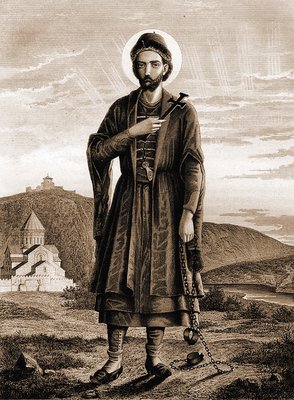
Eustathius is depicted as a bearded man in the prime of life, in Persian or Georgian secular dress rather than in the tunic-and-mantle of the antique martyrs — a long belted coat, a soft cap or turban — and holding the martyr's cross; the fetters or chains of his imprisonment are his particular attribute, and are often shown hanging from his wrist or coiled at his feet. The background of the Georgian type is the landscape of Mtskheta, with Svetitskhoveli and the confluence of the rivers.
The stored image is the 1882 lithograph after Mikhail (Gobron) Sabinin (1845–1900), from the great illustrated corpus of Georgian saints he produced in the later nineteenth century: the saint stands full-length in a long dark coat over a Persian-cut tunic, nimbed, his right hand at his breast and a length of chain with its shackle in his left, with the cathedral of Svetitskhoveli on its hill behind him at the left and the river valley to the right. Sabinin's plates are the source of virtually all modern Georgian iconography of this saint; the underlying work is out of copyright, its author having died in 1900.
Disputed questions
- The date. The Georgian tradition and the received calendars place the martyrdom in 589, under a marzban Vezhan Buzmihr; a substantial body of modern scholarship, followed by the Wikidata record, places it in the 540s or 550s, in the reign of Khosrow I, and reads the Martyrdom as a text of the mid-sixth century. The Catholicos Samuel of the narrative can be identified with more than one holder of the name, which is the root of the difficulty. The traditional 589 is given here with the earlier dating recorded beside it.
- The name of the second marzban appears as Vezhan Buzmihr, Vezhan Buzmir, and Bezhan Buzmihr in the transmission.
- Not to be confused with Eustathius Placidas (September 20), the Roman general-martyr, nor with Eustathius of Antioch (February 21), the confessor archbishop and champion of Nicaea — the three are unrelated, and the Georgian martyr's name is simply the baptismal name given him at the font at Mtskheta.