
Euthymius I of Constantinople
Our Father among the Saints Euthymius the Confessor, Patriarch of Constantinople
Patriarch · Confessor · Venerable · b. c. 834, at Seleucia in Isauria — d. August 5, 917, at the monastery of ta Agathou
Commemorated 5 August — His repose in exile at the monastery of ta Agathou
Euthymius was a monk of great age and greater obstinacy who was made Patriarch of Constantinople in 907, at the worst moment in the Church's relations with the imperial house, and who managed the impossible task set him with a scrupulousness that satisfied nobody and cost him everything. The emperor Leo VI the Wise had married a fourth wife — a thing the canons forbade absolutely — and had deposed the patriarch Nicholas Mystikos for refusing to accept it. Euthymius, Leo's own spiritual father, took the see: he acknowledged the legitimacy of the child Constantine VII, and he refused to the end to call the marriage lawful or the empress an Augusta, and deposed the priest who had blessed it. When Leo died, the new regime threw him out — with violence, at a synod in the Magnaura — and he lived his last five years in exile, dying on 5 August 917. The Church keeps him as a confessor.

Monk
He was born about 834 at Seleucia in Isauria, in the south-eastern corner of Asia Minor, and became a monk while still young. His formation was in the classic houses of the Bithynian ascetic revival — Mount Olympus and a monastery near Nicomedia — after which he came to Constantinople and entered the monastery of St Theodore. He founded, in the reign of Leo VI, the monastery at Psamathia on the southern shore of the capital, which became his own house and the place from which his biographer wrote.
He became the spiritual father of Leo before Leo was emperor — in the years when the young prince was in disgrace and under arrest at the hands of his father Basil I — and the bond held for the rest of Leo's life, through quarrels, dismissals and reconciliations. It is the key to everything that followed: Euthymius owed his rise to the emperor's affection and spent his patriarchate refusing the emperor what he most wanted.
About 888–889 he was appointed syncellus — the patriarch's chief assistant and, in that century, the designated heir to the throne of Constantinople.
The tetragamy
The crisis that made him patriarch is the most famous canonical scandal of the Byzantine middle ages. Leo VI had buried three wives and had no living son. In 905 his mistress Zoe Karbonopsina bore him one — the future Constantine VII Porphyrogennetos. Byzantine law and canon frowned on a third marriage and forbade a fourth outright; Leo's own Tomos of Union of 907 would later say so. The patriarch Nicholas Mystikos agreed to baptise the child on the express condition that Leo put Zoe away. Leo had the baptism performed, waited three days, brought Zoe back into the palace and married her, a priest named Thomas performing the ceremony.
Nicholas excommunicated the emperor from the church of Hagia Sophia. Leo appealed over his head to the other patriarchs — Rome supported him — and in February 907 deposed Nicholas and put Euthymius in his place.
Patriarch, 907–912
Euthymius took the see, and what he then did has been read ever since as either weakness or a very exact form of courage. He granted the emperor economy so far as concerned the child: Constantine VII was recognised as legitimate and as heir, which was the point on which the empire's peace depended. Beyond that he gave nothing:
- he would not declare the marriage canonical;
- he would not commemorate Zoe as Augusta in the diptychs, or receive her as empress;
- he deposed the priest Thomas who had performed the wedding;
- and he imposed on the emperor the penance the canons required.
The result was that he was hated by both parties at once. The rigorists regarded him as the usurper of a lawful patriarch's throne; the court regarded him as an ingrate who had taken the office and withheld the price of it. He held on for five years, sustained by nothing but Leo's personal regard.
Deposition and exile
Leo VI died in May 912, and his brother Alexander, who hated the whole settlement, took the government. Within days Nicholas Mystikos was restored and a synod was convened in the Magnaura palace to deal with Euthymius. The account in the Life — written by a monk of Psamathia who was present or nearly so — describes not a trial but an assault: the old man, then near eighty, was stripped of his vestments, struck and beaten, his beard torn, and thrown out.
He was exiled to the monastery of ta Agathou, across the water near the capital, and there he lived quietly for five more years. He died on 5 August 917.
The reconciliation came afterwards, and posthumously. Nicholas Mystikos — who had opposed him, been deposed by him, and deposed him in turn — is said to have visited him in his exile and asked and given forgiveness; and the Tomos of Union of 920, which finally closed the tetragamy affair by condemning fourth marriages absolutely, restored peace to a Church that had been split for thirteen years. Euthymius was numbered among the saints, and his relics were afterwards brought back to his own monastery of Psamathia.
Feast and commemoration
August 5 (church date; Old Calendar civil August 18), the forefeast of the Transfiguration and within the Dormition fast — the day of his repose in exile. He is commemorated in the Greek synaxaria (Ἅγιος Εὐθύμιος Πατριάρχης Κωνσταντινουπόλεως), and is one of the commemorations of this day that is carried by the Greek books but not by the Slavonic ones; the Orthodox Church in America's listing for the day does not include him.
Hymns
Apolytikion — Tone 4 (common of a hierarch and confessor)
A rule of faith and an image of meekness didst thou show thyself to be, O hierarch Euthymius; thou didst not yield the truth to the will of princes, but wast driven from thy throne for righteousness' sake, and didst finish thy course in exile and in peace: entreat Christ God that our souls may be saved.
Iconography
Euthymius is painted as an aged patriarch: white-bearded, in the polystaurion phelonion — the white chasuble sown with black crosses which marks the patriarchs and metropolitans in Byzantine art — and the omophorion, with the Gospel book and the hand raised in blessing. Because his fame is that of a confessor rather than a wonderworker, no special attribute attaches to him, and in the Byzantine manuscript cycles he is identified by inscription and by context alone.
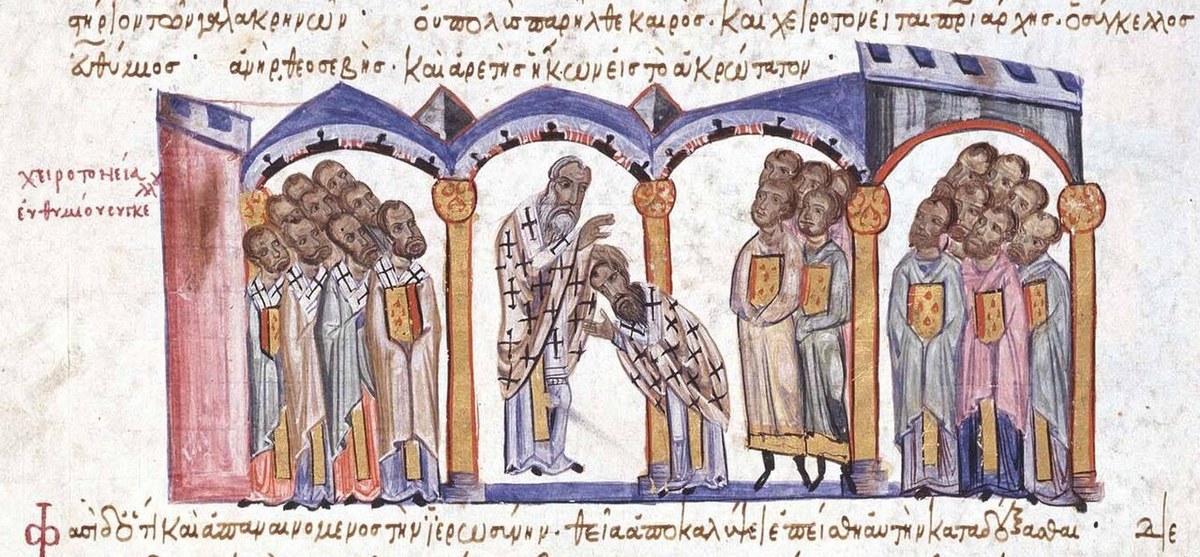
The stored image is a miniature from the Madrid Skylitzes (Biblioteca Nacional de España, MS Graecus Vitr. 26-2), the uniquely illustrated copy of John Skylitzes' Synopsis of Histories made in Norman Sicily in the twelfth or thirteenth century — the only illustrated Greek chronicle to survive. The scene shows his consecration as patriarch in 907: under a triple arcade, the officiating hierarch in the crossed polystaurion lays his hand on Euthymius, who bows deeply before him in the same vesture, while the bishops stand in a rank at the left and the court and clergy at the right. The red marginal rubric names the subject — ΧΕΙΡΟΤΟΝΕΙΑ ΕΥΘΥΜΙΟΥ ΣΥΓΚΕ[ΛΛΟΥ], "the ordination of Euthymius the Syncellus" — which fixes the identification from the manuscript itself.
Disputed questions
- Confessor or collaborator? The judgement on Euthymius has always divided. The strict party of Nicholas held that he had accepted an uncanonical elevation and thereby legitimised the emperor's adultery; the Life of Euthymius, written from Psamathia, is a sustained defence, and the Church's verdict — expressed in his commemoration as a confessor — is that he took an office nobody could hold cleanly in order to keep the empire from schism, and paid for the parts of it he refused to concede. Both readings are recorded here.
- His age. "About eighty" at his deposition, which gives a birth around 834; the figure is the Life's and is approximate.
- The Vita Euthymii. The principal source, the so-called Psamathia Chronicle, is a partisan and near-contemporary document, defective at both ends in its single manuscript. It is invaluable for the reign of Leo VI and openly hostile to Nicholas Mystikos.
- Not to be confused with Euthymius the Great (†473) of Palestine, with Euthymius the New of Thessalonica, with Euthymius of Sardis the iconodule confessor (†831), or with the Bulgarian Patriarch Euthymius of Tarnovo (†c. 1402).