
Sergius and Herman of Valaam
Our Venerable Fathers Sergius and Herman, Wonderworkers of Valaam
Venerable · Wonderworker · d. c. 1353 (traditional; see Disputed questions)
Commemorated 28 June — Repose of the founders of Valaam, 11 September — Return of the relics from Novgorod to Valaam
Sergius and Herman are venerated as the founders of the Monastery of the Transfiguration on Valaam, the great island house in the northern reaches of Lake Ladoga that became the mother of monasticism for the whole Karelian north and, through its children, for Solovki, Konevets, Ondrusov and at last Alaska. Tradition makes Sergius a Greek monk who came northward as a missionary among the pagan Karelians and Herman his companion, sometimes named as a Karelian convert; they settled on the rocky archipelago, gathered a brotherhood under a rule of fasting, vigil and manual labour, and reposed there — the service books say about the year 1353. No Life of them survives, and the dating of their coming is one of the vexed questions of Russian church history, ranging from the tenth century to the end of the fourteenth. Their relics lie hidden beneath the floor of the monastery cathedral, twice carried to Novgorod for safety from Swedish raids and twice brought home. The Church keeps their memory on June 28, and on September 11 the return of their relics to the island.

The island in the northern lake
Valaam (Finnish Valamo) is an archipelago of some fifty islands of grey granite and pine at the northern end of Lake Ladoga, the largest lake in Europe, on what was for centuries the moving frontier between the lands of Novgorod and the kingdom of Sweden, and between Orthodoxy and the Latin West. The Karelian peoples of that shore were still largely pagan in the high Middle Ages, and the island — remote, defensible, and set in a lake that could be crossed only in season — offered exactly the combination the Northern Thebaid required: solitude for the monk, and a base for the missionary.
The tradition of the monastery holds that its first fathers found on the island a place of pagan sacrifice, and that the founding of the monastery was itself an act of mission: the cross set where the idols had been. Whatever the historical value of that memory, it states truly what Valaam became. From it went out, in the fourteenth to sixteenth centuries, the monks who evangelised the Karelians and the Lapps and who founded the northern houses; and the same impulse carried, in 1794, the Valaam mission — Herman of Alaska among them — across Siberia and the Pacific to Kodiak.
Sergius the Greek and Herman his companion
Of the founders themselves the record preserves almost nothing beyond their names and their inseparability. The received tradition, as it stands in the Russian service books and the monastery's own memory, is this: Sergius was a Greek — a monk from the Byzantine world who came north with the mission that followed the baptism of Rus', preaching to the Karelians of the Ladoga shore; Herman, his fellow-ascetic, is variously described as a Greek who came with him and as a Karelian whom he converted and tonsured, the first fruit of the mission joined to the missionary. Together they withdrew to the uninhabited islands, lived as hermits, and were found out by others who came to share their life; and out of that gathering rose the coenobium of the Transfiguration.
Their asceticism is described in the terms the Slavonic troparion uses of them and which are all the tradition claims to know: that they were "true hearers of the Gospel of Christ," that they despised the world and all that is in the world as perishable, that they took up the Cross and lived angelically in the flesh — in prayers and labours, in fastings and vigils — and that God gave them for it the gift of healings, of soul and of body alike, for those who come to them in faith. The date the books give for their repose is about 1353, and June 28 is kept as the day.
The relics, and the two flights to Novgorod
The relics of the founders were, according to the monastery's tradition, uncovered and then carried to Novgorod when Swedish raids made the island untenable — the tradition dates the removal to 1163–1164 — and returned to Valaam in 1180, some accounts giving 1182. The eleventh of September is kept for that return, and is the second of the two feasts in the saints' calendar entry. (These dates belong to the tenth-century form of the tradition and share its difficulties; what is certain is that the relics were more than once evacuated from an exposed frontier island and more than once brought home.)
Valaam's later history was a repetition of the same pattern on a larger scale. The monastery was destroyed by the Swedes in 1611 and lay waste for a century, until Peter I restored it after the Great Northern War; the brotherhood returned, and the eighteenth and nineteenth centuries were its golden age, under such abbots as Nazarius and Damascene. The relics of Sergius and Herman were never re-exhumed: they rest under a bushel — beneath the floor of the lower church of the Transfiguration cathedral, where a shrine stands over them and where they have been venerated without translation ever since. In 1819 the Holy Synod extended their veneration to the whole Russian Church, which had previously been local.
The children of Valaam
The best evidence for what Sergius and Herman founded is what came out of it. Sabbatius of Solovki came to Valaam from the White Lake monastery of Cyril and left it, at God's command, by night, to begin the solitude of the White Sea; Adrian of Ondrusov, the courtier-turned-hermit, was tonsured at Valaam before founding his own house on the Ladoga shore about 1520; Arsenius of Konevets took the monastic habit there before withdrawing to his island; and the mission of 1794 to Russian America was manned from Valaam, so that the last and farthest child of the Ladoga monastery is the Alaskan church. The eighteenth- and nineteenth-century revival made Valaam a school of the Jesus Prayer and of the eldership, and the twentieth-century evacuation to Finland in the Winter War carried the tradition to New Valamo at Heinävesi, where it continues.
Feast and commemoration
June 28 (church date; Old Calendar civil July 11) is the principal feast of the two founders, kept as their repose. The eleventh of September (Old Calendar civil September 24) commemorates the return of their relics to the island from Novgorod. Both are Russian in origin; the whole-Russian veneration dates from the Synod's act of 1819, and the feasts are kept also by the autonomous Orthodox Church of Finland, heir of the Valaam brotherhood, and appear on the OCA calendar. They are further named in two of the Russian regional synaxes — the Synaxis of the Saints of Karelia and the Synaxis of the Saints of Valaam — both of which are movable, tied to Sundays, and do not belong to this fixed day.
The day is the eve of the great feast of the chief apostles Peter and Paul and the last day of the Apostles' Fast, which always ends on June 28; the fast's beginning is movable and its length varies with the date of Pascha, but its end does not, so that the memory of the Valaam fathers falls on the final day of that fast in every year in which it is kept.
Not to be confused: the Herman of this pair is not Herman of Alaska (†1837), though that saint was a Valaam monk and carried the monastery's tradition to Kodiak; nor Herman of Solovki, the companion of Sabbatius; nor Herman of Kazan. The Sergius of this pair is not Sergius of Radonezh, the great abbot of the Trinity, whose lifetime the traditional date of the Valaam founders' repose happens to overlap.
Hymns
Troparion — Tone 4
Having become true hearers of the Gospel of Christ, O venerable ones, ye counted the world and all that is in the world as a perishing thing, and made your dwelling upon an island of the lake of Ladoga; and there, wounded with the love of Christ and taking His Cross upon your shoulders, ye lived in the flesh as angels, in prayers and labours, in fastings and vigils. Wherefore ye received from God the gift of healings, to heal the sicknesses of soul and body in them that run to you with faith. Therefore do we now cry unto you: O venerable fathers Sergius and Herman, entreat Christ God that our souls may be saved.
Original translation from the Slavonic
Kontakion — Tone 4
Ye left the tumult of the world and came to the isle of Ladoga, and there upon the bare rock ye planted a garden of monastics, watering it with your tears; and now, standing before the Transfigured Lord, ye keep unharmed the habitation ye founded. Wherefore we cry: rejoice, Sergius and Herman, boast of the northern land.
Original translation from the Slavonic
Iconography
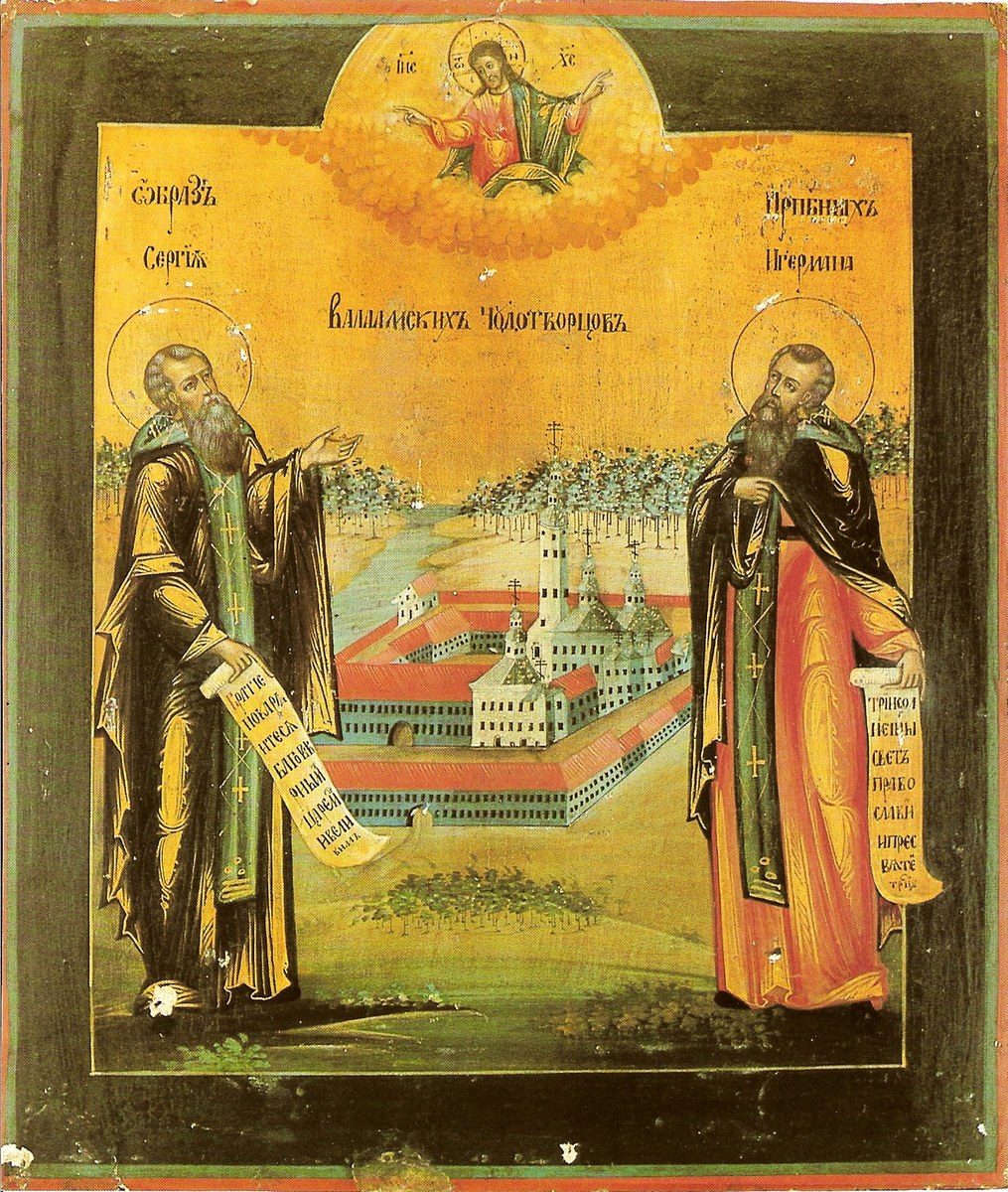
Sergius and Herman are painted together and almost never apart: two elders in the monastic mantle and schema, standing to left and right, in the pose of founders — one hand raised in prayer or gesturing, the other holding an unrolled scroll with a monastic admonition. Between and below them, at the centre of the composition, is set a view of the monastery itself, walls, cathedral and cupolas on its granite island in the water, with the pine forest behind; above, in a cloud of glory, Christ blesses the house with both hands. The type is that of the Russian "founders' icon," in which the saints present their monastery to Christ; the same scheme is used for Zosimas and Sabbatius of Solovki. Sergius is generally the grey-bearded elder at the left, Herman the darker and shorter-bearded at the right, though the two are not sharply distinguished and the identification depends on the inscription.
The stored image is a nineteenth-century Russian icon of exactly this type, preserved in the Orthodox Church Museum at Kuopio in Finland — one of the treasures evacuated from Valaam when the brotherhood withdrew before the Winter War. Its Slavonic inscription across the upper field reads Образъ преподобныхъ Сергія и Германа Валаамскихъ чудотворцевъ, "Image of the venerable Sergius and Herman, Valaam wonderworkers," which confirms the identification; the monastery is shown in detail between them and the blessing Christ above (source, public domain, pd-old-work).
Disputed questions
The date of the foundation of Valaam, and therefore the age of its founders, is genuinely unsettled, and this entry states the problem rather than resolving it.
- The monastic tradition places Sergius and Herman in the tenth century, and a widely repeated form of it fixes their settling on the island between 973 and 980 — that is, within a decade of the baptism of Rus'. This is the dating one meets in nineteenth-century monastery publications and in much popular literature.
- Critical scholarship has moved the founders steadily later. The Finnish historian Heikki Kirkinen argued for a twelfth-century origin; more recent historians regard even that as too early. John H. Lind and Michael C. Paul, working from the sixteenth-century Tale of the Valamo Monastery and from what can be reconstructed of the Novgorodian archiepiscopate, date the foundation to about 1389–1393, under Archbishop John II of Novgorod.
- The difficulty is documentary: the monastery is not mentioned in any surviving document before the sixteenth century. There is thus a gap of centuries between the events and the first written notice, and the dates in circulation — the tenth, twelfth, and late fourteenth centuries — are inferences from later material rather than contemporary testimony.
- The liturgical books themselves are not consistent with the tenth-century tradition: they give the repose of the two fathers as c. 1353, which belongs to the fourteenth century and sits far closer to the critical dating than to the popular one. This entry therefore records died: c. 1353 and century: 14, as the calendar does, while noting that the monastery's own tradition claims a far greater antiquity.
- How many founders, and of what origin? The pairing of a Greek and a Karelian is itself a traditional formula for a mission, and it is possible that the two names preserve the memory of a founding generation rather than of two identifiable men. Nothing in the record permits more than this observation.