
Hermes, Serapion and Polyaenus
The Holy Martyrs Hermes, Serapion and Polyaenus of Rome
Martyr · d. 2nd century, at Rome
Commemorated 18 August — Martyrdom at Rome, dragged over rough ground and stoned
Three Roman Christians of the second century, remembered together in a notice of a very few lines. Hermes, Serapion and Polyaenus were arrested for winning others to the faith and for arguing down the reasoning of the pagans; they were imprisoned, questioned, and ordered to sacrifice, and refused. They were then handed over to the crowd, dragged through the streets and over rough and stony ground until their bodies were torn, and were killed at last with stones. The synaxarion preserves nothing else — no persecutor, no consular year, no burial place — and nothing else is supplied here.

What is transmitted
The whole of the surviving record fits in a paragraph, and it is worth being exact about how little it is. The three are described as Romans, that is, citizens or residents of the City itself, and as Christians of the second century. They were noticed by the authorities not for any public act of iconoclasm but for preaching: they brought others to the faith and, the notice says, refuted the arguments of the pagans — the phrase suggests men who disputed in the ordinary way of the streets and workshops rather than professional apologists, though nothing forbids the second reading.
They were imprisoned, and under interrogation they held to their confession. Required to offer sacrifice to the idols, they refused. The magistrate then gave them over to a form of execution which is essentially a lynching under colour of law: they were bound and dragged by the populace through the streets and across broken and stony ground, so that their bodies were lacerated as they went; and the crowd finished them with stoning and blows. So they received, in the synaxarist's phrase, their crowns.
Names and the silence around them
The three names are unremarkable and thoroughly of their period: Hermes — the Greek form, which the Slavonic books give as Ermiy and older English versions as Hermas — Serapion, an Egyptian theophoric name common all over the eastern Mediterranean, and Polyaenus, "much-praised." Their combination suggests a group of Greek-speaking provincials resident at Rome, which is exactly what the capital's Christian community largely was in the second century; but this is inference from onomastics and is offered as no more than that.
Nothing is recorded of their status, their trades, their ages, or their burial. No Roman martyrological tradition of the West claims them; they come to us through the Greek synaxarion of Constantinople, and they are among the many companies of the early Roman Church whose memory the East preserved when the West had lost the file.
Feast and commemoration
August 18 (church date; Old Calendar civil August 31), within the afterfeast of the Dormition of the Theotokos. They stand second in the day's synaxarion, after Florus and Laurus, and are kept without a proper service: the common of martyrs is sung. Their commemoration is universal in the Byzantine calendars but has generated no local cultus, no dedication and no translation of relics known to this collection.
Hymns
Troparion — Tone 4 (common of martyrs)
Thy martyrs, O Lord, in their contest received incorruptible crowns from Thee our God; for possessing Thy strength, they cast down the tyrants and shattered the feeble insolence of the demons. By their intercessions, O Christ our God, save our souls.
Original translation from the Greek
Iconography
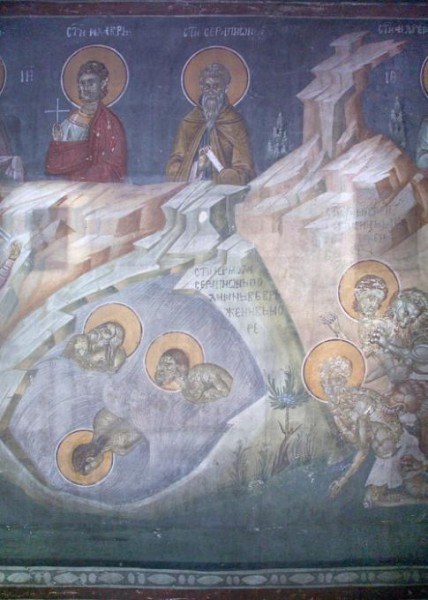
No individual type exists. Where they are painted at all — in menologia and in the calendar frescoes of the month of August — they appear as a group of three laymen, of varied age and beard, in tunic and mantle, each holding the cross; the youngest of the three is conventionally set in the middle. Their manner of death would properly be shown by the stones at their feet or in the hands of the crowd, as in the standard depiction of the stoning of the Protomartyr Stephen. The stored image — the menologion fresco cycle of Gračanica (Serbian, c. 1320), the standing figures inscribed in Church Slavonic, Serapion's name legible over the central elder — in fact renders their death more exactly than the stoning convention: the three are shown above, each with the cross of confession, and below their haloed bodies lie cast into the narrow rocky places where, the synaxarion says, they were dragged until they gave up their souls.
Disputed questions
- The century. "Second century" is the synaxarion's own dating and is not independently attested. A second-century Roman execution by mob-violence under judicial sanction is entirely credible — it is precisely the pattern that Justin Martyr and Tertullian describe — but the notice gives no emperor and no prefect, and any tighter date would be invention.
- Hermes. The name has caused persistent confusion with the several other Hermes and Hermas figures of the calendar, among them Hermes of the Seventy (April 8) and Hermas, the apostolic men greeted by St Paul in Romans 16, and the Roman martyr Hermes of August 31 in the Western martyrologies. This Hermes is none of them.
- Serapion. Distinct likewise from Serapion the Martyr of July 13 (†c. 205, burnt under Severus), from Serapion of Thmuis and from Serapion the Sindonite. The name is one of the commonest in the martyrologies and the coincidences are of no significance.