
Hyacinth of Caesarea
The Holy Martyr Hyacinth the Cubicularius, of Caesarea in Cappadocia
Martyr · Child Martyr · b. c. 90, at Caesarea in Cappadocia — d. 108, at Rome — of starvation in prison
Commemorated 3 July — Death by starvation in prison under Trajan
Hyacinth (Greek Ὑάκινθος, "the jacinth-stone") was a young Christian of Caesarea in Cappadocia who served in the household of the emperor Trajan as cubicularius — chamberlain of the imperial bedchamber, one of the most intimate offices of the palace. Denounced as a secret Christian while the court was sacrificing to the idols, he refused to deny Christ, was scourged, and was shut in a cell where the only food set before him was meat that had been offered to the idols. He would not touch it, and after some six weeks he died of hunger, about the year 108. He is one of the few martyrs of the calendar whose death was neither by sword nor by fire but by deliberate, patient starvation; the synaxarion couplet says simply that "on the third, Hyacinth died of the destroying famine."
_-_%D0%B8%D0%BA%D0%BE%D0%BD%D0%B0_11031_%D0%98%D0%B0%D0%BA%D0%B8%D0%BD%D1%84.png)
The chamberlain of Trajan
The Greek synaxarion places Hyacinth's birth at Caesarea in Cappadocia, in the reign of Trajan (98–117), and says he was raised by Christian parents. He was taken into imperial service young and rose to be κουβικουλάριος — a cubicularius, one of the chamberlains of the sacred bedchamber. The office was held by men of tested discretion and gave its holders daily access to the emperor's person; it was, in the second century as later, a position of real influence and of very considerable luxury. The synaxarion is careful to say that Hyacinth performed his duties impeccably and yet was not corrupted by the softness of the palace: he kept the Christian faith secretly, fasting and praying in his own chamber while the court went about its business.
Denunciation and confession
The persecution broke over him not by any act of defiance but by accident. On a day when the emperor and his household went out to sacrifice, Hyacinth stayed behind, shut himself in a small room, and prayed aloud. A fellow servant overheard him, and denounced him to Trajan: the man entrusted with the bedchamber of the emperor honoured neither the gods of Rome nor the emperor's piety, but prayed in secret to Christ.
Brought before Trajan, he was met not first with threats but with the charge of ingratitude — that he repaid with contempt the trust and honour the palace had given him. The synaxarion preserves the shape of his answer, and it turns the accusation round: if gratitude is indeed a virtue, what defence could he offer for denying the Saviour who had shed His own blood for him, who had given him faith, hope and love, who was his harbour in the storms of the soul, his comfort in grief, his breastplate in trial, and who held out to him an eternal share in His kingdom and His glory? Neither promises nor the emperor's anger moved him. He was scourged and thrown into prison.
Death by hunger
The sentence devised for him was subtle, and its cruelty is of a particular kind. He was not to be executed. He was to be fed only on idol-meat — the food sacrificed to the gods, which no Christian might eat (Acts 15:29; 1 Cor. 10:20–21) — and left to choose between apostasy and starvation. Nothing else was set before him. Day after day the meat was brought, and day after day he refused it.
The Greek synaxarion says that he endured forty days in this way and gave up his spirit on the forty-first; the Russian tradition, following the Menologion of St Dimitri of Rostov, gives thirty-eight days. Either way the substance is the same: a boy of the palace outlasted the imperial power by simply declining to eat, and died of the refusal.
When the guards came to bring him out for further examination they found him already dead. The passion adds that the jailer saw two angels in the cell — one covering the body with his own garment, the other setting a crown upon the martyr's head. The Christians of the city took up the body, and the relics were afterwards translated to Caesarea in Cappadocia, his native place, where his cultus was kept.
Companions in the prison
The Greek books commemorate on the same day a company of martyrs who, according to their own synaxarion notice, were imprisoned with Hyacinth and were strengthened in the faith by him: Theodotus, Theodote, Golindouch, Diomedes, Eulampius and Asclepiades. After his death they were led out to the temple to eat of the sacrifices, refused, rebuked the idol-religion to the tyrant's face, were hung on the wood and torn, and were then beheaded. They are filed here under their own entry, Theodotus, Theodote and Companions. The Russian calendar keeps only four of the six with Hyacinth (Diomedes, Eulampius, Asclepiodotus and the martyr Golindouch), and the Slavonic books attach them directly to his notice rather than giving them a separate memory.
Veneration
His cultus was strong at Constantinople: the oikos of the day's kontakion addresses him as "the protector of our city" and speaks of the city itself as "the training-ground of his contest," which indicates a shrine and a significant relic-cult in the capital independent of the Cappadocian one. The hymns of the day return again and again to the pun latent in his name — the hyacinth-stone, the deep blue-violet jacinth of the high priest's breastplate and of the foundations of the heavenly Jerusalem (Ex. 28:19; Rev. 21:20). The kathisma of the day sharpens it into an epigram: Hyacinth, himself a precious stone treasured in the heavenly storerooms, refuted those who worship stones.
Feast and commemoration
July 3 (church date; New Calendar civil July 3, Old Calendar civil July 16). Hyacinth is the day's principal commemoration in the Greek books, which appoint a full set of proper stichera at Vespers, a canon by Theophanes the Branded with the acrostic Σὲ τὸν διαυγῆ, Μάρτυς, αἰνέσω λίθον ("Thee, O martyr, the translucent stone, will I praise"), a proper kathisma, a proper kontakion and oikos. He heads the synaxarion notice for the day at Constantinople and in the Greek Menaion; in the Slavonic books he heads the day equally, though there the day is crowded with Russian commemorations — the translation of the relics of Philip of Moscow, Basil of Ryazan, and others — and his own service is often displaced by theirs.
Hymns
Apolytikion — Tone 4
As a stone of jacinth of the Church of Christ, thou dost flash lightning to the ends of the earth with the rays of grace, O all-blessed Hyacinth; for being set aflame by the confession of true worship, thou didst shine in thy contest by imitation of the Word, and thence dost thou make glad those who honour thee. Thy martyr, O Lord, in his contest received the crown of incorruption from Thee our God; for possessing Thy strength, he cast down the tyrants and broke the feeble insolence of demons. By his supplications, O Christ our God, save our souls.
Kontakion — Tone 4
For Hyacinth today let all we faithful weave a crown out of unfading hyacinths, crying aloud with a great voice: Rejoice, O Hyacinth, glory of the martyrs!
Original translation from the Greek
Oikos
Above many martyrs let us hymn the protector of our city, who guarding our city as the training-ground of his own contest, armed with boldness and holding the axe of truth — with which he cut down the tree of error — rouses us also to the working of good things. Let us therefore cry out with him: Rejoice, O Hyacinth, glory of the martyrs!
Iconography
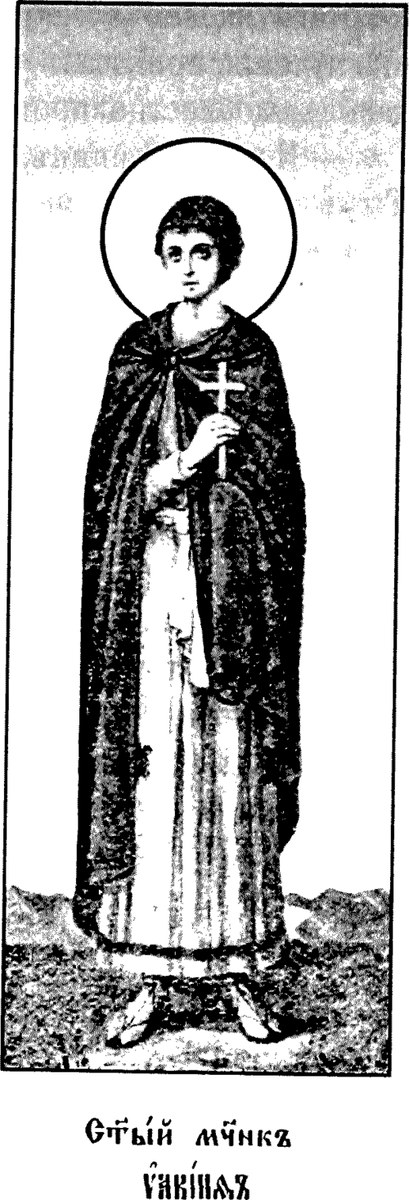
Hyacinth is painted as a beardless youth, of the courtly rather than the military type: a long tunic to the ankles with a chlamys clasped at the shoulder, the dress of a palace official, and in his right hand the martyr's cross. He is never given the armour or the shield of the soldier-martyrs, and the instruments that identify other martyrs — wheel, gridiron, sword — are absent, since his death left no instrument behind. In menologion cycles for July he appears at the head of the third day, sometimes shown in the cell with the untouched dish of idol-meat before him and an angel above, the moment on which the passion turns.
The stored image is the plate for July 3 from the illustrated Russian Lives of the Saints after St Dimitri of Rostov (1903–1911): the youth stands frontally on the ground-line in a long pale tunic under a dark cloak, holding the cross, the inscription reading Стый мчнкъ Иакинѳъ, "the holy martyr Hyacinth." The plate numbering of that edition encodes the calendar day (11031 = July 3, first plate), which fixes the identification against the other Hyacinth of the July calendar.
Disputed questions
- Where did he die? The Greek synaxarion makes him a Cappadocian who died in the imperial city, and the Russian calendar accordingly styles him "Hyacinth of Rome" (Иакинф Римский) while the Greek styles him from his birthplace and his office. Both are describing the same man: born at Caesarea, martyred at Rome under Trajan, his relics returned to Caesarea. The apparent conflict between the epithets "of Caesarea" and "of Rome" is therefore only apparent.
- His age. The Russian synaxarion makes him a boy of twelve. The Greek notice does not give a number but calls him νέος, a youth, and the canon of the day praises "the youthfulness of his years and the nobility of his mind" together — implying an adolescent rather than a child. He is classified here as a child-martyr on the strength of the Russian tradition, with the caution that the Greek witness is vaguer.
- A duplicated memory. Certain synaxaria repeat the memory of Hyacinth, together with that of the martyr Diomedes, on June 3 as well as July 3. The Greek synaxaristes note this expressly as a redundant repetition (περιττῶς), not a second feast; no separate June commemoration is kept here.
- Not to be confused with the martyr Hyacinth of Amastris (July 18), the Paphlagonian who as a child of three raised a dead infant and was killed by the crowd for felling a sacred tree, nor with the Roman martyr Hyacinth commemorated with Protus (September 10 in the Western calendar), nor with the Hyacinth who suffered with Eugenia of Rome (December 24).